WONDERS FROM THE PAST 8
THINK AND DISCUSS (page 141) Possible answers:
1. Some people believe that the Rapa Nui people constructed the statues to honor their ancestors like gods. Other answer will vary.
2. We will learn about other structures or things that were built or created a long time ago and that we don’t know a lot about.
EXPLORE THE THEME (pages 142–143)
1.–2. Answers will vary.
3. Possible answers: People in ancient Greece and Egypt had gold. People in ancient Egypt wore beautiful jewelry. The Maya painted their containers. Some of the Maya wore big earrings and hats or crowns. These civilizations valued physical beauty.
4. Answers will vary.
Lesson A
VOCABULARY
B (page 145) 1. tomb; 2. images; 3. dig; 4. buried;
5. archaeologist; 6. royal; 7. ancient; 8. ruins; 9. reveal; 10. civilization
C (page 145)
1. Possible answer: In places where there were ancient civilizations like Egypt, Peru, Guatemala, and Mexico.
2.–3. Answers will vary.
4. Possible answer: They look for things people left behind a long time ago to find answers about how they lived.
5. Answers will vary.
D (page 145) 1. b; 2. c; 3. d; 4. a; 5. e
LISTENING
A (page 146) Possible answers:
1. The ancient Maya people lived in parts of present-day Mexico and Central America, including Guatemala and Belize.
2. The ancient Maya lived in cities such as Palenque, Tikal, Chichen Itza, Uxmal, and Calakmul. They practiced agriculture and had a sophisticated
understanding of mathematics and astronomy.
B (page 146) 1. c; 2. a; 3. a
C (page 147)
1. late Classic period (A.D. 600–900)
2. one night
3. three hundred (300)
4. five (5)
5. the ball court
6. The Jaguar Throne
7. a wild cat, the largest wild cat in the Americas
D–E (page 147) Answers will vary.
SPEAKING

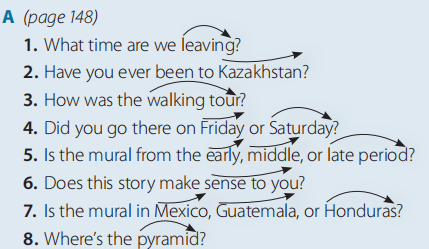
C (page 148) Answers will vary.
D (page 149) 1. was built; 2. were planted;
3. was constructed; 4. was destroyed; 5. was kept;
6. were needed; 7. was designed
E (page 150)
1. Possible answer: One large statue is the Statue of Liberty, which was a gift from France to the U.S. in the late 1800s. It was built to symbolize American independence and freedom. It was placed on
an island in New York Harbor to welcome new immigrants.
2. Possible answer: The Hanging Gardens of Babylon may have been planted because the king loved plants. Similar places today are public gardens and parks. I know that governments protect certain places so that people can enjoy them.
3. Possible answer: Lighthouses are built in order to shine a bright light out to sea and provide ships with important location information. They also warn ships about dangerous land near coastlines.
4. Answers will vary.
LESSON TASK
A (pages 150–151) Possible answers:
1. The spoon or shovel was found in the southwestern United States. The mask was found in Mexico. The necklace was found on the Island
of Crete in Greece.
2. The spoon or shovel was made when the Anasazi civilization lived in the southwestern United States. The mask was made during the Maya
civilization hundreds of years ago. The necklace was made a very long time ago in ancient Greece.
3. The spoon or shovel was made from the horn of an animal. The mask was made from jade. The necklace was made from glass and gold.
4. Answers will vary.
B–D (page 151) Answers will vary.
Video
A (page 152) 1. c; 2. a; 3. d; 4. e; 5. b; 6. f
B (page 152) Answers will vary.
D (page 153) 1. c; 2. b; 3. a
E (page 153) 1. T; 2. T; 3. F (She uses satellites to map and model ancient civilizations.); 4. T; 5. F (She has found more than 3,000 ancient settlements.);
6. F (There was never a single moment; it’s a passion that grew and was nurtured over time.)
F (page 153) Answers will vary.
Lesson B
VOCABULARY
B (page 155) 1. treasures; 2. analyze; 3. precious;
4. discovery; 5. reported; 6. alive; 7. ruled;
8. investigate; 9. remains; 10. determined
C (page 155) 1. analyzes; 2. treasures; 3. ruled; 4. report; 5. discovery
D (page 155) Answers will vary.
LISTENING
A (page 156) Answers will vary.
B (page 156) 1. a; 2. c; 3. b; 4. b
C (page 157) Possible answers:
1. ex: remains of old buildings (palaces)
2. e.g. Who was involved?
3. ex: dishes, coins
D (page 157) Answers will vary.
SPEAKING
A (page 158) Possible answers:
1. Hanoi, Vietnam
2. in 2002
3. The Vietnamese gov’t was constructing a new building. They discovered the site when they began construction.
4. the Vietnamese government, construction workers, and archaeologists
5. They stopped construction and chose a different location for the building because the Citadel site was important historically.
6. The Citadel became a UNESCO World Heritage Site.
B (page 158) Answers will vary.
C (page 158) Possible answers:
Who discovered the site? (Willliam Saturno, an archaeologist)
Where is the site? (Guatemala)
What was found at the site? (a Maya mural, a royal tomb, and other objects)
How did Saturno find the whole mural? (He dug through earth and stone to find the whole mural.)
When do you think Saturno found the mural? (He probably found it recently since the photos are modern.)
Why is the site important? (It is important historically because we can learn a lot about how people lived in the past from the objects found at the site.)
E (page 159) Answers will vary.
FINAL TASK
A–E (pages 159–160) Answers will vary.