
译作分享
炎症:与压力有关的疾病的共同途径
Stressful experiences are fundamental in the provocation of major depression of disorder (MDD). HPA axis activation and hypercortisolemia often seen in depressed patients may represent increased stress hormones, CRH and ACTH secretion (Capuron et al., 2003). MAPK pathways have been proved to increase the activity of serotonin membrane transporters, the most important neurotransmitter associated with depression (Zhu et al., 2006).
压力的经历是诱发重度抑郁症(MDD)的根本原因。在抑郁症患者中经常看到HPA轴激活和高皮质醇血症,可能代表应激激素、CRH和ACTH分泌的增加 (Capuron et al., 2003))。MAPK通路已被证明可以增加血清素膜转运蛋白的活性,而血清素膜转运蛋白是与抑郁症相关的最重要的神经递质 (Zhu et al., 2006)。
Recently, the “cytokine hypothesis” or “macrophage theory” has been suggested in MDD. The main idea of inflammatory depression is the activation of the inflammatory immune response, particularly the synthesis of cytokines, which might influence neurochemicals and contribute to MDD (Smith, 1991). Stress can facilitate the development of depressive-like behavior by promoting inflammatory cytokine expression (Norman et al., 2010). Additionally, a new pathway—kynurenine pathway (KP) has attracted much more attention in cytokine hypothesis. Proinflammatory cytokines activate KP to affect tryptophan metabolism and produce neurotoxin, which either reduces serotonin synthesis or fastens the reuptake of serotonin (Miura et al., 2008).
最近,MDD研究领域提出“细胞因子假说”或“巨噬细胞理论”。炎症性抑郁症的主要观点是炎症性免疫反应的激活,特别是细胞因子的合成,可能影响神经化学物质并导致MDD (Smith, 1991)。压力可以通过促进炎症细胞因子表达来促进抑郁症样行为的发展(Norman et al., 2010)。此外,一种新的途径-犬尿氨酸途径(KP)在细胞因子假说中引起了更多的关注。 促炎细胞因子激活KP以影响色氨酸代谢并产生神经毒素,从而减少血清素合成或加快血清素的再摄取 (Miura et al., 2008)。
Data from animal models and clinical patients prove the role of inflammation in depression. Exposure to inflammatory cytokines such as TNFα, IFNα and IL-1β or cytokine inducers such as LPS or vaccination has been shown to lead to marked behavioral alterations in human and rodent. Elevated inflammatory mediators such as cytokines and their soluble receptors, chemokines, acute phase proteins, adhesion molecules and prostaglandins (PGs) have also been found with depression in peripheral blood, CNS and cerebrospinal fluid (CSF; Miller et al., 2009; Dowlati et al., 2010; Norman et al., 2010; Raison et al., 2010). We use chronic stress to establish depression model. Four-week chronic stress exposure significantly upregulates the inflammatory cytokines such as TNFα, IL-18, IL-1β and inflammatory inducible NOS (iNOS) expression (Peng et al., 2012). Accompanying the upregulation of proinflammatory cytokines, depressive-like behaviors were established. In contrast, blocking iNOS or inflammatory cytokines with 1400W (Peng et al., 2012) or minocycline could abrogate the depressive-like behavior induced by stress (Peng et al., 2012). In fact, some clinical antidepressants really have the role of anti-inflammation. Antidepressant drug and nonsteroidal anti-inflammatory drugs (NSAIDs) like minocycline, decrease blood levels of IL-6, attenuate microglial activation and central cytokine secretion and behavioral changes (Henry et al., 2008).
来自动物模型和临床患者的数据证明了炎症在抑郁症中的作用。 暴露于炎症细胞因子(如TNFα,IFNα和IL-1β)或细胞因子诱导剂(如LPS或疫苗接种)已被证明会导致人类和啮齿动物的显着行为改变。炎症介质,如细胞因子及其可溶性受体、趋化因子、急性期蛋白、粘附分子和前列腺素(PGs)的升高,也被发现与外周血、中枢神经系统和脑脊液(CSF)中的抑郁症有关 (Miller et al., 2009; Dowlati et al., 2010; Norman et al., 2010; Raison et al., 2010)。我们使用慢性压力来建立抑郁模型。四周的慢性应激暴露会显着上调炎症细胞因子,如TNFα,IL-18,IL-1β和炎症诱导NOS(iNOS)表达(Peng et al., 2012)。伴随着促炎细胞因子的上调,类似抑郁症的行为被确立。相反,用1400W (Peng et al., 2012) 或米诺环素阻断iNOS或炎症细胞因子可以消除由压力引起的抑郁症样行为 (Peng et al., 2012)。事实上,一些临床抗抑郁药确实具有抗炎作用。抗抑郁药和非甾体抗炎药(NSAIDs),如米诺环素,可以降低IL-6的血液水平,减弱小胶质细胞的活化和中枢细胞因子的分泌和行为变化(Henry et al., 2008)。
Inflammasomes are multi-molecular platforms, driving the maturation and secretion of pro-inflammatory factors IL-1β and IL-18 to take part in innate immune defenses (Schroder and Tschopp, 2010). We found that NLRP3 inflammasome is involved in LPS-induced mice depressive-like behaviors (Zhang et al., 2014). Recent research showed protective effect of caspase-1 inhibition on brain function, and gut microbiota induced depressive- and anxiety-like behaviors (Wong et al., 2016).
Epidemiological, clinical studies and animal model of AD suggest that stress and inflammation interact with processing and deposit of Aβ, contributing to the pathogenesis of AD (Kunjathoor et al., 2004). Hypercortisolemia is one of the features found in patients diagnosed of AD. An array of elevated inflammatory mediators including TNFα, IL-1, PGE2, NF-κB, COX-2 and MCP-1 has been detected from patients with AD (Wyss-Coray, 2006; Comi et al., 2010) and correlated with the amount of Aβ and the severity of AD pathogenesis (Hoshino et al., 2009; Chen et al., 2012). Researchers also observed increased cytokines such as TNFα, IL-1β and IFN in the substantianigra of PD patients (Nagatsu and Sawada, 2005). Activation of the systemic innate immune system by infection may participate in the early stages of AD pathogenesis (Perry et al., 2007). Neuroinflammation induces degenerative changes in the DA system, which lowers the set point toward neuronal dysfunction and degeneration (Morand and Leech, 1999). Proinflammatory lipid mediators include PGs and platelet activating factor, together with cytokines may significantly affect the progressive neurodegeneration in PD (Busillo et al., 2011). Mice with microglial activation-induced oxidative stress and inflammation, and nigrostriatal DA neuronal damage have been used to serve as an experimental model of PD. Stress exposure increased neuroinflammation in AD and is characterized by astrogliosis, increased inflammatory gene expression and lipid peroxidation (Perez Nievas et al., 2011). It has been confirmed with the changes in glial cells surrounding the senile plaques. Genetic research demonstrates that inherited variations in inflammatory response mechanisms may influence AD pathogenesis (Grimaldi et al., 2000; Nicoll et al., 2000). In contrast, anti-inflammatory agents such as NSAIDs and antioxidant therapy might protect against the development of AD. Long-term use of NSAIDs, inhibitors of COX, suppression of neuroinflammation by glial inhibitors, delays the initiation and reduces the risk of AD (Tsukuda et al., 2009; Chen et al., 2012). In consistent with epidemiology, nicotine was proved to have a neuroprotective effect on DA neurons by means of an anti-inflammatory mechanism mediated by the regulation of microglial activation (Park et al., 2007). Therefore, new potent neuroprotective therapies for PD might be taken into account by focusing on critical inflammatory mechanisms, such as cytokine-induced neurotoxicity (Morand and Leech, 1999). A variety of preclinical studies have corroborated the therapeutic potential of targeting cholinergic anti-inflammatory pathway (Bencherif et al., 2011).
Chronic stress has been demonstrated to account for a place in physiological and pathological disease outcomes, including several types of cancers (Krizanova et al., 2016). Chronic stress is thought to correlate with the etiology of tumor growth, progression and metastasis (Thaker et al., 2006). In a clinical study of breast cancer patients 3 years post-treatment, elevated levels of stress-inducible acute phase proteins correlated with an increase in morbidity and mortality in the experimental cohort (Pierce et al., 2009). Furthermore, animal experiment by using daily exposure to a novel environment to explore the effect of stress on the growth rate of SC115 carcinoma showed that social housing condition and novelty stress may lead to various impacts on the growth rate of tumor in mice (Kerr et al., 1999). Metastasis is the main cause of death in cancer patients. Researchers demonstrated that chronic stress accelerates liver metastasis of colorectal cancer breast cancer and prostate cancer metastasis (Barbieri et al., 2015; Zhao et al., 2015; Wong et al., 2016).
慢性压力已被证实可以在生理和病理疾病结果中占有一席之地,包括几种类型的癌症 (Krizanova et al., 2016)。慢性应压力被认为与肿瘤生长,进展和转移的病因有关 (Thaker et al., 2006)。在一项对乳腺癌患者治疗后3年的临床研究中,压力诱导的急性期蛋白水平升高与实验族中发病率和死亡率的增加相关 (Pierce et al., 2009)。此外,通过每天暴露于一个新的环境中的动物实验,来探索压力对SC115癌生长速率的影响,表明社会性住房条件和新的压力可能导致对小鼠肿瘤生长速率的不同 (Kerr et al., 1999)。转移是癌症患者死亡的主要原因。研究人员证实,慢性压力会加速结直肠癌、乳腺癌和前列腺癌转移的肝转移 (Barbieri et al., 2015; Zhao et al., 2015; Wong et al., 2016)。
经典的应激信号,β肾上腺素能信号激活被认为是胰腺癌、急性淋巴细胞白血病、乳腺癌进展和侵袭的主要原因(Lamkin et al., 2012; Kim-Fuchs et al., 2014; Qin et al., 2015)。这些效应被证明与肿瘤细胞中侵袭基因表达的增加有关。 药理学β肾上腺素能阻断拮抗剂可以逆转观察到的慢性应激对癌症进展的影响。 此外,通过βAR激动剂激活β肾上腺素能信号,可以降低高度转移的人乳腺癌细胞、卵巢、前列腺、黑色素瘤和白血病细胞的变形性,这取决于肌动蛋白细胞骨架和肌球蛋白II的活性。细胞变形性的这些变化可以通过药物β阻断或β2-肾上腺素能受体(β2-AR) (Kim et al., 2016)。除βAR外,儿茶酚胺也向α肾上腺素能受体发出信号。相反,α2-肾上腺素能信号传导被证明可以通过自身感受器机制抑制交感神经儿茶酚胺的释放。选择性α2-肾上腺素能阻断模拟慢性压力对乳腺癌进展的加速作用 (Lamkin et al., 2015)。
The β2-ARs are expressed on multiple cell types involved in immunoregulation, including not only immune cells (Theron et al., 2013; Padro and Sanders, 2014), but also non-immune cells with a bystander role in the immune response (e.g., glia cells, fibroblasts, endothelial cells, etc.; Mantyh et al., 1995; Johnson, 2006). Stress-induced epinephrine binds to β2-ARs, and then results in the activation of p38 MAPK, which in turn enhances NF-κB DNA binding and cytokines and chemokines expression (Kolmus et al., 2015). More recently, stress-mediated immune modulation of cytokines including TNF-α, TGF-β, IL-1 and IL-6 have been suggested as indictors of cancer progression, metastasis and recurrence. Additionally, in some cancers (e.g., colon, renal cell, lung and breast) secretion of these same cytokines by tumor cells helps drive and sustain pro-tumorigenic inflammatory loops (Angelo et al., 2002; Gao et al., 2007). Among several cytokines, IL-6 is the most studied pro-inflammatory factor in tumor. Circulating levels of IL-6 have been reported as forecast cytokine of survival and metastasis in human cancers (Chung and Chang, 2003; Salgado et al., 2003; Pierce et al., 2009). Several studies revealed that high serum concentration of IL-6 is a prognostic indicator of poor outcome in cancer patients with diverse tumor types including gastric, pancreatic, melanoma, breast, colorectal, myeloma and lung cancer (Heikkilä et al., 2008; Lippitz, 2013). A higher lung cancer risk for participants with elevated concentrations of IL-6 was observed in recent clinical trial (Brenner et al., 2017). In animal studies, IL-6 trans-signaling is linked to tumor development in inflammation-induced colorectal and pancreatic cancer (Grivennikov et al., 2009; Rose-John, 2012). Moreover, evidence that disruption of IL-6 trans-signaling delays growth in established murine tumors demonstrates that IL-6 activities are important during neoplastic progression (Grivennikov et al., 2009; Rose-John, 2012). IL-6 trans-signaling-dependent activation of STAT3 can drive cancer progression through the transcription of target genes including the cell cycle regulator cyclin D1, the proto-oncogene c-myc, transcriptional regulators such as JunB, cFos, C/EBPβ and C/EBPδ, and metabolic regulators such as mTORC1 (Hirano et al., 2000; Thiem et al., 2013). IL-6 blockade would change immunological environment and reinforce the effectiveness of anti-programmed death-1-ligand 1 (anti-PD-L1) therapy, therefore evoking significant tumor suppression activity in pancreatic ductal adenocarcinoma (Mace et al., 2016); additionally, neutralization of IL-6 abrogated hepatocellular carcinoma (HCC) progression and myeloid-derived suppressive cells (MDSC) accumulation in Rarres2−/− mice (Lin et al., 2017). Taken together, evidence linking stress to cancer progression and inflammation provide penetration into the magnitude of modulation of cancer-related cytokines (e.g., IL-6) that appear to alleviate the effects of stress on cancer.
β2-ARs在参与免疫调节的多种细胞类型上表达,不仅包括免疫细胞 (Theron et al., 2013; Padro and Sanders, 2014),还包括在免疫反应中起旁观者作用的非免疫细胞(例如,神经胶质细胞,成纤维细胞,内皮细胞等)(Mantyh et al., 1995; Johnson, 2006)。压力诱导的肾上腺素与β2-ARs结合,然后导致p38 MAPK的激活,这反过来又增强了NF-κB 的DNA结合以及细胞因子和趋化因子的表达 (Kolmus et al., 2015)。最近,包括TNF-α,TGF-β,IL-1和IL-6在内的压力介导的细胞因子免疫调节已被建议作为癌症进展、转移和复发的指标。 此外,在某些癌症(例如,结肠癌,肾细胞癌,肺癌和乳腺癌)中,肿瘤细胞分泌的这些相同的细胞因子有助于驱动和维持促致肿瘤的炎症循环 (Angelo et al., 2002; Gao et al., 2007)。在几种细胞因子中,IL-6是肿瘤中研究最多的促炎因子。据报道,IL-6的循环水平作为人类癌症生存和转移的预测细胞因子 (Chung and Chang, 2003; Salgado et al., 2003; Pierce et al., 2009)。几项研究表明,血清中高浓度的IL-6是具有不同肿瘤类型的癌症患者预后不良的指标,包括胃癌,胰腺癌,黑色素瘤,乳腺癌,结直肠癌,骨髓瘤和肺癌 (Heikkilä et al., 2008; Lippitz, 2013)。在最近的临床试验中观察到IL-6浓度升高的参与者有较高的肺癌风险 (Brenner et al., 2017)。在动物研究中,IL-6转信号传导与炎症诱导的结直肠癌和胰腺癌的肿瘤发展有关(Grivennikov et al., 2009; Rose-John, 2012))。此外,中断IL-6转到信号的证据表明,IL-6的活动在肿瘤进展过程中很重要 (Grivennikov et al., 2009; Rose-John, 2012)。IL-6转导信号依赖的STAT3的激活可以通过靶基因的转录来驱动癌症进展,包括细胞周期调节因子cyclin D1,原癌基因c-myc,转录调节因子如JunB,cFos,C / EBPβ和C / EBPδ,以及代谢调节因子如mTORC1 (Hirano et al., 2000; Thiem et al., 2013)。IL-6阻断将改变免疫环境并增强抗程序性死亡-1-配体1(抗PD-L1)治疗的有效性,因此在胰腺导管腺癌中唤起显着的肿瘤抑制活性(Mace et al., 2016); 此外,IL-6的中和作用能消除肝细胞癌(HCC)的进展和Rarres2-/-小鼠骨髓源性抑制细胞(MDSC)的积累 (Lin et al., 2017)。综上所述,将压力与癌症进展和炎症联系起来的证据提供了对癌症相关细胞因子(例如IL-6)调节程度的渗透,这些细胞因子似乎可以减轻压力对癌症的影响。
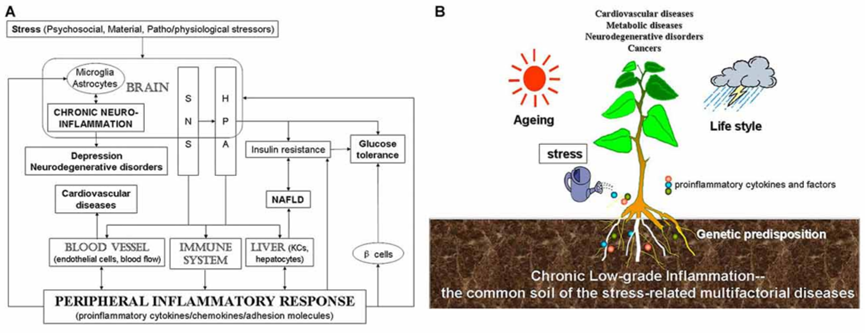
总结,通过扰乱免疫系统的平衡,压力会诱发外周和中枢炎症。这种不平衡导致了多种与压力相关的疾病。虽然可能有各种不同的触发事件,但它们似乎都收敛于炎症。在这篇综述文章中,我们提供了证据表明压力通过外周炎症和神经炎症诱发或恶化心血管疾病、非酒精性脂肪肝、抑郁症、神经退行性疾病和癌症。压力主要通过激活SNS和HPA轴而使中枢小胶质细胞和星形胶质细胞、血管、免疫系统和肝脏参与进来(图1A)。 因此,我们认为炎症可能是与压力相关疾病的共同途径,它可能是导致疾病进展的一个因素,也可能在疾病发展的早期发生。图1B显示,包括遗传易感性、衰老和生活方式在内多因素因子,作用于与压力相关的疾病,而压力诱发的慢性低度炎症也是多种慢性病的共同土壤。
Stress-induced inflammation described here may be relevant to understand the common mechanisms of stress-related diseases. However, quite a few unanswered questions still need to be further discussed. For instance, besides inflammation, is there the crosstalk among inflammation and other related pathways such as cell stress? Is there the specific cell or pathway for the specific stress-related disease? Can anti-inflammatory specifically affect neuroinflammation without modulating periphery immunity for CNS disease? More crucially, to reach clinical application, anti-inflammatory therapies will need to accurately target on specific cells and pathways in CNS, which are fundamentally important in human disease pathogenesis. All these limitations could be the next research key point. Breaking through these barriers would make great progress on the treatment of stress-related diseases.
总的来说,目前有一点是明确的。为了改善压力状况,应将减轻心理和身体压力列入患有各种慢性多因素压力相关疾病的患者的议程。此外,针对压力风险因素的干预措施,特别是压力引起的炎症,将有利于疾病的治疗(主要针对特定的炎症因素),特别是对于高压力人群的疾病预防(主要是抗炎非特殊)。
C-LJ设计了工作并编辑了手稿。Y-ZL和Y-XW进行了文献研究并准备了手稿。所有作者都阅读并批准了该稿件。
Conflict of Interest Statement/利益冲突声明
The authors declare that the research was conducted in the absence of any commercial or financial relationships that could be construed as a potential conflict of interest.
作者声明,该研究是在没有任何商业或财务关系的情况下进行的,这些关系可以被解释为潜在的利益冲突。
Acknowledgements/鸣谢
The authors acknowledge the funding support provided by National Natural Science Foundation of China 81571169, 31371200, Military Medical Research Foundation AHJ16J001, National Instrumentation Program 2013YQ19046708, and the Natural Science Foundation of Shanghai (17ZR1437800).
作者感谢国家自然科学基金81571169、31371200、军事医学研究基金AHJ16J001、国家仪器设备项目2013YQ19046708和上海市自然科学基金(17ZR1437800)提供的资金支持。
Albert M. A., Glynn R. J., Buring J., Ridker P. M. (2006). Impact of traditional and novel risk factors on the relationship between socioeconomic status and incident cardiovascular events. Circulation 114, 2619–2626. 10.1161/circulationaha.106.660043
Alley D. E., Seeman T. E., Ki Kim J., Karlamangla A., Hu P., Crimmins E. M. (2006). Socioeconomic status and C-reactive protein levels in the US population: NHANES IV. Brain Behav. Immun. 20, 498–504. 10.1016/j.bbi.2005.10.003
Angelo L. S., Talpaz M., Kurzrock R. (2002). Autocrine interleukin-6 production in renal cell carcinoma: evidence for the involvement of p53. Cancer Res. 62, 932–940.
Aparicio-Vergara M., Hommelberg P. P. H., Schreurs M., Gruben N., Stienstra R., Shiri-Sverdlov R., et al.. (2013). Tumor necrosis factor receptor 1 gain-of-function mutation aggravates nonalcoholic fatty liver disease but does not cause insulin resistance in a murine model. Hepatology 57, 566–576. 10.1002/hep.26046
Barbieri A., Bimonte S., Palma G., Luciano A., Rea D., Giudice A., et al.. (2015). The stress hormone norepinephrine increases migration of prostate cancer cells in vitro and in vivo. Int. J. Oncol. 47, 527–534. 10.3892/ijo.2015.3038
Bellinger D. L., Millar B. A., Perez S., Carter J., Wood C., ThyagaRajan S., et al.. (2008). Sympathetic modulation of immunity: relevance to disease. Cell. Immunol. 252, 27–56. 10.1016/j.cellimm.2007.09.005
Bencherif M., Lippiello P. M., Lucas R., Marrero M. B. (2011). α7 nicotinic receptors as novel therapeutic targets for inflammation-based diseases. Cell. Mol. Life Sci. 68, 931–949. 10.1007/s00018-010-0525-1
Bleil M. E., Adler N. E., Appelhans B. M., Gregorich S. E., Sternfeld B., Cedars M. I. (2013). Childhood adversity and pubertal timing: understanding the origins of adulthood cardiovascular risk. Biol. Psychol. 93, 213–219. 10.1016/j.biopsycho.2013.02.005
Brenner D. R., Fanidi A., Grankvist K., Muller D. C., Brennan P., Manjer J., et al.. (2017). Inflammatory cytokines and lung cancer risk in 3 prospective studies. Am. J. Epidemiol. 185, 86–95. 10.1093/aje/kww159
Busillo J. M., Azzam K. M., Cidlowski J. A. (2011). Glucocorticoids sensitize the innate immune system through regulation of the NLRP3 inflammasome. J. Biol. Chem. 286, 38703–38713. 10.1074/jbc.M111.275370
Calcia M. A., Bonsall D. R., Bloomfield P. S., Selvaraj S., Barichello T., Howes O. D. (2016). Stress and neuroinflammation: a systematic review of the effects of stress on microglia and the implications for mental illness. Psychopharmacology (Berl) 233, 1637–1650. 10.1007/s00213-016-4218-9
Capuron L., Raison C. L., Musselman D. L., Lawson D. H., Nemeroff C. B., Miller A. H. (2003). Association of exaggerated HPA axis response to the initial injection of interferon-α with development of depression during interferon-α therapy. Am. J. Psychiatry 160, 1342–1345. 10.1176/appi.ajp.160.7.1342
Chen C.-H., Zhou W., Liu S., Deng Y., Cai F., Tone M., et al.. (2012). Increased NF-κB signalling up-regulates BACE1 expression and its therapeutic potential in Alzheimer’s disease. Int. J. Neuropsychopharmacol. 15, 77–90. 10.1017/S1461145711000149
Chung Y.-C., Chang Y.-F. (2003). Serum interleukin-6 levels reflect the disease status of colorectal cancer. J. Surg. Oncol. 83, 222–226. 10.1002/jso.10269
Cohen S., Janicki-Deverts D., Miller G. E. (2007). Psychological stress and disease. JAMA 298, 1685–1687. 10.1001/jama.298.14.1685
Comi C., Carecchio M., Chiocchetti A., Nicola S., Galimberti D., Fenoglio C., et al.. (2010). Osteopontin is increased in the cerebrospinal fluid of patients with Alzheimer’s disease and its levels correlate with cognitive decline. J. Alzheimers Dis. 19, 1143–1148. 10.3233/JAD-2010-1309
Cosgrove M. P., Sargeant L. A., Caleyachetty R., Griffin S. J. (2012). Work-related stress and Type 2 diabetes: systematic review and meta-analysis. Occup. Med. (Lond) 62, 167–173. 10.1093/occmed/kqs002
Danese A., Pariante C. M., Caspi A., Taylor A., Poulton R. (2007). Childhood maltreatment predicts adult inflammation in a life-course study. Proc. Natl. Acad. Sci. U S A 104, 1319–1324. 10.1073/pnas.0610362104
Day C. P. (2006). Non-alcoholic fatty liver disease: current concepts and management strategies. Clin. Med. 6, 19–25. 10.7861/clinmedicine.6-1-19
Donath M. Y., Shoelson S. E. (2011). Type 2 diabetes as an inflammatory disease. Nat. Rev. Immunol. 11, 98–107. 10.1038/nri2925
Dowlati Y., Herrmann N., Swardfager W., Liu H., Sham L., Reim E. K., et al.. (2010). A meta-analysis of cytokines in major depression. Biol. Psychiatry 67, 446–457. 10.1016/j.biopsych.2009.09.033
Elenkov I. J. (2008). Neurohormonal-cytokine interactions: implications for inflammation, common human diseases and well-being. Neurochem. Int. 52, 40–51. 10.1016/j.neuint.2007.06.037
Gao S. P., Mark K. G., Leslie K., Pao W., Motoi N., Gerald W. L., et al.. (2007). Mutations in the EGFR kinase domain mediate STAT3 activation via IL-6 production in human lung adenocarcinomas. J. Clin. Invest. 117, 3846–3856. 10.1172/jci31871
García-Bueno B., Caso J. R., Leza J. C. (2008). Stress as a neuroinflammatory condition in brain: damaging and protective mechanisms. Neurosci. Biobehav. Rev. 32, 1136–1151. 10.1016/j.neubiorev.2008.04.001
Gastaldelli A., Harrison S. A., Belfort-Aguilar R., Hardies L. J., Balas B., Schenker S., et al.. (2009). Importance of changes in adipose tissue insulin resistance to histological response during thiazolidinedione treatment of patients with nonalcoholic steatohepatitis. Hepatology 50, 1087–1093. 10.1002/hep.23116
Gentile C. L., Nivala A. M., Gonzales J. C., Pfaffenbach K. T., Wang D., Wei Y., et al.. (2011). Experimental evidence for therapeutic potential of taurine in the treatment of nonalcoholic fatty liver disease. Am. J. Physiol. Regul. Integr. Comp. Physiol. 301, R1710–R1722. 10.1152/ajpregu.00677.2010
Graham J. E., Christian L. M., Kiecolt-Glaser J. K. (2006). Stress, age, and immune function: toward a lifespan approach. J. Behav. Med. 29, 389–400. 10.1007/s10865-006-9057-4
Grimaldi L. M., Casadei V. M., Ferri C., Veglia F., Licastro F., Annoni G., et al.. (2000). Association of early-onset Alzheimer’s disease with an interleukin-1α gene polymorphism. Ann. Neurol. 47, 361–365. 10.1002/1531-8249(200003)47:3<361::AID-ANA12>3.0.CO;2-N
Grivennikov S., Karin E., Terzic J., Mucida D., Yu G.-Y., Vallabhapurapu S., et al.. (2009). IL-6 and Stat3 are required for survival of intestinal epithelial cells and development of colitis-associated cancer. Cancer Cell 15, 103–113. 10.1016/j.ccr.2009.01.001
Heikkilä K., Ebrahim S., Lawlor D. A. (2008). Systematic review of the association between circulating interleukin-6 (IL-6) and cancer. Eur. J. Cancer 44, 937–945. 10.1016/j.ejca.2008.02.047
Henry C. J., Huang Y., Wynne A., Hanke M., Himler J., Bailey M. T., et al.. (2008). Minocycline attenuates lipopolysaccharide (LPS)-induced neuroinflammation, sickness behavior, and anhedonia. J. Neuroinflammation 5:15. 10.1186/1742-2094-5-15
Hirano T., Ishihara K., Hibi M. (2000). Roles of STAT3 in mediating the cell growth, differentiation and survival signals relayed through the IL-6 family of cytokine receptors. Oncogene 19, 2548–2556. 10.1038/sj.onc.1203551
Hoshino T., Namba T., Takehara M., Nakaya T., Sugimoto Y., Araki W., et al.. (2009). Prostaglandin E2 stimulates the production of amyloid-β peptides through internalization of the EP4 receptor. J. Biol. Chem. 284, 18493–18502. 10.1074/jbc.M109.003269
Huang J.-L., Zhang Y.-L., Wang C.-C., Zhou J.-R., Ma Q., Wang X., et al.. (2012). Enhanced phosphorylation of MAPKs by NE promotes TNF-α production by macrophage through α adrenergic receptor. Inflammation 35, 527–534. 10.1007/s10753-011-9342-4
Janusek L. W., Tell D., Gaylord-Harden N., Mathews H. L. (2017). Relationship of childhood adversity and neighborhood violence to a proinflammatory phenotype in emerging adult African American men: an epigenetic link. Brain Behav. Immun. 60, 126–135. 10.1016/j.bbi.2016.10.006
Jiang C. L., Lu C. L., Liu X. Y. (1998). The molecular basis for bidirectional communication between the immune and neuroendocrine systems. Domest. Anim. Endocrinol. 15, 363–369. 10.1016/s0739-7240(98)00026-5
Johnson M. (2006). Molecular mechanisms of β2-adrenergic receptor function, response, and regulation. J. Allergy Clin. Immunol. 117, 18–24; quiz 25. 10.1016/j.jaci.2005.11.012
Johnson J. D., Campisi J., Sharkey C. M., Kennedy S. L., Nickerson M., Greenwood B. N., et al.. (2005). Catecholamines mediate stress-induced increases in peripheral and central inflammatory cytokines. Neuroscience 135, 1295–1307. 10.1016/j.neuroscience.2005.06.090
Kamari Y., Shaish A., Vax E., Shemesh S., Kandel-Kfir M., Arbel Y., et al.. (2011). Lack of interleukin-1α or interleukin-1β inhibits transformation of steatosis to steatohepatitis and liver fibrosis in hypercholesterolemic mice. J. Hepatol. 55, 1086–1094. 10.1016/j.jhep.2011.01.048
Kerr L. R., Wilkinson D. A., Emerman J. T., Weinberg J. (1999). Interactive effects of psychosocial stressors and gender on mouse mammary tumor growth. Physiol. Behav. 66, 277–284. 10.1016/s0031-9384(98)00296-0
Kiecolt-Glaser J. K. (2010). Stress, food, and inflammation: psychoneuroimmunology and nutrition at the cutting edge. Psychosom. Med. 72, 365–369. 10.1097/PSY.0b013e3181dbf489
Kim-Fuchs C., Le C. P., Pimentel M. A., Shackleford D., Ferrari D., Angst E., et al.. (2014). Chronic stress accelerates pancreatic cancer growth and invasion: a critical role for β-adrenergic signaling in the pancreatic microenvironment. Brain Behav. Immun. 40, 40–47. 10.1016/j.bbi.2014.02.019
Kim T.-H., Gill N. K., Nyberg K. D., Nguyen A. V., Hohlbauch S. V., Geisse N. A., et al.. (2016). Cancer cells become less deformable and more invasive with activation of β-adrenergic signaling. J. Cell Sci. 129, 4563–4575. 10.1242/jcs.194803
Kolmus K., Tavernier J., Gerlo S. (2015). β2-Adrenergic receptors in immunity and inflammation: stressing NF-κB. Brain Behav. Immun. 45, 297–310. 10.1016/j.bbi.2014.10.007
Kop W. J. (2003). The integration of cardiovascular behavioral medicine and psychoneuroimmunology: new developments based on converging research fields. Brain Behav. Immun. 17, 233–237. 10.1016/s0889-1591(03)00051-5
Krizanova O., Babula P., Pacak K. (2016). Stress, catecholaminergic system and cancer. Stress 19, 419–428. 10.1080/10253890.2016.1203415
Kunjathoor V. V., Tseng A. A., Medeiros L. A., Khan T., Moore K. J. (2004). β-Amyloid promotes accumulation of lipid peroxides by inhibiting CD36-mediated clearance of oxidized lipoproteins. J. Neuroinflammation 1:23. 10.1186/1742-2094-1-23
Kuo L. E., Czarnecka M., Kitlinska J. B., Tilan J. U., Kvetnanský R., Zukowska Z. (2008). Chronic stress, combined with a high-fat/high-sugar diet, shifts sympathetic signaling toward neuropeptide Y and leads to obesity and the metabolic syndrome. Ann. N Y Acad. Sci. 1148, 232–237. 10.1196/annals.1410.035
Lamkin D. M., Sloan E. K., Patel A. J., Chiang B. S., Pimentel M. A., Ma J. C. Y., et al.. (2012). Chronic stress enhances progression of acute lymphoblastic leukemia via β-adrenergic signaling. Brain Behav. Immun. 26, 635–641. 10.1016/j.bbi.2012.01.013
Lamkin D. M., Sung H. Y., Yang G. S., David J. M., Ma J. C. Y., Cole S. W., et al.. (2015). α2-Adrenergic blockade mimics the enhancing effect of chronic stress on breast cancer progression. Psychoneuroendocrinology 51, 262–270. 10.1016/j.psyneuen.2014.10.004
Landsbergis P. A. (2003). The changing organization of work and the safety and health of working people: a commentary. J. Occup. Environ. Med. 45, 61–72. 10.1097/00043764-200301000-00014
Li G., Xu Y., Ling F., Liu A., Wang D., Wang Q., et al.. (2012). Angiotensin-converting enzyme 2 activation protects against pulmonary arterial hypertension through improving early endothelial function and mediating cytokines levels. Chin. Med. J. 125, 1381–1388.
Lin Y., Yang X., Liu W., Li B., Yin W., Shi Y., et al.. (2017). Chemerin has a protective role in hepatocellular carcinoma by inhibiting the expression of IL-6 and GM-CSF and MDSC accumulation. Oncogene [Epub ahead of print]. 10.1038/onc.2016.516
Lippitz B. E. (2013). Cytokine patterns in patients with cancer: a systematic review. Lancet. Oncol. 14, e218–e228. 10.1016/S1470-2045(12)70582-X
Liu Y., Qiu D. K., Ma X. (2012). Liver X receptors bridge hepatic lipid metabolism and inflammation. J. Dig. Dis. 13, 69–74. 10.1111/j.1751-2980.2011.00554.x
Ma K. L., Ruan X. Z., Powis S. H., Chen Y., Moorhead J. F., Varghese Z. (2008). Inflammatory stress exacerbates lipid accumulation in hepatic cells and fatty livers of apolipoprotein E knockout mice. Hepatology 48, 770–781. 10.1002/hep.22423
Mace T. A., Shakya R., Pitarresi J. R., Swanson B., McQuinn C. W., Loftus S., et al.. (2016). IL-6 and PD-L1 antibody blockade combination therapy reduces tumour progression in murine models of pancreatic cancer. Gut [Epub ahead of print]. 10.1136/gutjnl-2016-311585
Mantyh P. W., Rogers S. D., Allen C. J., Catton M. D., Ghilardi J. R., Levin L. A., et al.. (1995). β 2-adrenergic receptors are expressed by glia in vivo in the normal and injured central nervous system in the rat, rabbit and human. J. Neurosci. 15, 152–164.
Marangou A. G., Alford F. P., Ward G., Liskaser F., Aitken P. M., Weber K. M., et al.. (1988). Hormonal effects of norepinephrine on acute glucose disposal in humans: a minimal model analysis. Metab. Clin. Exp. 37, 885–891. 10.1016/0026-0495(88)90124-2
Mikolajczyk R. T., El Ansari W., Maxwell A. E. (2009). Food consumption frequency and perceived stress and depressive symptoms among students in three European countries. Nutr. J. 8:31. 10.1186/1475-2891-8-31
Miller G. E., Chen E., Sze J., Marin T., Arevalo J. M. G., Doll R., et al.. (2008). A functional genomic fingerprint of chronic stress in humans: blunted glucocorticoid and increased NF-κB signaling. Biol. Psychiatry 64, 266–272. 10.1016/j.biopsych.2008.03.017
Miller A. H., Maletic V., Raison C. L. (2009). Inflammation and its discontents: the role of cytokines in the pathophysiology of major depression. Biol. Psychiatry 65, 732–741. 10.1016/j.biopsych.2008.11.029
Miura H., Ozaki N., Sawada M., Isobe K., Ohta T., Nagatsu T. (2008). A link between stress and depression: shifts in the balance between the kynurenine and serotonin pathways of tryptophan metabolism and the etiology and pathophysiology of depression. Stress 11, 198–209. 10.1080/10253890701754068
Mooy J. M., de Vries H., Grootenhuis P. A., Bouter L. M., Heine R. J. (2000). Major stressful life events in relation to prevalence of undetected type 2 diabetes: the Hoorn Study. Diabetes Care 23, 197–201. 10.2337/diacare.23.2.197
Morand E. F., Leech M. (1999). Glucocorticoid regulation of inflammation: the plot thickens. Inflamm. Res. 48, 557–560. 10.1007/s000110050503
Mulder A. H., Tack C. J., Olthaar A. J., Smits P., Sweep F. C. G. J., Bosch R. R. (2005). Adrenergic receptor stimulation attenuates insulin-stimulated glucose uptake in 3T3–L1 adipocytes by inhibiting GLUT4 translocation. Am. J. Physiol. Endocrinol. Metab. 289, E627–E633. 10.1152/ajpendo.00079.2004
Munhoz C. D., García-Bueno B., Madrigal J. L. M., Lepsch L. B., Scavone C., Leza J. C. (2008). Stress-induced neuroinflammation: mechanisms and new pharmacological targets. Braz. J. Med. Biol. Res. 41, 1037–1046. 10.1590/s0100-879x2008001200001
Musso G., Gambino R., Pacini G., De Michieli F., Cassader M. (2009). Prolonged saturated fat-induced, glucose-dependent insulinotropic polypeptide elevation is associated with adipokine imbalance and liver injury in nonalcoholic steatohepatitis: dysregulated enteroadipocyte axis as a novel feature of fatty liver. Am. J. Clin. Nutr. 89, 558–567. 10.3945/ajcn.2008.26720
Nadrowski P., Chudek J., Skrzypek M., Puzianowska-Kuźnicka M., Mossakowska M., Wiecek A., et al.. (2016). Associations between cardiovascular disease risk factors and IL-6 and hsCRP levels in the elderly. Exp. Gerontol. 85, 112–117. 10.1016/j.exger.2016.10.001
Nagatsu T., Sawada M. (2005). Inflammatory process in Parkinson’s disease: role for cytokines. Curr. Pharm. Des. 11, 999–1016. 10.2174/1381612053381620
Nicoll J. A., Mrak R. E., Graham D. I., Stewart J., Wilcock G., MacGowan S., et al.. (2000). Association of interleukin-1 gene polymorphisms with Alzheimer’s disease. Ann. Neurol. 47, 365–368. 10.1002/1531-8249(200003)47:3<365::AID-ANA13>3.3.CO;2-7
Norman G. J., Karelina K., Zhang N., Walton J. C., Morris J. S., Devries A. C. (2010). Stress and IL-1β contribute to the development of depressive-like behavior following peripheral nerve injury. Mol. Psychiatry 15, 404–414. 10.1038/mp.2009.91
Padro C. J., Sanders V. M. (2014). Neuroendocrine regulation of inflammation. Semin. Immunol. 26, 357–368. 10.1016/j.smim.2014.01.003
Park H. J., Lee P. H., Ahn Y. W., Choi Y. J., Lee G., Lee D.-Y., et al.. (2007). Neuroprotective effect of nicotine on dopaminergic neurons by anti-inflammatory action. Eur. J. Neurosci. 26, 79–89. 10.1111/j.1460-9568.2007.05636.x
Peng Y.-L., Liu Y.-N., Liu L., Wang X., Jiang C.-L., Wang Y.-X. (2012). Inducible nitric oxide synthase is involved in the modulation of depressive behaviors induced by unpredictable chronic mild stress. J. Neuroinflammation 9:75. 10.1186/1742-2094-9-75
Perez Nievas B. G., Hammerschmidt T., Kummer M. P., Terwel D., Leza J. C., Heneka M. T. (2011). Restraint stress increases neuroinflammation independently of amyloid β levels in amyloid precursor protein/PS1 transgenic mice. J. Neurochem. 116, 43–52. 10.1111/j.1471-4159.2010.07083.x
Pérez-Nievas B. G., García-Bueno B., Caso J. R., Menchén L., Leza J. C. (2007). Corticosterone as a marker of susceptibility to oxidative/nitrosative cerebral damage after stress exposure in rats. Psychoneuroendocrinology 32, 703–711. 10.1016/j.psyneuen.2007.04.011
Perry V. H., Cunningham C., Holmes C. (2007). Systemic infections and inflammation affect chronic neurodegeneration. Nat. Rev. Immunol. 7, 161–167. 10.1038/nri2015
Pierce B. L., Ballard-Barbash R., Bernstein L., Baumgartner R. N., Neuhouser M. L., Wener M. H., et al.. (2009). Elevated biomarkers of inflammation are associated with reduced survival among breast cancer patients. J. Clin. Oncol. 27, 3437–3444. 10.1200/JCO.2008.18.9068
Qin J., Jin F., Li N., Guan H., Lan L., Ni H., et al.. (2015). Adrenergic receptor β2 activation by stress promotes breast cancer progression through macrophages M2 polarization in tumor microenvironment. BMB Rep. 48, 295–300. 10.5483/bmbrep.2015.48.5.008
Quan N., Banks W. A. (2007). Brain-immune communication pathways. Brain Behav. Immun. 21, 727–735. 10.1016/j.bbi.2007.05.005
Raison C. L., Borisov A. S., Woolwine B. J., Massung B., Vogt G., Miller A. H. (2010). Interferon-α effects on diurnal hypothalamic–pituitary–adrenal axis activity: relationship with proinflammatory cytokines and behavior. Mol. Psychiatry 15, 535–547. 10.1038/mp.2008.58
Rich-Edwards J. W., Mason S., Rexrode K., Spiegelman D., Hibert E., Kawachi I., et al.. (2012). Physical and sexual abuse in childhood as predictors of early-onset cardiovascular events in women. Circulation 126, 920–927. 10.1161/CIRCULATIONAHA.111.076877
Ridker P. M., Rifai N., Rose L., Buring J. E., Cook N. R. (2002). Comparison of C-reactive protein and low-density lipoprotein cholesterol levels in the prediction of first cardiovascular events. N. Engl. J. Med. 347, 1557–1565. 10.1056/nejmoa021993
Rohleder N. (2014). Stimulation of systemic low-grade inflammation by psychosocial stress. Psychosom. Med. 76, 181–189. 10.1097/PSY.0000000000000049
Rose-John S. (2012). IL-6 trans-signaling via the soluble IL-6 receptor: importance for the pro-inflammatory activities of IL-6. Int. J. Biol. Sci. 8, 1237–1247. 10.7150/ijbs.4989
Rosenzweig S., Reibel D. K., Greeson J. M., Edman J. S., Jasser S. A., McMearty K. D., et al.. (2007). Mindfulness-based stress reduction is associated with improved glycemic control in type 2 diabetes mellitus: a pilot study. Altern. Ther. Health Med. 13, 36–38.
Salgado R., Junius S., Benoy I., Van Dam P., Vermeulen P., Van Marck E., et al.. (2003). Circulating interleukin-6 predicts survival in patients with metastatic breast cancer. Int. J. Cancer 103, 642–646. 10.1002/ijc.10833
Schroder K., Tschopp J. (2010). The inflammasomes. Cell 140, 821–832. 10.1016/j.cell.2010.01.040
Scrivo R., Vasile M., Bartosiewicz I., Valesini G. (2011). Inflammation as “common soil” of the multifactorial diseases. Autoimmun. Rev. 10, 369–374. 10.1016/j.autrev.2010.12.006
Seidman M. D., Standring R. T. (2010). Noise and quality of life. Int. J. Environ. Res. Public Health 7, 3730–3738. 10.3390/ijerph7103730
Smith R. S. (1991). The macrophage theory of depression. Med. Hypotheses 35, 298–306. 10.1016/0306-9877(91)90266-2
Sorrells S. F., Caso J. R., Munhoz C. D., Sapolsky R. M. (2009). The stressed CNS: when glucocorticoids aggravate inflammation. Neuron 64, 33–39. 10.1016/j.neuron.2009.09.032
Steptoe A., Hamer M., Chida Y. (2007). The effects of acute psychological stress on circulating inflammatory factors in humans: a review and meta-analysis. Brain Behav. Immun. 21, 901–912. 10.1016/j.bbi.2007.03.011
Sterling P., Eyer J. (1988). “Allostasis: a new paradigm to explain arousal pathology,” in Handbook of Life Stress, Cognition and Health, eds Fisher S., Reason J. (Oxford: John Wiley & Sons; ), 629–649.
Su S., Jimenez M. P., Roberts C. T. F., Loucks E. B. (2015). The role of adverse childhood experiences in cardiovascular disease risk: a review with emphasis on plausible mechanisms. Curr. Cardiol. Rep. 17:88. 10.1007/s11886-015-0645-1
Szczepanska-Sadowska E., Cudnoch-Jedrzejewska A., Ufnal M., Zera T. (2010). Brain and cardiovascular diseases: common neurogenic background of cardiovascular, metabolic and inflammatory diseases. J. Physiol. Pharmacol. 61, 509–521.
Tack C. J., Stienstra R., Joosten L. A. B., Netea M. G. (2012). Inflammation links excess fat to insulin resistance: the role of the interleukin-1 family. Immunol. Rev. 249, 239–252. 10.1111/j.1600-065X.2012.01145.x
Thaker P. H., Han L. Y., Kamat A. A., Arevalo J. M., Takahashi R., Lu C., et al.. (2006). Chronic stress promotes tumor growth and angiogenesis in a mouse model of ovarian carcinoma. Nat. Med. 12, 939–944. 10.1038/nm1447
Theron A. J., Steel H. C., Tintinger G. R., Feldman C., Anderson R. (2013). Can the anti-inflammatory activities of β2-agonists be harnessed in the clinical setting? Drug Des. Devel. Ther. 7, 1387–1398. 10.2147/DDDT.S50995
Thiem S., Pierce T. P., Palmieri M., Putoczki T. L., Buchert M., Preaudet A., et al.. (2013). mTORC1 inhibition restricts inflammation-associated gastrointestinal tumorigenesis in mice. J. Clin. Invest. 123, 767–781. 10.1172/JCI65086
Thurston R. C., Chang Y., Derby C. A., Bromberger J. T., Harlow S. D., Janssen I., et al.. (2014). Abuse and subclinical cardiovascular disease among midlife women: the study of women’s health across the nation. Stroke 45, 2246–2251. 10.1161/STROKEAHA.114.005928
Tilg H., Moschen A. R. (2011). IL-1 cytokine family members and NAFLD: neglected in metabolic liver inflammation. J. Hepatol. 55, 960–962. 10.1016/j.jhep.2011.04.007
Tsirpanlis G. (2005). Inflammation in atherosclerosis and other conditions: a response to danger. Kidney Blood Press. Res. 28, 211–217. 10.1159/000087121
Tsukuda K., Mogi M., Iwanami J., Min L.-J., Sakata A., Jing F., et al.. (2009). Cognitive deficit in amyloid-β-injected mice was improved by pretreatment with a low dose of telmisartan partly because of peroxisome proliferator-activated receptor-γ activation. Hypertension 54, 782–787. 10.1161/HYPERTENSIONAHA.109.136879
Tsuneki H., Tokai E., Sugawara C., Wada T., Sakurai T., Sasaoka T. (2013). Hypothalamic orexin prevents hepatic insulin resistance induced by social defeat stress in mice. Neuropeptides 47, 213–219. 10.1016/j.npep.2013.02.002
von Känel R., Bellingrath S., Kudielka B. M. (2008). Association between burnout and circulating levels of pro- and anti-inflammatory cytokines in schoolteachers. J. Psychosom. Res. 65, 51–59. 10.1016/j.jpsychores.2008.02.007
Weber M. D., Frank M. G., Tracey K. J., Watkins L. R., Maier S. F. (2015). Stress induces the danger-associated molecular pattern HMGB-1 in the hippocampus of male Sprague Dawley rats: a priming stimulus of microglia and the NLRP3 inflammasome. J. Neurosci. 35, 316–324. 10.1523/JNEUROSCI.3561-14.2015
Wellen K. E., Hotamisligil G. S. (2005). Inflammation, stress, and diabetes. J. Clin. Invest. 115, 1111–1119. 10.1172/jci25102
Wohleb E. S., Delpech J.-C. (2016). Dynamic cross-talk between microglia and peripheral monocytes underlies stress-induced neuroinflammation and behavioral consequences. Prog. Neuropsychopharmacol. Biol. Psychiatry [Epub ahead of print]. 10.1016/j.pnpbp.2016.04.013
Wong M.-L., Inserra A., Lewis M. D., Mastronardi C. A., Leong L., Choo J., et al.. (2016). Inflammasome signaling affects anxiety- and depressive-like behavior and gut microbiome composition. Mol. Psychiatry 21, 797–805. 10.1038/mp.2016.46
Wyss-Coray T. (2006). Inflammation in Alzheimer disease: driving force, bystander or beneficial response? Nat. Med. 12, 1005–1015. 10.1038/nm1484
Zhang Y., Liu L., Peng Y.-L., Liu Y.-Z., Wu T.-Y., Shen X.-L., et al.. (2014). Involvement of inflammasome activation in lipopolysaccharide-induced mice depressive-like behaviors. CNS Neurosci. Ther. 20, 119–124. 10.1111/cns.12170
Zhao L., Xu J., Liang F., Li A., Zhang Y., Sun J. (2015). Effect of chronic psychological stress on liver metastasis of colon cancer in mice. PLoS One 10:e0139978. 10.1371/journal.pone.0139978
Zhou J.-R., Xu Z., Jiang C.-L. (2008). Neuropeptide Y promotes TGF-β1 production in RAW264.7 cells by activating PI3K pathway via Y1 receptor. Neurosci. Bull. 24, 155–159. 10.1007/s12264-008-0130-6
Zhou J.-R., Zhang L.-D., Wei H.-F., Wang X., Ni H.-L., Yang F., et al.. (2013). Neuropeptide Y induces secretion of high-mobility group box 1 protein in mouse macrophage via PKC/ERK dependent pathway. J. Neuroimmunol. 260, 55–59. 10.1016/j.jneuroim.2013.04.005
Zhu C.-B., Blakely R. D., Hewlett W. A. (2006). The proinflammatory cytokines interleukin-1β and tumor necrosis factor-α activate serotonin transporters. Neuropsychopharmacology 31, 2121–2131. 10.1038/sj.npp.1301029