7 OUR ACTIVE EARTH
THINK AND DISCUSS (page 121)
1. Mount Pinatubo is erupting.
2. Possible answers: Mount St. Helens, Washington, USA; Sakurajima, Japan; Mount Vesuvius, Italy
3. Possible answers: volcanoes, hurricanes, floods, and other natural disasters
EXPLORE THE THEME (pages 122–123)
1. Possible answer: The San Andreas Fault is located in California. It is the boundary line of two tectonic plates. Earthquakes are frequent there as a result.
2. The color red means very high hazard. It shows where earthquakes are most likely to occur.
3. Earthquakes are most likely to occur in Peru, Chile, California, Alaska, Pakistan, Indonesia, Japan, New Zealand, Haiti, and Mexico. Earthquakes are least likely to occur in most of Africa, Brazil, and Canada, as well as in Madagascar, Russia, and the Midwest and East in the United States.
4. Answers will vary.
Lesson A
VOCABULARY
B (page 125) 1. T; 2. F (It does move.); 3. F (It means they are not killed.); 4. T; 5. F (When you construct something, you put it up or build it.); 6. T; 7. T;
8. F (We reinforce walls to make them stronger.);
9. T; 10. T
C (page 125) 1. collapse; 2. construct, reinforce;
3. survive; 4. shakes; 5. materials; 6. zone;
7. boundaries; 8. earthquake; 9. major
D (page 125)
1. Possible answer: The first house has light walls which are less likely to fall to the ground. The second house has light roofs which won’t
collapse and small windows to keep walls stronger. The third house uses plastic to reinforce the walls. The fourth house uses concrete and metal rods to hold together brick walls.
2.–3. Answers will vary.
LISTENING
A (page 126)
1. The colors represent the probable strength of earthquakes in the area.
2. The green lines on the map represent tectonic plates.
3. Possible answers: Chile, Peru, California, U.S.A., Pakistan, and Indonesia
B (page 126)
1. plate tectonics
2. the places where the earth’s plates meet
3. three
4. Possible answer: The buildings were constructed in the right way for earthquake zones with reinforced walls so building stays in one piece.
C (page 127)

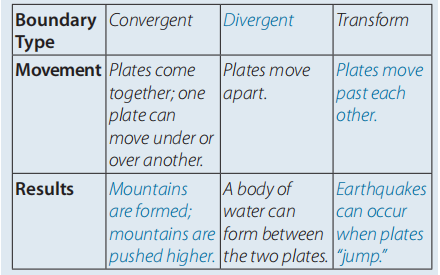
D (page 127) Possible answers:
1. Define convergent boundaries and describe what happens at those boundaries.
2. Contrast convergent and divergent boundaries.
3. Along what type of boundaries do earthquakes occur?
4. Which type of boundary can result in the formation of bodies of water?
5. What kinds of buildings improve people’s chances of survival during earthquakes?
SPEAKING
A (page 128)
1. Therefore/As a result
2. However/On the other hand
3. For instance/For example
4. In addition/Furthermore
5. Therefore/As a result
B (page 129) Possible answers:
1. We do live in an earthquake zone. Therefore, we need to be prepared for earthquakes.
2. For instance, we sometimes have typhoons.
3. Furthermore, I always have bottled water in the refrigerator.
4. On the other hand, I know how to stay safe if one occurs.
5. In addition, public transportation might not be available.
6. As a result, many people and animals died.
C (page 130) 1. Predicting; 2. being; 3. going;
4. Having; 5. repeating; 6. getting
D (page 130) Answers will vary.
LESSON TASK
A (pages 130–131) 1. Living, knowing; 2. thinking;
3. helping; 4. Traveling; 5. returning; 6. taking
B–D (page 131) Answers will vary.
Video
A (page 132) 1. crater; 2. magma; 3. lava; 4. lava lake; 5. eruption
B (page 133) Answers will vary.
C (page 133) 1. T; 2. F (They use camels.); 3. F (They’re
from the University of Nice.); 4. T; 5. F (As lava cools,
it becomes black.); 6. F (The team returns at 2:00 a.m.)
D (page 133) Possible answers:
The professors traveled far to see the volcano, and it was difficult to climb, so they must be enthusiastic about their work.
One professor says it is quite exciting.
The professors stay in the crater for a long time.
They might not do that if they didn’t enjoy the work.
E (page 133) Answers will vary.
Lesson B
VOCABULARY
B (page 135) 1. i; 2. h; 3. b; 4. g; 5. j; 6. d; 7. e; 8. f; 9. a; 10. c
C (page 135) Possible answers:
1. Volcanic eruptions are dangerous because they can happen without a lot of warning.
2. According to my parents, I do not worry enough about possible disasters.
3. If we ever need to evacuate this building, I’ll leave behind almost everything.
4. The worst natural disaster that I remember was the tsunami in the Indian Ocean in 2004.
5. Active volcanoes are unpredictable.
6. Worrying about an earthquake affects my life every day.
D (page 135) 1. affect; 2. effects; 3. affects; 4. effect;
5. affect; 6. affect; 7. effects; 8. effect
LISTENING
A (page 136) Answers will vary.
B (page 136)
Discussed: a, b, d
Not discussed: c, e
C (page 136) 1. inside; 2. lava; 3. start fires;
4. evacuate; 5. Fifty-seven (57); 6. culture
D (page 137)
1. provide more information (In addition,)
2. contrast (On the other hand,)
3. result (as a result,)
E (page 137) Answers will vary.
SPEAKING
A (page 138)
1. common (2 syllables)
2. practical (3 syllables)
3. circumstances (4 syllables)
4. flow (1 syllable)
5. summarize (3 syllables)
6. clothes (1 syllable)
7. psychological (5 syllables)
8. recommend (3 syllables)
9. reinforce (3 syllables)
10. definitely (4 syllables)
B (page 138) Answers will vary.
FINAL TASK
A (page 139) Answers provided on student book
page 139.
1. T (up to 300 mph/500 kph); 2. T; 3. F (in Chile in 1960);
4. F (1 in 700,000); 5. T (Hog Island in 1893);
6. T; 7. T (the Peshtigo Fire in 1871);
8. F (cold liquid raindrops freeze as soon as they touch a surface.)
B–E (page 140) Answers will vary.