UNIT 10 THE FUTURE OF FOOD
THINK AND DISCUSS (page 181)
1. Answers will vary.
2. Possible answer: Genetically modified food refers to food
produced from organisms whose genetics have been changed
in a way that is not natural, usually to enhance certain
characteristics.
EXPLORE THE THEME (pages 182–183)
1. Possible answer: The goal of the Svalbard Global Seed Bank is
to store and keep secure a wide variety of crop seeds.
2. Possible answer: This remote location was probably chosen
because it is a natural refrigerator for the seeds and is far away
from the effects of possible natural or man-made disasters.
3. Possible answers: Doomsday means a time of danger or crisis.
This name was probably chosen for the seed bank in Norway
because the seeds will be useful if disaster strikes crops on
earth.
4. Answers will vary.
LESSON A
Vocabulary
B (page 184)
1. by means of
2. offset
3. intense
4. invaluable
5. detrimental
6. skeptics
7. resistance
8. cultivate
9. advocate
10. drawback
C (page 185)
1. prove
2. to, for
3. clearly, potentially, particularly
4. effect
5. of, to
6. serious
7. to
8. show
D Personalizing (page 185)
Possible answers:
1. I tend to be a skeptic about achieving world peace.
2. I generally advocate for animal rights.
3. A drawback of GM foods is there may be risks to our health.
4. Music has a detrimental effect on my studies.
5. Oil has been invaluable to the development of my country.
A LISTENING A Lecture about GM Foods
BEFORE LISTENING
A Prior Knowledge (page 186)
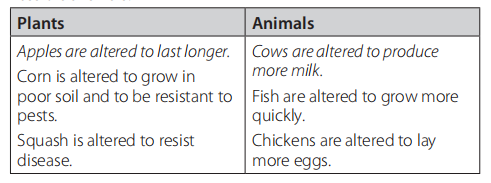
Possible answers:

WHILE LISTENING
B Listening for Main Ideas (page 186)
1. Yes
2. Yes
3. No
4. Yes
5. No
C Note Taking (page 187)
1. genes
2. lettuce
3. killers
4. insects
5. flow
6. accustomed
7. vegetables
8. 2010
9. five/5
10. children
11. Skeptics
12. resistance
AFTER LISTENING
D (page 187)
1. genes
2. characteristics
3. concerns
4. Approval
5. GM salmon
6. popular
7. benefits
8. resistant
A SPEAKING
A Critical Thinking: Evaluating (page 188)
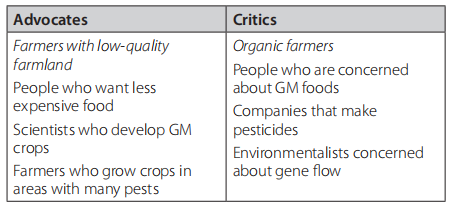
Possible answers:
B Referring to Group Opinions (page 189)
Answers will vary.
C Critical Thinking: Evaluating (page 189)
Possible answers:
A benefit of traditional breeding is that there may be fewer
negative effects on the environment because the process is more
natural. A drawback is that creating a successful hybrid may take a
long time. A benefit of interspecies crosses might be the creation
of new crops that we never could have imagined. A drawback
is that the failure rate could be high. A benefit of genetic
modification is that scientists can target the exact characteristic
they want to change. A drawback is that not enough is known
about the side effects of eating GM foods.
D Critical Thinking: Categorizing (page 190)
1. IC
2. GM
3. TB
4. GM
5. TB
6. IC
E (page 190)
Answers will vary.
LESSON TASK Role-playing a Town Hall Meeting
A–B (page 191)
Answers will vary.
VIDEO Farming the Open Ocean
BEFORE VIEWING
A (page 192)
Possible answers:
1. Similarities: Both require the right environment, nutrients to
feed the crop/fish, and protection from threats to healthy
growth.
Differences: Ease of accessing the crops/fish, effects of drought
on crops/fish, development of techniques/equipment
2. Panama is located in Central America and is bordered by both
the Pacific and Atlantic oceans. Its location makes it easy to
bring in supplies and equipment and allows easy access to the
fish farm in the ocean.
WHILE VIEWING
B Understanding Main Ideas (page 192)
1. Yes
2. Yes
3. No
4. No
5. Yes
C Understanding Details (page 193)
1. land
2. founder
3. materials
4. markets
5. tons
6. labor
7. productivity
8. opportunity
D (page 193)
1. detrimental
2. intense
3. drawback
4. cultivating
5. by means of
6. invaluable
AFTER VIEWING
E Critical Thinking: Reflecting (page 193)
Possible answers:
1. Yes, because the fish farm can be moved to be near
transportation and markets. Also, the fish are clean, and there’s
a lot of potential for productivity.
No, because these farms still pollute the ocean, and these fish
aren’t as healthy to eat as wild-caught fish.
2. Because these fish farms are farther out in the ocean, they
might endanger the natural habitats of wild fish. They may also
drive traditional fish farms out of business.
LESSON B Vocabulary
B Meaning from Context (page 194)
1. output
2. coincided
3. root
4. exceed
5. calling for
6. scenario
7. inadequate
8. surge
9. opt
10. ample
C (page 195)
1. d
2. h
3. a
4. b
5. c
6. i
7. e
8. j
9. g
10. f
D (page 195)
1. hopelessly
2. of
3. a celebration
4. time
5. expectations
6. case
7. in
8. with
9. low
10. for
E (page 195)
Possible answers:
1. The choice of restaurants in my neighborhood is hopelessly
inadequate.
2. The root of last year’s failed harvest was the flooding we had.
3. The bountiful harvest this year calls for a celebration.
4. We have ample time to cook dinner.
5. The food at that restaurant exceeded our expectations.
6. Complete destruction of crops by the storm is a worst case
scenario.
7. There has been a surge in interest in eating healthy foods.
8. The restaurant opening coincided with the release of the
chef’s new cookbook.
9. Compared with ocean farming, land-based farming has low output.
10. I usually opt for brown rice when given the choice.
F Personalizing (page 195)
Answers will vary.
B LISTENING A Conversation about Food Prices
BEFORE LISTENING
A Prior Knowledge (page 196)
1. Possible answer: Food in the U.S. and in Singapore could be
relatively less expensive than in the other countries, or income
in the other countries could be comparatively lower.
2. Answers will vary.
3. Possible answer: shortages or surpluses
WHILE LISTENING
B Listening for Main Ideas (page 196)
1. T
2. T
3. F
4. NG
5. F
C (page 197)
1. Problem: Food prices are out of control. Suggestion: Someone
really has to do something about it.
2. Problem: Inadequate food supplies. Suggestion: Why don’t
they just start planting more food on more land?
3. Problem: People lack access to affordable food. Suggestion:
Somebody needs to make sure people have access to food at
reasonable prices.
4. Problem: Large areas of Africa and Asia may become deserts.
Suggestion: Something needs to be done about it before it’s
too late.
D Listening for Details (page 197)
1. food shortages
2. a/one third/1/3
3. (more) expensive foods/meat and dairy
4. half/1/2 a kilogram
5. 42(%)
6. restrictions on exports
7. Africa and Asia
8. (on) existing farmland
AFTER LISTENING
E Critical Thinking: Analyzing (page 197)
Answers will vary.
B SPEAKING
A (page 198)
Possible answers:
We recommend that the country start using GM crops that are
resistant to pests.
We propose that the government initiate a marketing campaign
with our allies.
It is essential that overfishing be stopped.
It is imperative that island restaurants be inspected for cleanliness
and quality.
We suggest that all schoolchildren be checked for nutrition
problems.
We recommend that the country create an agricultural college to
train more farmers.
B (page 199)
1. I could have told you it was going to rain.
2. They must have raised the price again.
3. I’ll have to get some next time.
4. I could have told you that.
5. Someone really has to do something about it.
6. I would have brought home lamb for dinner.
7. And I certainly wouldn’t have had any trouble buying rice!
8. We’re going to be in trouble.
C (page 199)
Answers will vary.
FINAL TASK Making a Formal Proposal
A–D (page 200)
Answers will vary.