EXPLORING SPACE 7
THINK AND DISCUSS (page 121)
1. Astronauts outside the International Space Station on a spacewalk.
2. Answers will vary.
3. Possible answer: To explore, to learn about other planets
EXPLORE THE THEME (pages 122–123)
1. 1958, almost 200
2. 8 missions, 5 moons
3. to asteroids and comets and to deep space
Lesson A
VOCABULARY
B (page 124) 1. issue; 2. stressful; 3. definitely;
4. method; 5. period; 6. fortunately; 7. conditions;
8. challenges; 9. adapt; 10. exposed
C (page 125) 1. period; 2. Fortunately; 3. challenges;
4. definitely; 5. conditions; 6. exposed; 7. issue;
8. adapt; 9. method; 10. stressful
D (page 125) 1. 5; 2. 1, 3; 3. 4; 4. 3, 1
LISTENING
A (page 126) Answers will vary.
X Astronauts have special jobs to do while they’re in space.
B (page 126)
√ Astronauts often don’t get enough sleep.
√ Astronauts wear special spacesuits to protect their bodies.
√ Astronauts need to get a lot of exercise in space.
C (page 127) Wording will vary. Notes should include only key words and phrases.

D (page 127) 1. F; 2. F; 3. T; 4. F
E (page 127) Possible answers:
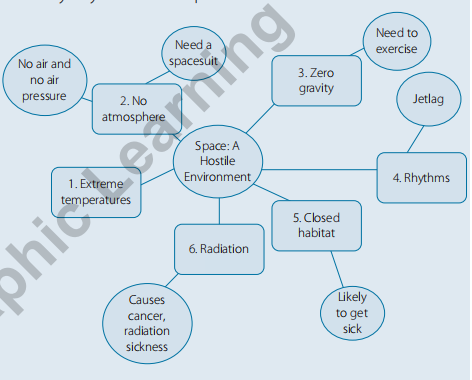
1. You could train in space suits in a special environment to prepare for the extreme temperatures and having no air or air pressure.
2. You could work out for long periods every day to prepare for zero gravity and muscle loss.
3. You could practice waking up often and get special lighting to prepare for 90-minute days.
4. You could stay healthy and get medical training to prepare for the closed habitat.
5. You could get a space suit with protective material to prepare for the strong radiation.
F (page 127) Answers will vary.
SPEAKING
B (page 129)
A: How’s your presentation going?
B: Fine, but I think I’m going to change my topic a little.
A: How are you going to change it?
B: Well, I’m still going to talk about life on the International Space Station.
A: Uh-huh.
B: But I’ll add information about future research on the station.
A: That sounds interesting. What kind of research are they going to do?
B: Oh, research on human health, space science, and engineering.
A: But aren’t they researching those things now?
B: Sure, but the research projects will be even more international in the future.
A: So astronauts from different countries will work together more?
B: Exactly!
C (page 129) Answers will vary.
D (page 129) Going to Mars
A: Did you read this article about Elon Musk? He’s the founder and CEO of SpaceX, which is a private company that promotes space exploration. He thinks humans will live on Mars, maybe as soon as 2060.
B: Really? How will we get there?
A: SpaceX is already sending rockets into space. He thinks they’ll have a rocket big enough to reach Mars by the mid-2020s.
B: Are those rockets going to take people to Mars?
A: Not right away. The first rockets will bring supplies. But landing a heavy spacecraft safely on Mars will be difficult because of the thin
atmosphere.
B: When are people going to go to Mars?
A: Not long after. A spaceship will carry a crew into orbit. Once there, the ship will use solar panels to get energy from the sun. The crew will stay in orbit until Earth and Mars come close together, which happens every 26 months. Then the trip to Mars will be shorter.
E (page 130) Possible answers:
1. The environment will have less gravity and cooler temperatures than Earth.
2. I don’t think Mars will be ready for humans to live on by 2060. We still have a lot to learn about making it safe for humans to live there.
F (page 130) Possible questions:
1. Will there be an age limit on who can use them?
2. How will that affect the projects currently going on there?
3. How will they protect themselves against the cold temperatures?
4. What kinds of jobs will humans have? Will they still work?
5. What kinds of power sources will we use instead?
6. What are different jobs that you might want to do?
G (page 130) Answers will vary.
LESSON TASK
A (page 131)
1. is taking classes/takes classes
2. will take his final exams/is going to take his final exams
3. will graduate/is going to graduate
4. will move back to Europe/is going to move back to Europe
5. will get married and have children
C–D (page 131) Answers will vary.
Video
A (page 132) Possible answers:
Advantages: it’s less dangerous; it’s cheaper than manned
Disadvantages: people can adapt to unexpected conditions better than robots can; robots can get stuck
C (page 133) √ canyon, √ lake, √ ocean, √ volcano
D (page 133) 1. c; 2. b; 3. d; 4. a
E (page 133) Possible answers:
1. We can learn about the possibility of life on other planets from space travel. The robotic explorers can send back images that provide a lot of
information. We can learn about planets’ surfaces and orbits without leaving Earth.
2. The night sky reminds us that we are very small in a big universe.
3. Hopefully scientists will discover planets that can support life or that already have life.
Lesson B
VOCABULARY
B (page 135) 1. necessary; 2. among; 3. invented;
4. observe; 5. completely; 6. discovered; 7. reach;
8. reflect; 9. view; 10. size
C (page 135) 1. size; 2. reflects; 3. necessary;
4. discovered; 5. among
D (page 135) 1. b; 2. b; 3. b; 4. c; 5. b; 6. a; 7. b
LISTENING
A (page 136) Possible answers:
1. The Yerkes Observatory is very old.
2. Older telescopes were very big and heavy.
3. Albert Einstein was involved in the research at Yerkes.
B (page 136) Answers will vary.
C (page 137) Possible answers:
1. Astronomers and other scientists use observatories to make discoveries.
2. To see small stars and galaxies they normally would not be able to see.
3. He wrote about the theory of relativity.
D (page 137) 1. b; 2. c; 3. c
E (page 137) 1. 1890s; 2. mirrors; 3. lenses; 4. 40-inch;
5. Einstein; 6. starfish/spiral
F (page 137)
1. Possible answers: There’s no elevator because it’s an old building. Modern observatories probably have elevators because they are bigger and newer. Also, elevators are necessary to allow people with special needs to have access.
2. Possible answer: Yes, because it was built out in the country, high on a hill, away from the bright lights of the city.
3. Answers will vary.
SPEAKING
A (page 138) Answers will vary.
C (page 139)
A: Hi! What are you reading?
B: It’s information about a star party.
A: A star party? Is that a party with a lot of movie stars or something?
B: No. At star parties, people get together to look at the night sky.
A: Do you need to go to a party to do that?
B: Well, they’re going to a national park. It’s far from any cities.
A: Is that because of the lights near a city?
B: Exactly. People say it’s a lot of fun. Do you want to go?
A: Maybe. When?
B: The bus leaves at five o’clock on Friday afternoon.
A: What time does the bus get back here?
B: It gets back pretty late—around midnight. What do you think?
A: It sounds like fun. Let’s go!
D (page 139) Answers will vary.
FINAL TASK
A–D (pages 139–140) Answers will vary.