Look and Remember
Lesson 1
1 Look at the photo. Then read the text and circle the correct words.
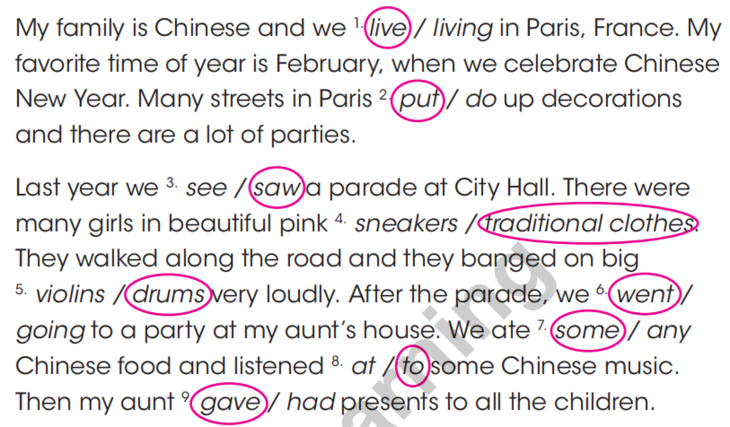
2 Complete the questions with the simple present or the present progressive. Then ask and answer the questions in pairs.
1. What are the girls doing (girls / do) in the photo?
(They’re playing music and they’re waving red streamers.)
2. Are they dancing (they / dance)? (No, they aren’t.)
3. Do you ever go (you / ever / go) to parades like this?
4.Do you like (you / like) Chinese food?
5. What do your parents do (your parents / do) for the New Year?
3 Complete the text with the simple past of the verbs from the box.
1 had 2 went 3 bought 4 made 5 played 6 ate 7 tasted
Lesson 2
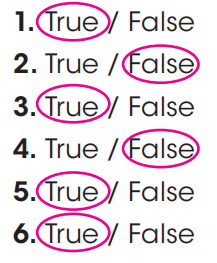
1 Look at the photo. Then listen to the sentences. Circle True or False.
2 Work in pairs. Write four more true/false sentences about the photo. Read the sentences to your partner.
/
3 Match the questions (1–6) with the answers (A–F).
1C 2E 3A 4F 5B 6D
Lesson 3
1 Put the words into the correct row on the word mountain.
1 office building
2 circle square
3 cello flute violin
4 dentist designer nurse pilot
5 e-book headphones laptop microphone tablet
6 broccoli chili pepper corn jam lettuce nuts
1 Making Contact(一单元)
1 Vocabulary
2 Complete the text with words from Activity 1. There are two words you don’t need.
2 envelope
3 stamps
4 postcard
5 mail
3 Listen to the radio travel show. Complete the sentences with the correct place, Vanuatu (V) or Port Lockroy (PL).
1V 2PL 3PL 4PL 5V
2 Grammar
2 Write questions with the present perfect and ever. Then ask and answer the questions with a partner.
2 Have you ever seen a penguin?
3 Has your best friend ever mailed you a postcard?
4 Have your parents ever made a video call?
5 Have you ever had a pen pal?
3 Reading
3 Read again. Write T (true) or F (false).
1 F (They are messages for the future.)
2 T
3 T
4 F (It is about 50 years old.)
5 F (It is still underground.)
6 F (He wrote a letter for the time capsule.)
4 Grammar
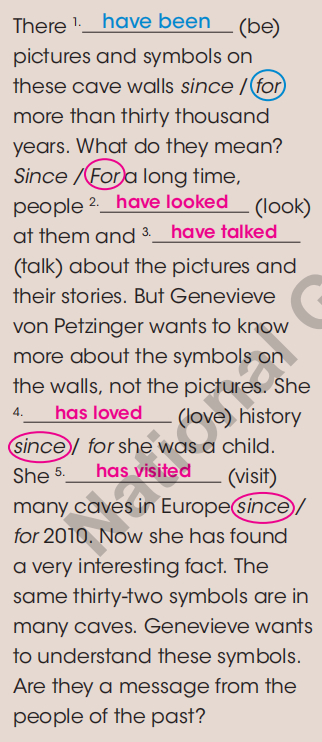
2 Complete the text with the verbs in parentheses. Use the present perfect and circle for or since.
6 Writing
1 Read the e-mail. Then answer the questions.
1 Samira
2 Cairo, Egypt
3 Aya’s cat
4 forty
5 She goes swimming and plays video games.
2 Read the information in the box. Then look at the e-mail and answer questions 1 and 2.
1 Hi Samira
2 Please write back soon!
3 Writing Skill
b. Match topics 1–4 with the paragraphs in Aya’s e-mail.
1 paragraph 2
2 paragraph 4
3 paragraph 1
4 paragraph 3
7 Video
2 Watch the video. Check (✓) the information the scientists want to find out.
2. What do adult cats’ meows mean? √
4. Do cats from different regions meow in different ways? √
3 Watch the video again. Complete the sentences with the words from the box.
1 cats
2 humans
3 children
4 regions
5 meows
2 Life on the Road(二单元)
1 Vocabulary
3 Cibrilla is a Tuareg nomad from Niger in Africa. Listen to the description of his life. Then complete the text. Write one word in each blank.
1 sixteen
2 slept
3 blankets
4 cold
5 electricity
6 pot
7 cities
2 Grammar
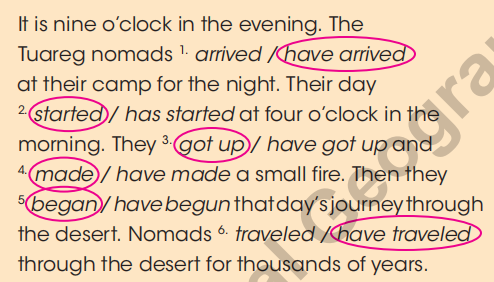
2 Circle the correct answer.
3 Complete the sentences with the verbs in parentheses. Use the present perfect or simple past.
2 went
3 has lived
4 moved
5 watched
3 Reading
3 Read again. Complete each sentence with one word.
1 eighty
2 Argentina
3 ninety
4 languages
5 friends
4 Grammar
2 Circle the correct answer.
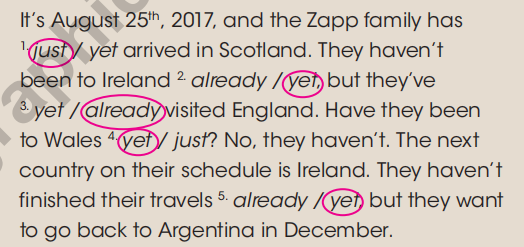
6 Writing
1 Read the biography. Write T (true) or F (false).
1 F (She was sixteen.)
2 T
3 T
4 T
5 F (No, the writer doesn’t like sailing.)
2 Read the information in the box. Then look at the biography and answer the question.
Which of these pieces of information is in Jessica Watson’s biography?
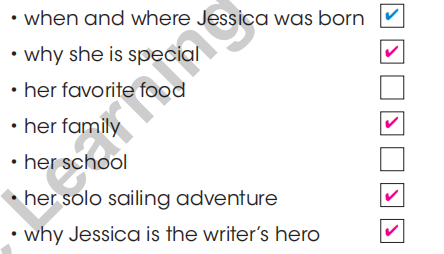
3 Writing Skill
b. Find examples of the time expressions from the box in the biography.
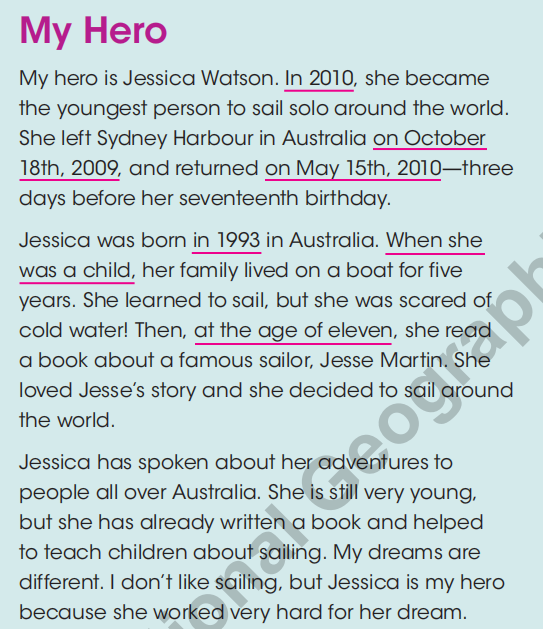
7 Video
1 Watch the video. Match the children (1–3) with the photos (A–C).
1C 2A 3B
2 Watch the video again. Check (✓) the ways of traveling you hear.

3 Read the sentences. Write T (true) or F (false).
1 T
2 F (The Corniche is a long waterfront in Jeddah.)
3 F (She visited her aunt.)
4 T
5 T
6 F (He tried surfing for the first time in San Diego.)
Function 1: Leaving a message
1 Listen and complete.
1 I’m not here
2 soccer game
3 nine o’clock
4 675-2441
5 I can’t answer the phone
6 to walk
3 Work in pairs. Record the messages in Situations 1 and 2.
Sample answers:
Situation 1
A: Hello, this is Paulo / Paula. I’m sorry, I’m not here right now. Please leave a message after the beep.
B: Hi Paulo / Paula, this is Martin / Martina. I want to talk to you about the math homework. It’s difficult! Please call me back. My number’s 532-1176. Thank you, goodbye!
Situation 2
A: Hello, this is Louis / Louisa. I’m sorry, I can’t answer the phone right now. Leave a message!
B: Hi Louis / Louisa, it’s Michel / Michelle. I want to ask you about the swimming lesson tomorrow. When does it start? Please call me back. My number’s 609-2337. Thanks!
SCHOOL TRIP 1
2 Watch the video. Read the sentences and write T (true) or F (false).
1 F (There are about four hundred caves with paintings in Europe.)
2 T
3 F (They used red and black paint.)
4 T
5 F (Some people think the symbols are an early form of writing.)
6 T
Review 1: Units 1–2
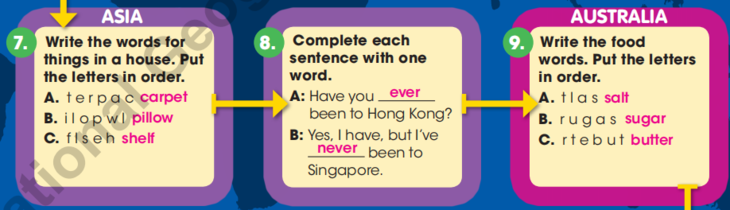
1 Read sentences 1–9. Write the words from the box. There are four words you do not need.
1 envelope 2 electricity 3 post office 4 shelf 5 Carpet 6 postcard 7 pillow 8 stamp
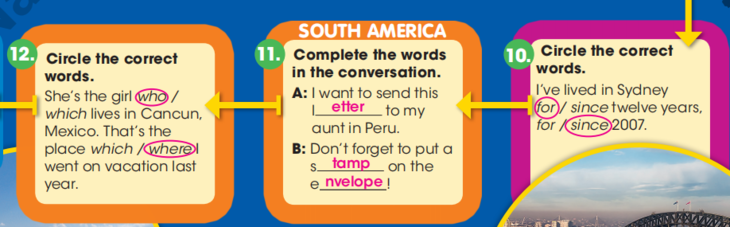
2 Complete the sentences. Use ever, never, for, or since.
1 ever 2 for 3 never 4 ever 5 since 6 never
3 Circle the correct answer
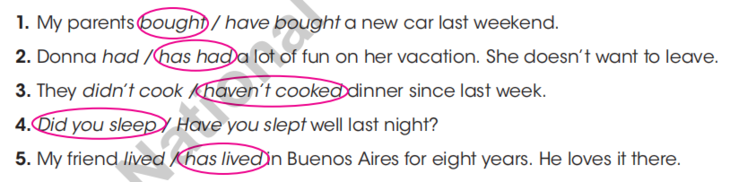
4 Listen. Write sentences about Ferdi and his sisters, Marta and Ines. Use yet, already, or just.
2 He’s just taken a shower.
3 He hasn’t started his homework yet.
4 Marta and Ines have already finished their homework.
5 They’ve just gone to the supermarket.
6 They haven’t written to Grandma yet.
3 Challenges(三单元)
1 Vocabulary
3 Complete the text with words from Activities 1 and 2. Then listen and check.
1 Stadium
2 riders
3 win
4 race
5 winner
6 prize
4 Listen to the report about the Naadam Festival in Mongolia. Circle the correct answer (A, B, or C).
1A 2C 3B 4C
2 Grammar
2 Look at this photo of a race in California. Imagine you were at the race. Describe the scene.
2 Lots of children were running.
3 A boy was wearing a striped shirt.
4 A girl was wearing pink pants.
5 A man was taking photographs.
3 Reading
3 Read again. Write T (true) or F (false).
1. F (They were playing a game of chess against each other.)
2. F (They were already excellent chess players.)
3. T
4. F (They didn’t go to school.)
5. F (Judit is probably the best female chess player in the world today.)
4 Grammar
2 Complete the sentences with the verbs in parentheses. Use the simple past or past progressive
2 won ; got
3 was reading ; rang
4 was listening ; turned off
5 came ; were singing
6 got ; opened
3 Write your own endings for these sentences. Then compare your sentences with a partner’s.
Sample Answers: 1. I was talking to my pet fish when he jumped out of the tank.; 2. When we arrived at our uncle’s house, he was dancing in the garden.; 3. Why were you sitting on the table when we opened the door?; 4. She was looking for her socks when she saw a mouse under the bed.; 5. When the teacher came into the classroom, we were finishing our homework.; 6. When I got home from school, my sister was watching TV.
6 Writing
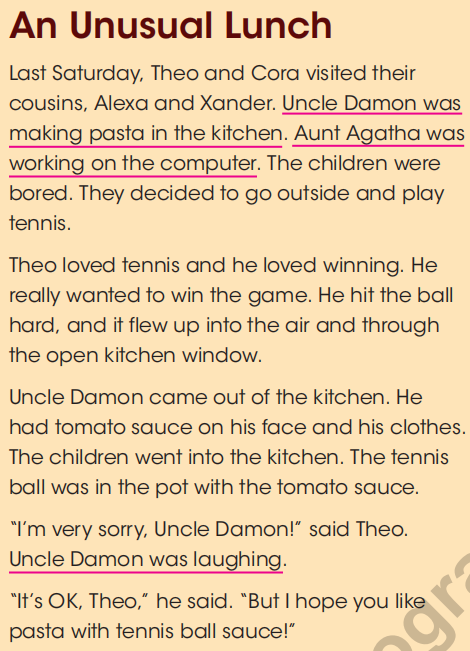
1 Read the story. Why was the lunch unusual?
The lunch was unusual because there was a tennis ball in the tomato sauce.
2 Read the information in the box. Then look at the story in Activity 1 and find three examples of the past progressive.
3 Writing Skill
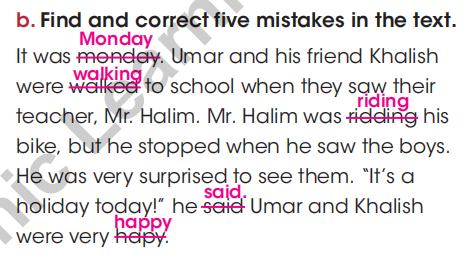
b. Find and correct five mistakes in the text.
4 Look at the pictures and write a story. Use the words in the box.
Sample Answer: Excellent performance
Three friends were playing in the park, and they entered a competition. The slow boy looked at the boys climbing the wall. He jumped on the trampoline and flew high over the wall. He won first prize.
Sample Answer: Satisfactory performance
Three boys were in (the) park. They did (entered) a competition. The slow boy watched the boys. He jumped over the wall. He won.
7 Video
2 Watch the video. Circle the correct answer.

3 Watch the video again. Write T (true) or F (false).
1 F (He’s moving to a special place where he can train his horses.)
2 T
3 T
4 F (It’s a type of Mongolian instrument.)
5 F (He was very happy.)
4 What’s on Your Plate?(四单元)
1 Vocabulary
2 Complete the text with the words from the box. You can use a word more than once.
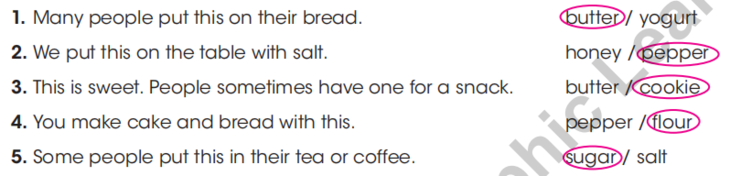
1 cookies 2 sugar 3 Honey 4 salt/pepper 5 pepper/salt 6 Pepper7 salt
3 Listen to the report. Then complete the sentences with the words from the box.
1 spread 2 honey 3 sugar4 salt 5 flour 6 butter 7 race
2 Grammar
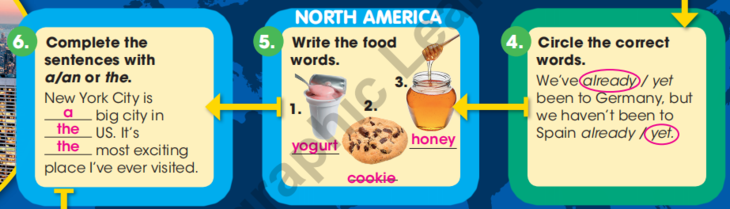
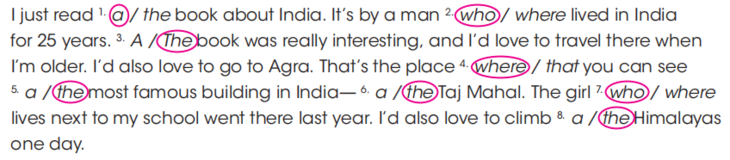
2 Complete the text with a/an or the.
1 The 2 an 3 The 4 the 5 a 6 the
3 Complete the questions with a/an or the.
1 the 2 a 3 a 4 the 5 a 6 a ; the
3 Reading
3 Read again. Write T (true) or F (false).
1T 2F 3F 4T 5F
4 Grammar
2 Complete the food quiz with who, that, or where.
2 who B
3 where B
4 that C
6 Writing
1 Read the review. Answer the questions.
1 Yes, the writer mostly liked the café.
2 Check the things included in the review.
1. The café was very busy. √
4. There were many pictures of bees. √
5. The tea wasn’t hot. √
6. The pieces of cake were big √
2 Read the information in the box. Then match sentences A–D with 1–4 in the box.
B. The Thai Kitchen is in Bangkok. 1
C.The cheapest pizza was $18.00. 4
D. There were beautiful flowers on the tables. 2
3 Writing Skill
Find these adjectives from the review in Activity 1. Are they positive or negative?
busy—negative; cold—negative; delicious— positive; excellent—positive; great—positive; noisy—negative
7 Video
1 Watch the video. Match the countries (1–3) with the photos (A–C).
1A 2C 3B
2 Watch the video again. Match the words (1–4) with the descriptions (A–D).

3 Circle the correct words
Game 1
1 Work in pairs. Play the game. Answer all the questions.
Reading Extra 1
2 Listen and read. Check your answers to Activity 1.
A marathon is a race that is 42.195 kilometers long.
3 Which reason for running in a marathon is NOT mentioned in the text?
A
4 Read again. Answer the questions.
1 It was underwater.
2 To tell Athens about the Greek victory
3 To celebrate the legend of Pheidippides
4 Nine
5 So that the runners finished in front of the royal box
Review 2: Units 3–4
1 Complete the story with the words from the box. There are two words you don’t need.
1 took part
2 competition
3 race
4 won
5 prize
6 winners
2 Circle the correct word.
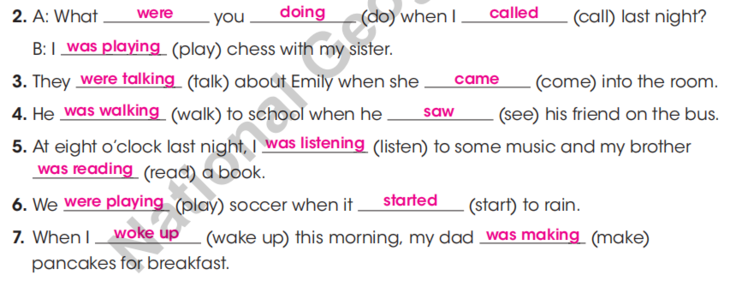
3 Complete the sentences with the verbs in parentheses. Use the past simple or past progressive.
4 Circle the correct word.
5 The Animal Kingdom(五单元)
1 Vocabulary
2 Complete the text with words from Activity 1.
1 plants
2 beetles
3 mice
4 Snakes
5 Eagles
6 tortoises
3 Listen and complete the notes about the harpy eagle.
1 South America
2 Nine
3 Two
4 birds
5 mammals
6 Capuchin
7 insects
2 Grammar
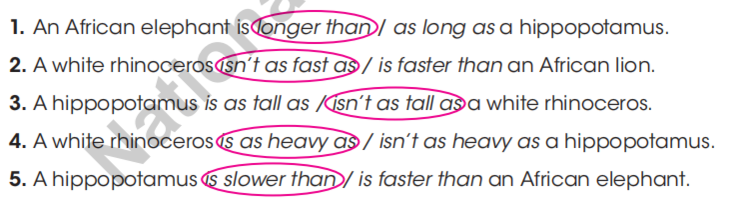
2 Look at the animal information chart. Then read sentences 1–5. Circle the correct answer.
3 Reading
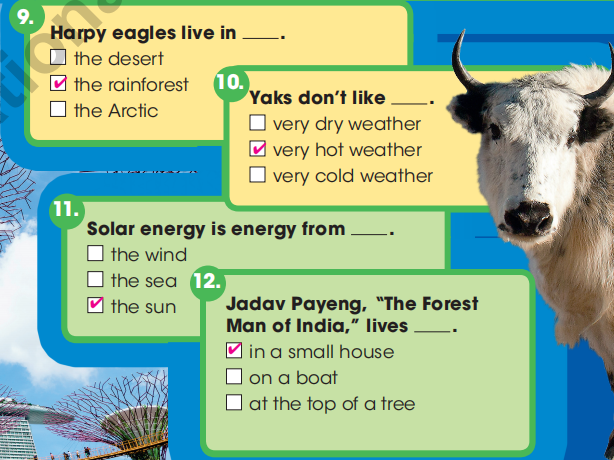
3 Read again. Then check three more correct sentences about the yaks’ home. Explain how the yak is adapted for each problem.
3. It’s very cold in the winter. √
They have thick fur.
4. The sunlight is very strong. √
Their fur is thick.
5. There isn’t a lot of water in the winter. √
They get water from the snow and ice.
4 Grammar
2 Complete the text with the words too or enough.
1 too
2 enough
3 enough
4 too
5 enough
3 Work in pairs. Ask and answer the questions with too or not enough and your own ideas.
Sample answers: 1. It was too difficult. I didn’t have enough time.; 2. I’m too cold. I’m not warm enough.; 3. I’m not tall enough. I’m too short.; 4. I was too hungry. There wasn’t enough cake. The cake wasn’t big enough.; 5. He’s too young. He isn’t old enough.
5 Song
2 Listen and read. Look back at Unit 5. Match each verse with a photo from the unit.
verse 1: yak (p. 52); verse 2: sand boa snake (p. 53); verse 3: polar bear (p. 54); verse 4: harpy eagle (p. 50)
6 Writing
Work in pairs. How much do you know about giraffes? Read sentences 1–4 and write T (true) or F (false). Then read the fact file and check.
1 T
2 F (They live in Africa.)
3 F (They eat plants and leaves.)
4 T
2 Read the information in the box. Then match questions 1–6 to the subheads in the giraffe fact file.
1 Diet
2 Interesting facts
3 Size
4 Speed
5 Lifespan
6 Habitat
3 Writing Skill
b. Complete the giraffe chart with information from the giraffe fact file.
Height: 5.5 meters
Weight: 1,100 kilograms
Speed: 55 kilometers per hour
7 Video
2 Watch the video. Circle the correct summary of the video (A, B, or C).

3 Watch the video again. Answer the questions.
1 The male giraffe
2 To eat leaves at the top of trees; to look out for dangerous animals
3 Seven
4 They fight.
5 To eat a lot of food; it’s dangerous to sleep when there are lions.
6 Helping the Environment(六单元)
1 Vocabulary
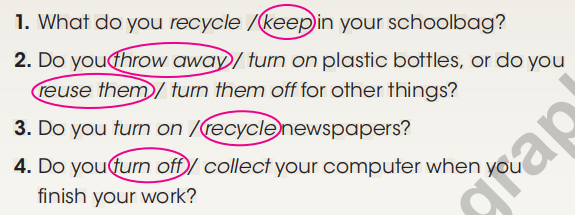
2 Circle the correct answer. Then ask and answer the questions with a partner.
3 Read the sentences. Then listen to a radio program about Thato and Rea from South Africa. Write T (true) or F (false).
1T 2F 3F 4F 5T 6T
2 Grammar
2 Complete the sentences with used to and a verb from the box.
1 used to see
2 used to watch
3 used to ride
4 used to keep
3 Reading
1 Look at the photo. Jadav Payeng is called “The Forest Man of India.” Why? Guess.
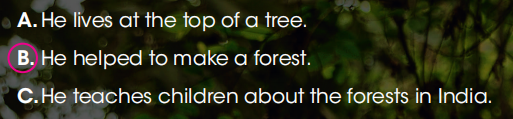
3 Read again. Answer the questions.
1 It’s on Majuli Island in northern India.
2 Tigers, rhinos, monkeys.
3 In 1979
4 It’s bigger than one thousand soccer fields.
5 He plants trees, takes care of the land, and makes sure the trees are healthy.
4 Grammar
2 Complete the text with didn’t use to and the verbs in parentheses.
1 didn’t use to be
2 didn’t use to spend
3 didn’t use to ride
4 didn’t use to walk
5 didn’t use to grow
3 Work in pairs. Ask and answer questions about La Linea Verde.
1 Did people use to walk here at night ten years ago? No, they didn’t.
2 Did this place use to be safe ten years ago? No, it didn’t.
3 Did the roads use to be dangerous here ten years ago? Yes, they did.
4 Did trees use to grow here ten years ago? No, they didn’t.
6 Writing
3 Writing Skill
b. Replace the underlined phrases in sentences 1–4 with a verb with a prefix.
1. rewrite it; 2. reread it; 3. retake it; 4. redo it
7 Video
1 Watch the video. Match the children (1–3) with the photos (A–C).
1C 2B 3A
2 Watch the video again. Match the words in 1–6 with A–F to make phrases from the video.
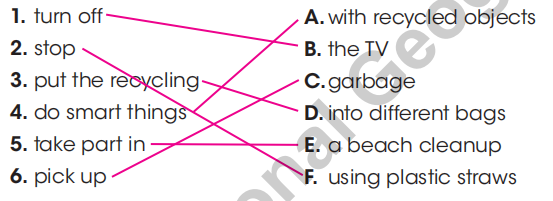
3 Answer the questions.
1 She puts them in special green bins.
2 We need to take care of our environment.
3 She used old plastic bags.
4 Tire Park
5 She can see penguins, dolphins, and whales.
6 She put it into bags.
Function 2: Ordering food in a restaurant
1 Listen and complete.
1 cheese
2 salad
3 chicken and mushroom
4 orange juice
5 water
6 great
7 dessert
8 the check
School Trip 2
2 Check (✓) the animals that are mentioned in the video.
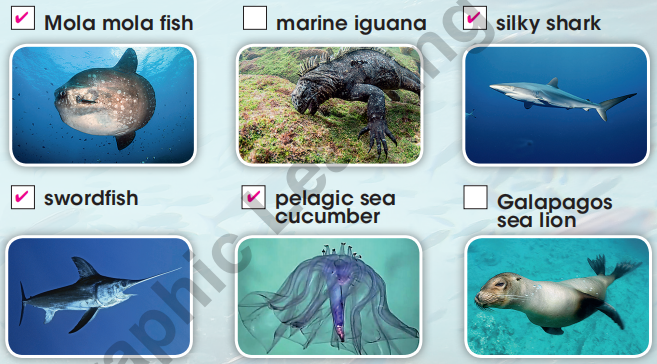
Review 3: Units 5–6
1 Write the animal words. Put the letters in order.
1mammal 2butterfly 3tortoise 4insect 5eagle 6beetle
2 Listen and draw lines. There is one example.
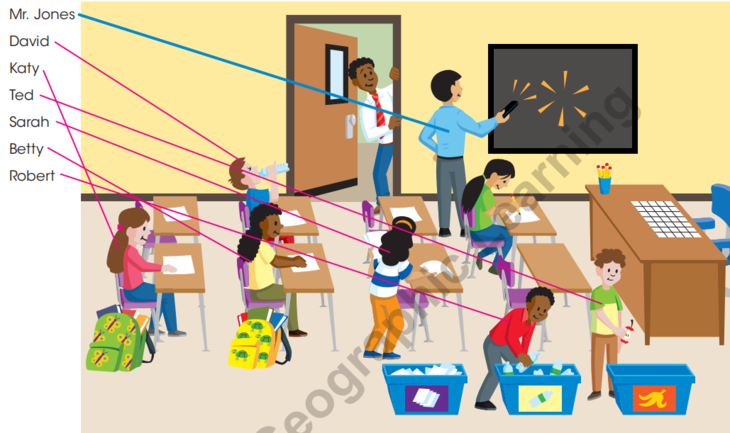
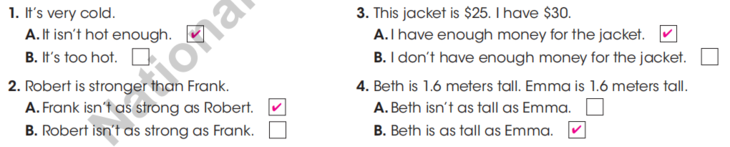
3 Read the first sentence. Then check (✓) the sentence (A or B) that has the same meaning.
4 Complete the conversation with used to or use to and the verbs in parentheses.
1 Did you use to walk
2 used to take
3 used to love
4 didn’t use to like
5 used to tell
7 Life in Space(七单元)
1 Vocabulary
2 Complete the sentences with the words from the box.
1 astronaut ; space
2 orbits
3 planets ; solar system
4 spacecraft ; took off ; landed
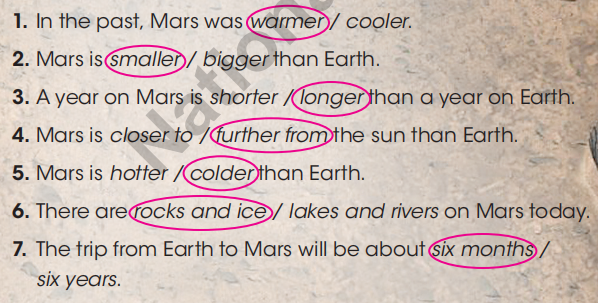
3 Listen to the description of the planet Mars. Circle the correct answer.
2 Grammar
2 Complete the text with will / won’t and the verbs from the box.
1 will travel
2 won’t live
3 ’ll build
4 will help
5 will eat
6 ’ll grow
3 Reading
3 Read again. Circle the correct answer (A, B, or C).
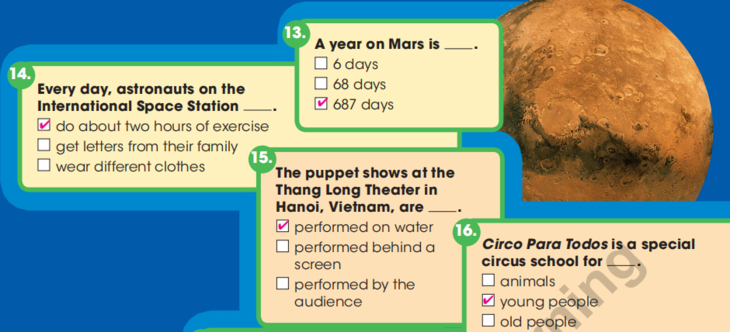
1B 2A 3C 4C 5B
4 Grammar
2 Look at this ISS astronaut’s schedule for tomorrow. Say what she is and isn’t doing.
In the morning: She’s running on the running machine. She isn’t cycling on the bike machine. She’s making a video call with a school on Earth. She’s checking e-mails. In the afternoon: She isn’t cleaning her bedroom. She’s putting the garbage into special bags. She isn’t going on a spacewalk. She’s talking to Mission Control.
6 Writing
2 Read the information in the box. Then match captions A–C with photos 1–3.
A. Jupiter has more than sixty moons. 3
B. Mars is often called the “red planet.” 1
C.Saturn has rings of ice around it. 2
3 Writing Skill
b. Match questions 1–3 in the box with reasons A–C.
A.If you can find the information on one website only, it may possibly be wrong. 3
B. If it’s a personal blog, the writer perhaps hasn’t checked all the facts. Use official websites, such as museum or newspaper ones. 2
C.Information that is old may have changed. 1
7 Video
1 The photo shows the Curiosity rover. It landed on Mars in 2012 and is still there. Work in pairs. Do you know the answers to these questions?
1. It’s on Mars to find out if there is or was life on Mars.
2. It travels around the surface of the planet and takes photographs and samples of rock.
3. Kobie Boykins and a team of engineers at NASA.
2 Watch the video. Then check (✓) the things you see.

3 Watch the video again. Circle the correct answer (A or B).
1A 2B 3B 4A
8 Come to the Show!(八单元)
1 Vocabulary
2 Complete the text with the words in bold from Activity 1.
1 fairy tales
2 traditional
3 queen
4 stage
5 Audience
6 act
7 end
3 Read the sentences. Then listen to the radio program about water puppet shows in Vietnam. Write T (true) or F (false).
1T 2F 3F 4T 5F 6T
2 Grammar
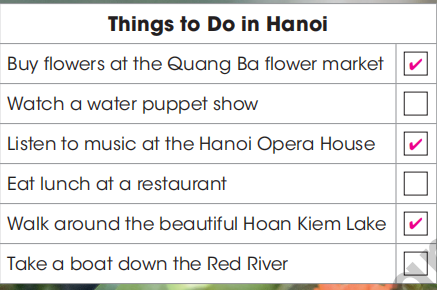
2 Listen to the conversation. Check the things that the speaker is going to do tomorrow.
3 Reading
3 Read again. Answer the questions.
1. Bogota, Colombia
2. about seventeen to twenty-eight
3. dancing, throwing and catching fire sticks, making human pyramids, flying through the air, performing acrobatics on a hoop, walking on a tightrope
4. They study there for four years.
5. They work at circuses all around the world.
4 Grammar
2 Look at the pictures. Make sentences with be going to.
2 She’s going to bounce.
3 They aren’t going to fall.
4 He’s going to drop a hat.
5 He’s going to throw the ball.
She isn’t going to catch it.
3 Read sentences 1–5. Make predictions with be going to.
2. It’s going to rain.; 3. I’m going to be tired tomorrow.; 4. He/She’s going to feel sick.; 5. He/She’s going to play tennis.
5 Chant
1 Work in pairs. Imagine you are at the circus. Think of four adjectives to describe it. Then read the chant quickly. Are your adjectives in the chant?
The following adjectives are in the chant: fantastic, noisy, exciting, funny, fast, dangerous, the best, great, and amazing.
6 Writing
1 Read the script. Why do Sofia, Mom, and Dad say “Hooray for Franco!” at the end?
Because he remembered the tickets
2 Read the information in the box. Then complete blanks 1–4 in the script in Activity 1 with instructions A–D.
1D 2C 3B 4A
3 Writing Skills
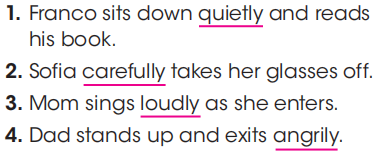
b. Read sentences 1–4 and underline the adverbs of manner.
7 Video
1 a. Watch the video. Look at the photo. What’s this type of performance called? Circle the correct answer (A, B, or C).

b. Match performances A–C to descriptions 1–3.
1C 2B 3A
2 Watch the video again. Complete the sentences.
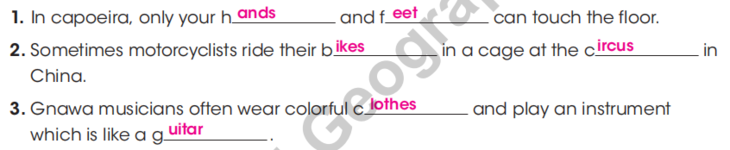
3 Complete the sentences with the words from the box.
1 carnival
2 puppet
3 important
4 drums
5 festival
Game 2
1 Spot the difference
1. In picture A, there are two plants on the stage. In picture B, there are three plants on the stage.
2. In picture A, the girl astronaut is taller than the boy astronaut. In picture B, the girl astronaut is as tall as the boy astronaut.
3. In picture A, the audience is sitting in their seats and clapping. In picture B, the audience is standing and clapping.
4. In picture A, there are two plastic bottles at the bottom of the spacecraft. In picture B, the spacecraft only has one plastic bottle.
5. In picture A, there is a snake in the tree. In picture B, there is an eagle in the tree.
6. In picture A, there is a tortoise under the tree. In picture B, there is a rabbit under the tree.
7. In picture A, the butterfly’s wings are blue. In picture B, the butterfly’s wings are orange.
8. In picture A, the astronauts are smiling. In picture B, the astronauts aren’t smiling.
Reading Extra 2
1 Why do people hunt?
People hunt animals for meat or as a sport. They also hunt animals to use their fur or skin, to use parts of their bodies as medicine, to find animals for zoos, to find animals for pets, to remove dangerous animals from places, and to remove animals that are destroying habitat or farmland.
3 Complete the sentences about the story. Use one, two, three, or four words in each blank.
1 the forest
2 a small harp
3 come back
4 the greatest hunter
5 meeting place
6 not
Review 4: Units 7–8
1 Complete the sentences with the words from the box.
1 planets
2 Astronauts
3 solar system
4 takes off
5 lands
6 gravity ; floats
2 Write the missing letters.

3 Read the question and choose the correct answer. Write a letter (A–G) for each answer. You do not need to use all the letters.
1 D 2 G 3 F 4 A 5 C
4 Complete the paragraph with be going to and the verbs from the box.
1 ’m going to visit
2 ’s going to take
3 ’re going to eat
4 ’re going to walk
5 ’re going to watch
6 ’s going to be
9 The World Outside(九单元)
1 Vocabulary
2 Complete the text with the words from the box.
1 stayed
2 hill
3 stream
4 stones
5 flashlight
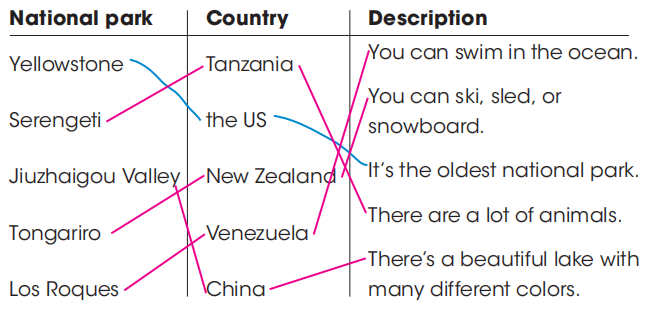
3 Listen to the program about national parks around the world. Match the parks with the countries and the descriptions.
2 Grammar
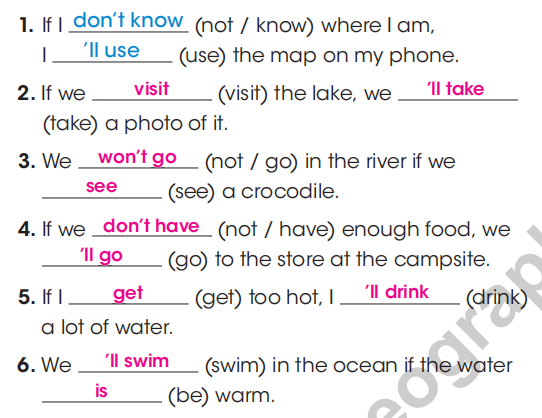
2 Complete sentences 1–6 with the verbs in parentheses. Use the first conditional.
3 Work in pairs. You are planning a trip to a national park. Complete sentences 1–5 with your own ideas. Then compare your sentences with another pair.
Sample answers
1. we’ll shout loudly.
2. we’ll go for a walk / have a picnic.
3. we’ll have a beautiful view.
4. if it gets dark.
5. if we wear enough clothes.
3 Reading
1 Look at the photo. Work in pairs. Think of different ways people have used the power of the sun.
Possible answers: dry laundry, dry and preserve food, solar energy, make fire, etc.
3 Read again. Put pictures A–E in order.
A. 4
B. 2
C. 5
D. 1
E. 3
4 Work in pairs. Discuss the questions.
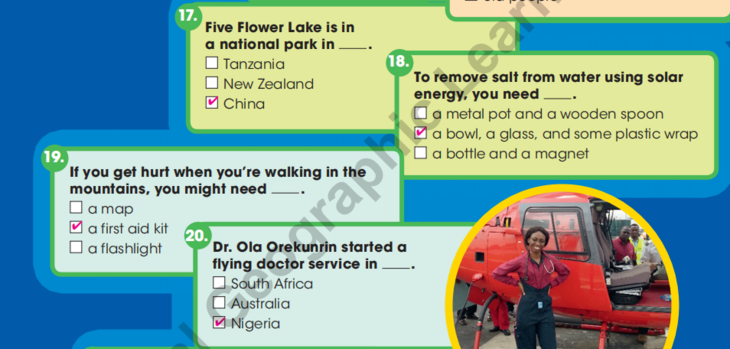
1. You can use this experiment to take the salt out of ocean water
and drink it.
2. Answers may vary.
4 Grammar
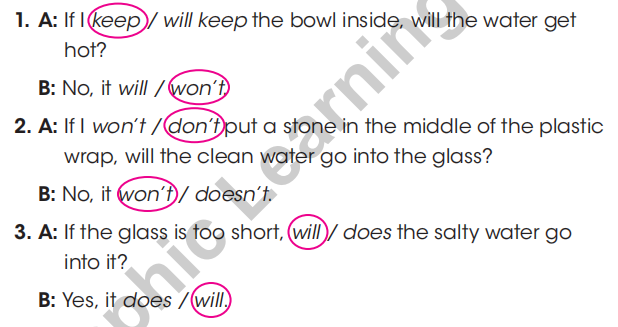
2 Circle the correct word.
3 Make first conditional questions. Then ask and answer the questions in pairs.
1 What will you do if it rains this weekend?
2 What will your teacher say if you don’t do your homework?
3 What will you wear if it’s very hot tomorrow?
4 What will you eat if you feel hungry this afternoon?
5 What time will you go to bed if you feel tired tonight?
6 Writing
1 Read the report. Answer the questions.
1 Twelve hours
2 Yes
2 Read the information in the box. Then look at sentences 1–4. Write F (fact) or O (opinion).
2O 3F 4O
3 Writing Skill
b. Look at the underlined reference words in the report in Activity 1. What does each reference word refer to?
2 the birds
3 the fish farm
4 the day
7 Video
2 Watch the video. Match the first part of the sentences (1–5) with the second part (A–E).

3 Watch the video again. Answer the questions.
1 Because they’re hungry and they like eating fish
2 To show us what the bear is looking at
3 Two hours
4 Yes
10 Help!(十单元)
1 Vocabulary
3 Complete the sentences with the words from the box.
1 first aid kit ; bandages
2 Band-Aid ; cut
3 fell down ; broke
4 storm
5 foggy
4 Listen to the report about the Lochaber Mountain Rescue team. Complete the advice.
1 warm jacket
2 boots
3 map
4 whistle
5 compass
6 first aid kit
2 Grammar
2 Complete the sentences with may, might, could, or will and the verbs in parentheses.
1 ’ll be
2 may/might/ could rain
3 may/might/ could feel
4 won’t get
5 may/might/ could walk
6 may/might/ could take
3 Work in pairs. Look at the photos. Guess what they are. Use may, might, or could.
1. a flashlight; 2. a whistle; 3. a hiking boot; 4. a smartphone
3 Reading
3 Read again. Write T (true) or F (false).
1 F (She went to college when she was fifteen.)
2 F (The ambulance couldn’t reach her.)
3 T
4 F (She moved to Nigeria because she wanted to help other sick people.)
5 T
4 Grammar
2 Complete the text. Use one word in each blank.
2 don’t
3 had
4 didn’t
5 to
6 have
3 Complete the sentences with (don’t / didn’t ) have to / had to and the verbs in parentheses.
1 had to go
2 don’t have to call
3 doesn’t have to stay
4 had to study
5 didn’t have to go
6 has to take
6 Writing
1 Read the newspaper story. Circle the best headline (1, 2, or 3).
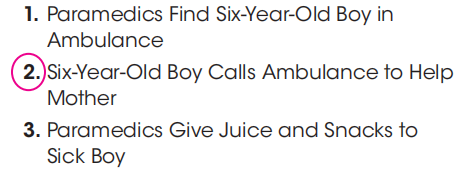
2 Read the information in the box. Then rewrite sentences 1–3 as headlines.
1 Doctor Opens Hospital in Nigeria
2 Cat Helps Young Child in River
3 Man Gets Lost in Mountains
3 Writing Skill
b. Rewrite sentences 1–3 with although and however.
2. Although the man had a flashlight, he didn’t see the rock. The man had a flashlight. However, he didn’t see the rock.;
3. Although the hospital was busy, the doctor saw us quickly. The hospital was busy. However, the doctor saw us quickly.
7 Video
2 Watch the video. Circle the correct words.

3 Watch the video again. Write T (true) or F (false).
1 F (A fire safety house came to their school.)
2 T
3 T
4 F (The paramedics put a bandage on Emilia.)
Function 3: Making plans
1 Listen and complete.
1 on Saturday morning
2 I’m playing tennis
3 the afternoon
4 chess match
5 new video game
6 a quarter to eleven
7 at the store
8 at the park
School Trip 3
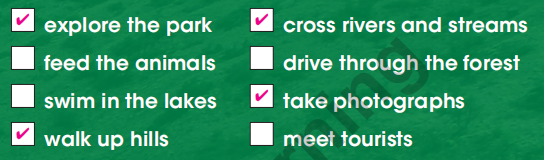
2 What do Marty and Ross do in the park? Check (✓) the activities you hear.
Review 5: Units 9–10
2 Make first conditional sentences with the verbs in parentheses.
1 don’t eat ;’ll be
2 fall ; ’ll get
3 will you do ; ’s
4 Will he go out ; doesn’t finish
5 cut ; ’ll put
6 will you call ; get
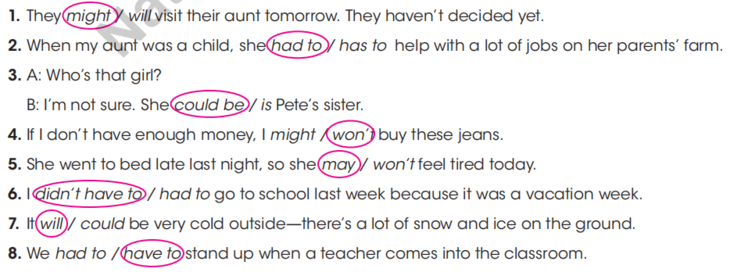
3 Circle the correct words.
11 How Is It Made?(十一单元)
1 Vocabulary
2 Complete the instructions with words from Activity 1
1 metal
2 Heat
3 cool
4 Pour
5 jars
3 Listen to the description of the factory that Annie Griffiths photographed. Then complete the sentences with the words from the box.
1 candies
2 sugar ; metal
3 fruit
4 pour
5 cardboard
6 festivals
2 Grammar
2 Make passive sentences with the words.
2 Nuts and fruit are added to the water and oil.
3 The mixture is heated in large metal pots.
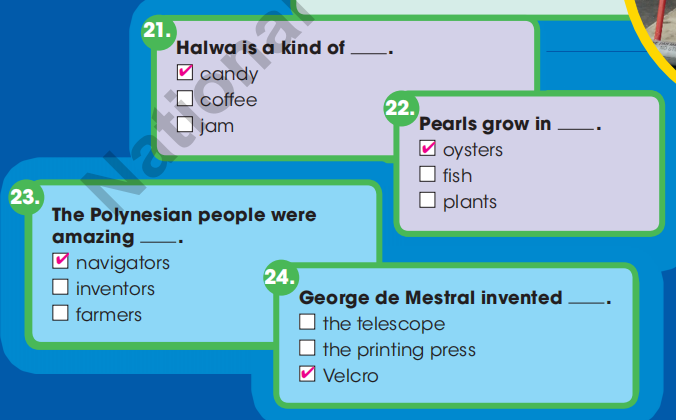
4 The candies are sold in candy stores.
5 Halwa is eaten with strong coffee.
3 Make these active sentences into passive sentences.
2 English and French are spoken in Canada.
3 Sushi is eaten in Japan.
4 Audi cars are made in Germany.
5 Thanksgiving is celebrated in the US.
4 Work in pairs. Choose one word from each pair. Describe the word with the simple present passive of the verb in parentheses. Can your partner guess the word?
English: It’s spoken in the UK/the US/ Australia/New Zealand.; French: It’s spoken in France.;
Yogurt: It’s eaten with fruit.; Jam: It’s eaten with bread.;
Shoes: They’re worn on your feet.; Pants: They’re worn on your legs.; Soccer: It’s played by two teams of eleven players.;
Ping-pong: It’s played by two players.; Letters: They’re sent in the mail.; E-mails: They’re sent by computer.
3 Reading
3 Read again. Answer the questions.
1 They are the only jewels made by living animals.
2 They are farmed.
3 Black pearls
4 They put a small piece of shell inside the young oysters.
5 About two years
4 Grammar
2 Make simple present passive questions with the words in 1–5.
2 Who are the young oysters collected by?
3 How are the oysters cleaned?
4 What are the pearls used for?
5 Who are the pearls bought by?
3 Sentences 1–5 are false. Correct them.
2. Pearls aren’t grown on trees. Pearls are grown in oysters/special pearl farms.;
3. Halwa isn’t sold in clothing stores. Halwa is sold in candy stores.;
4. Orange juice isn’t made from apples. Orange juice is made from oranges.;
5. Ambulances aren’t driven by farmers. Ambulances are driven by paramedics.
6 Writing
1 Look at the photo. Guess. What is this?Where is it from? What is it used for? Then
read the text and check your ideas.
It’s a paperweight. It’s from Italy. It’s used to keep pieces of paper in one place.
2 Read the information in the box. Then read the description in Activity 1 again and match paragraphs 1–4 to questions A–D.
A. Where do you keep it? 2
B. What is it, and what does it look like? 1
C. Why is it special to you? 4
D. What do you do with it? 3
3 Writing Skill
b. Put the adjectives in order. Add commas.
2 It’s an expensive, small, black pearl.
3 They are tiny, light, French cakes.
4 It’s a large, green, plastic net.
7 Video
2 Watch the video. How is mochi made? Put sentences A–F in order.

3 Watch the video again. Complete the sentences with words from the box.
1 four
2 twelve
3 forty
4 soup
12 Discoveries(十二单元)
1 Vocabulary
2 Complete the sentences with words in bold from Activity 1.
1 south
2 west
3 Sailors
4 magnet
5 invention
3 Read sentences 1–5. Then listen to a radio program about the history of navigation. Write T (true) or F (false). Correct the false sentences.
1 T
2 T
3 F The Polynesians used the stars, sun, winds, waves, clouds, and birds to navigate.
4 F The first compasses used a needle on a piece of wood.
5 T
4 Work in pairs. How do you think people used the stars and the sun to navigate? Discuss your ideas.
They watched where the sun was and that helped them know where east and west were. They used certain stars (the North Star and the South Star) to show where north and south were.
2 Grammar
2 Complete the text with the simple past passive of the verb in parentheses.
1 was taught
2 were invented
3 wasn’t written
4 wasn’t forgotten
5 was shared
3 Make passive sentences.
2 Chocolate was discovered by the Maya people.
3 The first submarine was built by a Dutch inventor.
4 The first e-mail was sent by an American computer engineer.
5 The first pens were sold in Argentina.
4 Work in pairs. Make the beginnings of simple past passive sentences with the words in 1–6. Then complete each sentence with a person from the box. Listen and check your answers.
1 The telephone was invented by Alexander Graham Bell.
2 The Statue of Liberty was built by Gustave Eiffel.
3 The Mona Lisa was painted by Leonardo da Vinci.
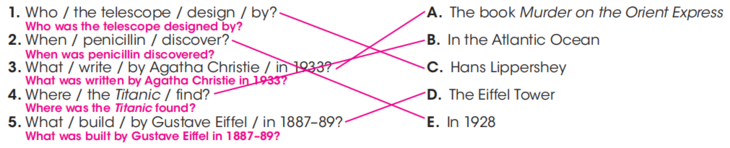
4 The first car was made by Karl Benz.
5 The play Hamlet was written by William Shakespeare.
6 Gravity was discovered by Sir Isaac Newton.
3 Reading
2 Listen and read.
1A 2B 3B 4C 5C 6B 7B 8A 9C
4 Grammar
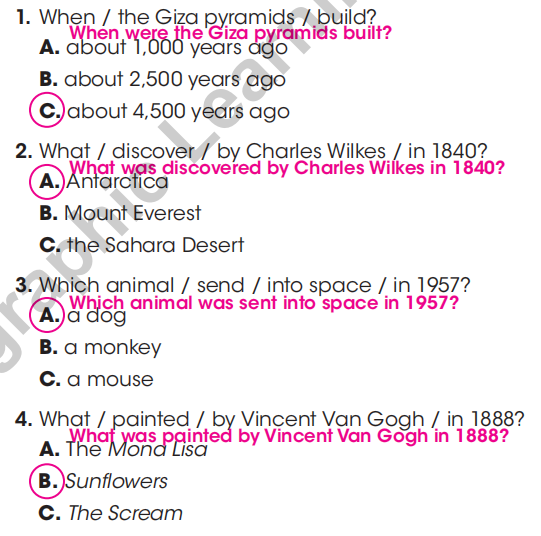
2 Write the four quiz questions. Circle the correct answer (A, B, or C) for each question. Then listen and check.
5 Song
1 Read the song quickly. Find:
five names: Gutenberg, Hans Lippershey, Pierre Curie, Marie Curie, Sir Tim Berners-Lee;
six inventions/ discoveries: the wheel, the printing press, the telescope, radium and polonium, the World Wide Web;
two dates: 1440, 1608
6 Writing
2 Read the information in the box. Then complete blanks 1 and 2 in the article with two sentences from A–D.
1B 2C
3 Writing Skill
b. Read the article in Activity 1 again and find two questions.
Do you have any clothes with Velcro? But who was it invented by, and how did they think of it?
7 Video
1 Watch the video. Match the countries (1–3) with the discoveries and inventions (A–C).
1B 2A 3C
2 Watch the video again. When were these things invented/discovered? Match 1–3 with A–C.

3 Answer the questions.
1 They used to think the sun went around Earth.
2 Because Copernicus was born there.
3 It’s played all around the world.
4 You climb the ladder and get closer to the end.
5 It was the biggest dinosaur ever discovered in the world.
6 It ate plants.
Game 3
1 Work in small groups. Play Snakes and Ladders.
2. Students’ own ideas; 4. This letter wasn’t written by my pen pal.; 5. Students’ own ideas; 6; See below. 8. Do you want to play soccer tomorrow?; 9. We may see a bear
in the woods!; 10. Students’ own ideas; 12. Spanish, English, and German are taught at this school.; 13. Students’ own ideas; 14 See below.; 16. Why don’t we meet at the library? 17; This might/may/could be Peter’s bag—I’m not sure.; 18. Students’ own ideas; 19. When was the radio invented?; 20. Students’ own ideas; 21 See below.; 22. Are you free on Tuesday afternoon?; 24. It might get very hot today.

Reading Extra 3
2 Listen and read. Check your answers to Activity 1.
The picture is from Australia. It shows a traditional Aboriginal story about the land.
3 Read again. Answer the questions.
1. They painted on rocks, drew pictures in the sand, and decorated their bodies.; 2. They used symbols.; 3. because they weren’t allowed to speak their own languages; 4. People all around the world could see Aboriginal art for the first time.; 5. Western Desert style; 6. Aboriginal art always tells a traditional Aboriginal story, and the stories belong to different tribes
Review 6: Units 11–12
1 What did each person give Katy at her party? Listen and write a letter in each box. There is one example.
1G 2E 4H 5C 6A
2 Read the clues. Complete the words.
1 needle 2 sailor 3 north south east west 4 navigation 5 invent
3 Rewrite these active sentences as passive sentences.
2 Grapes are grown in France.
3 Is German spoken in Austria?
4 How are halwa candies made?
5 Newspapers aren’t sold here.
6 Science is taught in a different classroom.
4 Make past passive questions. Then match the questions with answers A–E.
BONUS School Trip
1 Read the information about Greenland. Complete the sentences with numbers.
1. In the summer, the sun doesn’t set for 2months.
2. The ice sheet that covers 80% of Greenland 1500is meters thick.
3. The northern part of Greenland is 800kilometers from the North Pole.
4. Sometimes, in the winter, the temperature goes down to -30º Celsius.
2 Watch the video. Write T (true) or F (false).
1F 2T 3F 4F 5T
BONUS Reading Extra
1 Look at the words for materials in the box. Answer the questions.
1. hard: metal, stone, wood; soft: sand, water;
2. You can find all of these things in the desert except metal.
3 Read again. Which statement is true for Ahmad (A)? Which is true for Ismail (I)? Write A or I.
1A 2I 3I 4A 5I 6I
4 Look at sentences 1–4. Which would you write in sand? Which would you carve in stone? Add two more sentences of your own.
1 in sand
2 in stone
3 in stone
4 in sand
BONUS Game
1 Work in a small group. Read and check (✓) the correct answer.