ENTREPRENEURSAND INNOVATORS 10
THINK AND DISCUSS (page 181)
Possible answers:
1. It cleans up trash in space.
2. Entrepreneurs are people who start a new business or enterprise. Innovators are people who create new things or come up with new ways of doing things.
EXPLORE THE THEME (pages 182–183)
1. Possible answers: creative, hard-working, confident, optimistic, persistent, etc.
2. Answers will vary.
3. Possible answers: The water tower is probably the most useful because clean water is so important. The machine that allows you to inhale tastes is fun, but less useful.
4. Answers will vary.
Lesson A
VOCABULARY
B (page 184) 1. T; 2. T; 3. T; 4. F (Failures are when things go badly and you don’t get what you want.); 5. F (They happen after some time.); 6. T; 7. F (It changes over time.); 8. T; 9. F (If something is essential, you really need it.); 10. T
C (page 185) Answers will vary.
D (page 185) 1. permanent, regional; 2. well, confident;
3.persistent, ideal; 4. capable, independently, eventually;
5. perfect, highly, good
LISTENING
A (page 186) Answers will vary.
B (page 186) 1. Y; 2. Y; 3. N; 4. Y; 5. Y; 6. N
C (page 187) 1. the company; 2. it seems; 3. ask me;
4. receive stock; 5. how great; 6. in 2000
D (page 187) 1. fact (verbs “isn’t” and “did start”);
2. opinion (use of “it seems”); 3. opinion (use of “if you ask me”); 4. fact (verbs “are” and “can receive”);
5. opinion (adjective implies opinion); 6. fact (verb phrase “was in 2000” is fact)
E (page 186) Answers will vary.
SPEAKING
A (page 188) 1. has been; 2. have called, haven’t answered; 3. Have, ever stayed; 4. has always wanted; 5. have owned; 6. have bought,
has been, has never been; 7. has worked; 8. haven’t sent
B (page 189)
Questions:
1. Have you ever taken a class in business or economics?
2. Have you ever bought a coffee drink at Starbucks?
3. Have you ever visited your country’s capital city?
4. Have you ever gotten paid for your work?
5. Have you ever been interviewed for a job?
6. Have you ever thought about starting your own company?
Answers to questions will vary.
C (page 189)
1. My best friend started her own company/about five years ago/right after college.
2. Her son wants to study business/and then work at a bank.
3. Running a successful business is not easy/because you work a lot/and have to take risks.
4. I got a job/at the new café/on Main Street.
5. If you work hard/and treat people well/you’ll be successful.
6. After work/I usually take a walk/so I can relax/and get some exercise.
D (page 190) Possible answers:
1. In other words, I’m hungry.
2. What I mean is, why did you decide to study English?
3. In other words, our English teacher is a real grammar expert.
4. That is, I want to be an entrepreneur.
5. To clarify, do you believe in yourself and your abilities?
6. In other words, I’ve never bought anything online.
G (page 191) Answers will vary.
LESSON TASK
A–B (page 191) Answers will vary.
Video
A–B (page 192) Answers will vary.
C (page 193) 1. sister; 2. shocked; 3. furniture; 4. CEO; 5. follow
D (page 193) 1. 2; 2. 65; 3. 105,000; 4. 10, 16
E (page 193)
1. Answers will vary.
2. Possible answers: The literacy rate for girls is lower. This information supports Moses’s concern that girls have to take time away from school to find and carry wood for cooking.
3. Answers will vary.
Lesson B
VOCABULARY
B (page 194) 1. probability; 2. achieve; 3. recognition;
4. potential; 5. income; 6. evidently; 7. appreciate;
8. founded; 9. considerable; 10. mission
C (page 195) 1. T; 2. F (If a company earns considerable profits, it is making a lot of money.); 3. F (Someone who founded a company started it.); 4. F (Investors will probably lend you money if your company has
the potential to succeed.); 5. T
D (page 195) Answers will vary.
LISTENING

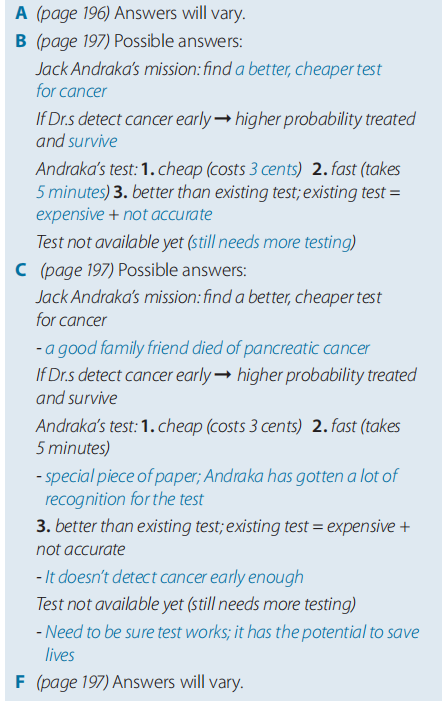
SPEAKING
A (page 198) Possible answers:
1. Howard Schultz chooses to pay employees a little more to make their lives better.
2. Starbucks partners write the customer’s name on the coffee cup to make the customers feel like individuals or friends.
3. Chanda Shroff commissioned 30 saris from Kutch women to sell at an art exhibit.
4. Shroff founded the Shrujan organization to help Kutch women earn an income.
5. Jack Andraka invented a new cancer test to help doctors detect cancer in its early stages.
6. The test uses a special kind of paper to detect cancer.
7. Many people become doctors in order to help people.
8. People go to business school to learn how to manage a business.
9. We are meeting with potential investors in order to develop a relationship with them.
10. The company hired ten new sales people to increase their sales revenue.
B (page 198) Possible answers:
1. People take test preparation courses to (in order to) improve their test scores.
2. People spend time with their friends to (in order to) relax and have fun.
3. Businesses have to advertise to (in order to) sell their products.
4. People drink coffee or tea in the morning to (in order to) feel awake.
5. People go to the library to (in order to) do research.
6. I take notes in class to (in order to) remember important information.
7. I’m learning English to (in order to) get a better job.
8. I use the Internet to (in order to) access information.
9. I use a weather app to (in order to) check the forecast.
10. People visit New York to (in order to) see the Statue of Liberty.
FINAL TASK
A–D (pages 199–200) Answers will vary.