GOOD TIMES,GOOD FEELINGS 2
THINK AND DISCUSS (page 21) Possible answers:
1. They are doing yoga there because there is a lot of space. They probably feel good and relaxed.
2. exercise, listen to music, talk with friends
EXPLORE THE THEME (pages 22–23)
1. HPI is the Happy Planet Index. It is measured by life expectancy, wellbeing, environmental footprint, and inequality.
2. Costa Rica ranks as the happiest country.
3. South America has the most “happy” countries.
4. A low environmental footprint is better. A low percentage of inequality is better.
5. Answers will vary.
Lesson A
VOCABULARY
C (page 24) 1. amusing; 2. comedy; 3. sound;
4. researcher; 5. happiness; 6. led; 7. joke;
8. recorded; 9. laughter; 10. situations
D (page 25) 1. situations; 2. happiness; 3. led;
4. researcher; 5. joke, amusing; 6. laughter, comedy;
7. recorded; 8. sound
E (page 25)
1. researcher; 2. happiness; 3. leaders, followers;
4. laughter, laugh
F (page 25) Answers will vary.
LISTENING
A (page 26) Answers will vary.
B (page 26) 1. b; 2. b
C (page 26) Answers will vary. The following are in
the lecture:
√ facts about laughter
√ research results
D (page 27) 1. c; 2. c
E (page 27) 1. Bowling Green; 2. high; 3. 80; 4. laugh
F (page 27) Answers will vary.
SPEAKING
A (page 28) 1. Are; 2. Do, do (or like); 3. Do, have;
4. Do, take; 5. Do, get; 6. Do, like
B (page 28) Answers will vary.
C (page 29)
1. When do you get up in the morning?
2. What is your favorite food?
3. Who do you send a lot of text messages or emails to?
4. How do you relax on the weekends?
5. Where is the closest park in this city?
6. Why are trees good for the environment?
E (page 29) Answers will vary.
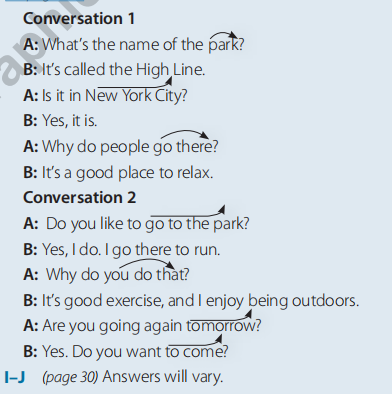
H (page 30)

LESSON TASK
A–C (page 31) Answers will vary.
Video
A (page 32) Answers will vary.
B (page 32) Possible answers:
instinctive = natural
contagious = spreads from person to person
ease = to make something less difficult
behavior = a way of acting
bottom line = the most important point
C (page 33)
1. Other people will start laughing, too.
2. It eases awkward situations, helps certain diseases, and brings people together.
D (page 33) Possible answers:
1. They laugh to improve their health and feel good.
2. It can ease pain and depression and improve heart health.
3. You can burn up to 40 calories.
4. They start laughing at just 3 to 4 months.
5. They use it to communicate with their mothers before they can talk.
E (page 33) 1. F; 2. T; 3. F; 4. T
F (page 33)
1. a. to tell us about the benefits of laughter
2.–5.Answers will vary.
Lesson B
VOCABULARY
B (page 34) 1. d; 2. g; 3. e; 4. b; 5. c; 6. j; 7. i; 8. a; 9. f; 10. h
C (page 35)
1. free time; 2. enjoy; 3. disadvantage; 4. benefits;
5. relax; 6. exercise; 7. outdoors; 8. healthy; 9. Crime; 10. common
D (page 35) Possible answers:
1. It gives them a green space in which to spend their free time. It is a good place to exercise outdoors.
2. Then the money cannot be spent on other things such as education or infrastructure. It takes up space that businesses could use.
LISTENING
A (page 36) Answers will vary.
B (page 36) 1. benefits; 2. health; 3. crime; 4. problems
C (page 37) 1. b; 2. a; 3. b; 4. c
D (page 37) Possible answers:
What are the health benefits of parks?
What are the social benefits of parks?
What are the disadvantages of parks?
E (page 37) Answers will vary.
SPEAKING
A (page 38)
1. Oh, why not?
2. Really? / How funny!
3. Good for you! / Really?
4. How funny! / Really?
5. Oh, that’s too bad. / Really?
B (page 38) Answers will vary.
C (page 39) Answers will vary. Possible answers:
There are a lot of people here today.
It’s a beautiful day to be outdoors.
Do you know if it’s going to last?
It’s great that the kids can play here.
FINAL TASK
A–C (page 40) Answers will vary.