UNIT 2 PROTECTING THE WILD
THINK AND DISCUSS (page 21)
1. Possible answers: These men are in southern Kenya. As
Lion Guardians, they put collars on lions and track the lions’
movements from a distance with radio telemetry and GPS
equipment to prevent lion attacks on livestock and to prevent
herders from killing lions to protect themselves and their
livestock.
2. Possible answer: Animals become extinct for reasons such as
habitat loss and over-hunting.
3. Answers will vary.
EXPLORE THE THEME (pages 22–23)
A
1. Possible answers: They are in the gorilla sanctuary of Virunga
National Park in the Democratic Republic of the Congo. The
man is a warden at a gorilla sanctuary. The responsibilities of
a warden are to protect the gorillas in the park from illegal
hunters and to monitor the condition and numbers of the
gorillas. Wardens may also be involved in giving tours to
visitors and making sure they don’t upset the gorillas.
2. Answers will vary.
B
1. The 11 animals are all endangered or extinct, and their pictures
are all in the Photo Ark.
2. The Photo Ark is a collection of photographs of animals that are
endangered or extinct. Its purpose is to save images of animals
that may disappear and to bring attention to the problem of
endangered species.
LESSON A
Vocabulary
B (page 25)
1. a
2. h
3. d
4. i
5. j
6. b
7. c
8. g
9. e
10. f
C (page 25)
1. backed out
2. signed
3. died out
4. wait it out
5. cross
6. handing out
7. tore them out
8. leave them out
D Critical Thinking: Reflecting (page 25)
1–2. Answers will vary.
3. Possible answer: Some ways that humans modify animal
habitats include deforestation and pollution such as oil spills
and use of pesticides. Humans also kill large numbers of a
species, which can upset the balance of animal/plant food
chains in a habitat.
4. Possible answer: We can use fewer disposable plastic products,
which might end up in the ocean. This could help species
survive because they would be less likely to die from eating
humans’ plastic trash.
A Listening A Q&A Session about
an Extinct Species
Before Listening
A Predicting (page 26)
Possible answers:
1. Marshlands, wetlands, swamps
2. Pollution; modification of their habitat
3. Laws that protect species and their habitats, such as the
Endangered Species Act
4. These laws might cause conflict between landowners and the
government; they are hard to enforce.
C Checking Predictions (page 26)
Answers will vary.
While Listening
D Note Taking (page 27)
Q1: What caused them to go extinct/ What caused extinction?
Q2: Are there any lessons we can take away (to make sure it never
happens again)?
Q3: How can we protect large areas (such as rivers and forests)?
Q4: Is the law working? What’s the status of endangered species in
the United States today?
E Note Taking (page 27)
1. habitat destruction
2. wipe out/wiped out
3. suitable habitat
4. habitat
5. Species Act
6. enforce
7. landowners
8. hunting wolves
9. worse
10. 300
After Listening
F Critical Thinking: Analyzing (page 27)
Possible answers: Humans should care about the extinction of a
species because, if one species dies, there may be environmental
repercussions because all life is interconnected. Ecosystems might
fail. We also rely on a diversity of plants and animals for food and
medicines.
A Speaking
A Brainstorming (page 28)

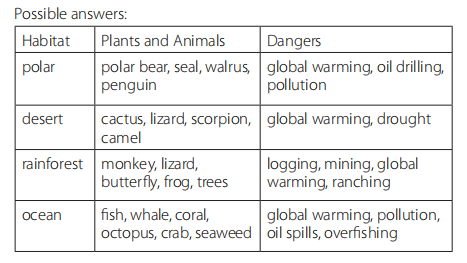
B (page 28)
Answers will vary.
C (page 29)
1. The police initiated an investigation that led to several arrests.
2. The woman who/that is speaking tonight is an advocate for
protecting wildlife.
3. I know a man who/that keeps two tigers as pets.
4. I think it was a black bear that was to blame for all the tree damage.
5. There are many people who/that care about endangered species.
6. The dodo was a flightless bird that was wiped out in the 17th century.
7. People who/that engage in irresponsible actions that harm wildlife should be fined.
8. Greenpeace is an environmental group whose mission is to protect animal habitats.
9. The wolves (that) the government introduced to this area are thriving.
10. The tree (that) the environmentalists saved was over 200 years old.
D Personalizing (page 29)
Possible answers:
1. I’m fascinated by animals that can survive freezing temperatures.
2. I really admire people who fight for wildlife conservation.
3. Let me tell you about the time that I saw a wild mountain lion.
4. I saw a video that showed the dangers of global warming last week.
5. I know someone whose grandfather was an explorer in the Amazon jungle.
6. The teacher who told jokes in class made the students laugh.
E (page 30)
1. /s/
2. /z/
3. /əz/ or /ɪz/
4. /z/
5. /s/
6. /z/
7. /əz/ or /ɪz/
8. /z/
F (page 30)
See answers for exercise E.
G (page 30)
1. tourists in cities
2. animals in movies
3. causes of extinction
4. parks in cities
5. whales and dolphins
6. kids and pets
7. images in ads
8. ponds and lakes
9. habitats in danger
10. species under protection
Statements will vary. Possible answers:
1. Tourists in cities like to go shopping and visit museums.
2. Animals in movies should be treated well during filming.
3. Illegal hunting is one of the causes of extinction.
4. Public parks in cities provide safe spaces for leisure and
entertainment events.
5. Both whales and dolphins are mammals.
6. Young kids and pets are often best friends growing up.
7. Images in ads can influence how people act toward the
environment.
8. The university campus had both ponds and lakes for students
to swim in.
9. Some habitats in danger due to global warming are the north
and south poles.
10. The government should put more species under federal
protection.
LESSON TASK Discussing Environmental
Impact
A–C (page 31)
Answers will vary.
VIDEO Hope for the Mugger Crocodile
BEFORE WIEWING
A Predicting (page 32)
Possible answer: Loss of habitat due to growing or expanding
human populations.
B Meaning from Context (page 32)
1. a
2. c
3. d
4. a
WHILE VIEWING
C Understanding Details (page 33)
1. to blame
2. threaten
3. habitat
4. captive
D Understanding Details (page 33)
1. T
2. F (Because of expanding human populations, there is no room
left for mugger crocodiles.)
3. T
4. T
5. NG
6. F (A healthy young crocodile is a very good sign.)
E Checking Predictions (page 33)
Answers will vary.
F (page 33)
Possible answers:
1. They were experiencing good conditions. There was enough to
eat and drink, and the waters were high.
2. They need to stay alert because they could be attacked
by muggers hidden in the water just beneath the surface.
Muggers can travel at surprisingly fast speeds under water to
attack animals that approach.
3. He observes them at night because the shining of their eyes
makes it easy to see them. He is counting them by shining a
flashlight at them.
4. In mating season, males fight for dominance, territory, and the
right to choose females. They are sometimes killed, but not
usually.
AFTER VIEWING
G Critical Thinking: Evaluating (page 33)
Possible answers:
1. He has a love for the crocodiles and thinks trying to preserve
the species is worth the risk.
2. Similarities: Human behavior is threatening the animals’
habitat. Protective measures are being taken by some humans.
There are conflicts of interest between residents and animals/
conservationists
Differences: the specific reason for threatened habitat (growing
human population versus use of chemicals/modification of
habitat), level of awareness of threat to species, existence of
laws that protect species
3. Muggers may be able to coexist with humans if people are
aware of the need to protect and respect their habitat.
LESSON B
Vocabulary
B (page 35)
1. g
2. j
3. i
4. f
5. e
6. b
7. h
8. d
9. c
10. a
C (page 35)
1. F (The program has just been initiated.)
2. F (It is undeniable that great white sharks do attack humans every year.)
3. T
4. F (Their populations may soon fall below sustainable levels.)
5. T
6. F (The organization never gets involved in controversy.)
7. T
8. T
D Critical Thinking: Reflecting (page 35)
Possible answers:
1. Once a population has become too big, carefully monitored
hunting could be allowed just to control the population, but
until that point, wolves should be protected.
2. No, a farmer doesn’t have the right to kill a predator. The farmer
can use other means to protect his animals such as fences and
shepherds.
3. No, the government shouldn’t pay farmers or ranchers, but it
might help to find other solutions for the farmers and share the
costs of these solutions.
4. By explaining a preference to donate money to help another
animal that is endangered that is more likable and not so
frightening.
B Listen ing A Debate on Legalized Hunting
BEFORE LISTENING
A Prior Knowledge (page 36)
1. Possible answers: People hunt for sport or entertainment,
but some people also hunt for food. People typically hunt
for different types of birds (turkey, quail), deer, moose, wolf,
whale, etc.
2. Answers will vary.
3. Possible answer: They might discuss the ethical issues
surrounding hunting, and whether it’s right or wrong to hunt
animals for different purposes.
WHILE LISTENING
B Previewing (page 36)
1. Yumi
2. Raoul
C Note Taking (page 37)
1. Yumi’s first argument: Hunting helps control the populations of
animals such as deer.
2. Yumi’s second argument: Hunting supports wildlife conservation
through the sale of stamps.
3. Raoul’s first argument: Hunting is cruel.
4. Raoul’s second argument: Some hunters hunt irresponsibly and,
sometimes, illegally.
D Note Taking (page 37)
1. Raoul’s opposing argument: Deer populations become too large
because hunters kill off their natural predators, such as wolves
and mountain lions.
2. Raoul’s opposing argument: Money can also be raised by
having tourists pay to visit and observe animals in their natural
habitats.
3. Yumi’s opposing argument: Cattle also suffer when they’re killed
for their meat, and most hunters try to cause as little suffering
as possible.
4. Yumi’s opposing argument: Those kinds of violations are rare.
Most hunters follow the law and kill only what they plan to eat.
AFTER LISTENING
E (page 37)
Possible Answers:
1. Yumi’s first argument: Hunting can help species like deer
survive by controlling their populations so they don’t grow
too large.
2. Yumi’s second argument: Hunters are required to buy stamps
before they can legally hunt birds, and this money supports
wildlife conservation efforts.
3. Raoul’s first argument: Hunting should be outlawed because
animals suffer unnecessarily.
4. Raoul’s second argument: There are a lot of irresponsible and
illegal hunting practices.
F Critical Thinking: Evaluating (page 37)
Answers will vary.
B SPEAKING
A (page 38)
1. That’s a good argument, but
2. OK, but
3. You’re right that; however
B Responding to an Argument (page 38)
Answers will vary.
C Critical Thinking: Analyzing a Chart (page 39)
1. States bring in $1.836 billion (or 1 billion, 836 million dollars);
the federal government brings in $24 million. Answers to the
last question will vary.
2. $1.22 billion. It is used to help state wildlife agencies acquire,
maintain, and improve fish and wildlife habitats through
the North American Wetlands Conservation Act and other
programs. Answers to the last question will vary.
3. Excise taxes. Some items that would be taxed are fishing poles
and hunting rifles.
4. At age 16 and older. Answers to last question will vary.
5. The chart shows how much money the U.S. government
(federal and state) makes from issuing licenses and taxes that
hunters have to pay. It also shows the specific amounts of
money made from licenses, taxes, and stamps, as well as how
the money generated is spent.
FINAL TASK A Debate on Wild Animals in Zoos
A Critical Thinking: Evaluating (page 40)
1. F
2. F
3. A
4. A
5. F
6. F
7. A
8. A
B–D (page 40)
Answers will vary.