UNIT 6 TRADITION AND PROGRESS
THINK AND DISCUSS (page 101)
1. Possible answer: The photo shows a culture that values horses,
nature, and colorful clothing. Answers to second question will
vary.
2. Answers will vary.
3. Answers will vary.
EXPLORE THE THEME (pages 102–103)
1. Traditional peoples: the Suris, the Amish, and the Kyrgyz. Ways
of life: Wearing costumes for ritual celebrations and oldfashioned clothes, using horses and wagons for transportation,
and herding sheep.
2. Answers will vary.
3. Answers will vary.
LESSON A
Vocabulary
B (page 105)
1. e
2. d
3. g
4. j
5. a
6. c
7. i
8. b
9. f
10. h
C (page 105)
Answers will vary.
D (page 105)
1. about, to
2. to, to, to
3. from
4. from
5. with
A LISTENING A Student Presentation about Bhutan
BEFORE LISTENING
A Previewing (page 106)
Possible answers:
1. Bhutan is in Asia, between China and India. It’s a country with
ancient traditions and great natural beauty.
2. It’s yellow and orange with a dragon holding balls in its claws.
3. Gross National Happiness is a measure of a nation’s happiness.
WHILE LISTENING
B Listening for Main Ideas (page 106)
1. P the circumstances surrounding the decision to open Bhutan
up to the world
3. P a new approach to development devised by the king of
Bhutan
6. P social and cultural changes since the Gross National
Happiness policy was implemented
C Listening for Details (pages 106–107)
1. T
2. NG
3. F
4. T
5. NG
D Note Taking (page 107)
1. Happiness
2. government
3. king
4. belongs
5. sustainable
6. enough
7. competition
8. environmental
9. forests
10. waste
11. preservation
12. unique
13. channels
AFTER LISTENING
E Critical Thinking: Synthesizing (page 107)
Possible answers:
Good government: Implement referenda on important issues;
encourage local participation in decision-making; ensure basic
freedoms
Sustainable development: Make sure all industries agree to abide by
GNH; make sure workers are paid for overtime work; give time off
to both husband and wife when they have a new baby
Environmental protection: Protect endangered species and their
habitats; enforce strict anti-pollution laws; make sure trash
collection occurs frequently
Cultural preservation: Allot government money for the upkeep
of historic sites; support the continued celebration of traditional
festivals and holidays; charge tourists who visit Bhutan and use the
money to support the arts
A SPEAKING
A (page 108)
1. What kinds of images does that bring to mind?
2. And what do I mean by sustainable development?
3. We wouldn’t want to lose all those wonderful things, would we?
B (page 108)
Question 1: Type 1
Question 2: Type 3
Question 3: Type 2
C Using Rhetorical Questions (page 108)
Possible answers:
1. Can you imagine what that must have felt like?
2. That’s really quite a big change, isn’t it?
3. So, what is meant by Gross National Happiness?
D (page 109)
1. a
2. a
3. b
4. a
5. a
6. b
7. b
8. b
E (page 109)
Answers will vary.
F (page 110)
1. Bhutan encourages its citizens to take responsibility for the
environment.
2. The government asks companies to work in a sustainable way.
3. The government has ordered companies not to cut down trees
for export.
4. The king of Bhutan invites other countries to implement GNH
strategies.
5. Bhutan requires all visiting tourists to obtain a tourist visa
G Critical Thinking: Applying (page 110)
Possible answers:
I would advise restaurants to keep their prices reasonable.
I would require the subway to run 24/7.
I wouldn’t force anyone who is sick to work.
I wouldn’t allow people in apartments to have noisy or large pets.
I would encourage all students to learn two foreign languages.
LESSON TASK Conducting an Interview
A–B (page 111)
Answers will vary.
VIDEO Preserving Endangered Languages
BEFORE WIEWING
A Predicting (page 112)
1. Half of the languages in the world may go extinct this century.
2. Languages go extinct mostly because of social pressure and
attitudes that devalue small languages.
B Meaning from Context (page 112)
1. lexicon
2. insight
3. indigenous
4. savvy
5. revitalize
WHILE VIEWING
C Understanding Main Ideas (page 113)
√ The Enduring Voices Project helps preserve languages with
Talking Dictionaries.
D Understanding Details (page 113)
1. half
2. disappear
3. social
4. attitudes
5. presence
6. tool
7. Internet
8. application
9. human
10. extinction
E Checking Predictions (page 113)
Answers will vary.
After Vie win g
F Critical Thinking: Evaluating (page 113)
1. Possible answers: Yes, isolation could benefit languages by
helping them to preserve their ancient forms. No, isolation
doesn’t benefit languages because it restricts their growth.
2. Possible answers: Yes, because the Talking Dictionaries will
raise awareness of these languages, making them harder to
ignore. Also, awareness may prompt the next generation to
pass their language on.
No, because Talking Dictionaries cannot teach people how
to use a language, only what individual words/phrases mean
and how they sound. Without grammar knowledge too, the
language will die out.
3. Possible answers: Beliefs, social structures, traditional rituals,
traditional foods, etc.
4. Answers will vary.
LESSON B
Vocabulary
B (page 114)
1. undertake
2. flourish
3. diversity
4. ultimately
5. replicate
6. livelihood
7. consent
8. hardship
9. merits
10. heritage
C (page 115)

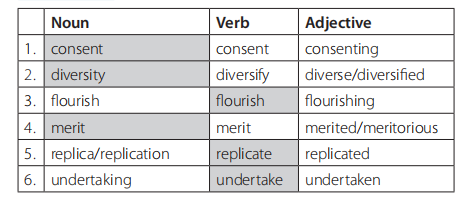
D (page 115)
1. g
2. f
3. a
4. h
5. b
6. i
7. j
8. c
9. e
10. d
E Personalizing (page 115)
Possible answers:
1. People flourish when they work in a field that they really like.
2. The part of my heritage I appreciate most is the tradition of
honesty and open conversation.
3. One benefit of hardship is learning to appreciate the value of
money.
4. A respected livelihood in my country is anything in the medical
profession: doctor, nurse, medical technician, and so on.
5. Diversity is important because the world is full of different
people, and things work best when different people interact.
6. One merit of studying alone is that you won’t get distracted by
conversation.
7. My parents would never give their consent for me to live alone.
8. Ultimately, my goal is to be a good father.
LISTENING: A Discussion about American
Indian Lands
BEFORE LISTENING
A Predicting (page 116)
Answers will vary.
WHILE LISTENING
B Checking Predictions (page 116)
1. b
2. c
3. b
C Listening for Details (page 117)
1. Oh, you mean the one about American Indian tribes?
2. For example, I was surprised to learn that there are over
300 American Indian reservations in the United States.
3. And the land is part of their heritage.
4. The first one was in New Mexico, wasn’t it?
5. I think it was the InterTribal Sinkyone Wilderness area.
D Note Taking (page 117)
1. New
2. exotic
3. native
4. cinema
5. Wilderness
6. 1997
7. wild
8. medicine
9. ceremonies
Big Cypress Swamp
Possible answers: owned by Seminole Tribe that bought Hard Rock
Cafes; most of land dedicated to agriculture, but swamp can’t be
used for that; bringing back original species
AFTER LISTENING
E Critical Thinking: Analyzing (page 117)
1. Answers will vary.
2. Possible answer: They probably moved away from reservations
for more economic and social opportunities.
B SPEAKING
A–D (pages 118–119)
Answers will vary.
FINAL TASK Presenting a Tradition
A–F (pages 119–120)
Answers will vary.