LET'S EAT! 6
THINK AND DISCUSS (page 101)
1. Possible answer: The people in the photo are eating noodles from a huge pot.
2.–3. Answers will vary.
EXPLORE THE THEME (pages 102–103)
1. The foods shown in the photos are fish and bread.
Answers to second question will vary.
2. People get more of their calories from fruits and vegetables than from meat.
3.–4. Answers will vary.
Lesson A
VOCABULARY
B (page 104) 1. guidelines; 2. recommend; 3. Grains;
4. servings; 5. source; 6. regional; 7. varied;
8. protein; 9. specific; 10. modernize
C (page 105) Possible answers:
1. Usually: I eat several kinds of foods every week.
2. Usually: I eat bread with every meal.
3. Sometimes: I try to eat a vegetable at dinner and
a piece of fruit for a snack every day.
4. Sometimes: I try to eat in a healthy way, but sometimes I eat too many sweets.
5. Sometimes: I don’t like to eat a lot of meat, but I eat dairy products and nuts.
6. Usually: I carry a water bottle with me everywhere I go.
7. Sometimes: I love cheese, but I don’t like yogurt.
8. Never: I never check food labels before I buy things at the store.
D (page 105)
1.–2. Answers will vary.
3. Possible answer: The food is less fresh and local, and people eat faster because they are busier.
4. Possible answers: A varied diet is healthier. If you eat just a few kinds of food, you will not get enough nutrients.
5. Possible answers: Because they may not have a lot of choices and because they may not have enough money.
LISTENING
A (page 106) Answers will vary.
B (page 106)
1. They were eating about six servings of rice a day.
Their diet wasn’t varied.
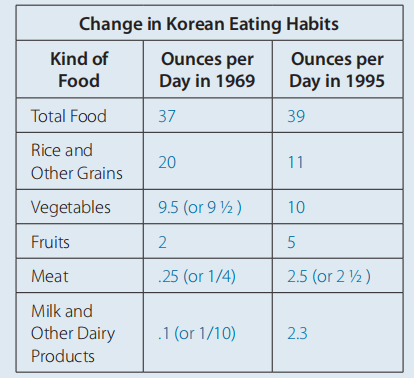
2. By 1995, Koreans were eating more fruit and animal products (meat, milk, and dairy products).
3. They were taller in 1995 than they were in 1969.
4. She thinks the modern way of eating is healthier.
D (page 107)

E (page 107)
1. Answers will vary.
2. The greatest decrease was in rice and other grains. The greatest increase was in meat.
3.–5. Answers will vary.
SPEAKING
A (page 108) Possible answers:
1. If I don’t eat breakfast, I feel very hungry by late morning.
2. If I arrive late to class, I enter the room quietly.
3. If my sister sees fresh oranges, she always wants to buy some.
4. If you don’t like fish, you shouldn’t order that dish.
5. If I feel hungry at night, I sometimes order a pizza.
6. If people don’t like to eat meat, they can become vegetarians.
B (page 108) Possible answers:
1. You won’t have healthy teeth if you eat a lot of sugar.
2. If you drink coffee late at night, you won’t be able to fall asleep.
3. If children eat a lot of fast food, they are going to have too much salt in their diet.
4. If you don’t eat enough fruits and vegetables, you won’t get enough vitamins in your diet.
5. If people learn how to cook, they’ll eat better meals for the rest of their lives.
6. If I eat a very big lunch, I’ll feel sleepy all afternoon.
C (page 109) Answers will vary.
D (page 109)
1. Mi-Ran, may I say something here?
2. Moving on . . . when we compare the kinds of food people ate, we see a significant difference.
3. Could I ask a question, Mi-Ran?
4. To continue—as the country developed, instead of just eating a lot of rice and vegetables, Koreans started including many other kinds of foods in their diets,…
E (page 110) 1. F; 2. U; 3. U; 4. F; 5. U; 6. F
G (page 110) Answers will vary.
LESSON TASK (page 111)
A–D Answers will vary.
Video
A (page 112) Possible answers: tortillas, tacos, enchiladas, fruit drinks, guacamole
B (page 112) Answers will vary.
C Checking Predictions (page 112) Answers will vary. Food words from the video include: spicy, serve, cooking, ingredients, dishes, chicken, meat, eat, smells, sauce
D (page 113) 1. T; 2. F (Oaxaca is one of the poorest states in Mexico.);
3.F (Susana Trilling went to Oaxaca to start her own cooking school.);
4. T; 5. T;
6. F (The Guelagetza is an old dance from Oaxaca.)
E (page 113) 1. colors, smells; 2. famous; 3. loves; 4. learn, dishes;
4. heard, countries; 6. interesting, difficult; 7. large, beautiful;
8. happy, eat
F (page 113) Answers will vary.
G (page 113) 1. d; 2. a; 3. c; 4. b
Lesson B
VOCABULARY
B (page 115)
Verbs: 1. convinced; 2. appeal; 3. stimulates; 4. market; 5. target
Nouns: 6. element; 7. strength; 8. strategy; 9. hunger
Adjective: 10. relevant
C (page 115) Sample answers:
1. The smell of pizza always stimulates my appetite.
It’s my favorite food.
2. Some kinds of foods that don’t appeal to me are shellfish and fish. I don’t like the way they smell.
3. Companies use advertising to convince people to buy things. For example, there are a lot of commercials for breakfast cereals for kids.
4. I think the most important element in good cooking is fresh, natural ingredients.
5. A good kind of food to eat to increase your strength after an illness is meat because it has a lot of protein.
D (page 115) 1. noun; 2. noun; 3. verb; 4. verb;
5. noun; 6. noun; 7. verb; 8. verb
LISTENING
A (page 116) Answers will vary.
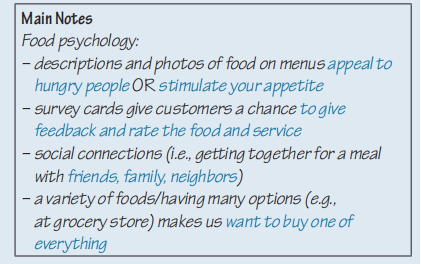
B (page 117) Possible answers:
C (page 117) Answers will vary.
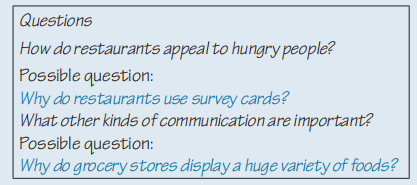
D (page 117) Possible answers:
F (page 117)
1. Answers will vary.
2. Possible answer: Food psychology is used to make certain foods appeal to us. Tropical fruits are colorful and fun. This might appeal to people in North America because they don’t see them regularly, so they are new and interesting.
3. Answers will vary.
SPEAKING
A (page 118)
1. Answers will vary.
2. Possible answer: One advantage of owning a food truck is that you can move it around to where there are the most people at any time.
One disadvantage is it isn’t as large as a traditional restaurant. Also, it doesn’t offer seating.
B–D (pages 118–119) Answers will vary
FINAL TASK
A–E (pages 119–120) Answers will vary.