UNIT 7 Extreme Sports
Match the words from Group A and Group B to make extreme sports.

Leaaon1.Vocabulary
2 Complete the sentences with the bold words from Activity 1.
1. challenging
2. beginner
3. experts
4. experience
5. concentrate
6. accident
7. routes
8. Large
3 Listen to the radio program about rock climbing. Write T (true) or F (false). Correct the false sentences.
1. F
2. T
3. F
4. T
5. F
6. F
Leaaon2. Grammar
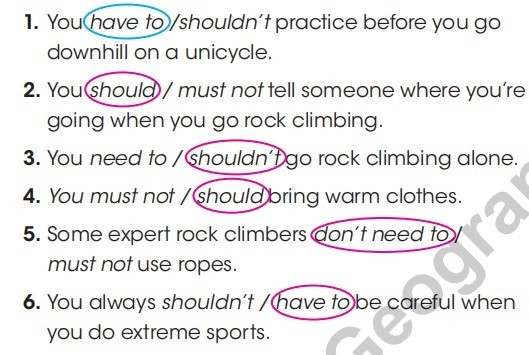
2 Circle the correct answer.
3Complete the sentences. Use the words and phrases from the box.
1. must
2. should
3. don't have to
4. shouldn't
5. must not
Leaaon4.Grammar
2 Match to form correct sentences.
1. C
2. E
3. A
4. B
5. G
6. H
7. F
8. D
3 Complete the sentences with reflexive pronouns.
1. ourselves
2. Herself
3. themselves
4. myself
5. itself
6. yourselves
3 Read again. Write T (true) or F (false). Correct the false sentences.
1. F
2. T
3. F
4. F
5. F
6. T
7. T
Lesson 5 chant
1 Read the chant and say the sport foreach verse. Then listen and chant.
Answers: Verse
1: mountain unicycling; Verse
2: whitewater
kayaking;Verse
3: rock climbing; Verse
4: snowboarding
Lesson 6 writing
1 Read the article. Answer the questions.
1. It's a new extreme sport.
2. You need:a board with a rope attached, a helmet, gloves,goggles, to be brave, a volcano.
2 Read the information in the box. Then look at the article and answer the questions.
1. volcano boarding
2. Volcano Boarding- Who Needs Snow?!
3. Four
4. What do you think? Would you like to try it (volcano boarding)?Do you think you would find it scary or fun and exciting?
Wrifing Skill Organizing your writing.paragraphs
b. Look at the article. Match the paragraph numbers with the information they give.
1.D
2.C
3.A
4.B
Lesson 7 video
3 Watch the video again. Complete the sentences with words from the box.
1. skis
2. helicopter
3. choose
4. exp;ore
5. routes
6. danger
UNIT 8 Tales of Survival
Leaaon1.Vocabulary
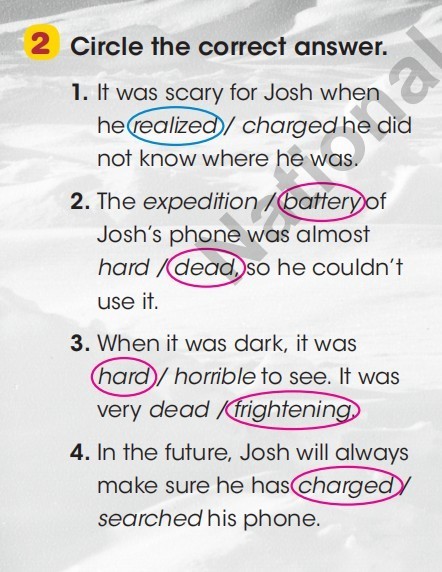
3 Listen to the podcast about Ernest Shackleton's expedition. Number the events in the correct order.
A.7
B.6
C.2
D.1
E.4
F.5
G.3
Leaaon2. Grammar
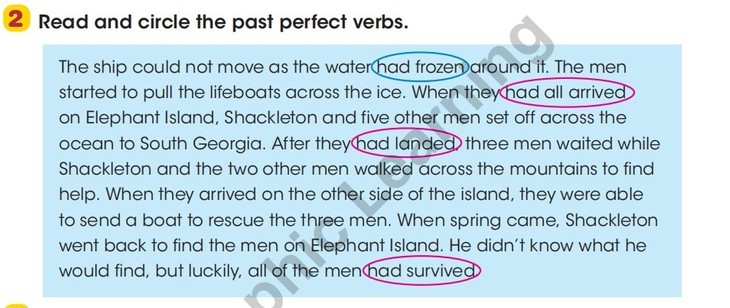
3 Complete the sentences with the verbs in parentheses. Use the past perfect for the actions that happened first. Use the simple past for the actions that happened second.
1. After the men. had pulled (pull) the lifeboats across the ice, they arrived (arrive) at the island.
2. They set off (set off) for home after they'd/had rescued (rescue) everyone.
3. At the beginning of the expedition, the weather had been (be) horrible, but later it improved (improve).
4. After they 'd/had rested (rest) for twenty minutes, they started (start) walking again.
5. They camped (camp) by a river after they'd/had crossed (cross) the desert.
6. After they 'd/had eaten (eat) all their food, they wanted (want) to go home.
Leaaon3.Reading
1 Look at the photo and read the title of the text. Who is the woman in the photo? What do you think the text will be about?
The woman in the photo is Alison Wright. She's a photojournalist with National Geographic Other answers will vary.
3 Read again. Write T (true) or F (false). Correct the false sentences.
1. F
2. T
3. T
4. F
5. F
6. F
7. T
Leaaon4.Grammar
2 Complete the sentences with the verbs in parentheses. Use the past perfect for the actions that happened first. Use the simple past for the actions that happened second.'
1.I hadn't/had not known (not / know) anything about Alison Wright before I read (read) the text.
2.It was (be) dark in the house, because his mom hadn't/had not turned on (not / turn on) the lights.
3. She hadn't/had not been (not / be) to Mexico before she visited (visit) her friend Rosa there last summer.
4.He hadn't/had not charged (not / charge) his phone battery before he set off (set off) on his journey .
5. I didn't/did not do (not / do) well on the test, because I hadn't/had not studied (not / study).
Lesson 6 writing
Read the survival tips. Then do steps 1 and 2.
1. Make a list of the things you need to wear or take with you.
warm clothes, sun block, sunglasses, a hot drink, food, a sleeping bag
2. Think of another tip to add to the list.
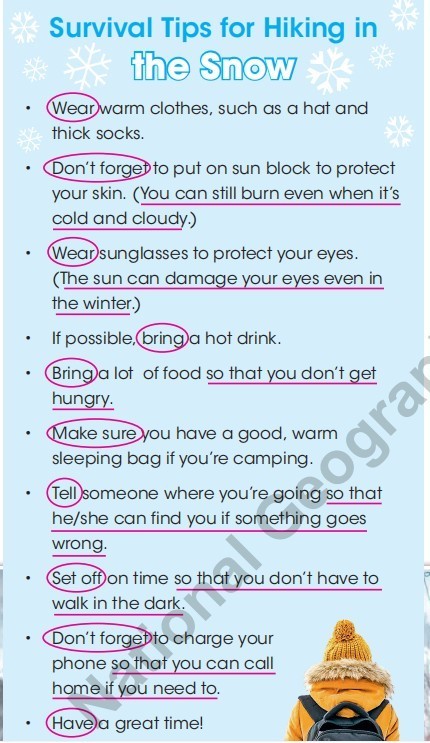
3 Writing Skills Giving reasons
a. Read the information in the box. Then complete the sentences with so that or to.
1.to
2.to
3.so that
Lesson 7 video
1 Watch the video. Match the countries (1-3) with the people.
1. B
2. C
3. A
2 Watch the video again. Write T (true) or F (false). Correct the false sentences.
1. F
2. F
3. T
4. T
5. T
6. F
7. F
GAME 2
Work in groups. Check (V ) the correct answer.
1.250 kilograms
2.Australia
3. one week
4.The Alps
5.chicken and nuts
6.volcano
7.climb a route called La Rambla in Spain
8.four and a half months
9. photojournalist
10.Central Park in New York City, US
Reading Extra 2
3 Complete this summary of the story. You can use1, 2, 3, or 4 words in each blank.
1. Wisdom piece of advice
2.full steal it (the gourd/the wisdom)
3. to hide your back
4. shared with the wind
Review 4: Units 7-8
1Complete the sentences with the words from the box.
1. realized
2. battery dead
3. expedition
4. challenging5. On difficult
5.routes concentrate
2 Read the sentences and follow the instructions. Use phrases of obligation.
1. You should practice in an easy place first./You should learn how to roll over in the kayak. /You should wear a wetsuit/ a helmet.
2. You must/ need to be quiet/stop talking /work harder/ concentrate more.
3. You shouldn't/ should not go alone/ go in bad weather.
4. You should wear goggles, gloves, and a helmet.
5. You don't/do not have to/ need to wear a helmet.
3 Amy is telling her friend Lara about a kitten she found. Lara is asking her questions. What does Lara say? Read the conversation and choose the best question (A-F). You don't need two of the questions.
1. D
2. F
3. B
4. A
UNIT 9 Exploring the World
Leaaon1.Vocabulary
2 Complete the sentences with the words from the box.
1.decide backpack
2.hea
3. bite
4.sting
5. run out have the chance
6. prefer
7. meet
8. brave
3 Listen to the account of Ed Stafford's walk along the Amazon. Then answer the questions. Write Yes or No.
1. N
2. N
3. Y
4. Y
5. N
6. N
Leaaon2. Grammar
2 Match to form correct sentences. Then underline the verb forms.
1. D
2. C
3. F
4. E
5. A
6. B
3 Complete the third conditional sentences with the verbs in parentheses.
1. had brought would have taken
2. had snowed would have gotten
3. hadn't/had not stung wouldn't/would not have had
4.hadn't/had not met wouldn't/would not have walked
5.hadn't/had not caught wouldn't/would not have arrived
6. hadn't/had not touched wouldn't/would not have bitten
Leaaon4.Grammar
2 Complete the third conditional questions with the verbs in parentheses.
1. had found have done
2. 'd/had discovered have called
3.have happened hadn't/had not woken up
4. have done 'd/had stayed
5. hadn't/had not finished have said
3 Read again. Answer the questions.
1. He discovered a mastodon tooth. It was about ten thousand years old.
2. It's a star bigger than the sun, which burns very brightly. She was looking at new and old pictures of stars when she saw one that she hadn't seen before.
3. Because her younger brother discovered one two years later.
4. His grandfather gave it to him.
5. from a ship near the coast of Spain
Lesson 6 writing
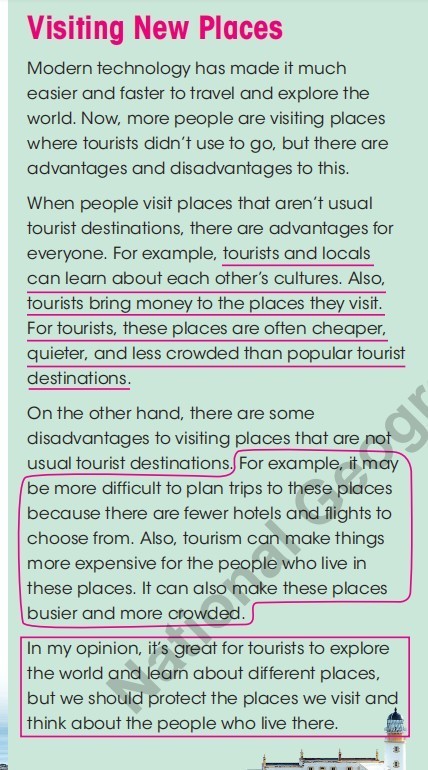
1 Read the for and against essay. Answer the questions.
1. It's made. it easier and faster to travel and explore the world.
2. They're visiting places where tourists didn't use to go.
Lesson 7 video
2Watch the video. Circle the correct answer.

3 Watch the video again. Write T (true) or F (false). Correct the false sentences.
1. T
2. F
3. F
4. T
5. T
6. F