UNIT 8 HEALTH AND TECHNOLOGY
THINK AND DISCUSS (page 141)
Possible answers:
1. Advantages: Robots would not get tired and could perform
long operations; they might be very accurate. Disadvantages:
They do not have empathy or the ability to connect to humans;
they cannot rely on past experiences.
2. Technology is used to diagnose illnesses, monitor patients,
help people track their well-being, organize and keep track of
patients’ health records.
EXPLORE THE THEME (pages 142–143)
1. They are devices that detect the level of pollen in the air and
send that information back to a weather forecasting company
in Japan. They are used to warn people with allergies or
breathing problems to avoid areas with high levels of pollen.
2. Possible answers: These robots could also detect pollution in
the air and warn people when levels are high. They could also
find companies that are polluting too much, so they can be
made to stop.
3. Possible answers: The kinds of information that can be
monitored by technology include levels of air and water
pollution for the environment; heart rate and blood pressure
for health; number of steps taken and calories burned for
fitness.
LESSON A
Vocabulary
B (page 144)
1. g
2. j
3. a
4. h
5. d
6. i
7. e
8. f
9. b
10. c
C (page 144)
Answers will vary.
D (page 145)
1. reluctant
2. confidential
3. by leaps and bounds
4. gadget
5. keep track of
6. comparatively
7. tendency
8. clarify
9. consult
10. diagnosis
E (page 145)
1. at a rapid pace
2. tool
3. keep track of
4. comparatively, relatively
5. reluctant
6. consult
7. private, confidential
8. assessment
9. tendencies
10. clarified
11. private
12. gadgets, devices
A LISTENING A Lecture about Big Data in Health Care
BEFORE LISTENING
A Prior Knowledge (page 146)
1. Possible answers: medical history, blood type, allergies, family
health history
2. Answers will vary.
3. Possible answer: Big data is large sets of data that are analyzed
for specific purposes.
WHILE LISTENING
B (page 146)
Answers will vary.
C Listening for Main Ideas (page 146)
1. No
2. Yes
3. Yes
4. No
5. Yes
D Note Taking (page 147)
1. dishonest
2. confidential
3. can use
4. overwhelming
5. AI programs
6. reluctant
7. monitor patients
8. factual information
9. data security
10. to access
11. analyze
12. by doctors
13. patients are
14. apps
After Listening
E Critical Thinking: Making Inferences (page 147)
Possible answers:
1. The “right people” to receive big data in this context are the
health care professionals who need data about patients to do
their jobs such as doctors, nurses, pharmaceutical companies,
etc.
2. His emphasis on the constant progress being made in big data
analysis implies that someday doctors may be partly replaced
in some areas.
3. He implies that the use of apps will lead to more accurate
information about patients’ well-being once they are out of the
hospital, and that patients will use these apps.
A Speaking
A (page 148)
1. Information the speaker emphasizes: All the medical data in the
world is useless unless doctors receive it in a form they can use,
such as patient profiles or software to help them with decisionmaking. Why it’s important: Having data that can be easily used
is essential.
2. Information the speaker emphasizes: We haven’t yet reached
the point where a computer can replace a doctor. Why it’s
important: Doctors are still needed to diagnose disease.
3. Information the speaker emphasizes: The more data, the better
the results. Why it’s important: Having a lot of data is necessary
for successful data-sharing arrangements.
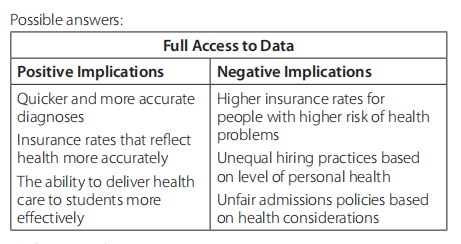
B (page 148)
Possible answers:

C (page 149)
1. c
2. a
3. b
D (page 149)
Possible answers:
I don’t think that health care professionals should trust big data
because much of it is still self-reported.
I agree that AI can be trusted to analyze big data because it
can provide a diagnosis for certain diseases more quickly and
effectively than doctors.
I’m not sure that drug companies should share their data with
each other because that seems like an invasion of privacy for their
clients.
I feel that big data has immense potential to treat and monitor
patients because it keeps track of them without being too
invasive.
E Critical Thinking: Evaluating (page 150)
Possible answers:
Yes, the company’s decision was the right one because the owners
have to think about the long-term sustainability of their company.
No, the company’s decision was not the right one because using
someone’s personal medical information to inform hiring practices
could be considered discrimination.
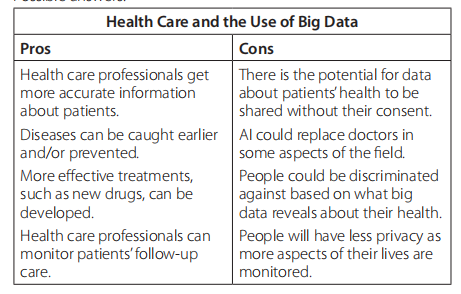
F Critical Thinking: Synthesizing Information
(page 150)
Possible answers:
LESSON TASK Assessing a City’s Health
A–D (page 151)
Answers will vary.
VIDEO Biking in the City
Before Viewing
A Prior Knowledge (page 152)
1. Possible answers: data about calories used, heart rate,
breathing rate, body temperature, air quality, smog
2. Answers will vary.
3. Possible answer: I think it is better for your health because at
least you are getting exercise outdoors.
B (page 152)
1. c
2. a
3. e
4. b
5. d
While Viewing
C Understanding Main Ideas (page 153)
1. T
2. F
3. T
4. NG
5. T
6. F
D Understanding Details (page 153)
1. air pollution
2. every half hour
3. a GPS device
4. two years
5. lungs and bloodstream
6. saving time
After Viewing
E (page 153)
1. Is exercising in close proximity to traffic bad enough for you
that we should completely separate biking lanes?
2. Participants were recruited to ride their bicycles around the city
while wearing devices that allow the scientists to take various
health measurements and monitor their positions via GPS. In
this way, the scientists hoped to determine if cycling in the city
has a negative health impact.
3. They will go on and do the larger health study, and eventually
create an app that lets bicyclists minimize their exposure to
pollution as they ride.
4. Answers will vary.
LESSON B
Vocabulary
B (page 155)
1. posture
2. sedentary
3. notify
4. prone to
5. productivity
6. nutritional
7. track
8. resolve
9. detect
10. repetitive
C Using Collocations (page 155)
1. stress
2. lifestyle
3. value
4. issues
5. of
6. of
7. increased
8. am
9. poor
10. escaped
D Critical Thinking: Ranking (page 155)
Answers will vary.
E Personalizing (page 155)
Possible answers:
You could download an app that lets you scan some food items to
see their nutritional value.
There are websites that track how long you work on the
computer and shut it down after a half hour.
To help you be less sedentary, you should invest in a standing
desk.
If you are prone to anxiety, you should be sure to get at least
8 hours of sleep.
To increase your study-time productivity, you could turn off all
notifications on your cell phone.
B Listening A Podcast about Fitness Gadgets
BEFORE LISTENING
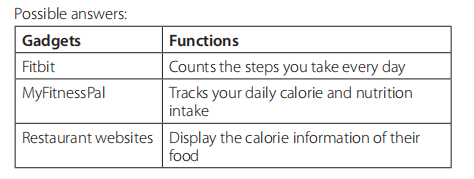
A Prior Knowledge (page 156)
Possible answers:
WHIKLE LISTENING
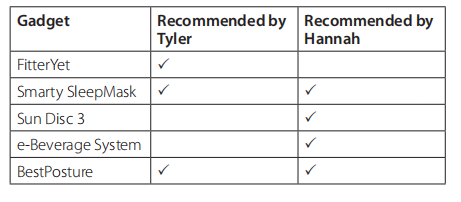
B Listening for Main Ideas (page 156)
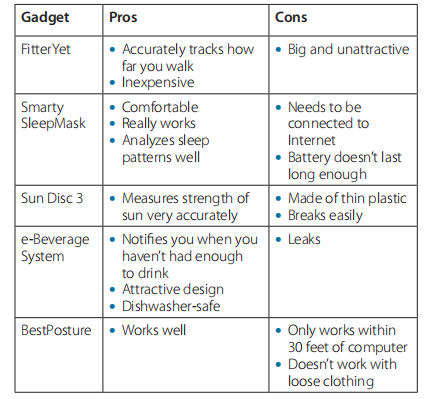
C Listening for Details (page 157)
AFTER LISTENING
D Personalizing (page 157)
Answers will vary.
B SPEAKING
A (page 158)
1. laboratory
2. mathematics
3. corporate
4. broccoli, memory
5. vegetable
6. restaurant
7. several, every
8. actually, chocolate
9. family
10. business, collaborative
B (page 158)
1. average
2. deliberately
3. elementary
4. desperate
5. federal
6. different
7. preference
8. reference
9. temperature
10. traveler
C (page 158)
Answers will vary.
D Critical Thinking: Interpreting Visuals (page 159)
1. Possible answer: People prefer to attach fitness gadgets to their
clothing probably because they have more options for where
to attach the gadgets and because the gadgets may stay in
place better. It also may be more comfortable than having a
gadget touching their skin.
2. Possible answer: It would be small; it wouldn’t fall off of you;
others wouldn’t notice you wearing it; it would be easy to
remember to wear it.
3. Answers will vary.
FINAL TASK Presenting on a Health Tech Product
A–F (pages 159–160)
Answers will vary