P.5 leaaon1 Look and Remember
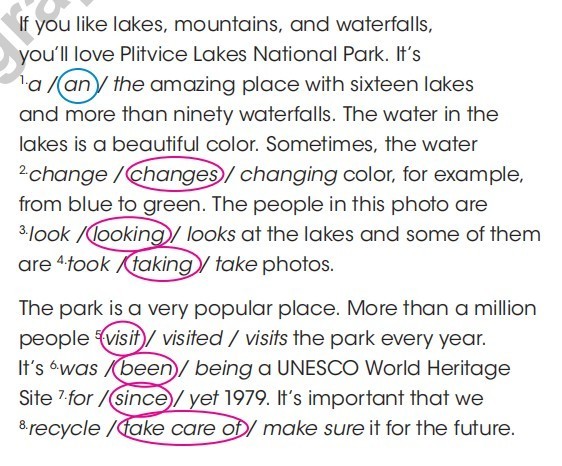
Read the text and circle the correct words.
P.7 lesson2 Look and Remember
2.Listen and write the sentences. Then look at the photo and caption and write T (true) or F (false). Correct the false sentences.
1. Two of the men are wearing striped shirts.T
2.The man in the green shirfis eating a banana.F (The man in the green shirt is buying apples.)
3.A man is selling pineapples. F (A man is selling bananas.)
4. There are a lot of onions.T The carrofs are next to the oranges. F The carrots are next to
5.the potatoes. OR The carrots are next to the bananas.)
6.Two women are buying apples. F (Two men are buying apples.)
Unit1 A GoodStart
Leaaon1.Vocabulary
2.Write answers. Use the words from Activity 1.
How can 1...
1. get stronger? Exercise
2. get better at the piano? Practice music
3. help my teacher? Help clean the classroom
4. make new friends? Be friendlier
5. feel less tired in class? Go to bed early
6. get better grades? Study harder
7. learn a new activity and meet new people? Join a club
8. be on time for my classes? Arrive at school on time
3 Listen to a radio program about Friendship Benches. Write T (true) or F (false). Correct the false sentences.
1. The children wanted their school to be friendlier. T
2. Most of the Friendship Benches are green. F (yellow)
3. Other children might sit with the child on the bench. T
4. Older people don't need Friendship Benches.
F (Older people need Friendship Benches.)
5. The women who listen are called' "aunts.'
F ("grandmothers"
6.There are going to be many more Friendship Benches. T
Leaaon2. Grammar
2.Read the sentences. Write intentions or offers. Use be going to or will.
1. You want to make new friends this school year. What do you say?
I'm going to be friendlier.
2. Your friend stays after class to clean the classroom. You offer to help. What do
you say?
I'll help (you) clean the classroom.
3. You want to get better grades in school this year. What do you say?
I'm going to study harder. (OR I'm going to get better grade
4. There are lots of books on the table. They need to be put on the shelves. What do you say?
I'll put the books on the shelves.
5. The soccer team is meeting this afternoon and they need more players. You decide to join. What do you say?
I'm going to join the soccer team.
6. You have decided to practice your guitar every day. What do you say?
I'm going to practice the guitar every day.
Leaaon3.Reading
3. Read again.Answer the questions
Answers: 1. Because they don't have enough teachers or equipment.;
2. inside the bus;
3. so that teachers can repeat the experiments with the class after the bus leaves;
4. scientists, families, students, teachers, and other people;
5. They collect as many different kinds of plants and animals as possible in a certain place.;
6.It helps us understand our world.
Leaaon4.Grammar
2. Read Tom's blog. Circle the examples of the present progressive for future plans.
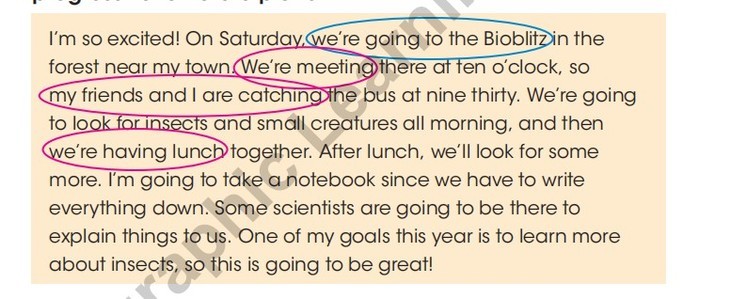
3 Look at Tom's planner. Write sentences about his plans for tomorrow and for Thursday, Friday, and Saturday. Use the present progressive for future.
1. He's studying with Finn after school tomorrow.
2.He's finishing an experimentin science class on Thursday.
3.He's meeting with the Science Club at four o'clock on Friday.
4.He's helping Harry with his homework after dinner on Friday
5.He's catching the bus for the Bioblitz with Ali and Finn at nine thirty on Saturday.
6.He's meeting with the Biobltz group at ten o'clock in the park on Saturday.
Activity 3
1.They don't have enough teachers or materials/equipment.
2. Sometimes they have their classes inside the bus and sometimes they have them in the classroom.
3.The materials should be easy to find so the teachers can repeat the experiments.
4. Scientists, students, teachers, famillies, and other people take part in Bioblitzes.
5.They collect as many kinds of plants and animals as they can in a certain place.
6 It helps us understand our world.
Lesson 5 chant
Extra Support Read the rhyming verses aloud, stopping after each pair to give students time to recognize and write down the perfect and imperfect rhymes.
Answers: Perfect rhymes: goodbye/sky, way/play, song/ along, dream/team. Imperfect rhymes are far/stars, fans/ band, and end/friends.
Lesson 6 Writing
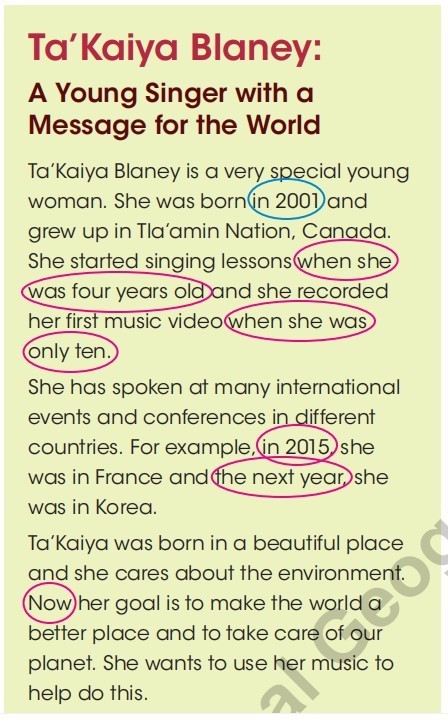
1 Read the biography. Then answer the questions.
Lesson 7 video
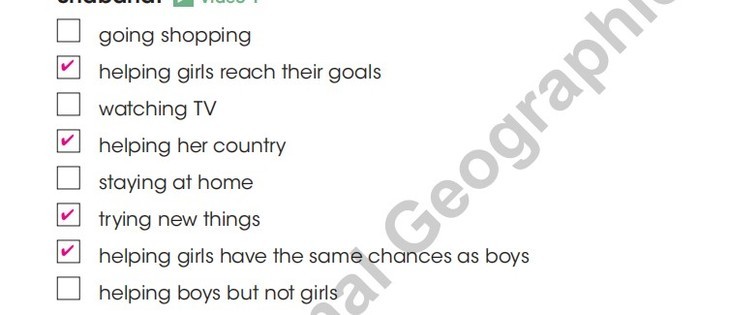
2,Watch the video. Then check (√ ) the things you think are important to Shabana.
3 Watch the video again. Circle the correct answer (A or B).
Answers:1.b 2.b 3.a 4.a
Unit2 Amazing Animals
Leaaon1.Vocabulary
P17 What do you know about tigers? Circle the best answer.
1. orange stripes
2.different
3.cub
4. forest
5. more
2 Complete the sentences with the words from Activity 1.
1. There are different ways to help to protect .the environment
and animals that are in danger of becoming extinct The artist Asher Jay uses her art.
2. There aren't many tigers left in the wild. We need to do something or they will disappear
3. If you throw garbage on the street or in the park, it will damage the environment.
4. The bottles in the photo have pictures of different creatures that live in the ocean. What
marine animals can you see?
3 Listen to an interview with Asher Jay. Write the missing words.
1. Name of artwork:
Message in a Bottle
2. What the artwork shows us: How plastic damages ocean plants and creatures
3. Number of bottles in the artwork:
365
4. People who wrote the messages:
Celebrities, biologists, photographers journalists, students, and teachers
5. What is on the bottles:
Images of marine animals or sea birds
6. What happens if animals eat plastic:
They get sick and often they die
Leaaon2. Grammar
2 Complete the sentences with the verbs in parentheses.
1. Teach yourself: If you learn (learn) more about animals in your area, you
will know(know) which ones are in danger of becoming extinct.
2. Tell your friends: If you tell (tell) others about it,
they. will be able (be able) to help, too.
3. Recycle: If you do not/don't put(not / put) things like plastic bottles in the recycling bin, they will damage (damage) the environment.
4. Shop carefully: You will help (help) animals in
danger, like tigers, if you do not/don't buy (not / buy) things (wood, paper, etc.) that come from where they live.
5. Drive slowly: If you drive (drive) more slowly, you will not/won't hit(not / hit) small animals as they cross the road.
6. Protect animal spaces: Animals will be (be) safer if we protect (protect) the areas where they live- parks, gardens, and other open spaces.
3 Match to form correct sentences.
1.e 2.d 3.f 4.b 5.a 6.c
Leaaon3.Reading
Leaaon4.Grammar
2 Complete the conditional sentences.
1. I don't like animals, so 1 don't have a pet. If i liked animals ,I would have a dog
2.I don't have a dog. so I don't go to the park very often. IfI had a dog,I would go to the park
more often.
3. I live in the city, so I don't see many wild animals. If.I didn't live in the city,i would see many wild animals
4. You feel nervous because you're not an experienced horseback rider. You wouldn't feel ne rvous if you were an experienced horse back rider
5. You don't have a pet snake. If you had a pet snake, what name give it?
6. You won't see a scorpion. If you saw a scorpion, what would you do?
Lesson 6 writing
Lesson 7 video
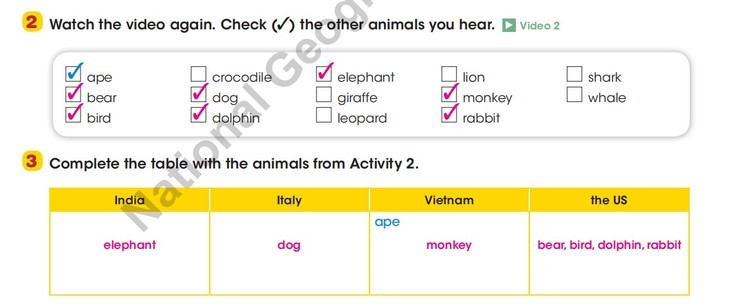
Function 1: Giving advice
1 Listen and complete.
you should a good idea fi were you why don't You might try
School Trip 1
1 Read the text. Discuss the questions.
1. Marine resenves drenature reserves in the ocean. They're important because they:protect the ocean floor and the fish and seasreatures that live there.
2,Answers will vary.
3.Because sometimes fishing boats damage the ocean floor, and when people catch too many fish, it causes problems because there aren't enough fish left.
1 Watch the video. Write T (true) or F (false). Correct the false sentences .
1. T
2. F
3. T
4. T
5. F
6. F
Review 1: Units 1- -2
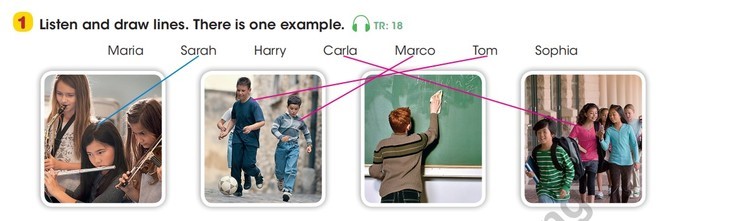
2 Complete the sentences with the words from the box.
1. Cutting down trees can damage the environment.
2. Fish, whales, and dolphins are examples of marine animals.
3. Dinosaurs became extinct a long time ago. There aren't any now.
4. If we don't take care of the planet, many more kinds of animals will disappear
5. Zookeepers take care of many kinds of creatures like elephants, lions, and tigers.
6. My sister likes to paint and draw. She wants to be a(n) artist.
3 Complete the sentences. Use will or be going to. Then write two sentences using the present progressive for the future.
1. This weekend, we are going to visit the lions at the zoo.
2. I'm not sure where I want to go on vacation. I think I will go to Egypt.
3. The teachers are sure their students will remember the information.
4. EIsa found baby turtles on the beach. She is going to take care of them.
5. Do you need help? They will give you advice about the future.
UNIT 3 Working Outdoors
Leaaon1.Vocabulary
2 Complete the sentences with the jobs from the box.There are two jobs you don't need.
1. A painter paints walls, bridges, and buildings.
2.A gardener takes care of plants and flowers.
3. A photojournalist takes photos for news stories.
4.A mechanic fixes cars and electrical equipment.
5.A lifeguard checks that people on the beach are safe.
6. A mountain guide leads groups of walkers and climbers.
3 Listen to an interview with J6nina Herdis Olafsdottir. Circle the correct answer (A-C).
1. c 2.b 3.a 4.a
Leaaon2. Grammar
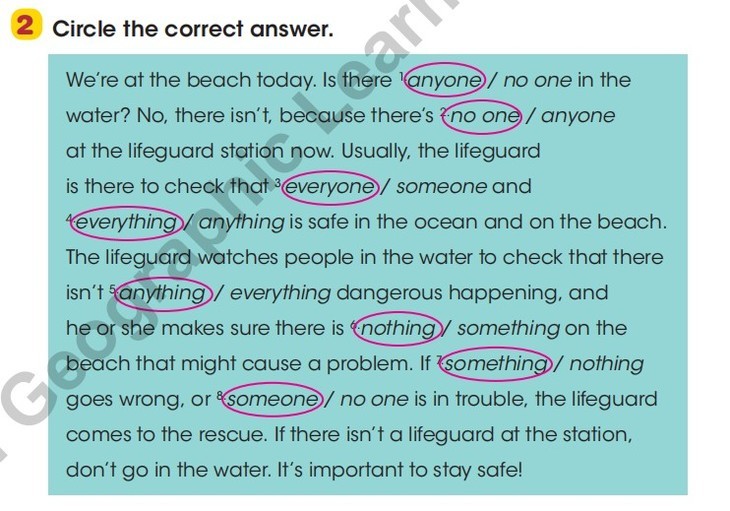
Leaaon3.Reading
3 Read again. Answer the questions.
1. 无
2. They paint places Tike walls.
3. They help make cities and towns more beautiful.
4. 无
5. It's hard to stop working.
Leaaon4.Grammar
2 Match the sentences (1-10) with the question tags (A-J).
1. H
2. E
3. D
4. F
5. G
6. C
7. B
8. A,I
9. J
10. I,A
3 Add question tags to the sentences. Then write three of your own ideas.
1. It's a nice day, isn't it ?
2. We have next, don't we?
3. You're playing tennis this weekend, aren't you ?
4. That's a new bag, isn't it ?
5. Our teacher's nice, isn't he/she ?
Lesson 5 chant
2 Work in two groups. Group A chants the statements, Group B chants the question tags.
He's a gardener.
She's a mechanic.
He's a lifeguard.
She's a marine biologist.
Lesson 6 writing
1 Read the description of a mechanic's job. Answer the questions.
Answers:
1. They study how things work.
2. They do something different every day.
3. Yes.
2 Read the information in the box. Then look at the description of a mechanic's job and answer questions 1-4.
Answers: 1. in garages, on roads, and in big or small buildings;
2. They fix things;
3. safety glasses;
4. You have to work hard at school, especially in math and science.
Lesson 7 video
1 Work in pairs. Look at the photo. Talk about penguins. What do you know about them? Where do they live? What do they eat? What can they do? What can't they do?
Sample Answers: Most penguins live in cold places/in the Antarctic. Some penguins live in temperate locations (South America, Australia, Africa). They leat fish. They can swim, but they can't fly.
2 Watch the video. Circle the correct answer (A or B).
1. A
2. A
3. B
3 Watch the video again. Write T (true) or F (false). Correct the false sentences.
1. Chinstrap penguins live in the Arctic. F (in Antarctica)
2. Douglas is a photographer. F (a National Geographic Explorer and a wildlife biologist)
3. Douglas and his team attach the tags to the penguins' feathers. T
4. The tags tell Douglas what the penguins eat. F (when they go out to find food and when they come back)
5. The tags stay on the penguins for three days. F (three weeks)
6. When the penguins are wearing the tags, they can do their usual activities. T