HOUSING FORTHE FUTURE 6
THINK AND DISCUSS (page 101)
1. Possible answers: A very modern looking house with solar panels and a wind-powered energy source. The reason for the design is probably to be environmentally friendly.
2. Answers will vary.
3. Possible answers: Houses were traditionally made from stone or wood—generally from materials found in the area. In the future, they are likely to be more energy efficient and hi-tech.
EXPLORE THE THEME (pages 102–103)
1. The measures of sustainability are People, Planet, and Economy. “People” measures quality of life factors; “Planet” measures green factors; “Economy” measures the business environment. Answers to the second question will vary.
2. New York ranks 26th overall. It ranks 77th for people, 33rd for planet, and 8th for economy. Answers will vary as to why. Possible reasons for low people
ranking: there are a lot of people/it’s crowded; not everyone can afford the high costs.
3. Possible answer: Planning sustainable cities is important because the population is increasing and resources are decreasing.
Lesson A
VOCABULARY
A (page 104) 1. comfortable; 2. residents; 3. mainly;
4. obvious; 5. impact; 6. deal with; 7. remove;
8. architect; 9. technology; 10. zone
B (page 104) 1. residents; 2. architect; 3. obvious;
4. comfortable; 5. mainly; 6. Zone
C (page 105) Answers will vary.
D (page 105)

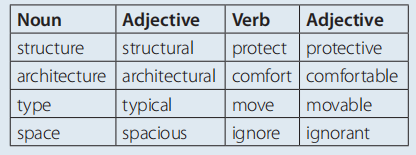
E (page 105) 1. architecture; 2. impactful; 3. comfortable;
4. obvious; 5. residential; 6. negative; 7. attractive
LISTENING
A (page 106)
Context clues for congestion: everyone is looking for a place to park; it’s hard to cross the street
Context clues for demographics: young families with good jobs
Context clues for geriatric: we’re still young enough
Context clues for real estate agent: ask to show us apartments
B (page 106) b. Architects are designing new solutions to deal with rising sea levels.
C (page 107)
1. 90
2. 3
3. 16 mil. (16 M)
4. >60%, 1/3
5. 48, 30-60 cm
6. 60,000 (60k), 5m x 20m
7. >200
D (page 107) Possible answers:
1. These are all basically walls or embankments to prevent flooding.
2. take them apart and put them together in places that need them
E (page 107) Possible answers:
1. Designing buildings to have parking garages on the lowest floors and living in houseboats.
2. The cars in parking garages might get flooded, and traditional houseboats are very small.
3. Coastal cities like San Francisco, U.S.A. or Rio de Janeiro in Brazil. They can start investing in creative solutions for different kinds of housing.
SPEAKING
A (page 108)
1. so, a result
2. but, a contrast
3. or, a choice
4. but, a contrast
5. and, an addition/two good things
6. so, a result
B (page 108) Possible answers:
1. Our apartment is large, so we have a lot of parties there.
2. I like my neighborhood, but sometimes it is noisy at night.
3. The building has friendly residents, and it allows pets.
4. I can eat dinner at home, or I can go out to eat.
5. I love big cities, so I want to live in Hong Kong.
6. Apartments downtown are expensive, so I’ll look for an apartment a little farther away.
E (page 109)
B: Being close to the bus line is good, but the east side is dangerous.
A: That’s a good point, but I think the neighborhood is improving.
B: That’s good.
A: I agree.
F (page 110) Possible answers:
Option 1: Benefits: close to university = don’t need car, res mangr takes care probs; Drawback:
downtown = noisy
Option 2: Benefits: house = more space, near park for jogging, bike riding; Drawback: quiet area may be boring
Option 3: Benefits: very large, near beach; Drawback: prob expnsve
G (page 110) Answers will vary.
LESSON TASK
A (page 110) Possible answers:
He loves music, so he goes to concerts in the city.
He works downtown, but he lives in the country.
He is an excellent cook, and he gardens on Saturday mornings.
He often hikes, or he goes out with friends.
B (page 111) Underlined expressions show disagreement; words in bold are coordinating conjunctions.
A: The climate here is too cold, so I want to move.
B: Where do you want to go?
A: San Francisco, California.
B: Are you sure about that?
A: I think so. California is really warm, right?
B: The southern part of California is warm, but the northern part is cooler.
A: That’s a good point. I’ll move to Los Angeles then.
B: Hmm, I don’t know . . . That may not be the best place for you.
A: Why not? You said it’s warm in southern California.
B: It is warm, but you don’t like big cities, and Los Angeles is very big.
A: You’re right. I probably need to think about this a little more.
C (page 111) Answers will vary.
Video
A (page 112) Answers will vary.
B (page 112)
versatile: can be made into everything from knives
and forks to toaster ovens and bridges standardized:
so now they are all the same transport: on roads, railroad, and on the sea sound: steel is so strong beat up: old
C (page 113) Answers will vary.
D (page 113)
√ why recycling containers is a good idea
√ a way to use containers as housing
E (page 113)
1 ½ tons iron ore
½ ton coal
75% energy
40% water
86% air pollution
76% water pollution
1 ¼ tons solid waste
% goods transported in steel containers: 90%
# containers worldwide: 200 million
F (page 113)
1. Possible answer: The amount of space might be surprising, as well as how warm and comfortable they are.
2. Answers will vary.
3. Possible answer: They could be used as portable shops. That way, if the owner wants to move the shop to a new location, they can.
G (page 113) Possible answer:
There are many similarities. Both design ideas use traditional materials—steel, concrete, and foam—in creative ways to solve housing problems. Also, they both make the living structures flexible and easy to move around and repurpose. Finally, the designs help reduce environmental problems, like pollution and waste.
Lesson B
VOCABULARY
A (page 114) 1. build; 2. especially; 3. tourists; 4. desert;
5. property; 6. location; 7. population; 8. damage;
9. rapid; 10. belong to
B (page 114) Answers will vary.
C (page 115) 1. location; 2. tourists; 3. desert; 4. property;
5. belong to; 6. especially; 7. population; 8. rapid;
9. build; 10. damage
LISTENING
A (page 116) 1. F; 2. T; 3. T; 4. F
B (page 116)
1. b. an article
2. c. places for people to live
3. a. they’re not sure who the Nile River water belongs to
C (page 117) 1. Egypt; 2. growing; 3. Nile River; 4. great,
green; 5. damage, environment
D (page 117) Possible answer:
The Egyptian government has a plan to “green” the desert by moving water from the Nile River to new land so people can grow food. The government is encouraging people to move there by building new
roads and offering land at low prices. This may be a good plan to provide more room for people to live in Egypt, but it may not be good for the river.
SPEAKING
A–B (page 118)
What is your house made of? Building a house from concrete (a mixture of sand, water, and cement) or metal requires large amounts of energy, and (an addition) it pollutes the air. Building a house from
wood means cutting down trees and damaging the environment.
Builder Michael Furbish has another idea: Use straw to make buildings. “Most other building materials require a lot of energy use in production and manufacturing at a factory,” explains Furbish. Straw is a kind of grass, and (two good things) it takes little energy to grow. It’s not very nutritious for animals, however, so (a result) farmers normally dry
it and use it for animals to sleep on. After the straw is dry, farmers use a machine to make bales—large rectangular bricks of straw. Builders
such as Furbish use the bales to build walls. They cover the walls with plaster inside and outside. The plaster becomes hard when it’s dry, so (a result) it keeps out water as well as insects and small animals.Furbish used about 900 straw bales for his family’s two-story, three-bedroom house. His company used about 4000 bales to build an elementary school in Maryland, U.S.A.
Do you think a straw-bale house is for you? You won’t know until you try living in one, but (a contrast) for Furbish, it’s a greener way to build.
C (page 118)
1. Possible answer: You dry the straw and use a machine to make it into bales. You use the bales to build the walls and cover them with plaster
inside and out. When the plaster dries, your house is ready.
2. Answers will vary.
3. Possible answer: Ways of going green include recycling, growing your own food, and riding a bike or taking public transportation instead of
driving a car.
D (page 119) 1. or; 2. but; 3. so; 4. and; 5. but
F (page 119) Answers will vary.
FINAL TASK
A–D (pages 119–120) Answers will vary.