UNIT 9 THE MYSTERIOUS MIND
THINK AND DISCUSS (page 161)
1. Possible answer: Humans show intelligence when they solve
problems, when they debate and discuss new ideas, and when
they learn new skills.
2. Answers will vary.
3. Answers will vary.
EXPLORE THE THEME (pages 162–163)
1. Possible answer: You would be a good communicator and
could look at problems from different angles to arrive at the
best solution.
2. Possible answers: Professional athletes probably have very
well-developed cerebellums and brain stems to better control
things such as their heartbeat and balance. Some athletes
probably also have very developed occipital lobes if they play
sports that require good vision.
3. Answers will vary.
LESSON A
Vocabulary
B (page 165)
1. Objective
2. Vice versa
3. Spatial
4. analytical
5. Namely
6. visualize
7. subjective
8. verbal
9. intuition
10. Logic
C (page 165)
1. educational
2. mathematical
3. influential
4. historical; biographical
5. practical
D Personalizing (page 165)
Answers will vary.
A LISTENING A Podcast on the Brain and Intelligence
BEFORE LISTENING
A Prior Knowledge (page 166)
Possible answers: The right brain controls the left side of the body,
and the left side controls the right side of the body. It is thought
that the left brain is responsible for rational thought, analytical
skills, and logical reasoning. It is thought that the right brain
influences creative and artistic ability, visualization, and intuition.
WHILE LISTENING
B Listening for Main Ideas (page 166)
1. Yes
2. No
3. Yes
4. No
5. Yes
C Note Taking (page 167)
1. verbal ability
2. speech
conclusion: speech problms = result of L-brain damage
3. separated
4. verbal processing
conclusion: L-brain is dominant in verbal processing
5. left
6. right
7. right brain
conclusion: spatial abilities are in the right brain
8. dominant half
conclusion: L-brain is the dominant half
9. math
10. diagrams
11. both
12. two halves
conclusion: the two halves of brain always work together
AFTER LISTENING
D Critical Thinking: Evaluating Conclusions (page 167)
Possible answers:
The conclusion that speech problems are the result of L-brain
damage is reasonable because it’s a logical conclusion based
on the available facts in Broca’s examinations. The conclusions
that the L-brain is dominant in verbal processing and that spatial
abilities are in the right brain are reasonable because they’re
based on data obtained from Sperry’s objective experiments. The
conclusion that the L-brain is the dominant half is not reasonable
because it’s fitting the information from Broca and Sperry’s
research to expectations about the most important capabilities in
the brain. The conclusion that the two halves of the brain always
work together is reasonable because it’s based on the available
facts from modern brain-mapping technologies.
A SPEAKING
A (page 168)
1. c
2. a
3. b
1. It seemed obvious that the speech problems were a direct
result of the damage.
2. Unfortunately, the fascinating scientific discoveries of Broca,
Sperry, and others led to some less-than-scientific conclusions
about the brain in the fields of psychology and education.
3. The influence of the right-brain/left-brain model on those in the
education field was responsible for the idea that “brain-balancing”
activities could strengthen the less dominant side of the brain.
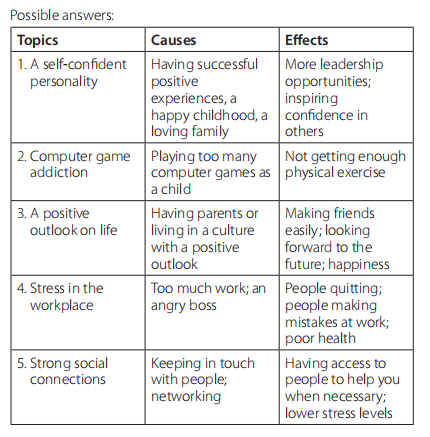
B Expressing Causal Relationships (page 168)

C Critical Thinking: Evaluating (page 169)
Answers will vary.
D (page 169)
Answers will vary.
E (page 169)
Answers will vary.
F Critical Thinking: Analyzing (page 170)
Answers will vary.
G Critical Thinking: Concluding (page 170)
Possible answers:
1. This experiment shows that humans are only capable of paying
attention to a certain number of things at one time.
2. This experiment shows that people assume that something
given away for free isn’t worth very much.
3. This experiment shows that most people tend to judge other
people by the way they look.
4. This experiment shows that our emotions can be affected by
words we read.
LESSON TASK Discussing Learning Styles
A–C (pages 170–171)
Answers will vary.
VIDEO Memory Man
BEFORE WIEWING
A (page 172)
Answers will vary.
WHILE WEIWING
B Understanding Main Ideas (page 172)
1. Yes
2. No
3. Yes
4. Yes
5. No
C Understanding Details (page 173)
1. 60
2. books
3. detail
4. genes
5. change
6. exercise
7. 11
8. historical
9. full-time
10. normal
AFTER WIEWING
D Critical Thinking: Ranking (page 173)
Answers will vary.
E Personalizing (page 173)
Answers will vary.
LESSON B
Vocabulary
B Meaning from Context (page 174)
1. stemmed from
2. norm
3. inferior
4. radical
5. obsolete
6. innate
7. unprecedented
8. superior
9. deepen
10. ethical
C (page 175)
1. c
2. b
3. a
4. j
5. i
6. d
7. f
8. g
9. e
10. h
D Critical Thinking: Analyzing (page 175)
1. Possible answers: For birds, the ability to fly is innate. For
humans, the ability to learn is innate. For spiders, the ability to
make a web is innate.
2. Possible answers: Animals have very high bodily/kinesthetic
intelligence. Animals understand each other very well, so they
may have high social intelligence.
3. Possible answers: Owning pets makes a home a warmer
place, keeps people close to nature, and helps teach children
responsibility.
4. Answers will vary.
B Listening A Conversation about Memory
BEFORE LISTENING
A Predicting (page 176)
Possible answers:
1. Superior autobiographical memory is the ability to remember
every detail of your life.
2. The method of loci is used for remembering lists of items.
WHILE LISTENING
B Checking Predictions (page 176)
Answers will vary.
C (page 176)
1. appositive: Amazing Science; identifies: a TV show
2. appositive: hippo meaning “horse” and campus meaning “sea
monster”; identifies: two ancient Greek words
3. appositive: the method of loci; identifies: this approach to
remembering things that began in ancient Greece
D Listening for Details (page 177)
1. University of California
2. 8/eight
3. TV star
4. bigger than norm(al)/they were bigger
5. 1953
6. loss of memory/memory loss/lost his memory
E Note Taking (page 177)
1. lists of words
2. you know well
3. create an image
4. images
5. visualize
6. remind you of
AFTER LISTENING
F (page 177)
Answers will vary.
B SPEAKING
A (page 178)
1. People with superior autobiographical memory can remember
virtually everything that’s ever happened to them.
2. It’s a part of the brain that’s really important for memory
function.
3. I have a huge history exam next week, and I have to memorize
a ton of information.
4. Having a good memory isn’t an innate skill, you know.
5. In your mind, you need to visualize a path that you know well,
like the way to school.
B (page 178)
The reduced function words are underlined:
A: Hey, how have you been?
B: Um, I’ve been a little depressed. Can you tell?
A: Yeah, I knew something or other was wrong. You know, I know
a great doctor. Do you want his number? I highly recommend
him!
B: No, it’s something that will pass. It always happens in January
and February.
A: Oh, the winter blues! That’s what my mom calls them, anyway.
She sits under a special lamp for half an hour a day and says it’s
better than medicine.
B: Really? Can I have her email? I want to ask her about her lamp so
I can get one, too.
C (page 179)
Answers will vary.
FINAL TASK Speaking about a “Life Hack”
A–E (pages 179–180)
Answers will vary.