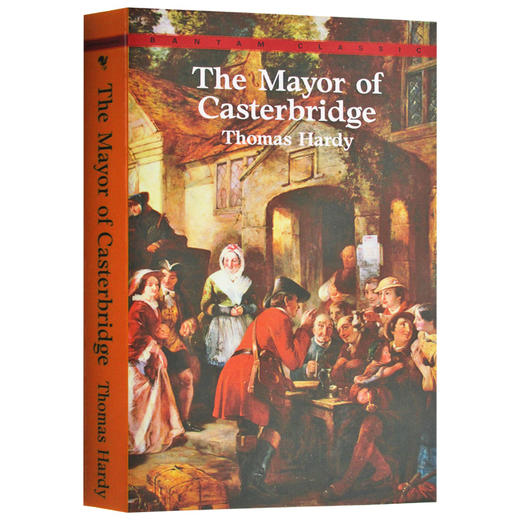
卡斯特桥市长 进口英文原版小说 The Mayor of Casterbridge 英文版书
| 运费: | ¥ 0.00-999.00 |
| 库存: | 46 件 |
商品详情

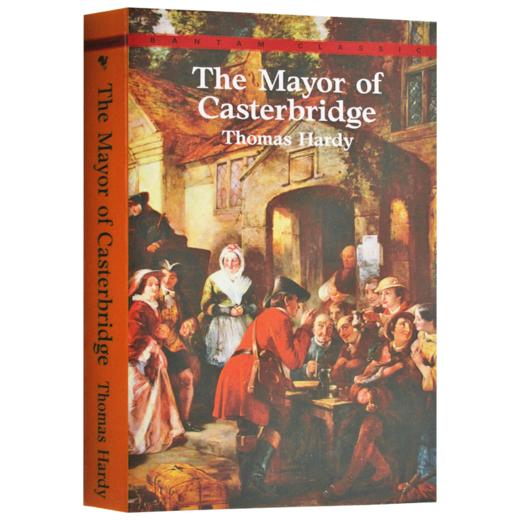
书名:The Mayor of Casterbridge卡斯特桥市长
难度:Lexile蓝思阅读指数1090
作者:Thomas Hardy托马斯•哈代
出版社名称:Bantam Classics
出版时间:1981
语种:英文
ISBN:9780553210248
商品尺寸:10.7 x 1.8 x 17.5 cm
包装:简装
页数:340 (以实物为准)

The Mayor of Casterbridge《卡斯特桥市长》是英国著名小说家、诗人哈代的威塞克斯小说体系中的一部重要之作。作品中融入了希腊酒神原型,以及俄狄浦斯王悲剧模式。与维多利亚时期同类作品相比,《卡斯特桥市长》不再拘于传统小说的善与恶的主题,而是努力探索人物形象、人格的双重性与复杂性。在哈代的十四部长篇小说中,《卡斯特桥市长》既体现了哈代创作一贯的风格,又独创了别具一格的艺术特色,由此也显现了一位大艺术家与平庸的多产作家本质的不同。至于这部小说的内容,不论是在历史的和现实的社会认知方面,它至今都有鲜活的意义。
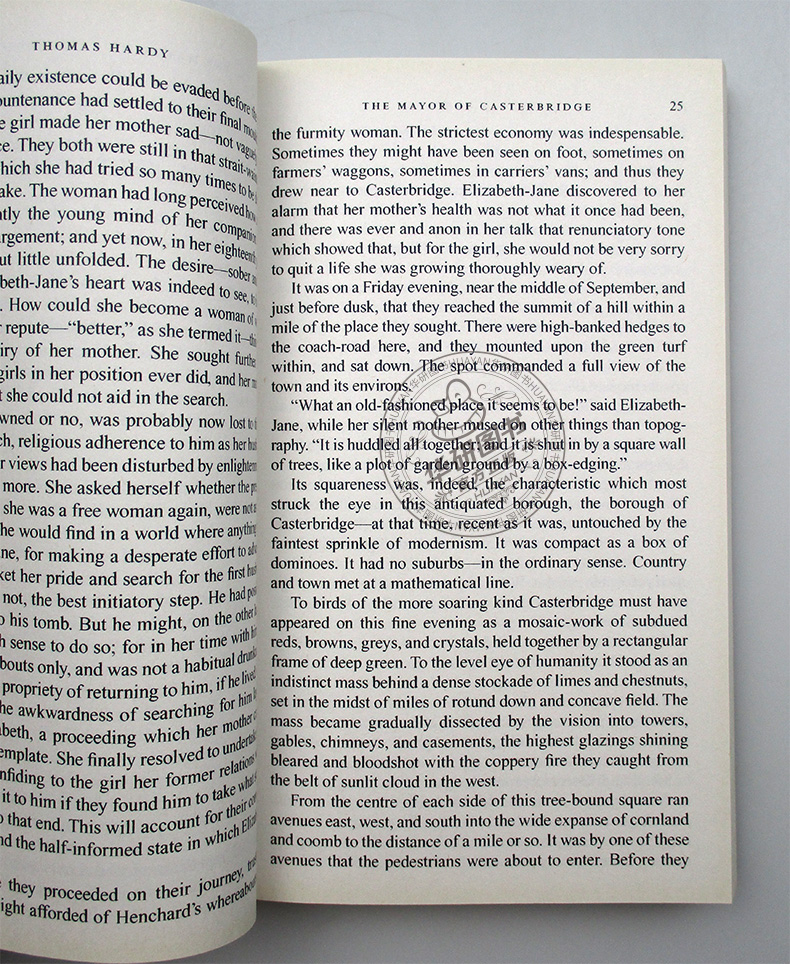
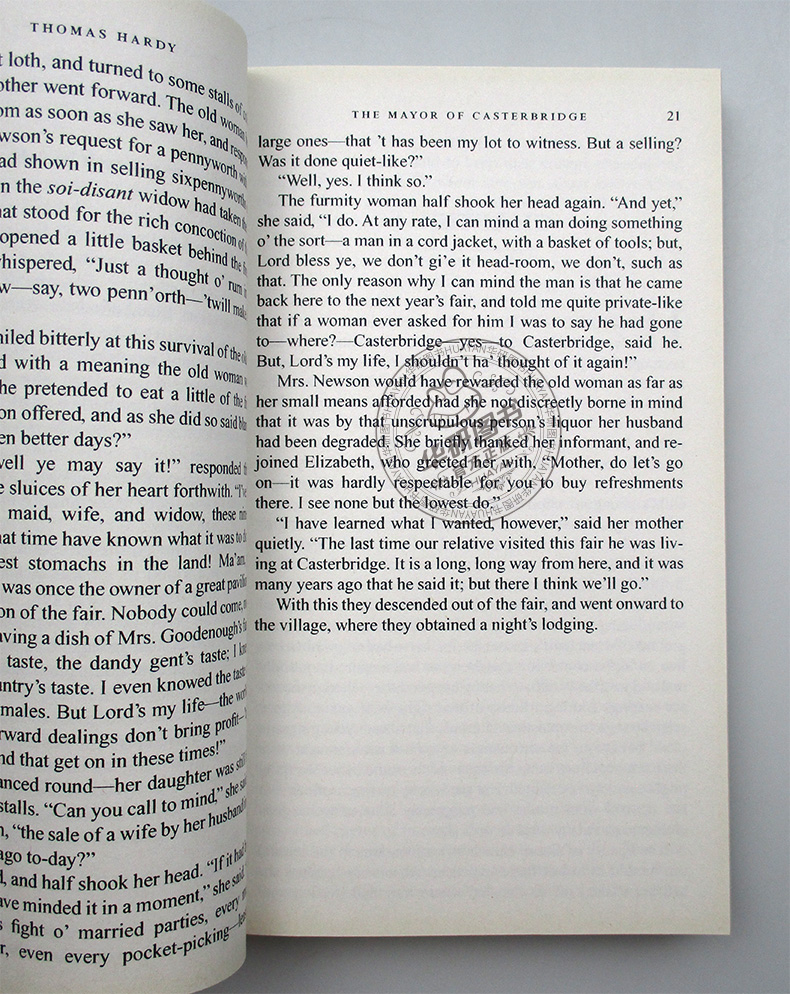
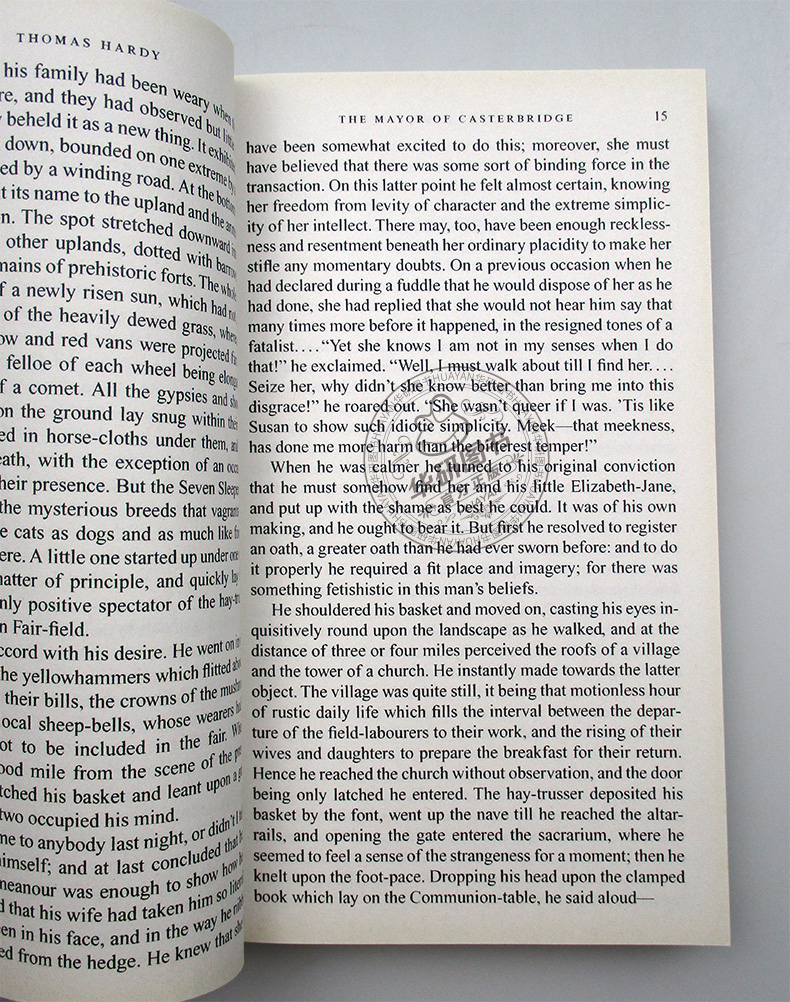
本书为Bantam Classics推出的英文版,内容完整无删节,体积小巧,方便随身携带。
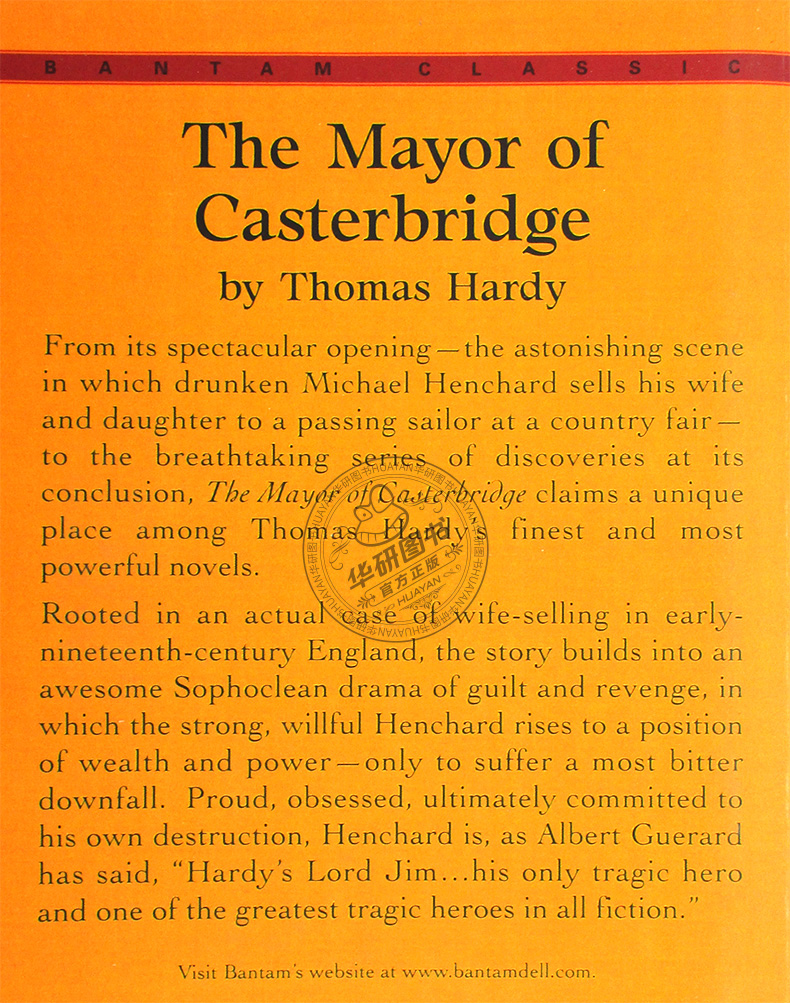
From its spectacular opening —the astonishing scene in which drunken Michael Henchard sells his wife and daughter to a passing sailor at a county fair —to the breathtaking series of discoveries at its conclusion, The Mayor of Casterbridge claims a unique place among Thomas Hardy’s finest and most powerful novels.
Rooted in an actual case of wife-selling in early nineteenth-century England, the story build into an awesome Sophoclean drama of guilt and revenge, in which the strong, willful Henchard rises to a position of wealth and power —only to suffer a most bitter downfall. Proud, obsessed, ultimately committed to his own destruction, Henchard is, as Albert Guerard has said, “Hardy’s Lord Jim… his only tragic hero and one of the greatest tragic heroes in all fiction.”

The Mayor of Casterbridge《卡斯特桥市长》讲述了主人公亨察尔原是个打草工,因醉酒将妻女出卖。事后追悔莫及,从此滴酒不沾,发奋致富,二十年后当上了卡斯特桥市长,后来妻女回到了他的身边,但灾难也接踵而至。由于他的刚愎、偏执,与原来的合伙人闹翻,并在竞争中陷于破产,当年出卖妻女的丑闻也张扬出去以至身败名裂,众叛亲离,在一所小屋里凄惨地死去。作者通过这一悲剧性的描写,揭示了资本主义发展给劳动人民带来的灾难,谴责资本主义制度的不合理性。
One of Hardy’s most powerful novels,The Mayor of Casterbridge opens with a shocking and haunting scene: In a drunken rage, Michael Henchard sells his wife and daughter to a visiting sailor at a local fair. When they return to Casterbridge some nineteen years later, Henchard —having gained power and success as the mayor —finds he cannot erase the past or the guilt that consumes him. The Mayor of Casterbridgeis a rich, psychological novel about a man whose own flaws combine with fate to cause his ruin.

托马斯•哈代(Thomas Hardy,1840-1928),英国作家。做过建筑师助手,19世纪60年代转向文学活动。一生写有许多作品,前期作品长篇小说《绿荫下》《远离尘嚣》,将宗法制农村生活理想化,反对资本主义的城市文明。长篇小说《还乡》《卡斯特桥市长》《林中居民》《德伯家的苔丝》和《无名的裘德》。
Thomas Hardy, whose writings immortalized the Wessex country side and dramatized his sense of the inevitable tragedy of life, was born near Egdon Heath Dorset in 1840, the eldest child of a prosperous stonesmason. As a youth he trained as an architect in 1862 obtained a post in London. During this time he began seriously to write poetry, which remained his first literary love and his last. In 1867-68, his fist novel was refused publication, butUnder the Greenwood Tree (1872), his first Essex novel, did well enough for him to continue writing. In 1874, Far from the Madding Crowd, published serially and anonymously in the Cornhill Magazine, became a great success. Hardy married Emma Gifford in1874, and in 1855, they settled at Max Gate in Dorchester, where he lived the rest of his life. There he wroteThe Return of the Native (1878), The Mayor of Casterbridge (1886),Tess of the d’Urbervilles (1891), andJude the Obscure (1895). With Tess Hardy clashed with the expectations of his audience; a storm of abuse broke over the “infidelity” and “obscenity” of this great novel he had subtitled “A Pure Woman Faithfully Presented.” Jude the Obscure aroused even greater indignation and was denounced as pornography. Hardy’s disgust at the reaction to Jude led him to announce in 1896 that he would never write fiction again. He published the Wessex Poems in 1898, Poems of the Past and Present in 1901, and from 1903 to 1908,The Dynasts, a huge drama in which Hardy’s conception of the Immanent Will, implicit in the tragic novels, in most clearly stated. In 1912, Hardy’s wife Emma died. The marriage was childless and had long been a troubled one, but in the years after her death, Hardy memorialized her in several poems. At 74, he married his longtime secretary, Florence Dugdale, herself a writer of children’s books and articles, with whom he lived happily until his death in 1928. His heart was buried in the Wessex countryside; his ashes were placed next to Charles Dickens’s in the Poets Corner of Westminster Abbey.

One evening of late summer, before the nineteenth century had reached one-third of its span, a young man and woman, the latter carrying a child, were approaching the large village of Weydon-Priors, in Upper Wessex, on foot. They were plainly but not ill clad, though the thick hoar of dust which had accumulated on their shoes and garments from an obviously long journey lent a disadvantageous shabbiness to their appearance just now.
The man was of fine figure, swarthy, and stern in aspect; and he showed in profile a facial angle so slightly inclined as to be almost perpendicular. He wore a short jacket of brown corduroy, newer than the remainder of his suit, which was a fustian waistcoat with white horn buttons, breeches of the same, tanned leggings, and a straw hat overlaid with black glazed canvas. At his back he carried by a looped strap a rush basket, from which protruded at one end the crutch of a hay-knife, a wimble for hay-bonds being also visible in the aperture. His measured, springless walk was the walk of the skilled countryman as distinct from the desultory shamble of the general labourer; while in the turn and plant of each foot there was, further, a dogged and cynical indifference personal to himself, showing its presence even in the regularly interchanging fustian folds, now in the left leg, now in the right, as he paced along.
What was really peculiar, however, in this couple’s progress, and would have attracted the attention of any casual observer otherwise disposed to overlook them, was the perfect silence they preserved. They walked side by side in such a way as to suggest afar off the low, easy, confidential chat of people full of reciprocity; but on closer view it could be discerned that the man was reading, or pretending to read, a ballad sheet which he kept before his eyes with some difficulty by the hand that was passed through the basket strap. Whether this apparent cause were the real cause, or whether it were an assumed one to escape an intercourse that would have been irksome to him, nobody but himself could have said precisely; but his taciturnity was unbroken, and the woman enjoyed no society whatever from his presence. Virtually she walked the highway alone, save for the child she bore. Sometimes the man’s bent elbow almost touched her shoulder, for she kept as close to his side as was possible without actual contact; but she seemed to have no idea of taking his arm, nor he of offering it; and far from exhibiting surprise at his ignoring silence she appeared to receive it as a natural thing. If any word at all were uttered by the little group, it was an occasional whisper of the woman to the child — a tiny girl in short clothes and blue boots of knitted yarn — and the murmured babble of the child in reply.

- 华研外语 (微信公众号认证)
- 本店是“华研外语”品牌商自营店,全国所有“华研外语”、“华研教育”品牌图书都是我司出版发行的,本店为华研官方源头出货,所有图书均为正规正版,拥有实惠与正版的保障!!!
- 扫描二维码,访问我们的微信店铺
- 随时随地的购物、客服咨询、查询订单和物流...