
商品详情

| 商品基本信息 | |
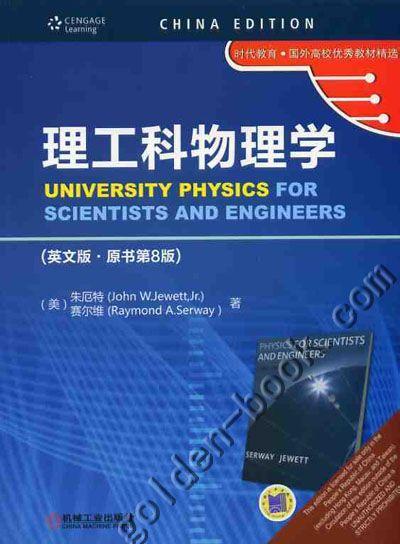
| 商品名称: | 理工科物理学 |
| 作者: | Raymond A.Serway |
| 市场价: | 128.00 |
| ISBN号: | 9787111320791 |
| 版次: | 1-1 |
| 出版日期: | 2010-11 |
| 页数: | 1240 |
| 字数: | 1950000 |
| 出版社: | 机械工业出版社 |
| 目录 | |
| Preface PART 1: MECHANICS 1.Physics and Measurement 1.1 Standards of Length, Mass, and Time 1.2 Matter and Model Building 1.3 Dimensional Analysis 1.4 Conversion of Units 1.5 Estimates and Order-of-Magnitude Calculations 1.6 Significant Figures Summary Objective Questions Conceptual Questions Problems 2.Motion in One Dimension 2.1 Position, Velocity, and Speed 2.2 Instantaneous Velocity and Speed 2.3 Analysis Model: Particle Under Constant Velocity 2.4 Acceleration 2.5 Motion Diagrams 2.6 Analysis Model: Particle Under Constant Acceleration 2.7 Freely Falling Objects 2.8 Kinematic Equations Derived from Calculus Summary Objective Questions Conceptual Questions Problems 3.Vectors 3.1 Coordinate Systems 3.9 Vector and Scalar Quantities 3.3 Some Properties of Vectors 3.4 Components of a Vector and Unit Vectors Summary Objective Questions Conceptual Questions Problems 4.Motion in Two Dimensions 4.1 The Position, Velocity, and Acceleration Vectors 4.2 Two-Dimensional Motion with Constant Acceleration 4.3 Projectile Motion 4.4 Analysis Model: Particle in Uniform Circular Motion 4.5 Tangential and Radial Acceleration 4.6 Relative Velocity and Relative Acceleration Summary Objective Questions Conceptual Questions Problems 5.The Laws of Motion 5.1 The Concept of Force 5.2 Newton's First Law and Inertial Frames 5.3 Mass 5.4 Newton's Second Law 5.5 The Gravitational Force and Weight 5.6 Newton's Third Law 5.7 Analysis Models Using Newton's Second Law 5.8 Forces of Friction Summary Objective Questions Conceptual Questions Problems 6.Circular Motion and Other Applications of Newton's Laws 6.1 Extending the Particle in Uniform Circular Motion Model 6.2 Nonuniform Circular Motion 6.3 Motion in Accelerated Frames 6.4 Motion in the Presence of Resistive Forces Summary Objective Questions Conceptual Questions Problems 7.Energy of a System 7.1 Systems and Environments 7.2 Work Done by a Constant Force 7.3 The Scalar Product of Two Vectors 7.4 Work Done by a Varying Force 7.5 Kinetic Energy and the Work-Kinetic Energy Theorem 7.6 Potential Energy of a System 7.7 Conservative and Nonconservative Forces 7.8 Relationship Between Conservative Forces and Potential Energy 7.9 Energy Diagrams and Equilibrium of a System Summary Objective Questions Conceptual Questions Problems 8.Conservation of Energy 8.1 Analysis Model: Nonisolated System (Energy) 8.2 Analysis Model: Isolated System (Energy) 8.3 Situations Involving Kinetic Friction 8.4 Changes in Mechanical Energy for Nonconser-vative Forces 8.5 Power Summary Objective Questions Conceptual Questions Problems 9.Linear Momentum and Collisions 9.1 Linear Momentum 9.2 Analysis Model: Isolated System (Momentum) 9.3 Analysis Model: Nonisolated System (Momentum) 9.4 Collisions in One Dimension 9.5 Collisions in Two Dimensions 9.6 The Center of Mass 9.7 Systems of Many Particles 9.8 Deformable Systems 9.9 Rocket Propulsion Summary Objective Questions Conceptual Questions Problems 10. Rotation of a Rigid Object About a Fixed Axis 10.1 Angular Position, Velocity, and Acceleration 10.2 Analysis Model: Rigid Object Under Constant Angular Acceleration 10.3 Angular and Translational Quantities 10.4 Rotational Kinetic Energy 10.5 Calculation of Moments of Inertia 10.6 Torque 10.7 Analysis Model: Rigid Object Under a Net Torque 10.8 Energy Considerations in Rotational Motion 10.9 Rolling Motion of a Rigid Object Summary Objective Questions Conceptual Questions Problems 11. Angular Momentum 11.1 The Vector Product and Torque 11.2 Analysis Model: Nonisolated System (Angular Momentum) 11.3 Angular Momentum of a Rotating Rigid Object 11.4 Analysis Model: Isolated System (Angular Momentum) 11.5 The Motion of Gyroscopes and Tops Summary Objective Questions Conceptual Questions Problems 12. Static Equilibrium and Elasticity 12.1 Analysis Model: Rigid Object in Equilibrium 12.2 More on the Center of Gravity 12.3 Examples of Rigid Objects in Static Equilibrium 12.4 Elastic Properties of Solids Summary Objective Questions Conceptual Questions Problems 13. Universal Gravitation 13.1 Newton's Law of Universal Gravitation 13.2 Free-Fall Acceleration and the Gravitational Force 13.3 Kepler's Laws and the Motion of Planets 13.4 The Gravitational Field 13.5 Gravitational Potential Energy 13.6 Energy Considerations in Planetary and Satellite Motion Summary Objective Questions Conceptual Questions Problems 14. Fluid Mechanics 14.1 Pressure 14.2 Variation of Pressure with Depth 14.3 Pressure Measurements |
| 内容简介 | |
| 《理工科物理学(英文版·原书第8版)》的两大编写原则:就物理学的基本概念和基本原理为学生提供一个清晰、富有逻辑性的讲解:通过大量、有趣的日常生活中的真实例子加强读者对基本概念及原理的理解全书涵盖了经典物理学的基本内容,并简要介绍了近代物理学的内容,共分6部分:牛顿力学及流体;碰撞、机械波及声学;热力学;电学和磁学;光学相对论。 《理工科物理学(英文版·原书第8版)》的整体风格是强调“易学”,注重启发性、紧密联系生活实际,主要特色有:“General Problem-Solving Strategy”为读者提供了一个解答一般性题目的详尽方法,并将这种解题方法贯穿在全书的每个例题中; 大约1/3的例题都包含“What If?”这样的问题,即在解题完成后,改变题目中的某些条件,让读者考虑各个待求量会相应地如何变化这有助于鼓励读者去思考例题的结果,而且也能帮助他们对原理进行概念性的理解: 贯穿在书中的大量的“Quick Quiz”可用来检验读者对物理概念的掌握程度; 《理工科物理学(英文版·原书第8版)》提供的两百多个“Pitfall Preventions”能帮助读者在学习中尽量避免常见错误和误解。 《理工科物理学(英文版·原书第8版)》可作为高等院校理工科各专业的大学物理双语课教材。也可供相关教师及自学爱好者参考之用。 |
- 机械工业出版社旗舰店 (微信公众号认证)
- 扫描二维码,访问我们的微信店铺
- 随时随地的购物、客服咨询、查询订单和物流...