【旗舰店】低碳废水生物脱氮理论与技术:英文 围绕低碳废水生物脱氮的技术原理、常见工艺、参数调控及微生物群落分析等
| 运费: | 免运费 |


商品详情
定价:58.0
ISBN:9787511477491
作者:陈重军
版次:1
出版时间:2025-01
内容提要:
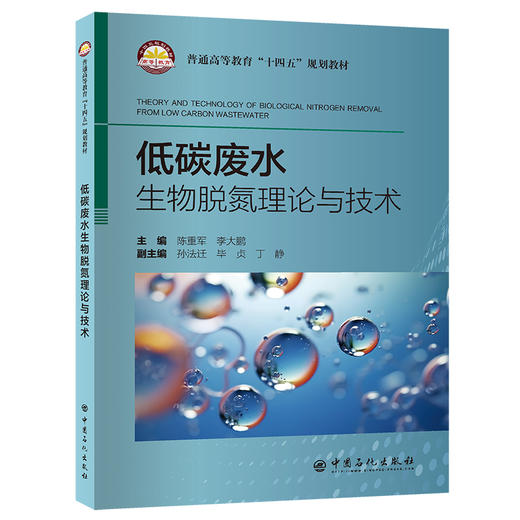
本书是作者根据长期从事低碳废水生物脱氮相关科研和教学的经验编写而成,主要介绍了常见低碳废水生物脱氮工艺的基本原理、影响因素及工艺应用,并着重介绍了亚硝酸盐型厌氧氨氧化工艺的快速启动及影响因素、匹配型亚硝化的调控、颗粒污泥的形成及控制、工艺调控及应用等内容。书中既重视对低碳废水生物脱氮理论的介绍,也注意融合作者在低碳废水强化生物脱氮研究方面的经验和*研究成果,注重知识的系统性,并力求做到重点突出、内容精练。
作者简介:
陈重军,工学博士(博士后),苏州科技大学环境科学与工程学院教授,硕士生导师,主要从事废水低碳处理技术研究和应用,入选江苏省青蓝工程和双创计划。主持国家自然科学基金、中国博士后科学基金、江苏省自然科学基金等20多项;*或通讯作者在国内外期刊发表论文80余篇,被引*过3200次,高被引论文5篇;申请国家专利28件(授权15件),参编江苏省重点教材2部,获中国产学研合作创新与促进奖二等奖,获*环境类专业本科生*毕业论文指导教师、江苏省协同创新管理先进个人等荣誉。兼任中国环境科学学会水处理与回用专业委员会委员及污染源排放与管控专业委员会委员、中国城镇供水排水协会青年工作者委员会委员、江苏省环境科学学会青年工作委员会委员,《中国环境科学》、《中国给水排水》、《工业水处理》、《生态环境学报》青年编委。主编:陈重军(苏州科技大学),李大鹏(苏州科技大学)副主编:孙法迁(浙江师范大学),毕贞(苏州科技大学),丁静(苏州科技大学)
媒体评论:
本书从工程视角入手,围绕低碳废水生物脱氮的技术原理、常见工艺、参数调控及微生物群落分析等基础知识和前沿热点,结合不同应用场景,提出技术的应用前景。本书可作为以工程应用创新能力培养为主的高等院校环境类专业学生的教材,可强化环境类专业学生废水生物脱氮理论的知识,并提升专业英语水平。
目录:
Chapter 1 Overview 1
1.1 The nitrogen cycle in nature 1
1.2 Nitrogen contamination risk 2
1.2.1 Global nitrogen pollution situation 3
1.2.2 Nitrogen pollution in China 4
1.3 Nitrogen pollution control 6
1.3.1 Increasingly higher emission
standards 6
1.3.2 Improvement of nitrogen pollution in
natural water bodies in China 7
1.4 Low carbon source wastewater treatment
issue 8
1.4.1 Typical low-carbon source wastewater 8
1.4.2 The challenges of conventional
nitrogen removal 9
1.4.3 The challenge of carbon neutrality 9
1.5 New biological nitrogen removal process 10
1.5.1 Shortcut
nitrification-denitrification systems 10
1.5.2 Simultaneous
nitrification-denitrification systems 11
1.5.3 Anaerobic ammonium oxidation (Anammox) 12
1.5.4 Sulfur-autotrophic denitrification 13
1.5.5 Ferric ammonium oxidation: Feammox 13
1.5.6 Anaerobic oxidation of methane (AOM) 15
1.5.7 Hydrogen autotrophic denitrification 15
Questions 16
References 16
Chapter 2 Partial nitrification and
denitrification 17
2.1 Introduction 17
2.2 Advantages of partial nitrification and
denitrification 18
2.3 Microorganism involved in nitrification 19
2.3.1 Morphologic and phylogenetic
diversity of AOB 19
2.3.2 Morphologic and phylogenetic
diversity of NOB 20
2.4 The main influencing parameters of partial
nitrification 21
2.4.1 pH, free
ammonia (FA) and free nitrous
acid (FNA) 21
2.4.2 Temperature 23
2.4.3 DO concentration 24
2.4.4 Sludge retention time 25
2.4.5 Toxic substances 25
2.5 The main challenges for partial
nitrification 26
2.6 Application of partial nitrification
and denitrification 27
Questions 30
References 30
Chapter 3 Simultaneous nitrification and
denitrification 33
3.1 Introduction 33
3.2 The mechanism and advantages of
simultaneous nitrification and
denitrification 34
3.2.1 The mechanism of SND 34
3.2.2 The advantages of SND 36
3.3 Microorganism involved in SND 37
3.3.1 Nitrifying bacteria within the
biofilm 38
3.3.2 Denitrifying bacteria in the biofilm 38
3.3.3 Bacteria capable of heterotrophic
nitrification and aerobic denitrification 39
3.4 The main factors affecting SND 40
3.4.1 DO 40
3.4.2 pH 40
3.4.3 C/N 41
3.4.4 Sludge flocs 41
3.5 Applications of SND 41
3.5.1 Moving bed biofilm reactors 42
3.5.2 Hybrid moving bed biofilm
reactor-membrane bioreactor systems 46
3.5.3 Aerobic granular sludge systems 47
Questions 51
References 52
Chapter 4 Nitrite-based anaerobic ammonia
oxidation (Anammox) 54
4.1 Discovery of nitrite-based Anammox 54
4.2 Nitrite-based Anammox stoichiometric
ratio 55
4.3 Nitrite-based Anammox microorganisms
and central metabolism 56
4.3.1 Diversity of functional bacteria for
nitrite-based Anammox 56
4.3.2 Central metabolic mechanism of
nitrite-based Anammox 58
4.4 Factors affecting Anammox of nitrite
type 62
4.4.1 Reactor impact 62
4.4.2 Influence of environmental factors 63
4.4.3 Substrate effects 65
4.5 Nitrite type Anammox main process 67
4.5.1 SHARON-ANAMMOX 69
4.5.2 CANON 70
4.5.3 Oxygen-Limited Autotrophic
Nitrification/Denitrification (OLAND) 72
4.5.4 Simultaneous partial Nitrification, Anammox and Denitrification (SNAD) 73
4.5.5 Partial Denitrification - Anammox (PD/A) 74
4.5.6 Denitrifying Anaerobic Methane
Oxidation/Anammox (DAMO/A) 75
Questions 77
References 77
Chapter 5 Matching nitrosation for Anammox 79
5.1 Matched nitrosation reaction 79
5.2 Process of realization of matched
nitrosation 80
5.2.1 Selection of reactor 80
5.2.2 Alkalinity 81
5.2.3 pH 83
5.2.4 DO content 85
5.2.5 HRT 86
5.3 Low temperature for matched nitrosation 86
5.4 Low substrate concentration for matched
nitrosation 89
5.5 Real-time reactor control 90
5.6 Microbial populations in matched
nitrosation systems 93
Questions 96
References 96
Chapter 6 Start-up of Anammox 98
6.1 The purpose and significance of quick startup 98
6.2 Initiation factor control 99
6.2.1 Selection of reactor 99
6.2.2 Selection of inoculated sludge 101
6.2.3 Selection of carrier 103
6.2.4 Start-up load 111
6.2.5 Low temperature start-up control 112
6.3 Start-up process characteristics 113
6.3.1 Start-up stage 113
6.3.2 Stoichiometry ratio 114
6.4 Microbial enrichment status 115
6.4.1 Trends and extent of microbial
enrichment 115
6.4.2 Enrichment population categories 116
- 索识旗舰店
- 读懂中国经济趋势,把握未来投资方向。
- 扫描二维码,访问我们的微信店铺