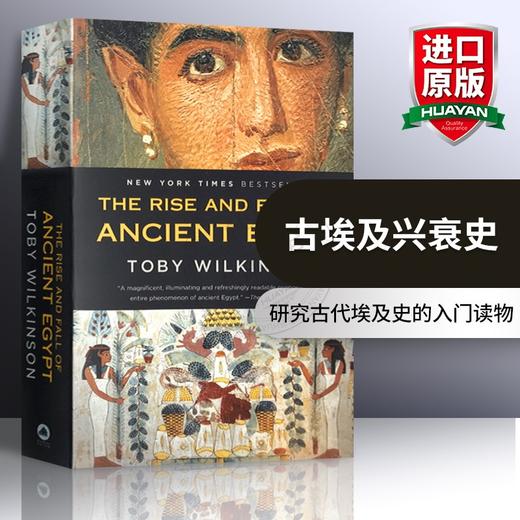
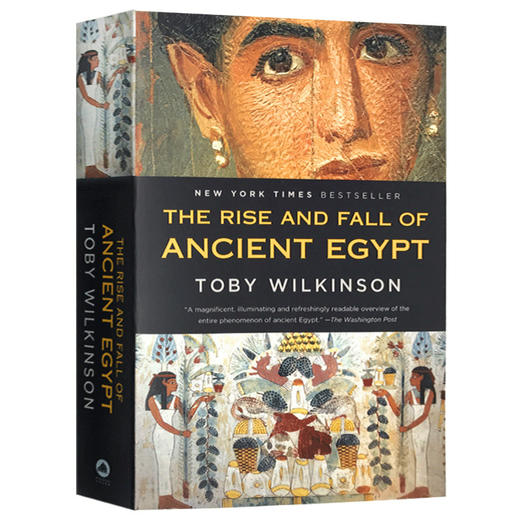
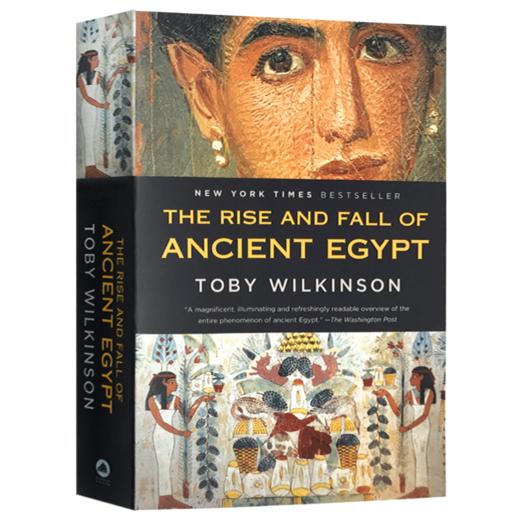
古埃及兴衰史 英文原版 The Rise and Fall of Ancient Egypt 英文版进口历史书籍正版 Toby Wilkinson
| 运费: | ¥ 0.00-999.00 |
| 库存: | 44 件 |
商品详情

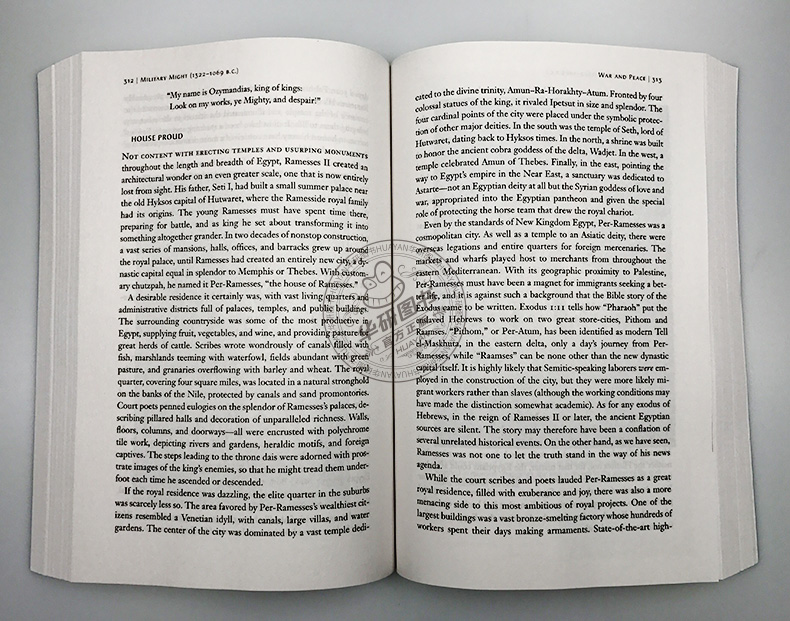
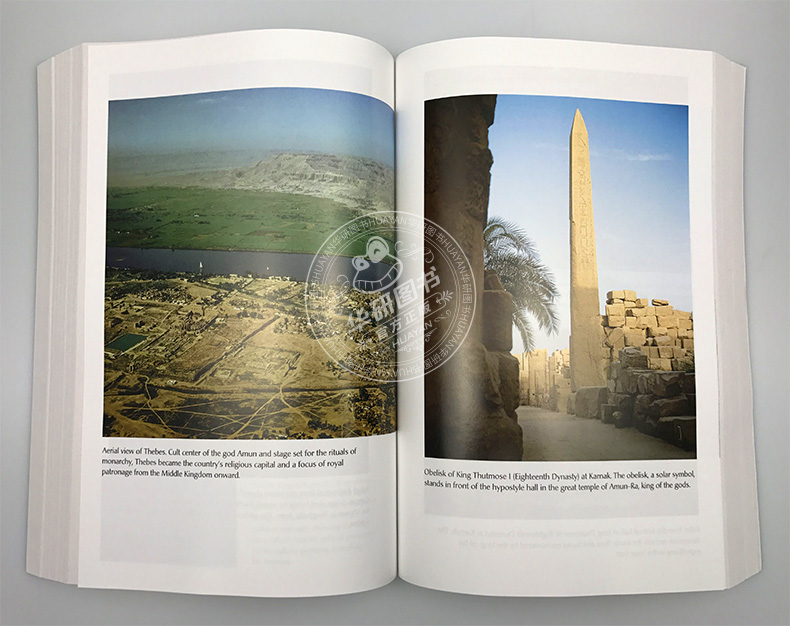
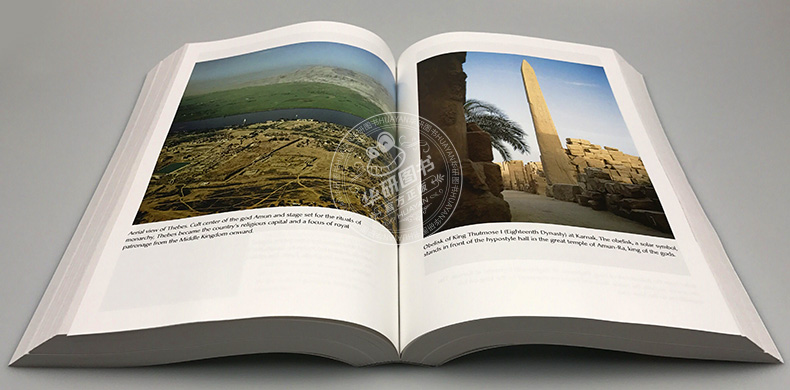
 书名:The Rise and Fall of Ancient Egypt 古埃及兴衰史
作者:Toby Wilkinson
出版社名称:Random House Trade Paperbacks
出版时间:2013
语种:英文
ISBN:9780553384901
商品尺寸:15.5 x 3.9 x 23.3 cm
包装:平装
页数:656 古埃及,四大文明古国之一。古埃及文明是指在尼罗河第1瀑布至三角洲地区,时间断限为公元前5000年的塔萨文化到公元641年阿拉伯人征服埃及的历史。学者们实际探讨古埃及文化的时间范围,是公元前3100年埃及南、北王国的首次联合,到公元前30年罗马帝国屋大维攻占埃及,克利奥帕特拉七世自杀,托勒密王朝覆灭,埃及并入罗马帝国。亦即通常所说的历史三千多年的法老王朝。古埃及文化是人类四大文明发祥地之一,也是阿拉伯文化的源头之一。
在3000多年的古埃及文明时期,古埃及人建造了巨大的金字塔、神庙、方尖碑,创立了当时世界上先进的医学体系。古埃及文明对后世的古希腊、古罗马、犹太等文明产生了巨大影响,对古埃及的研究在学术界已经形成一门专门的学科,称为“埃及学”。
这本The Rise and Fall of Ancient Egypt《古埃及兴衰史》是英国剑桥大学埃及学学家托比·威尔金森(Toby Wilkinson)凭借其四十年的考古研究而编写的一本历史专著,讲述了古埃及这个伟大文明古国从作为第1个民族国家诞生到并入罗马帝国的史诗故事。书本内容尊重史实,并包含新的信息及独特的诠释,文字简明扼要、并配有插图,非常适合研究古代埃及史的读者作为入门读物。
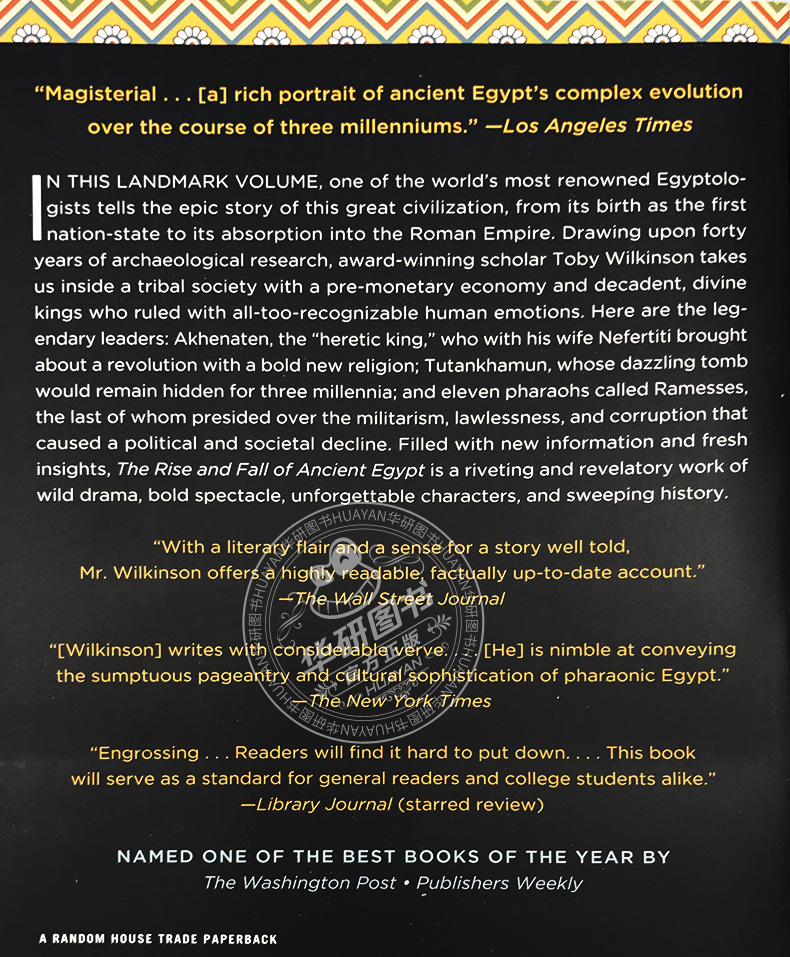
In this landmark volume, one of the world’s most renowned Egyptologists tells the epic story of this great civilization, from its birth as the first nation-state to its absorption into the Roman Empire. Drawing upon forty years of archaeological research, award-winning scholar Toby Wilkinson takes us inside a tribal society with a pre-monetary economy and decadent, divine kings who ruled with all-too-recognizable human emotions. Here are the legendary leaders: Akhenaten, the “heretic king,” who with his wife Nefertiti brought about a revolution with a bold new religion; Tutankhamun, whose dazzling tomb would remain hidden for three millennia; and eleven pharaohs called Ramesses, the last of whom presided over the militarism, lawlessness, and corruption that caused a political and societal decline. Filled with new information and unique interpretations, The Rise and Fall of Ancient Egypt is a riveting and revelatory work of wild drama, bold spectacle, unforgettable characters, and sweeping history.
Review
“A magnificent, illuminating and refreshingly readable overview of the entire phenomenon of ancient Egypt.”—The Washington Post
“Magisterial . . . [A] rich portrait of ancient Egypt’s complex evolution over the course of three millenniums.”—Los Angeles Times
“With a literary flair and a sense for a story well told, Mr. Wilkinson offers a highly readable, factually up-to-date account.”—The Wall Street Journal
“[Wilkinson] writes with considerable verve. . . . [He] is nimble at conveying the sumptuous pageantry and cultural sophistication of pharaonic Egypt.”—The New York Times
“Engrossing . . . Readers will find it hard to put down. . . . This book will serve as a standard for general readers and college students alike.”—Library Journal (starred review)
“Absolutely divine . . . a thorough, erudite and enthusiastic gallop through an astonishing three thousand years.”—The Sunday Times
 Toby Wilkinsongraduated with a first class honors degree in Egyptology from Downing College, University of Cambridge, winning the university’s Thomas Mulvey prize. He is the recipient of the Lady Wallis Budge Junior Research Fellowship in Egyptology, a Leverhulme Trust Special Research Fellowship, and an Honorary Research Fellowship in the Department of Archaeology at the University of Durham. He is currently at Clare College in the University of Cambridge. Wilkinson has published seven books and numerous articles, and has appeared on radio and television as an expert on ancient Egyptian civilization (especially the early periods). He is the recipient of the Antiquity Prize for the best journal article and is a member of the international editorial board of the Journal of Egyptian History.
CHAPTER 1
IN THE BEGINNING
The first king of Egypt
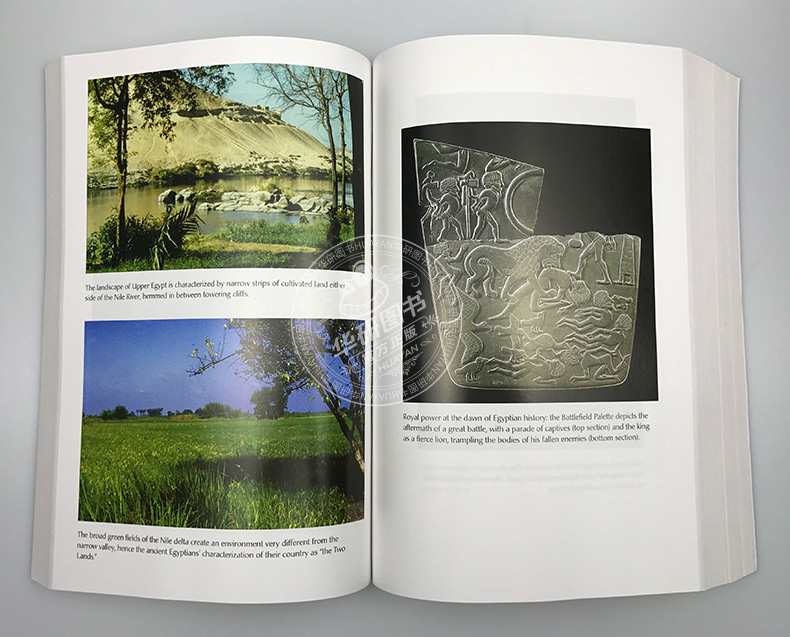
In a tall glass case in the entrance hall of the Egyptian Museum in Cairo stands an ancient slab of fine-grained greenish-black stone, about two feet high and no more than an inch thick. Shaped like a shield, it is carved on both sides in low relief. The scenes, though still crisp, are difficult to make out in the diffuse, hazy light that filters down through the dusty glazed dome in the museum ceiling. Most visitors barely give this strange object a second glance as they head straight for the golden riches of Tutankhamun on the floor above. Yet this modest piece of stone is one of the most important documents to survive from ancient Egypt. Its place of honor at the entrance to the Egyptian Museum, the world's greatest treasure- house of pharaonic culture, underlines its significance. This stone is the object that marks the very beginning of ancient Egyptian history.
The Narmer Palette, as it is known to Egyptologists, has become an icon of early Egypt, but the circumstances of its discovery are clouded with uncertainty. In the winter of a.d. 1897-1898, the British archaeologists James Quibell and Frederick Green were in the far south of Egypt, excavating at the ancient site of Nekhen (modern Kom el-Ahmar), the "city of the falcon" (classical Hierakonpolis). The nineteenth century was still the era of treasure seeking, and Quibell and Green, though more scientific in their approach than many of their contemporaries, were not immune from the pressure to discover fine objects to satisfy their sponsors back home. So, having chosen to excavate at Nekhen, a site eroded by countless centuries and largely devoid of major standing monuments, they decided to focus their attentions on the ruins of the local temple. Though small and unimpressive by comparison with the great sanctuaries of Thebes, this was no ordinary provincial shrine. Since the dawn of history, it had been dedicated to the celebration of Egyptian kingship. The local falcon god of Nekhen, Horus, was the patron deity of the Egyptian monarchy. Might the temple, therefore, yield a royal treasure?
The two men worked away, and their initial results were disappointing: stretches of mud brick wall; the remains of a mound, faced in stone; a few worn and broken statues. Nothing spectacular. The next area to be investigated lay in front of the mound, but here the archaeologists encountered only a thick layer of clay that resisted systematic excavation. The city of the falcon seemed determined to keep its secrets. But then, as Quibell and Green struggled their way through the clay layer, they came upon a scatter of discarded ritual objects, a motley collection of sacred paraphernalia that had been gathered up and buried by the temple priests some time in the remote past. There was no gold, but the "Main Deposit"-as the archaeologists optimistically called it-did contain some interesting and unusual finds. Chief among them was a carved slab of stone.
There was no doubt about what sort of object they had found. A shallow, circular well in the middle of one side showed it to be a palette, a grindstone for mixing pigments. But this was no workaday tool for preparing cosmetics. The elaborate and detailed scenes decorating both sides showed that it had been commissioned for a much loftier purpose, to celebrate the achievements of a glorious king. Beneath the benign gaze of two cow goddesses, a representation of the monarch himself-shown in the age-old pose of an Egyptian ruler, smiting his enemy with a mace-dominated one side of the palette. The archaeologists wondered who he was and when he had reigned. Two hieroglyphs, contained within a small rectangular panel at the very top of the palette, seemed to provide the answer, spelling out the monarch's name: a catfish ("nar" in the Egyptian language) and a chisel ("mer"): Narmer. Here was a king previously unknown to history. Moreover, the style of the carvings on the Narmer Palette pointed to a very early date. Subsequent research showed that Narmer was not just an early king; he was the very first ruler of a united Egypt. He came to the throne around 2950, the first king of the First Dynasty. In the mud of Nekhen, Quibell and Green had stumbled upon ancient Egypt's founding monument.
While Narmer may be the first historical king, he is not the beginning of Egypt's story. The decoration of his famous palette shows the art of the Egyptian royal court and the iconography of kingship already in their classical forms. However, some of the palette's stranger motifs, such as the intertwined beasts with long serpentine necks and the bull trampling the walls of an enemy fortress, hark back to a remote prehistoric past. On his great commemorative palette, Narmer was explicitly acknowledging that the cornerstones of Egyptian civilization had been laid long before his own time.
- 华研外语 (微信公众号认证)
- 本店是“华研外语”品牌商自营店,全国所有“华研外语”、“华研教育”品牌图书都是我司出版发行的,本店为华研官方源头出货,所有图书均为正规正版,拥有实惠与正版的保障!!!
- 扫描二维码,访问我们的微信店铺
- 随时随地的购物、客服咨询、查询订单和物流...