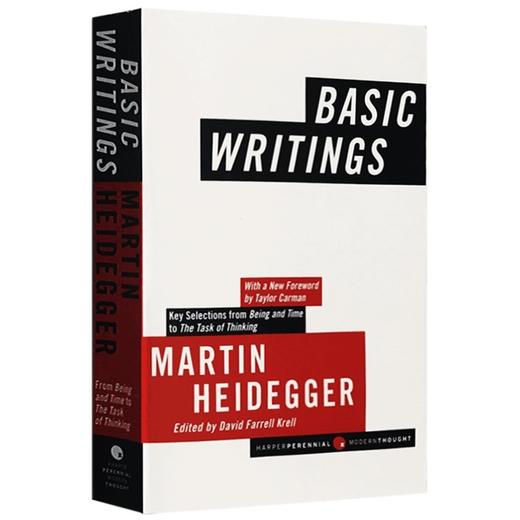
基本写作 英文原版 Basic Writings 马丁海德格尔文集 英文版哲学类进口书 存在与时间 什么是形而上学 现货正版英语书籍
| 运费: | ¥ 0.00-999.00 |
| 库存: | 8 件 |
商品详情
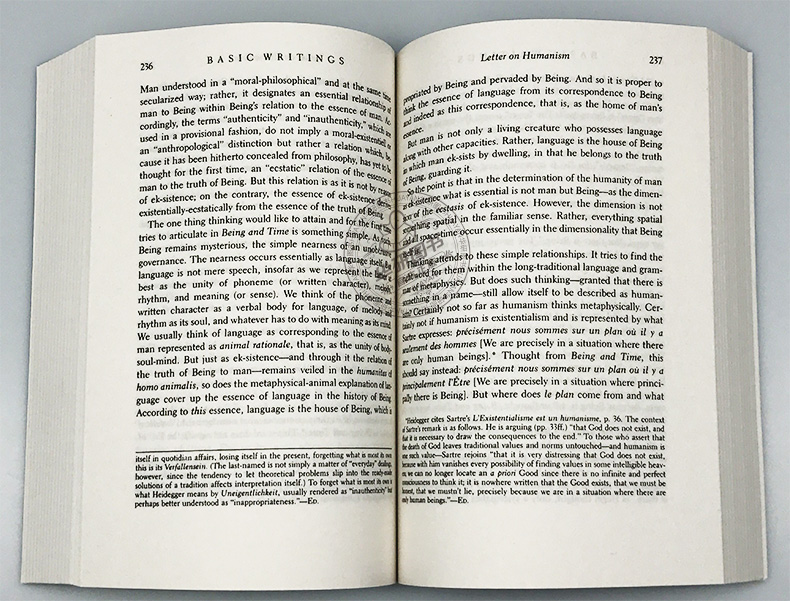
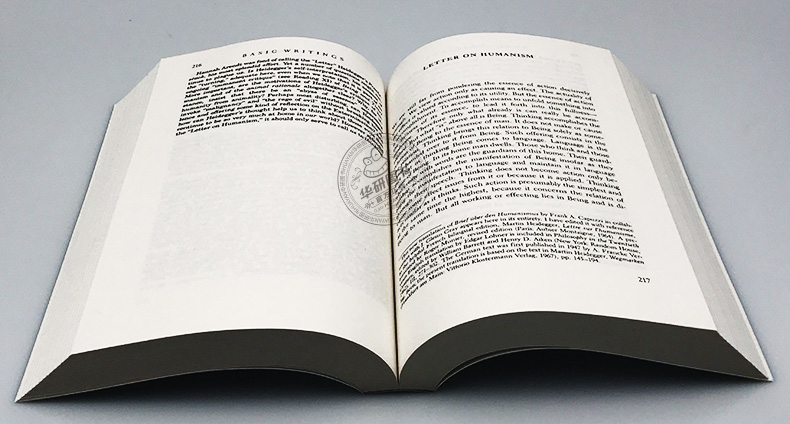

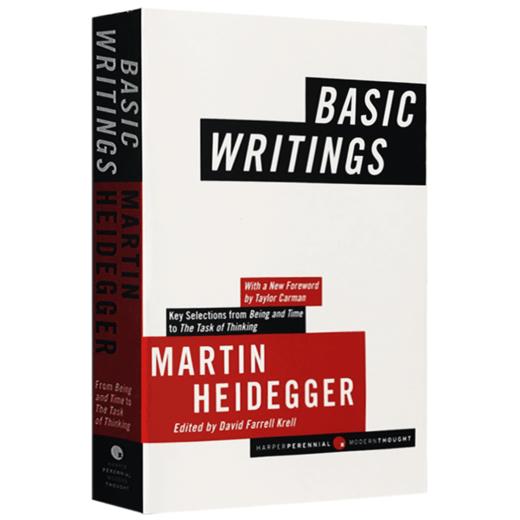
书名:Basic Writings 马丁海德格尔基本写作
作者:Martin Heidegger马丁·海德格尔
出版社名称:Harper Perennial
出版时间:2008
语种:英文
ISBN:9780061627019
商品尺寸:13.5 x 2.7 x 20.3 cm
包装:平装
页数:480

马丁·海德格尔,德国20世纪很具影响力的哲学家之一。
Basic Writings收录了马丁·海德格尔的部分重要著作,包括《艺术作品的本源》、《存在与时间》、《什么是形而上学》、《关于人道主义的信》、《关于科技的问题》、《语言的本质》、《哲学的终结》等。本书由海德格尔学者Taylor Carman写前言,向读者简要介绍了这位才华横溢、不可或缺的思想家的开创性哲学。
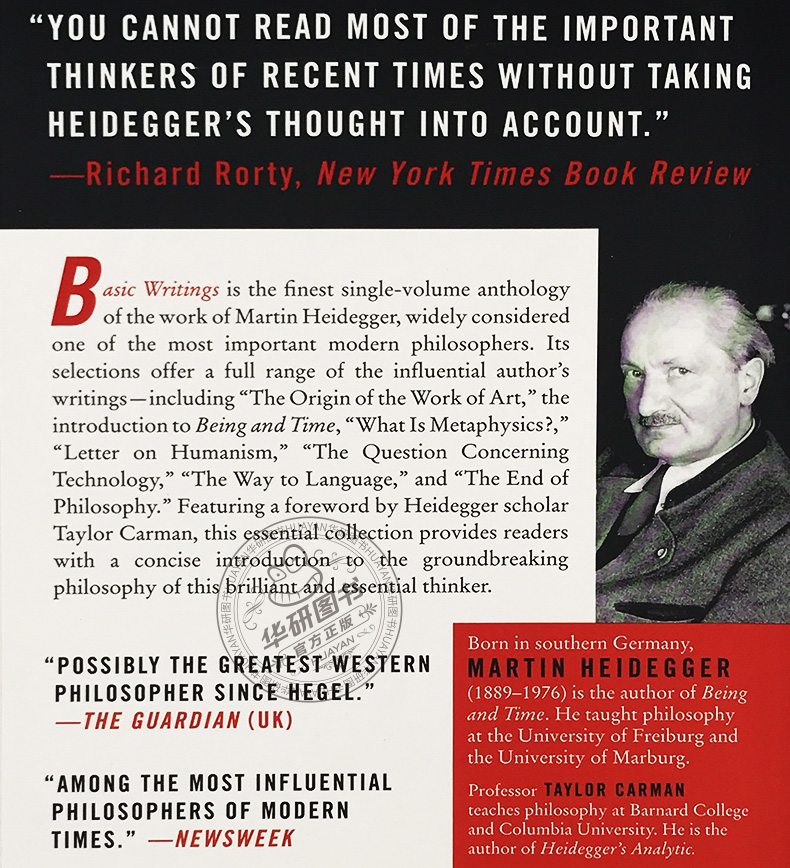
Basic Writings is the finest single-volume anthology of the work of Martin Heidegger, widely considered one of the most important modern philosophers. Its selections offer a full range of the influential author's writings—includingThe Origin of the Work of Art, the introduction toBeing and Time,What Is Metaphysics?,Letter on Humanism,The Question Concerning Technology,The Way to Language, andThe End of Philosophy. Featuring a foreword by Heidegger scholar Taylor Carman, this essential collection provides readers with a concise introduction to the groundbreaking philosophy of this brilliant and essential thinker.

马丁·海德格尔(1889.09.26-1976.05.26),德国哲学家,20世纪存在主义哲学的创始人和主要代表之一。出生于德国西南巴登邦(Baden)弗赖堡附近的梅斯基尔希(Messkirch)的天主教家庭,逝于德国梅斯基尔希。
Born in southern Germany,Martin Heidegger (1889-1976) is the author ofBeing and Time. He taught philosophy at the University of Freiburg and the University of Marburg.

I. Being and Time: Introduction
II. What Is Metaphysics?
III. On the Essence of Truth
IV. The Origin of the Work of Art
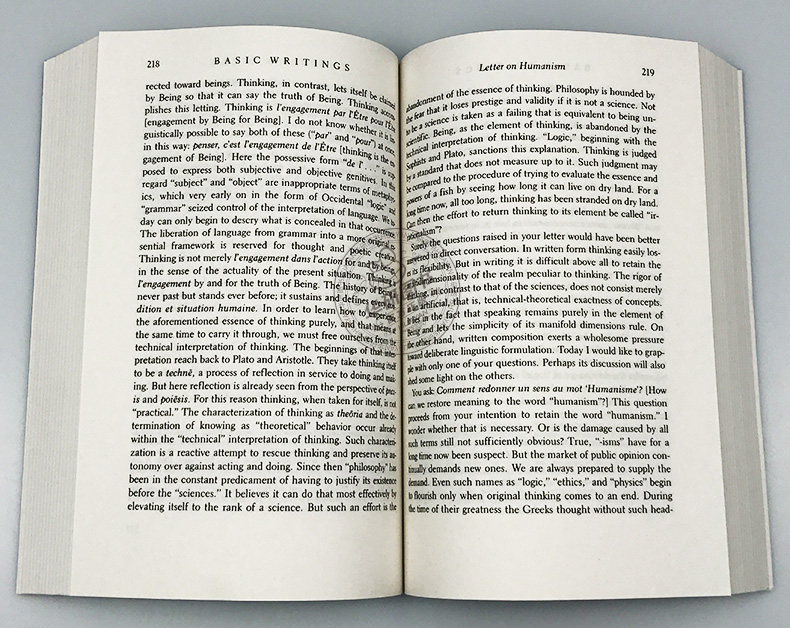
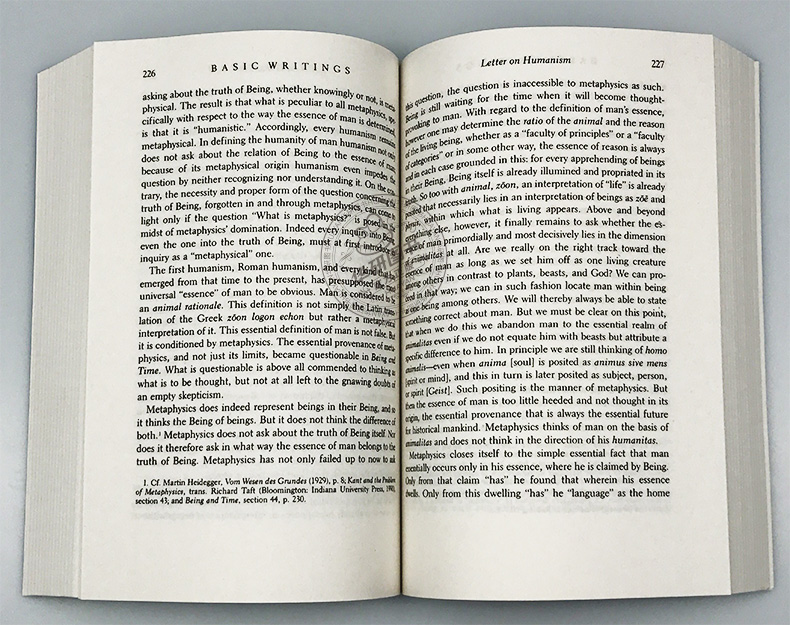
V. Letter on Humanism
VI. Modern Science, Metaphysics, and Mathematics
VII. The Question Concerning Technology
VIII. Building Dwelling Thinking
IX. What Calls for Thinking?
X. The Way to Language
XI. The End of Philosophy and the Task of Thinking

In his lecture course on Nietzsche in 1936, Heidegger said, “All great thinkers think the same. Yet this ‘same’ is so essential and so rich that no single thinker exhausts it.” The same (so to speak) could be said of Heidegger himself, though he claimed to have made a decisive break from the metaphysical thinking that had dominated Western philosophy for some 2,300 years. Metaphysical thinkers from Plato to Nietzsche had thought widely and deeply about entities, indeed the totality of entities, entities as a whole, the entirety of what there is. That sounds utterly comprehensive, yet Heidegger noticed that it leaves out something crucial, namely that in virtue of which entities are entities, what “makes” them entities, as it were. What makes entities cannot itself be another entity—Platonic forms, say, or substance, or God, or human experience—since that would beg the question, What makes that entity an entity? Heidegger’s new question, the question the metaphysical tradition since Plato had neglected and forgotten, is what he calls the question of being. The question of being is not, What is there? but, What does it mean to be? This was the question that gripped Heidegger throughout his life, his one great thought, the “same” that he thought from the beginning to the end of his intellectual career.
And yet, just as Plato, Descartes, and Nietzsche said profoundly different things about the most general structure and character of entities, so too, at different stages along what he called his “path” of thinking, did Heidegger say very different things about being. Consequently, just as we now distinguish the early Wittgenstein of the Tractatus from the later Wittgenstein of Philosophical Investigations, it has long been customary to distinguishthe early Heidegger of the 1920s from the later Heidegger of the 1930s, ‘40s, and ‘50s. Heidegger referred to the radical change in the style and orientation in his thinking—from the quasisystematic scholarly treatise Being and Time (1927) to the emphatically unsystematic essays on art, science, poetry, language, technology, and the history of metaphysics (written from about 1930 onward)—as “the turn” (die Kehre). The writings collected in the present volume trace Heidegger’s path of thinking and the turn it took from its earlier to its later incarnations, and in this way they offer a glimpse of a good part, though by no means all or even most, of his philosophical work.
As he makes clear in the introduction to Being and Time, Heidegger conceived of his early project of fundamental ontology as a kind of “transcendental” inquiry. Since Kant’s Critique of Pure Reason, transcendental philosophy has been concerned with the a priori conditions for the possibility of various manifest phenomena, for example our knowledge of objects and our awareness of ourselves as subjects. But whereas Kant either simply states or tries to provide formal arguments for what he considers the necessary conditions of objective experience— namely, space, time, and the categories of the understanding (for example, cause, substance, and number)—Heidegger undertakes a concrete phenomenological description of being as such, which he calls “the transcendens pure and simple,” so that “Every disclosure of Being as the transcendens is transcendental knowledge. Phenomenological truth (disclosedness of Being) is veritas transcendentalis.”
- 华研外语 (微信公众号认证)
- 本店是“华研外语”品牌商自营店,全国所有“华研外语”、“华研教育”品牌图书都是我司出版发行的,本店为华研官方源头出货,所有图书均为正规正版,拥有实惠与正版的保障!!!
- 扫描二维码,访问我们的微信店铺
- 随时随地的购物、客服咨询、查询订单和物流...