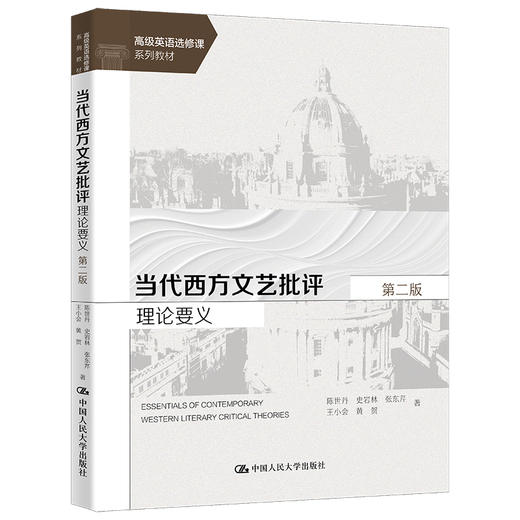
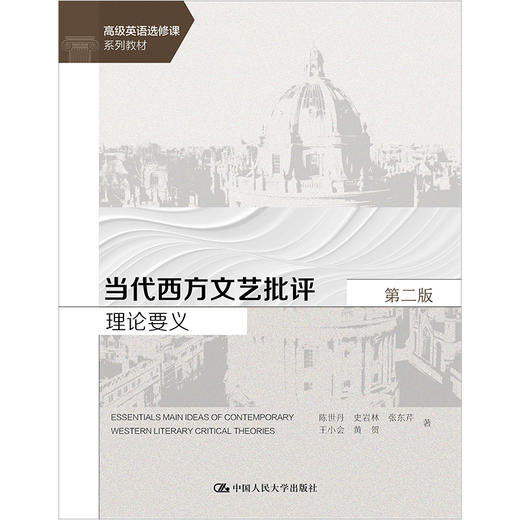
当代西方文艺批评理论要义(第二版)(高级英语选修课系列教材)陈世丹 史岩林 张东芹 王小会 黄贺
| 运费: | ¥ 0.00-20.00 |
商品详情
书名:当代西方文艺批评理论要义(第二版)(高级英语选修课系列教材)
定价:68.0
ISBN:9787300321400
作者:陈世丹 史岩林 张东芹 王小会 黄贺
版次:2
出版时间:2023-09
内容提要:
《当代西方文艺批评理论要义》) 是对20世纪和21世纪初以来陆续出现的每一种西方文艺批评理论的主要思想意义、理论主张、学术价值的概论。本书共讨论了18种当代西方文艺批评理论,同时,本书在每一章文后提供了相关理论学派代表人物的代表作(论文或专著)书单,作为学者们自主阅读的相关文献资料(Selected Readings),供研究使用。本书虽以专著的形式呈献给读者,但完全可以用作英美文学、文艺理论、比较文学与世界文学专业本科生和研究生的文学批评和理论研究课程教材,亦可作为文学、文化、文艺学研究生及从事文学批评和理论研究学者的工具书或参考书。
作者简介:
陈世丹,文学博士,中国人民大学外国语学院二级教授,外国语言文学学科带头人,英语系主任,英美文学、西方文论研究方向博士生导师、博士后合作导师。担任全国英国文学学会副会长、国际文学伦理学批评研究会常务理事、全国美国文学研究会常务理事、中国高等教育学会外国文学专业委员会常务理事。完成和在研国家社会科学基金项目3项,主持完成中国人民大学重大规划项目1项,在研中国人民大学重大规划项目1项“后现代文学伦理学中外平行对比研究”(22XNL017)。出版学术专著《美国后现代主义小说艺术论》(2002)、《美国后现代主义小说详解》(中、英文版,2010)、《后现代人道主义小说家冯内古特》(2014)、《美国后现代主义小说论》(2019)等10部;主编教材《美国文学史》(英文版,上、下册,2013)和《21世纪新编美国文学选读》(英文版,上、下册,2013)、《当代西方文艺批评理论选读》(2021)等6部。
目录:
Introduction
Volume 1
Chapter One Russian Formalism
Chapter Two The Anglo-American New Criticism
Chapter Three Marxist Criticism
Chapter Four Psychological and Psychoanalytic Criticism
Chapter Five Myth and Archetypal Criticism
Chapter Six Structuralist Criticism
Chapter Seven Reception-Aesthetics and Reader-Response Theory
Chapter Eight Post-structuralism
Chapter Nine Postmodernism
Volume 2
Chapter Ten Feminist Criticism
Chapter Eleven New Historicism
Chapter Twelve Post-Colonialist Studies
Chapter Thirteen Gender Studies
Chapter Fourteen Cultural Studies
Chapter Fifteen Postmodern Ecological Literary Criticism
Chapter Sixteen Ecological Postmodernism
Chapter Seventeen Postmodern Ethical Literary Criticism
Chapter Eighteen Post-humanism
在线试读:
Introduction
When analyzing a literary text, literary critics ask basic questions such as these about the philosophical, psychological, functional, and descriptive natures of the text itself: 1) Does a text have only one correct meaning? 2) Is a text always didactic; that is, must a reader learn something from every text? 3) Does a text affect each reader in the same way? 4) How is a text influenced by the culture of its author and the culture in which it is written? 5) Can a text become a catalyst for change in a given culture? No matter what question we may ask concerning a literary text, we are participating in an ongoing discussion of the value and enjoyment of a literary work while simultaneously engaging in literary criticism and functioning as practical literary critics. Traditionally, literary critics involve themselves in either theoretical or practical criticism. Theoretical criticism formulates the theories, principles, and tenets of the nature and value of art. By citing general aesthetic and moral principles of art, theoretical criticism provides the necessary framework for practical criticism. Practical criticism (also known as applied criticism) applies the theories and tenets of theoretical criticism to a particular work. Using the theories and principles of theoretical criticism, the practical critic defines the standards of taste and explains, evaluates, or justifies a particular piece of literature. A further distinction is made between the practical critic who posits that there is one theory or set of principles a critic may use when evaluating a literary work—the absolutist critic—and the relativistic critic, one who uses various or even contradictory theories in critiquing a text. The basis for either kind of critic, or any form of criticism, is literary theory. Without theory, practical criticism could not exist. The theories that we are going to study in this course of ours will include “literary theory,” “critical theory,” and “cultural theory” in a general sense.
Literary theory in a strict sense is the systematic study of the nature of literature and of the methods for analyzing literature. However, literary scholarship since the 19th century often includes—in addition to, or even instead of literary theory in the strict sense—considerations of intellectual history, moral philosophy, social prophecy, and other interdisciplinary themes which are of relevance to the way humans interpret meaning. In humanities in modern academia, the latter style of scholarship is an outgrowth of critical theory and is often called simply “theory.” As a consequence, the word “theory” has become an umbrella term for a variety of scholarly approaches to reading texts. Many of these approaches are informed by various strands of continental philosophy and sociology.
Critical theory (or “social critical theory”) describes the neo-Marxist philosophy of the Frankfurt School, which was developed in Germany in the 1930s. Critical theory maintains that ideology is the principal obstacle to human liberation. Martin Jay has stated that the first generation of critical theory is best understood as not promoting a specific philosophical agenda or a specific ideology, but as “a gadfly of other systems.” Critical theory was established as a school of thought primarily by five Frankfurt School theoreticians, Herbert Marcuse, Theodor Adorno, Max Horkheimer, Walter Benjamin, and Erich Fromm, drawing on the critical methods of Karl Marx and Sigmund Freud. Modern critical theory has additionally been influenced by György Lukács and Antonio Gramsci, as well as the second generation Frankfurt School scholars, such as Jürgen Habermas. Concern for economic base and superstructure is one of the remaining Marxist philosophical concepts in much of the contemporary critical theory. While critical theorists have been frequently defined as Marxist intellectuals, their tendency to denounce some
Marxist concepts and to combine Marxian analysis with other sociological and philosophical traditions has resulted in accusations of revisionism by Classical, Orthodox, and Analytical Marxists, and by Marxist-Leninist philosophers.
- 人民大学出版社微店 (微信公众号认证)
- 人大出版社自营微店,正版人大出版社书籍直发,品质保证!
- 扫描二维码,访问我们的微信店铺
- 随时随地的购物、客服咨询、查询订单和物流...

![[中级] 社会工作综合能力 2026年社会工作者职业资格考试指导教材](https://img01.yzcdn.cn/upload_files/2025/12/22/FnMBIN9HT2su3EtYJpPIll-rz6pE.png?imageView2/2/w/260/h/260/q/75/format/jpg)
![[高级]社会工作实务 2026年社会工作者职业资格考试指导教材 /中国人民大学出版社](https://img01.yzcdn.cn/upload_files/2025/12/22/FqMhOoLRyIM0MzEibxPazkDEBZLh.jpg?imageView2/2/w/260/h/260/q/75/format/jpg)