






商品详情
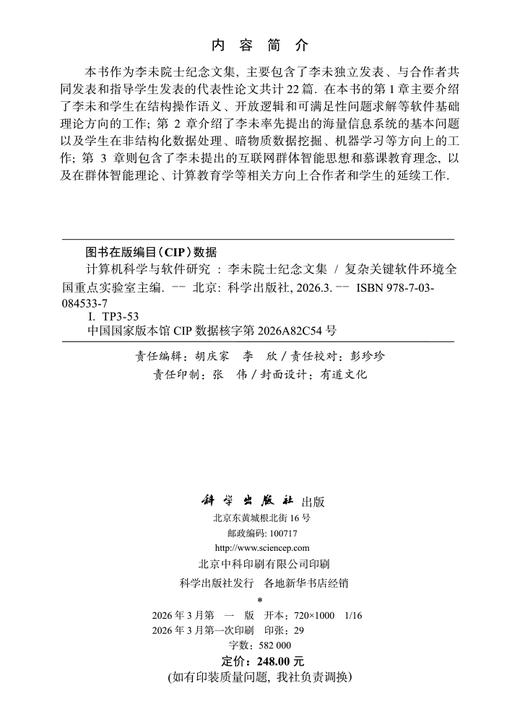
书名:计算机科学与软件研究——李未院士纪念文集
定价:248.0
ISBN:9787030845337
版次:1
出版时间:2026-03
内容提要:
本书作为李未院士纪念文集,主要包含了李未独立发表、与合作者共同发表和指导学生发表的代表性论文共计22篇。在本书的第1章主要介绍了李未和学生在结构操作语义、开放逻辑和可满足性问题求解等软件基础理论方向的工作;第2章介绍了李未率先提出的海量信息系统的基本问题以及学生在非结构化数据处理、暗物质数据挖掘、机器学习等方向上的工作;第3章则包含了李未提出的互联网群体智能思想和慕课教育理念,以及在群体智能理论、计算教育学等相关方向上合作者和学生的延续工作。
目录:
目录
序言
第1章 软件基础理论 1
1.1 An operational semantics of multitasking and exception handling in Ada 3
1.1.1 Introduction 3
1.1.2 An outline of multitasking and exception 3
1.1.3 An operational semantics for multitasking 12
1.1.4 An operational semantics for exceptions in Ada 26
1.1.5 Raising a failure exception in another task 30
1.1.6 Conclusion 33
References 33
1.2 A formal semantics for program debugging 35
1.2.1 Introduction 35
1.2.2 The language C* and basic notations 37
1.2.3 A structural operational semantics for tracing 40
1.2.4 A structural operational semantics for locating 49
1.2.5 Solving fixing equations 57
1.2.6 Conclusion 58
References 59
1.3 一个开放的逻辑系统 61
1.3.1 引言 61
1.3.2 新假设与事实反驳 63
1.3.3 认识进程 65
1.3.4 极限及经验模型 66
1.3.5 简单事实反驳 69
1.3.6 关于缺省推理的语义 71
1.3.7 结论 73
References 73
1.4 R-calculus: an inference system for belief revision 75
1.4.1 Motivation 75
1.4.2 A formal language of beliefs 76
1.4.3 A logical inference system for beliefs 77
1.4.4 The necessary antecedents 81
1.4.5 The refutation by facts 83
1.4.6 The R-calculus 84
1.4.7 Some examples 88
1.4.8 The reachability, soundness, and completeness 93
1.4.9 Conclusion 96
References 98
1.5 R-calculus without the cut rule 99
1.5.1 Introduction 99
1.5.2 R-calculus 100
1.5.3 Case study of the R-cut rule 103
1.5.4 R-calculus without the cut rule 106
1.5.5 Examples 108
1.5.6 The reachability, soundness and completeness 111
1.5.7 Conclusion 118
References 119
1.6 一种求解合取范式可满足性问题的数学物理方法 120
1.6.1 引言 120
1.6.2 关于可满足性问题的近似算法 121
1.6.3 梯度算法及计算结果分析 124
1.6.4 CNF 可满足问题与覆盖问题 128
1.6.5 目标函数$U_2$的物理意义 129
References 131
1.7 Many hard examples in exact phase transitions 133
1.7.1 Introduction 133
1.7.2 Preliminaries 135
1.7.3 Model RB and Model RD 137
1.7.4 Main results 139
1.7.5 Proof of Theorem 7.3 139
1.7.6 Conclusion 145
References 147
1.7.7 Appendix 149
1.8 A knowledge base management system on relation model and term rewriting 153
1.8.1 Introduction 153
1.8.2 KBMS status 153
1.8.3 The KBMS/BUAA model 154
1.8.4 The principle 155
1.8.5 The architecture 158
1.8.6 Application 162
1.8.7 Conclusion 162
References 163
第2章 海量信息方法 164
2.1 互联网海量信息系统的基本问题 167
2.1.1 背景简介 167
2.1.2 两个基本的科学问题 167
2.1.3 海量数据的协同和可生存性研究 169
2.1.4 软件计算的协同和可生存性研究 170
2.1.5 系统网络的协同和可生存性研究 172
2.1.6 结论 175
2.2 A tetrahedral data model for unstructured data management 176
2.2.1 Related work 177
2.2.2 The structure of the tetrahedral data model 179
2.2.3 The implementation structure of the tetrahedral data model 184
2.2.4 Unstructured data query language (UDQL) 186
2.2.5 A complete example 190
2.2.6 Conclusion 196
2.2.7 Acknowledgements 196
References 197
2.3 Capturing topology in graph pattern matching 199
2.3.1 Introduction 199
2.3.2 Strong simulation 204
2.3.3 Properties of strong simulation 209
2.3.4 An algorithm for strong simulation 212
2.3.5 Experimental study 220
2.3.6 Conclusion 227
References 228
2.4 First result from the alpha magnetic spectrometer on the international space station: precision measurement of the positron fraction in primary cosmic rays of 0.5-350GeV 231
2.4.1 Introduction 235
2.4.2 AMS detector 236
2.4.3 Results and conclusions 244
2.4.4 Acknowledgments 249
2.5 Collaborative hashing 253
2.5.1 Introduction 253
2.5.2 Collaborative hashing 256
2.5.3 Experiments 263
2.5.4 Conclusion 269
References 270
2.6 Large-scale 3D model repository: ShapeNet 272
2.6.1 Introduction 272
2.6.2 Background and related work 274
2.6.3 ShapeNet: an information-rich 3D model repository 276
2.6.4 Annotation acquisition and validation 282
2.6.5 Current statistics 286
2.6.6 Discussion and future work 288
2.6.7 Conclusion 290
References 291
第3章 群体智能与慕课 294
3.1 Crowdsourcing: Cloud-Based Software Development 296
3.1.1 Foreword 296
3.1.2 Summary of the book 297
3.2 An evaluation framework for software crowdsourcing 302
3.2.1 Abstract 302
3.2.2 Introduction 302
3.2.3 Characterizing software crowdsourcing processes 305
3.2.4 Evaluation framework for software crowdsourcing 308
3.2.5 Game theory interpretations 315
3.2.6 Illustration 320
3.2.7 Related work 328
3.2.8 Conclusion 330
3.2.9 Acknowledgments 331
References 332
3.3 Crowd intelligence in AI 2.0 era 334
3.3.1 Abstract 334
3.3.2 Introduction 335
3.3.3 Definition of crowd intelligence 335
3.3.4 Typical crowd intelligence platforms 340
3.3.5 Research problems in crowd intelligence 354
3.3.6 Conclusion 375
References 376
3.4 复杂软件系统的成长性构造与适应性演化 387
3.4.1 引言 387
3.4.2 复杂软件系统的特点和性质 389
3.4.3 基于还原论的软件开发方法所面临的挑战 392
3.4.4 复杂软件系统构造与演化基本法则 394
3.4.5 复杂软件系统成长性构造技术体系 396
3.4.6 复杂软件系统适应性演化技术体系 401
3.4.7 适应性演化实现机制 402
3.4.8 结论 404
References 405
3.5 群体智能系统的动力学模型与群体熵度量 409
3.5.1 引言 409
3.5.2 群体智能的动力学模型 413
3.5.3 群体熵的基本性质 416
3.5.4 群体智能的度量:以图搜索为例 417
3.5.5 结论 421
References 421
3.6 抓住MOOC发展机遇全面提高高等教育质量 424
3.6.1 我国高等教育的形势和任务 424
3.6.2 全面提高高等教育质量 424
3.7 面向智慧教育的学习大数据分析技术 429
3.7.1 智慧教育和大数据分析 429
3.7.2 面向教育的大数据分析实例 431
3.7.3 面向教育的大数据分析方法 433
3.7.4 课程推荐和学习规划 436
3.7.5 基于社区的学习分析 437
3.7.6 总结 438
References 439
3.8 升级大学软件教育 442
3.8.1 为什么要升级大学软件教育 442
3.8.2 如何升级大学软件教育 444
3.8.3 升级软件教育的探索与实践 446
References 448
定价:248.0
ISBN:9787030845337
版次:1
出版时间:2026-03
内容提要:
本书作为李未院士纪念文集,主要包含了李未独立发表、与合作者共同发表和指导学生发表的代表性论文共计22篇。在本书的第1章主要介绍了李未和学生在结构操作语义、开放逻辑和可满足性问题求解等软件基础理论方向的工作;第2章介绍了李未率先提出的海量信息系统的基本问题以及学生在非结构化数据处理、暗物质数据挖掘、机器学习等方向上的工作;第3章则包含了李未提出的互联网群体智能思想和慕课教育理念,以及在群体智能理论、计算教育学等相关方向上合作者和学生的延续工作。
目录:
目录
序言
第1章 软件基础理论 1
1.1 An operational semantics of multitasking and exception handling in Ada 3
1.1.1 Introduction 3
1.1.2 An outline of multitasking and exception 3
1.1.3 An operational semantics for multitasking 12
1.1.4 An operational semantics for exceptions in Ada 26
1.1.5 Raising a failure exception in another task 30
1.1.6 Conclusion 33
References 33
1.2 A formal semantics for program debugging 35
1.2.1 Introduction 35
1.2.2 The language C* and basic notations 37
1.2.3 A structural operational semantics for tracing 40
1.2.4 A structural operational semantics for locating 49
1.2.5 Solving fixing equations 57
1.2.6 Conclusion 58
References 59
1.3 一个开放的逻辑系统 61
1.3.1 引言 61
1.3.2 新假设与事实反驳 63
1.3.3 认识进程 65
1.3.4 极限及经验模型 66
1.3.5 简单事实反驳 69
1.3.6 关于缺省推理的语义 71
1.3.7 结论 73
References 73
1.4 R-calculus: an inference system for belief revision 75
1.4.1 Motivation 75
1.4.2 A formal language of beliefs 76
1.4.3 A logical inference system for beliefs 77
1.4.4 The necessary antecedents 81
1.4.5 The refutation by facts 83
1.4.6 The R-calculus 84
1.4.7 Some examples 88
1.4.8 The reachability, soundness, and completeness 93
1.4.9 Conclusion 96
References 98
1.5 R-calculus without the cut rule 99
1.5.1 Introduction 99
1.5.2 R-calculus 100
1.5.3 Case study of the R-cut rule 103
1.5.4 R-calculus without the cut rule 106
1.5.5 Examples 108
1.5.6 The reachability, soundness and completeness 111
1.5.7 Conclusion 118
References 119
1.6 一种求解合取范式可满足性问题的数学物理方法 120
1.6.1 引言 120
1.6.2 关于可满足性问题的近似算法 121
1.6.3 梯度算法及计算结果分析 124
1.6.4 CNF 可满足问题与覆盖问题 128
1.6.5 目标函数$U_2$的物理意义 129
References 131
1.7 Many hard examples in exact phase transitions 133
1.7.1 Introduction 133
1.7.2 Preliminaries 135
1.7.3 Model RB and Model RD 137
1.7.4 Main results 139
1.7.5 Proof of Theorem 7.3 139
1.7.6 Conclusion 145
References 147
1.7.7 Appendix 149
1.8 A knowledge base management system on relation model and term rewriting 153
1.8.1 Introduction 153
1.8.2 KBMS status 153
1.8.3 The KBMS/BUAA model 154
1.8.4 The principle 155
1.8.5 The architecture 158
1.8.6 Application 162
1.8.7 Conclusion 162
References 163
第2章 海量信息方法 164
2.1 互联网海量信息系统的基本问题 167
2.1.1 背景简介 167
2.1.2 两个基本的科学问题 167
2.1.3 海量数据的协同和可生存性研究 169
2.1.4 软件计算的协同和可生存性研究 170
2.1.5 系统网络的协同和可生存性研究 172
2.1.6 结论 175
2.2 A tetrahedral data model for unstructured data management 176
2.2.1 Related work 177
2.2.2 The structure of the tetrahedral data model 179
2.2.3 The implementation structure of the tetrahedral data model 184
2.2.4 Unstructured data query language (UDQL) 186
2.2.5 A complete example 190
2.2.6 Conclusion 196
2.2.7 Acknowledgements 196
References 197
2.3 Capturing topology in graph pattern matching 199
2.3.1 Introduction 199
2.3.2 Strong simulation 204
2.3.3 Properties of strong simulation 209
2.3.4 An algorithm for strong simulation 212
2.3.5 Experimental study 220
2.3.6 Conclusion 227
References 228
2.4 First result from the alpha magnetic spectrometer on the international space station: precision measurement of the positron fraction in primary cosmic rays of 0.5-350GeV 231
2.4.1 Introduction 235
2.4.2 AMS detector 236
2.4.3 Results and conclusions 244
2.4.4 Acknowledgments 249
2.5 Collaborative hashing 253
2.5.1 Introduction 253
2.5.2 Collaborative hashing 256
2.5.3 Experiments 263
2.5.4 Conclusion 269
References 270
2.6 Large-scale 3D model repository: ShapeNet 272
2.6.1 Introduction 272
2.6.2 Background and related work 274
2.6.3 ShapeNet: an information-rich 3D model repository 276
2.6.4 Annotation acquisition and validation 282
2.6.5 Current statistics 286
2.6.6 Discussion and future work 288
2.6.7 Conclusion 290
References 291
第3章 群体智能与慕课 294
3.1 Crowdsourcing: Cloud-Based Software Development 296
3.1.1 Foreword 296
3.1.2 Summary of the book 297
3.2 An evaluation framework for software crowdsourcing 302
3.2.1 Abstract 302
3.2.2 Introduction 302
3.2.3 Characterizing software crowdsourcing processes 305
3.2.4 Evaluation framework for software crowdsourcing 308
3.2.5 Game theory interpretations 315
3.2.6 Illustration 320
3.2.7 Related work 328
3.2.8 Conclusion 330
3.2.9 Acknowledgments 331
References 332
3.3 Crowd intelligence in AI 2.0 era 334
3.3.1 Abstract 334
3.3.2 Introduction 335
3.3.3 Definition of crowd intelligence 335
3.3.4 Typical crowd intelligence platforms 340
3.3.5 Research problems in crowd intelligence 354
3.3.6 Conclusion 375
References 376
3.4 复杂软件系统的成长性构造与适应性演化 387
3.4.1 引言 387
3.4.2 复杂软件系统的特点和性质 389
3.4.3 基于还原论的软件开发方法所面临的挑战 392
3.4.4 复杂软件系统构造与演化基本法则 394
3.4.5 复杂软件系统成长性构造技术体系 396
3.4.6 复杂软件系统适应性演化技术体系 401
3.4.7 适应性演化实现机制 402
3.4.8 结论 404
References 405
3.5 群体智能系统的动力学模型与群体熵度量 409
3.5.1 引言 409
3.5.2 群体智能的动力学模型 413
3.5.3 群体熵的基本性质 416
3.5.4 群体智能的度量:以图搜索为例 417
3.5.5 结论 421
References 421
3.6 抓住MOOC发展机遇全面提高高等教育质量 424
3.6.1 我国高等教育的形势和任务 424
3.6.2 全面提高高等教育质量 424
3.7 面向智慧教育的学习大数据分析技术 429
3.7.1 智慧教育和大数据分析 429
3.7.2 面向教育的大数据分析实例 431
3.7.3 面向教育的大数据分析方法 433
3.7.4 课程推荐和学习规划 436
3.7.5 基于社区的学习分析 437
3.7.6 总结 438
References 439
3.8 升级大学软件教育 442
3.8.1 为什么要升级大学软件教育 442
3.8.2 如何升级大学软件教育 444
3.8.3 升级软件教育的探索与实践 446
References 448
- 科学出版社旗舰店 (微信公众号认证)
- 科学出版社秉承多年来形成的“高层次、高水平、高质量”和“严肃、严密、严格”的优良传统与作风,始终坚持为科技创新服务、为传播与普及科学知识服务、为科学家和广大读者服务的宗旨。
- 扫描二维码,访问我们的微信店铺
- 随时随地的购物、客服咨询、查询订单和物流...