




商品详情
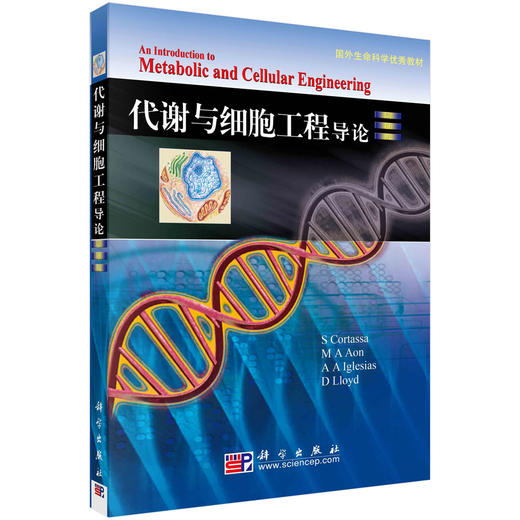
书名:代谢与细胞工程导论
定价:98.0
ISBN:9787030123640
作者:(阿根廷》科他萨(Cortasa.S.)等
版次:1
出版时间:2004-04
内容提要:
本书阐述了将两大技术遗传分子生物学技术与发酵技术有机联系在一起。将各学科如傲生物生珲学、生物能学、热动力学和酶动力学、生物数学与生物化学、遗传学与分子生物学的方法整合协调。形成跨学科的方法,经过介理设计,以某种方式…限度地利用微牛物或细胞。内容包括:物质与能量平衡、细胞生长与代谢产物、生物过程动力学、植物细胞发育、细胞工程等等。
目录:
Contents
Preface vii
List of Abbreviations xv
Introduction1
Introductory Outlines 1
Metabolic and Cellular Engineering in the Context of Bioprocess Engineering 2
Tools for Metabolic and Cellular Engineering 3
Engineering Cells for Specific Biotransformations 5
Metabolic Areas that Have Been Subjected to MCE 8
From DNA Sequence to Biological Function 17
Temporal and Spatial Scaling in Cellular Processes 21
Scaling in Microbial and Biochemical Systems 22
Views of the Cell 24
Black and Grey Boxes: Levels of Description of Metabolic Behavior in Microorganisms 24
Transduction and Intracellular Signalling 29
Self-organized Emergent Phenomena 30
Homeodynamics and Coherence 34
Matter and Energy Balances 39
Mass Balance 39
General Formulation of Mass Balance 40
Integral and Differential Mass Balances 41
Growth Stoichiometry and Product Formation 42
Biomass and Product Yields 46
Electron Balance 47
Theoretical Oxygen Demand 48
Opening the"Black Box".Mass Balance as the Basis of Metabolic Flux Analysis 56
Energy Balance 63
Forms of Energy and Enthalpy 64
An Introduction to Metabolic and Cellular Engineering Calorimetric Studies of Energy Metabolism 67
Heat of Combustion 68
An Energetic View of Microbial Metabolism 73
Cell Growth and Metabolite Production.Basic Concepts 77
Microbial Growth under Steady and Balanced Conditions 77
Microbial Energetics under Steady State Conditions 84
Growth Kinetics under Steady State Conditions 85
The Dilution Rate 86
The Dilution Rate and Biomass Concentration 86
The Dilution Rate and the Growth-limiting Substrate Concentration 87 Biomass and Growth-limiting Substrate Concentration at the Steady State 89
Growth as a Balance of Fluxes 91
The Flux Coordination Hypothesis 93
Toward a Rational Design of Cells 96
Redirecting Central Metabolic Pathways under Kinetic or Thermodynamic Control 97
Thermodynamic or Kinetic Control of Flux under Steady State Conditions 100
Kinetic and Thermodynamic Limitations in Microbial Systems Case Studies 102
Saccharomyces cerevisiae102
Escherichia coli 105
Increasing Carbon Flow to Aromatic Biosynthesis in Escherichia coli 106
Methods of Quantitation of Cellular "Processes Performance” 111
Stoichiometry of Growth: The Equivalence between Biochemical Stoichiometries and Physiological Parameters 111
A General Formalism for Metabolic Flux Analysis 114
A Comparison between Different Methods of MFA 115
MFA Applied to Prokaryotic and Lower Eukaryotic Organisms 115
MFA as Applied to Studying the Performance of Mammalian Cells in Culture 118
Metabolic Fluxes during Balanced and Steady State Growth 119
Bioenergetic and Physiological Studies in Batch and Continuous Cultures.Genetic or Epigenetic Redirection of Metabolic Flux 121
Introduction of Heterologous Metabolic Pathways 121
Metabolic Engineering of Lactic Acid Bacteria for Optimising Essential Flavour Compounds Production 123
Metabolic Control Analysis 126
Summation and connectivity theorems 131
Control and Regulation 133
The Control of Metabolites Concentration 134
A Numerical Approach for Control Analysis of Metabolic Networks and Nonlinear Dynamics 135
The TDA Approach as Applied to the Rational Design of Microorganisms: Increase of Ethanol Production in Yeast 135
Phase I: Physiological, Metabolic and Bioenergetic Studies of Different Strains of S.cerevisiae 136
Phase II: Metabolic Control Analysis and Metabolic Flux Analysis of the Strain under the Conditions Defined in Phase I 137
Phases III and IV: To Obtain a Recombinant Yeast Strain with an Increased Dose of PFK, and to Assay the Engineered Strain in Chemostat Cultures under the Conditions Specified in Phase I 141
Appendix A 142
A Simplified Mathematical Model to Illustrate the Matrix Method of MCA 142
Appendix B 144
Conditions for Parameter Optimisation and Simulation of the Mathematical Model of Glycolysis 144
Dynamic Aspects of Bioprocess Behavior 145
Transient and Oscillatory States of Continuous Culture 145
Mathematical Model Building 145
Transfer-Function Analysis and Transient-Response Techniques 152
Theoretical Transient Response and Approach to Steady State 152
Transient Responses of Microbial Cultures to Perturbations of the Steady State 155
Dilution Rate 155
Feed Substrate Concentration 156
Growth with Two Substrates 156
Temperature 156
Dissolved Oxygen 157
The Meaning of Steady State Performance in Chemostat Culture 157
Oscillatory Phenomena in Continuous Cultures 158
1.Oscillations as a Consequence of Equipment Artifacts 158
2.Oscillations Derived from Feedback Between Cells and Environmental Parameters 159
3.Oscillations Derived from Intracellular Feedback Regulation 159
4.Oscillations Derived from Interactions between Different Species in Continuous Culture 165
5.Oscillations Due to Synchronous Growth and Division 165
An Introduction to Metabolic and Cellular Engineering Bioprocess Development with Plant Cells 171
MCE in Plants: Realities and Potentialities 172
Plant Transformation for Studies on Metabolism and Physiology 172 Improving Plants through Genetic Engineering 173
Improving Plant Resistance to Chemicals, Pathogens and Stresses 173
Improving Quality and Quantity of Plant Products 176
Using Plant Genetic Engineering to Produce Heterologous Proteins 179 Tools for the Manipulation and Transformation of Plants 180
Plant Metabolism: Matter and Energy Flows and the Prospects of MCA 183
Metabolic Compartmentation in Plant Cells 184
Carbon Assimilation, Partitioning and Allocation 186
Carbon fixation in higher plants 188
MCA Studies in Plants 194
Regulation and Control: Starch Synthesis, a Case Study 196
Concluding Remarks 199
Cellular Engineering 201
Outline201
The Global Functioning of Metabolic Networks 202
The Nature of the Carbon Source Determines the Activation of Whole Blocks of Metabolic Pathways with Global Impact on Cellular Energetics 203
Carbon Sources that Share Most Enzymes Required to Transform the Substrates into Key Intermediary Metabolites under Similar Growth Rates, Bring About Similar Fluxes through the Main Amphibolic Pathways 203
Interaction between Carbon and Nitrogen Regulatory Pathways in S.cerevisiae 204
Flux Redirection toward Catabolic (Fermentation) or Anabolic (Carbohydrates) Products May Be Generated as a Result of Alteration in Redox and Phosphorylation Potentials 206
Temperature-Dependent Expression of Certain Mutations Depend upon the Carbon Source 207
There Seems to Exist a General Pattern of Control of the Intracellular Concentration of Metabolites 207
Dependence of the Control of Glycolysis on the Genetic Background and the Physiological Status of Yeast in Chemostat Cultures 211
Cellular Engineering 212
Growth Rate, G1 Phase of the Cell Cycle, Production of Metabolites and Macromolecules as Targets for Cellular Engineering 213
Catabolite Repression and Cell Cycle Regulation in Yeast 215
Protein Production as a Function of Growth Rate 217
The Selective Functioning of Whole Metabolic Pathways is Permissive for Differentiation 220
Bibliography 223
Index 243
定价:98.0
ISBN:9787030123640
作者:(阿根廷》科他萨(Cortasa.S.)等
版次:1
出版时间:2004-04
内容提要:
本书阐述了将两大技术遗传分子生物学技术与发酵技术有机联系在一起。将各学科如傲生物生珲学、生物能学、热动力学和酶动力学、生物数学与生物化学、遗传学与分子生物学的方法整合协调。形成跨学科的方法,经过介理设计,以某种方式…限度地利用微牛物或细胞。内容包括:物质与能量平衡、细胞生长与代谢产物、生物过程动力学、植物细胞发育、细胞工程等等。
目录:
Contents
Preface vii
List of Abbreviations xv
Introduction1
Introductory Outlines 1
Metabolic and Cellular Engineering in the Context of Bioprocess Engineering 2
Tools for Metabolic and Cellular Engineering 3
Engineering Cells for Specific Biotransformations 5
Metabolic Areas that Have Been Subjected to MCE 8
From DNA Sequence to Biological Function 17
Temporal and Spatial Scaling in Cellular Processes 21
Scaling in Microbial and Biochemical Systems 22
Views of the Cell 24
Black and Grey Boxes: Levels of Description of Metabolic Behavior in Microorganisms 24
Transduction and Intracellular Signalling 29
Self-organized Emergent Phenomena 30
Homeodynamics and Coherence 34
Matter and Energy Balances 39
Mass Balance 39
General Formulation of Mass Balance 40
Integral and Differential Mass Balances 41
Growth Stoichiometry and Product Formation 42
Biomass and Product Yields 46
Electron Balance 47
Theoretical Oxygen Demand 48
Opening the"Black Box".Mass Balance as the Basis of Metabolic Flux Analysis 56
Energy Balance 63
Forms of Energy and Enthalpy 64
An Introduction to Metabolic and Cellular Engineering Calorimetric Studies of Energy Metabolism 67
Heat of Combustion 68
An Energetic View of Microbial Metabolism 73
Cell Growth and Metabolite Production.Basic Concepts 77
Microbial Growth under Steady and Balanced Conditions 77
Microbial Energetics under Steady State Conditions 84
Growth Kinetics under Steady State Conditions 85
The Dilution Rate 86
The Dilution Rate and Biomass Concentration 86
The Dilution Rate and the Growth-limiting Substrate Concentration 87 Biomass and Growth-limiting Substrate Concentration at the Steady State 89
Growth as a Balance of Fluxes 91
The Flux Coordination Hypothesis 93
Toward a Rational Design of Cells 96
Redirecting Central Metabolic Pathways under Kinetic or Thermodynamic Control 97
Thermodynamic or Kinetic Control of Flux under Steady State Conditions 100
Kinetic and Thermodynamic Limitations in Microbial Systems Case Studies 102
Saccharomyces cerevisiae102
Escherichia coli 105
Increasing Carbon Flow to Aromatic Biosynthesis in Escherichia coli 106
Methods of Quantitation of Cellular "Processes Performance” 111
Stoichiometry of Growth: The Equivalence between Biochemical Stoichiometries and Physiological Parameters 111
A General Formalism for Metabolic Flux Analysis 114
A Comparison between Different Methods of MFA 115
MFA Applied to Prokaryotic and Lower Eukaryotic Organisms 115
MFA as Applied to Studying the Performance of Mammalian Cells in Culture 118
Metabolic Fluxes during Balanced and Steady State Growth 119
Bioenergetic and Physiological Studies in Batch and Continuous Cultures.Genetic or Epigenetic Redirection of Metabolic Flux 121
Introduction of Heterologous Metabolic Pathways 121
Metabolic Engineering of Lactic Acid Bacteria for Optimising Essential Flavour Compounds Production 123
Metabolic Control Analysis 126
Summation and connectivity theorems 131
Control and Regulation 133
The Control of Metabolites Concentration 134
A Numerical Approach for Control Analysis of Metabolic Networks and Nonlinear Dynamics 135
The TDA Approach as Applied to the Rational Design of Microorganisms: Increase of Ethanol Production in Yeast 135
Phase I: Physiological, Metabolic and Bioenergetic Studies of Different Strains of S.cerevisiae 136
Phase II: Metabolic Control Analysis and Metabolic Flux Analysis of the Strain under the Conditions Defined in Phase I 137
Phases III and IV: To Obtain a Recombinant Yeast Strain with an Increased Dose of PFK, and to Assay the Engineered Strain in Chemostat Cultures under the Conditions Specified in Phase I 141
Appendix A 142
A Simplified Mathematical Model to Illustrate the Matrix Method of MCA 142
Appendix B 144
Conditions for Parameter Optimisation and Simulation of the Mathematical Model of Glycolysis 144
Dynamic Aspects of Bioprocess Behavior 145
Transient and Oscillatory States of Continuous Culture 145
Mathematical Model Building 145
Transfer-Function Analysis and Transient-Response Techniques 152
Theoretical Transient Response and Approach to Steady State 152
Transient Responses of Microbial Cultures to Perturbations of the Steady State 155
Dilution Rate 155
Feed Substrate Concentration 156
Growth with Two Substrates 156
Temperature 156
Dissolved Oxygen 157
The Meaning of Steady State Performance in Chemostat Culture 157
Oscillatory Phenomena in Continuous Cultures 158
1.Oscillations as a Consequence of Equipment Artifacts 158
2.Oscillations Derived from Feedback Between Cells and Environmental Parameters 159
3.Oscillations Derived from Intracellular Feedback Regulation 159
4.Oscillations Derived from Interactions between Different Species in Continuous Culture 165
5.Oscillations Due to Synchronous Growth and Division 165
An Introduction to Metabolic and Cellular Engineering Bioprocess Development with Plant Cells 171
MCE in Plants: Realities and Potentialities 172
Plant Transformation for Studies on Metabolism and Physiology 172 Improving Plants through Genetic Engineering 173
Improving Plant Resistance to Chemicals, Pathogens and Stresses 173
Improving Quality and Quantity of Plant Products 176
Using Plant Genetic Engineering to Produce Heterologous Proteins 179 Tools for the Manipulation and Transformation of Plants 180
Plant Metabolism: Matter and Energy Flows and the Prospects of MCA 183
Metabolic Compartmentation in Plant Cells 184
Carbon Assimilation, Partitioning and Allocation 186
Carbon fixation in higher plants 188
MCA Studies in Plants 194
Regulation and Control: Starch Synthesis, a Case Study 196
Concluding Remarks 199
Cellular Engineering 201
Outline201
The Global Functioning of Metabolic Networks 202
The Nature of the Carbon Source Determines the Activation of Whole Blocks of Metabolic Pathways with Global Impact on Cellular Energetics 203
Carbon Sources that Share Most Enzymes Required to Transform the Substrates into Key Intermediary Metabolites under Similar Growth Rates, Bring About Similar Fluxes through the Main Amphibolic Pathways 203
Interaction between Carbon and Nitrogen Regulatory Pathways in S.cerevisiae 204
Flux Redirection toward Catabolic (Fermentation) or Anabolic (Carbohydrates) Products May Be Generated as a Result of Alteration in Redox and Phosphorylation Potentials 206
Temperature-Dependent Expression of Certain Mutations Depend upon the Carbon Source 207
There Seems to Exist a General Pattern of Control of the Intracellular Concentration of Metabolites 207
Dependence of the Control of Glycolysis on the Genetic Background and the Physiological Status of Yeast in Chemostat Cultures 211
Cellular Engineering 212
Growth Rate, G1 Phase of the Cell Cycle, Production of Metabolites and Macromolecules as Targets for Cellular Engineering 213
Catabolite Repression and Cell Cycle Regulation in Yeast 215
Protein Production as a Function of Growth Rate 217
The Selective Functioning of Whole Metabolic Pathways is Permissive for Differentiation 220
Bibliography 223
Index 243
- 科学出版社旗舰店 (微信公众号认证)
- 科学出版社秉承多年来形成的“高层次、高水平、高质量”和“严肃、严密、严格”的优良传统与作风,始终坚持为科技创新服务、为传播与普及科学知识服务、为科学家和广大读者服务的宗旨。
- 扫描二维码,访问我们的微信店铺
- 随时随地的购物、客服咨询、查询订单和物流...