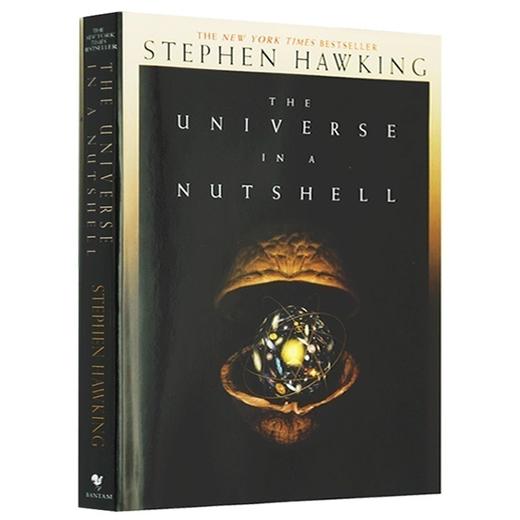
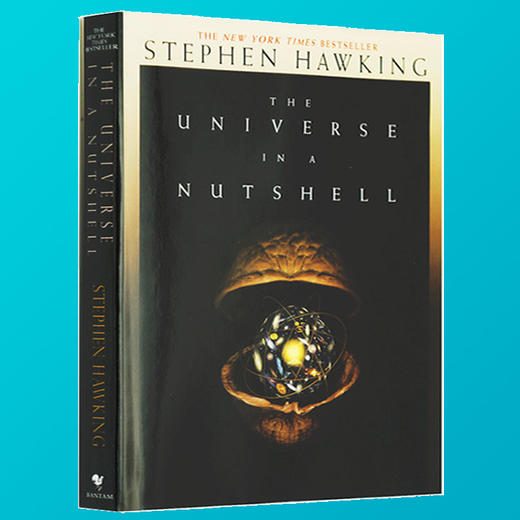
果壳中的宇宙 英文原版 The Universe in a Nutshell 史蒂芬霍金 精装全彩插图本 科普读物 时间简史作者正版进口书
| 运费: | ¥ 0.00-999.00 |
| 库存: | 12 件 |
商品详情
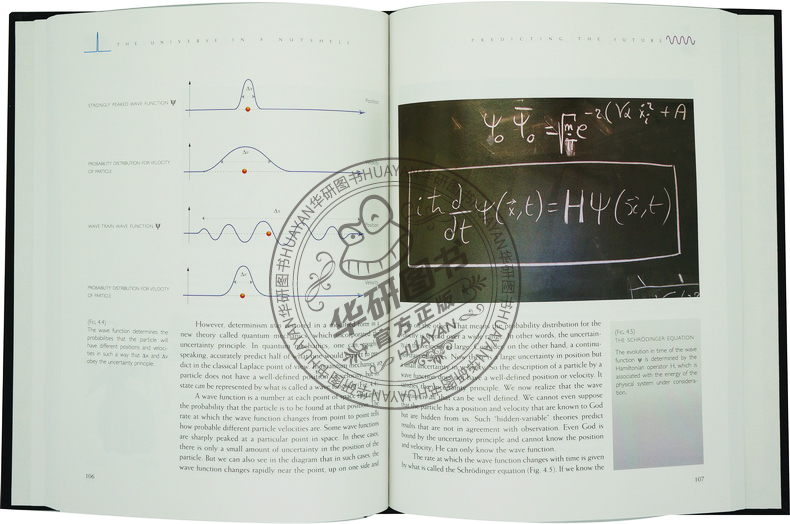
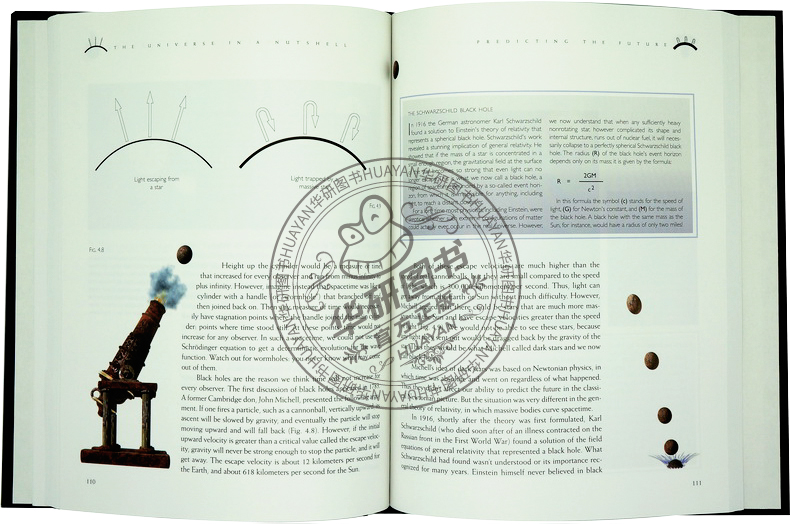
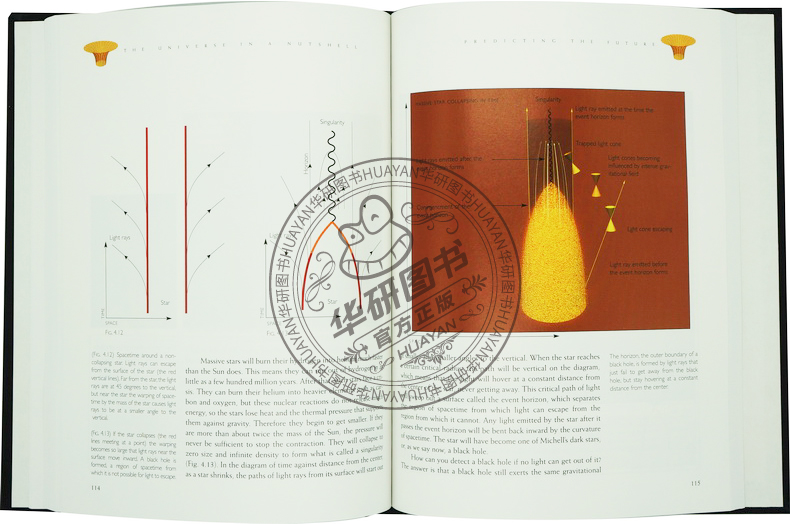

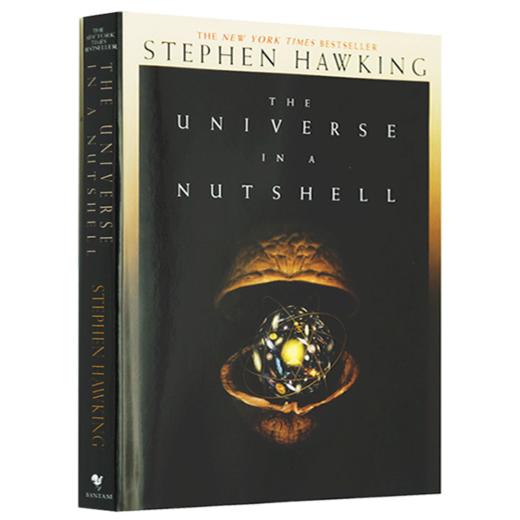
书名:The Universe in a Nutshell 果壳中的宇宙
作者:Stephen Hawking史蒂芬·霍金
出版社名称:Bantam
出版时间:2001
语种:英文
ISBN:9780553802023
商品尺寸:20.3 x 2.3 x 25.9 cm
包装:精装
页数:224

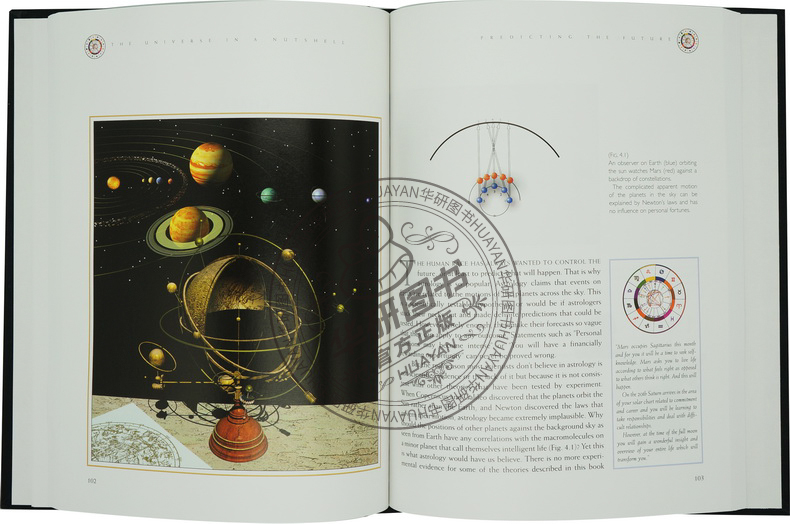
世界富有影响的思想家史蒂芬·霍金继推出轰动全球的《时间简史》后,奉献的又一部神圣的精华:The Universe in a Nutshell《果壳中的宇宙》。在这次新的出版盛事中,霍金又给我们送来了插图丰富的续篇。《果壳中的宇宙》将阐述在自倍受赞誉的第1部著作《时间简史》首版以来的重要突破的神秘。
推荐理由:
1.世界伟大的思想家、宇宙学家之一史蒂芬·霍金的经典著作;
2.国内外非常畅销的科普经典作品,曾获得安万特科学图书奖;
3.英文原版,精装插图版,大开本。
Stephen Hawking’s first full length book since the worldwide bestseller A Brief History of Time, lavishly illustrated in full colour throughout.
Review
“Clear, concise and accessible. And he leavens it further with occasional wry humor.” — St Louis Post-Dispatch
“Provocative and informed... plenty of comprehensible analogies and no small amount of humor, often self-deprecating... Best of all, the book is liberally sprinkled with well-conceived, gorgeously rendered and frequently whimsical illustrations. ” — Time

The Universe in a Nutshell《果壳中的宇宙》的一章相对论简史中主要是关于爱因斯坦的生平。量子论则是实验观测的被动产物,它的含义迄今还解释不清。在广义相对论中,时空不再是一个被动的背景,而是宇宙演化的主动参与者。物质分布使时空弯曲。现在再去侈谈宇宙之外的空间和时间,对这些概念进行所谓的思辨,只能是倒退到圣奥古斯丁之前。牛顿的时空观是一个虚幻,而虚幻的功能是对软弱者的安慰。
爱因斯坦的引力论是将万有引力归结为时空的曲率。那么时空能否被弯曲得这么厉害,以至于人们可以返回到过去改变历史呢?严格的科学计算指出,这是不可能的。
那么关于预言将来的能力呢?现在看来它至少在三个层次上受到限制。一,是动力学系统的混沌行为,使得拉普拉斯意义上的决定性在实际上是不可能实现的。第二,在量子力学中状态是由波函数描述的,海森堡的不确定性原理使得经典意义上的决定性被减半。第三,不平凡的时空拓扑,使波函数被密度矩阵所取代,就在这里引进了热力学意义上的随机性。
宇宙的未来是怎样的呢?如果我们承认科学定律的普适性和无穷威力,则不管人类的雄心有多大,毕竟要受环境和人口问题的限制,我们不能和这些限制作无望和愚昧的搏斗。人类只能采用一种明智和节制欲望的生活方式。
从《时间简史》首版以来的十年间,相对论家、宇宙学家和粒子物理学家通力合作,在寻找宇宙核心的万物理论上取得长足进展。但和人们以往期望不同的是,我们可能不再具有统一理论的表述,这正如不能用一张地图描绘整个地球表面一样。这种所谓的M理论把超引力和五种弦理论在一个单独的理论框架中统一起来。超弦理论是在不同情形下对自然的方便的近似。但是M理论的整体概况还是不很清楚。
我们的宇宙很可能是高维空间中的一个四维膜,我们的宇宙果壳也就更加神奇了。困扰天体物理学家多年的暗物质很可能是影子星系的贯穿高维空间到达我们星系的引力效应,引力的近距效应和牛顿定律有偏差等等。四维膜之外的高维空间的行为如何是个饶有兴趣的问题。但是只要它们对膜世界具有相同的效应,对于它们的区别就没有意义。
量子宇宙学家就相信无中生有的场景而言是彻底的无神论者,就科学的方法论而言是不可救药的实证主义者,而就沉迷于宇宙和理论的美而言,又是泛神论者。
此书也许是一部以十几种文字在全球同步发行的科学著作。
Stephen Hawking’s phenomenal, multimillion-copy bestseller, A Brief History of Time, introduced the ideas of this brilliant theoretical physicist to readers all over the world.
Now, in a major publishing event, Hawking returns with a lavishly illustrated sequel that unravels the mysteries of the major breakthroughs that have occurred in the years since the release of his acclaimed first book.
The Universe in a Nutshell
- Quantum mechanics
— M-theory
— General relativity
— 11-dimensional supergravity
— 10-dimensional membranes
— Superstrings
— P-branes
— Black holes
One of the most influential thinkers of our time, Stephen Hawking is an intellectual icon, known not only for the adventurousness of his ideas but for the clarity and wit with which he expresses them. In this new book Hawking takes us to the cutting edge of theoretical physics, where truth is often stranger than fiction, to explain in laymen’s terms the principles that control our universe.
Like many in the community of theoretical physicists, Professor Hawking is seeking to uncover the grail of science—the elusive Theory of Everything that lies at the heart of the cosmos. In his accessible and often playful style, he guides us on his search to uncover the secrets of the universe—from supergravity to supersymmetry, from quantum theory to M-theory, from holography to duality.
He takes us to the wild frontiers of science, where superstring theory and p-branes may hold the final clue to the puzzle. And he lets us behind the scenes of one of his most exciting intellectual adventures as he seeks “to combine Einstein’s General Theory of Relativity and Richard Feynman’s idea of multiple histories into one complete unified theory that will describe everything that happens in the universe.”
With characteristic exuberance, Professor Hawking invites us to be fellow travelers on this extraordinary voyage through space-time. Copious four-color illustrations help clarify this journey into a surreal wonderland where particles, sheets, and strings move in eleven dimensions; where black holes evaporate and disappear, taking their secret with them; and where the original cosmic seed from which our own universe sprang was a tiny nut.
The Universe in a Nutshell is essential reading for all of us who want to understand the universe in which we live. Like its companion volume, A Brief History of Time, it conveys the excitement felt within the scientific community as the secrets of the cosmos reveal themselves.

史蒂芬·霍金(Stephen Hawking,1942年1月8日—2018年3月14日),ALS患者,英国物理学家和宇宙学家。肌肉萎缩性侧索硬化症患者,全身瘫痪,不能发音。霍金的主要研究领域是宇宙论和黑洞,证明了广义相对论的奇性定理和黑洞面积定理,提出了黑洞蒸发现象和无边界的霍金宇宙模型,在统一20世纪物理学的两大基础理论——爱因斯坦创立的相对论和普朗克创立的量子力学方面走出了重要一步。
霍金是继牛顿和爱因斯坦之后杰出的物理学家之一,被世人誉为“宇宙之王”。2017年4月,霍金接访采访表示,他比以前更加坚定地认为人类应该在2117年之前离开地球。
2018年3月14日,史蒂芬·霍金去世,享年76岁。
Stephen Hawking was the Lucasian Professor of Mathematics at the University of Cambridge for thirty years, and has been the recipient of numerous awards and honors including, most recently, the Presidential Medal of Freedom. His books for the general reader include the classic A Brief History of Time, Black Holes and Baby Universes and Other Essays, The Universe in a Nutshell, and A Briefer History of Time.He passed away at the age of 76 on March 14, 2018.
CHAPTER 2
THE SHAPE OF TIME
EINSTEIN?S GENERAL RELATIVITY GIVES TIME A SHAPE.
HOW THIS CAN BE RECONCILED WITH QUANTUM THEORY.
What is time? Is it an ever-rolling stream that bears all our dreams away, as the old hymn says? Or is it a railroad track? Maybe it has loops and branches, so you can keep going forward and yet return to an earlier station on the line.
The nineteenth-century author Charles Lamb wrote: ?Nothing puzzles me like time and space. And yet nothing troubles me less than time and space, because I never think of them.? Most of us don?t worry about time and space most of the time, whatever that may be; but we all do wonder sometimes what time is, how it began, and where it is leading us.
Any sound scientific theory, whether of time or of any other concept, should in my opinion be based on the most workable philosophy of science: the positivist approach put forward by Karl Popper and others. According to this way of thinking, a scientific theory is a mathematical model that describes and codifies the observations we make. A good theory will describe a large range of phenomena on the basis of a few simple postulates and will make definite predictions that can be tested. If the predictions agree with the observations, the theory survives that test, though it can never be proved to be correct.
On the other hand, if the observations disagree with the predictions, one has to discard or modify the theory. (At least, that is what is supposed to happen. In practice, people often question the accuracy of the observations and the reliability and moral character of those making the observations.) If one takes the positivist position, as I do, one cannot say what time actually is. All one can do is describe what has been found to be a very good mathematical model for time and say what predictions it makes.
Isaac Newton gave us the first mathematical model for time and space in his PRINCIPIA MATHEMATICA, published in 1687. Newton occupied the Lucasian chair at Cambridge that I now hold, though it wasn?t electrically operated in his time. In Newton?s model, time and space were a background in which events took place but which weren?t affected by them. Time was separate from space and was considered to be a single line, or railroad track, that was infinite in both directions. Time itself was considered eternal, in the sense that it had existed, and would exist, forever.
By contrast, most people thought the physical universe had been created more or less in its present state only a few thousand years ago. This worried philosophers such as the German thinker Immanuel Kant. If the universe had indeed been created, why had there been an infinite wait before the creation? On the other hand, if the universe had existed forever, why hadn?t everything that was going to happen already happened, meaning that history was over? In particular, why hadn?t the universe reached thermal equilibrium, with everything at the same temperature?
Kant called this problem an ?antimony of pure reason,? because it seemed to be a logical contradiction; it didn?t have a resolution. But it was a contradiction only within the context of the Newtonian mathematical model, in which time was an infinite line, independent of what was happening in the universe. However, as we saw in Chapter 1, in 1915 a completely new mathematical model was put forward by Einstein: the general theory of relativity. In the years since Einstein?s paper, we have added a few ribbons and bows, but our model of time and space is still based on what Einstein proposed. This and the following chapters will describe how our ideas have developed in the years since Einstein?s revolutionary paper. It has been a success story of the work of a large number of people, and I?m proud to have made a small contribution.
General relativity combines the time dimension with the three dimensions of space to form what is called spacetime. The theory incorporates the effect of gravity by saying that the distribution of matter and energy in the universe warps and distorts spacetime, so that it is not flat. Objects in this spacetime try to move in straight lines, but because spacetime is curved, their paths appear bent. They move as if affected by a gravitational field.
- 华研外语 (微信公众号认证)
- 本店是“华研外语”品牌商自营店,全国所有“华研外语”、“华研教育”品牌图书都是我司出版发行的,本店为华研官方源头出货,所有图书均为正规正版,拥有实惠与正版的保障!!!
- 扫描二维码,访问我们的微信店铺
- 随时随地的购物、客服咨询、查询订单和物流...