大街 英文原版小说 Main Street 进口英语书籍 全英文版文学小说
| 运费: | ¥ 0.00-999.00 |
| 库存: | 3 件 |





商品详情
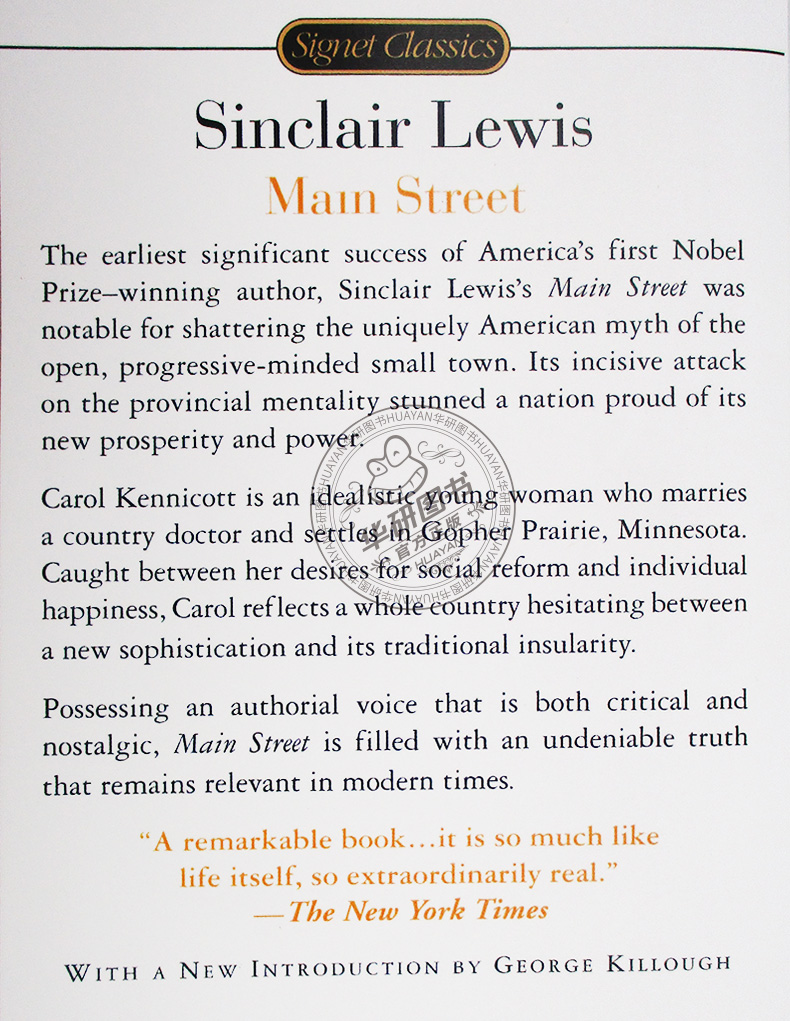
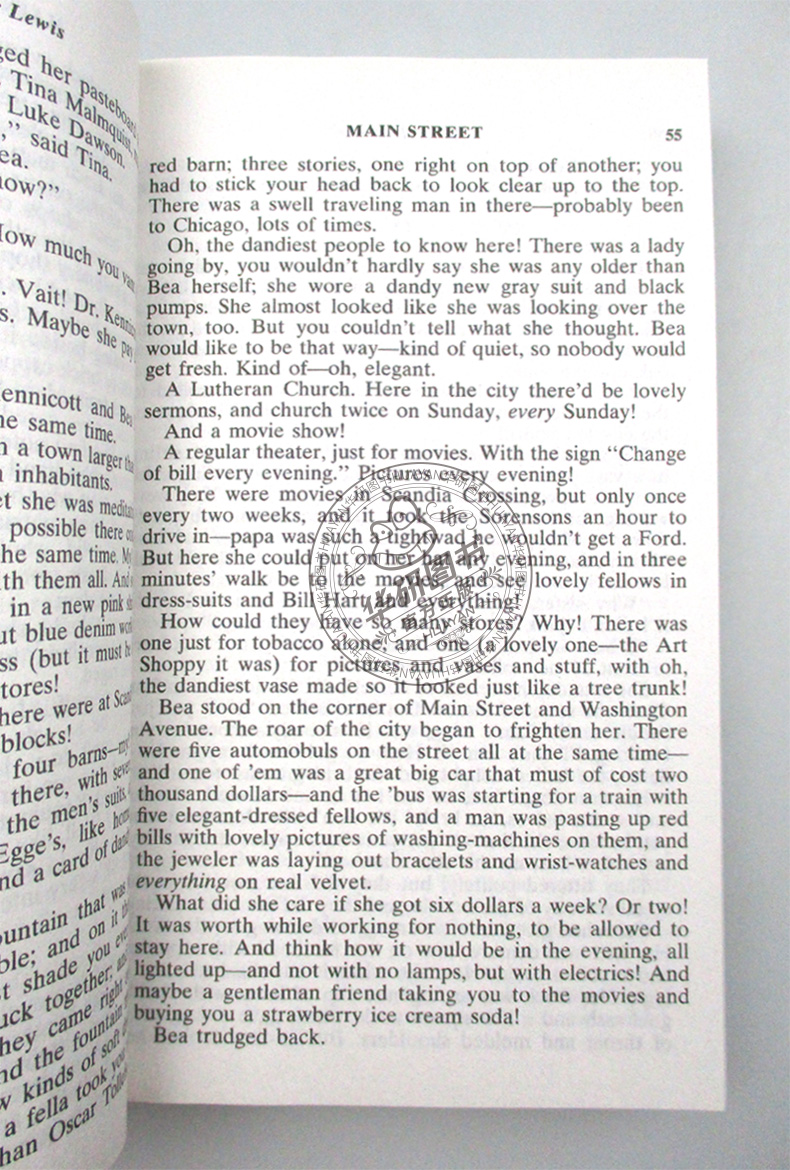
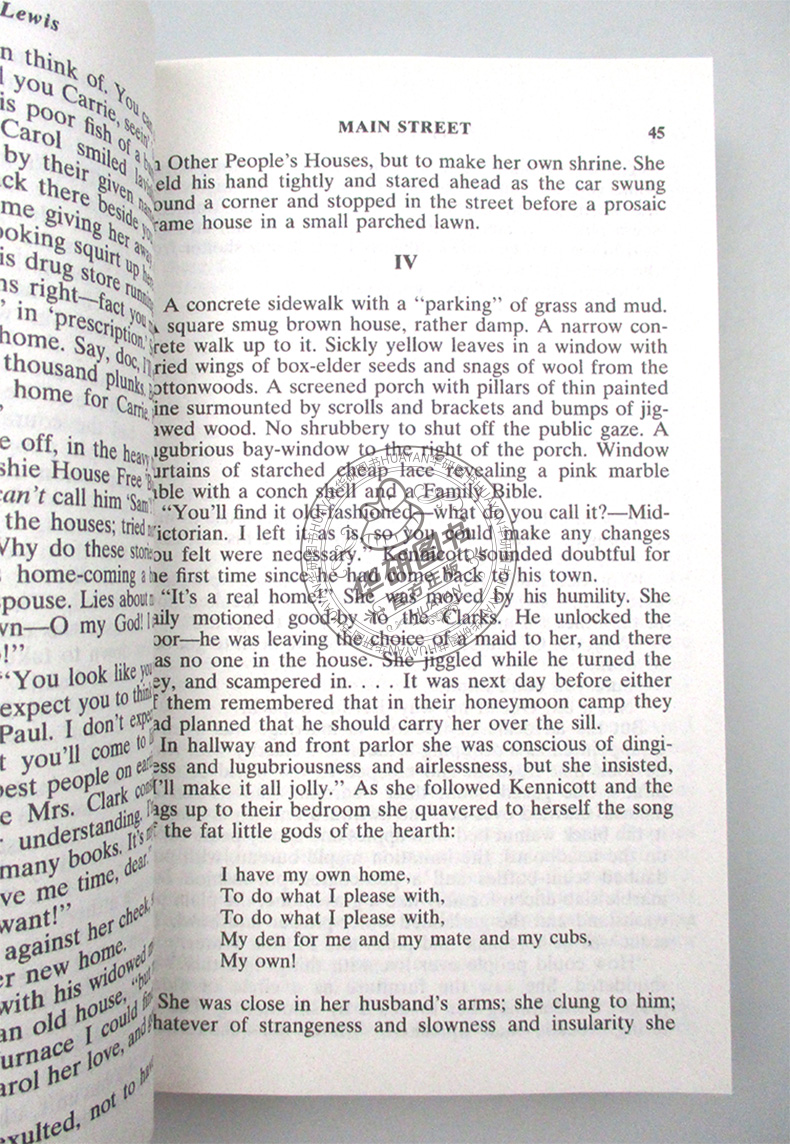
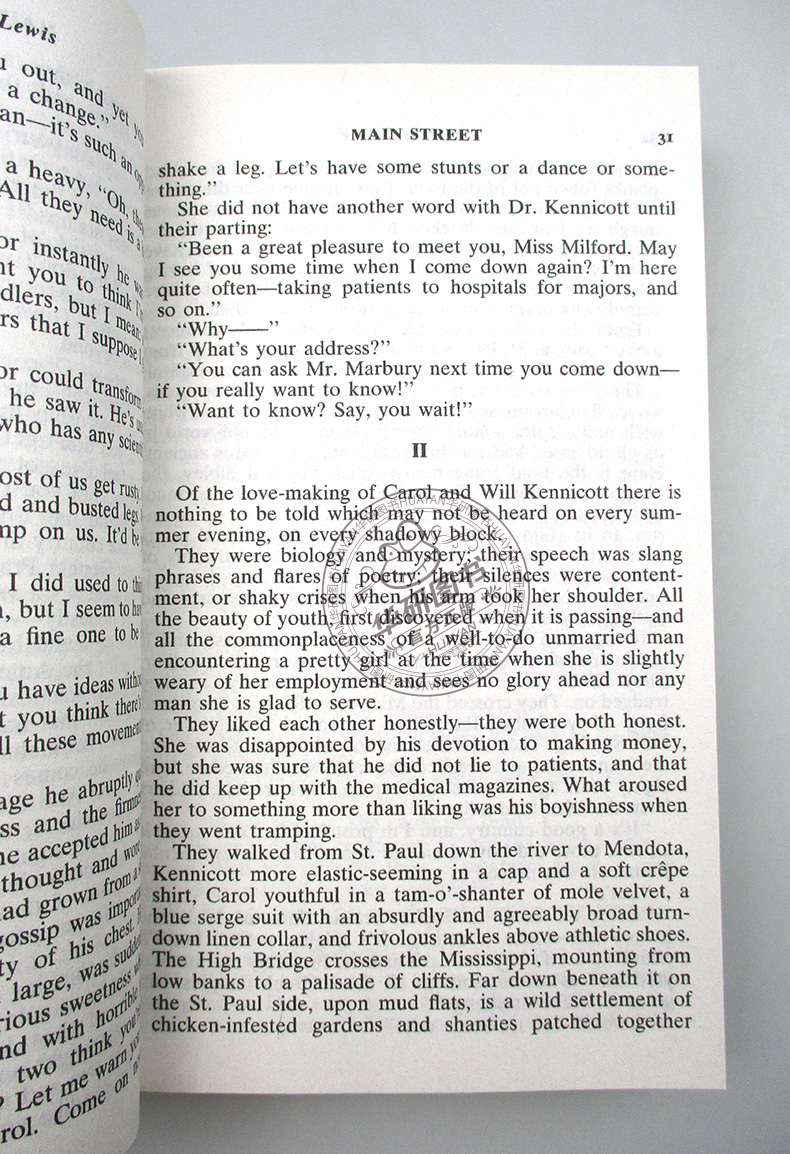



书名:Main Street大街
难度:Lexile蓝思阅读指数1010L
作者:Sinclair Lewis辛克莱•路易斯
出版社名称:Signet Classics
出版时间:2008
语种:英文
ISBN:9780451530981
商品尺寸:10.6 x 2.6x 17.3 cm
包装:简装
页数:480 (以实物为准)

Main Street《大街》是美国首位诺贝尔文学奖得主辛克莱·路易斯的代表作,问世后迅速风靡欧美国家,一年内重印28次,被誉为“发现美国的一个里程碑”,是“20世纪美国出版史上的轰动事件”。此书还成了当时堪萨斯州各级学校学生的必读教材。
辛克莱·路易斯在作品中对美国中产阶级的期望进行了嘲讽,引起了读者和评论家的共鸣。通过《大街》这部作品,路易斯展现了他的艺术潜质,创造出一部至今仍然影响深远的小说。他以深怀同情的笔触向我们描绘了一个在草原小镇看不到希望的知识女性的形象。来自圣保罗的图书馆员卡罗尔·米尔福德嫁给了威尔·肯尼科特医生,并随其来到他的家乡囊地鼠草原镇。肯尼科特希望卡罗尔安安静静做好他的妻子,支持他的事业,给他生一群孩子;卡罗尔则希望自己能有力量改良这个小镇的建筑风格、自然环境和人文环境。
本书为Signet Classics推出的英文原版,由George Killough作序,内容完整无删减,书本小巧便携。
The first of Sinclair Lewis’s great successes,Main Streetshattered the sentimental American myth of happy small-town life with its satire of narrow-minded provincialism. Reflecting his own unhappy childhood in Sauk Centre, Minnesota, Lewis’s sixth novel attacked the conformity and dullness he saw in midwestern village life. Young college graduate Carol Milford moves from the city to tiny Gopher Prairie after marrying the local doctor, and tries to bring culture to the small town. But her efforts to reform the prairie village are met by a wall of gossip, greed, conventionality, pitifully unambitious cultural endeavors, and—worst of all—the pettiness and bigotry of small-town minds.
Lewis’s portrayal of a marriage torn by disillusionment and a woman forced into compromises is at once devastating social satire and persuasive realism. His subtle characterizations and intimate details of small-town America makeMain Streeta complex and compelling work and established Lewis as an important figure in twentieth-century American literature.
With a new Introduction by George Killough

主人公卡罗尔出生于法官家庭,是个极具浪漫理想的女文青,大学毕业后嫁给了乡镇医生肯尼科特,满怀建设小镇的热情随夫来到囊地鼠草原镇。在试图改革重建的道路上,卡罗尔认识了形形色色的人,遇到了重重叠叠的障碍,特别是小镇上流社会保守势力的反对,她还被视为异端受到暗中监视。深感孤独与苦闷的卡罗尔选择逃离“大街”前往华盛顿独自谋生,却在两年后不得不重回丈夫身边,因为华盛顿只不过是放大了的囊地鼠草原镇,是另一条“大街”罢了。

辛克莱•路易斯(Sinclair Lewis,1885~1951),美国作家、剧作家,1885年出生于明尼苏达州的索克中心镇,1951年病逝于意大利首都罗马。路易斯一生创作20多部作品。1920年他以《大街》一举成名后,又推出《巴比特》(1922)和《阿罗史密斯》(1925)。这三部作品被认为是他的优秀之作,其中《阿罗史密斯》曾获1926年普利策文学奖,《巴比特》获1930年诺贝尔文学奖。
Sinclair Lewiswas born in 1885 in Sauk Centre, Minnesota, and graduated from Yale University in 1908. His college career was interrupted by various part-time occupations, including a period working at the Helicon Home Colony, Upton Sinclair’s socialist experiment in New Jersey. He worked for some years as a free lance editor and journalist, during which time he published several minor novels. But with the publication ofMain Street(1920), which sold half a million copies, he achieved wide recognition. This was followed by the two novels considered by many to be his finest,Babbitt(1922) andArrowsmith(1925), which was awarded the Pulitzer Prize in 1926, but declined by Lewis. In 1930, followingElmer Gantry(1927) andDodsworth(1929), Sinclair Lewis became the first American author to be awarded the Nobel Prize for distinction in world literature. This was the apogee of his literary career, and in the period fromAnnVickers(1933) to the posthumously publishedWorld So Wide(1951) Lewis wrote ten novels that reveal the progressive decline of his creative powers.From Main Street to Stockholm, a collection of his letters, was published in 1952, andThe Man from Main Street, a collection of essays, in 1953. During his last years Sinclair Lewis wandered extensively in Europe, and after his death in Rome in 1951 his ashes were returned to his birthplace.

Chapter One
ON A hill by the Mississippi where Chippewas camped two generations ago, a girl stood in relief against the cornflower blue of Northern sky. She saw no Indians now; she saw flour-mills and the blinking windows of skyscrapers in Minneapolis and St. Paul. Nor was she thinking of squaws and portages, and the Yankee fur-traders whose shadows were all about her. She was meditating upon walnut fudge, the plays of Brieux, the reasons why heels run over, and the fact that the chemistry instructor had stared at the new coiffure which concealed her ears.
A breeze which had crossed a thousand miles of wheatlands bellied her taffeta skirt in a line so graceful, so full of animation and moving beauty, that the heart of a chance watcher on the lower road tightened to wistfulness over her quality of suspended freedom. She lifted her arms, she leaned back against the wind, her skirt dipped and flared, a lock blew wild. A girl on a hilltop; credulous, plastic, young; drinking the air as she longed to drink life. The eternal aching comedy of expectant youth.
It is Carol Milford, fleeing for an hour from Blodgett College.
The days of pioneering, of lassies in sunbonnets, and bears killed with axes in piney clearings, are deader now than Camelot; and a rebellious girl is the spirit of that bewildered empire called the American Middlewest.
Chapter Two
Blodgett College is on the edge of Minneapolis. It is a bulwark of sound religion. It is still combating the recent heresies of Voltaire, Darwin, and Robert Ingersoll. Pious families in Minnesota, Iowa, Wisconsin, the Dakotas send their children thither, and Blodgett protects them from the wickedness of the universities. But it secretes friendly girls, young men who sing, and one lady instructress who really likes Milton and Carlyle. So the four years which Carol spent at Blodgett were not altogether wasted. The smallness of the school, the fewness of rivals, permitted her to experiment with her perilous versatility. She played tennis, gave chafing-dish parties, took a graduate seminar in the drama, went “twosing,” and joined half a dozen societies for the practise of the arts or the tense stalking of a thing called General Culture.
In her class there were two or three prettier girls but none more eager. She was noticeable equally in the classroom grind and at dances, though out of the three hundred students of Blodgett, scores recited more accurately and dozens Bostoned more smoothly. Every cell of her body was alive—thin wrists, quince-blossom skin, ingénue eyes, black hair.
The other girls in her dormitory marveled at the slightness of her body when they saw her in sheer negligée, or darting out wet from a shower-bath. She seemed then but half as large as they had supposed; a fragile child who must be cloaked with understanding kindness. “Psychic,” the girls whispered, and “spiritual.” Yet so radioactive were her nerves, so adventurous her trust in rather vaguely conceived sweetness and light, that she was more energetic than any of the hulking young women who, with calves bulging in heavy-ribbed woolen stockings beneath decorous blue serge bloomers, thuddingly galloped across the floor of the “gym” in practice for the Blodgett Ladies’ Basket-Ball Team.
Even when she was tired her dark eyes were observant. She did not yet know the immense ability of the world to be casually cruel and proudly dull, but if she should ever learn those dismaying powers, her eyes would never become sullen or heavy or rheumily amorous.
For all her enthusiasms, for all the fondness and the “crushes” which she inspired, Carol’s acquaintances were shy of her. When she was most ardently singing hymns or planning deviltry she yet seemed gently aloof and critical. She was credulous, perhaps; a born hero-worshipper; yet she did question and examine unceasingly. Whatever she might become she would never be static.
Her versatility ensnared her. By turns she hoped to discover that she had an unusual voice, a talent for the piano, the ability to act, to write, to manage organizations. Always she was disappointed, but always she effervesced anew—over the Student Volunteers, who intended to become missionaries, over painting scenery for the dramatic club, over soliciting advertisements for the college magazine.
She was on the peak that Sunday afternoon when she played in chapel. Out of the dusk her violin took up the organ theme, and the candle-light revealed her in a straight golden frock, her arm arched to the bow, her lips serious. Every man fell in love then with religion and Carol.
Throughout Senior year she anxiously related all her experiments and partial successes to a career. Daily, on the library steps or in the hall of the Main Building, the co-eds talked of “What shall we do when we finish college?” Even the girls who knew that they were going to be married pretended to be considering important business positions; even they who knew that they would have to work hinted about fabulous suitors. As for Carol, she was an orphan; her only near relative was a vanilla-flavored sister married to an optician in St. Paul. She had used most of the money from her father’s estate. She was not in love—that is, not often, nor ever long at a time. She would earn her living.
But how she was to earn it, how she was to conquer the world—almost entirely for the world’s own good—she did not see. Most of the girls who were not betrothed meant to be teachers. Of these there were two sorts: careless young women who admitted that they intended to leave the “beastly classroom and grubby children” the minute they had a chance to marry; and studious, sometimes bulbous-browed and pop-eyed maidens who at class prayer-meetings requested God to “guide their feet along the paths of greatest usefulness.” Neither sort tempted Carol. The former seemed insincere (a favorite word of hers at this era). The earnest virgins were, she fancied, as likely to do harm as to do good by their faith in the value of parsing Caesar.
At various times during Senior year Carol finally decided upon studying law, writing motion-pictures scenarios, professional nursing, and marrying an unidentified hero.
Then she found a hobby in sociology.
The sociology instructor was new. He was married, and therefore taboo, but he had come from Boston, he had lived among poets and socialists and Jews and millionaire uplifters at the University Settlement in New York, and he had a beautiful white strong neck. He led a giggling class through the prisons, the charity bureaus, the employment agencies of Minneapolis and St. Paul. Trailing at the end of the line Carol was indignant at the prodding curiosity of the others, their manner of staring at the poor as at a Zoo. She felt herself a great liberator. She put her hand to her mouth, her forefinger and thumb quite painfully pinching her lower lip, and frowned, and enjoyed being aloof.
A classmate named Stewart Snyder, a competent bulky young man in a gray flannel shirt, a rusty black bow tie, and the green-and-purple class cap, grumbled to her as they walked behind the others in the muck of the South St. Paul stockyards, “These college chumps make me tired. They’re so top-lofty. They ought to of worked on the farm, the way I have. These workmen put it all over them.”
“I just love common workmen,” glowed Carol.
“Only you don’t want to forget that common workmen don’t think they’re common!”
“You’re right! I apologize!” Carol’s brows lifted in the astonishment of emotion, in a glory of abasement. Her eyes mothered the world. Stewart Snyder peered at her. He rammed his large red fists into his pockets, he jerked them out, he resolutely got rid of them by clenching his hands behind him, and he stammered:
“I know. You get people. Most of these darn co-eds— Say, Carol, you could do a lot for people.”
“How?”
“Oh—oh well—you know—sympathy and everything—if you were—say you were a lawyer’s wife. You’d understand his clients. I’m going to be a lawyer. I admit I fall down in sympathy sometimes. I get so dog-gone impatient with people that can’t stand the gaff. You’d be good for a fellow that was too serious. Make him more—more—you know—sympathetic!”
His slightly pouting lips, his mastiff eyes, were begging her to beg him to go on. She fled from the steamroller of his sentiment. She cried, “Oh, see those poor sheep—millions and millions of them.” She darted on.
Stewart was not interesting. He hadn’t a shapely white neck, and he had never lived among celebrated reformers. She wanted, just now, to have a cell in a settlement-house, like a nun without the bother of a black robe, and be kind, and read Bernard Shaw, and enormously improve a horde of grateful poor.
The supplementary reading in sociology led her to a book on village-improvement—tree-planting, town pageants, girls’ clubs. It had pictures of greens and garden-walls in France, New England, Pennsylvania. She had picked it up carelessly, with a slight yawn which she patted down with her fingertips as delicately as a cat.
She dipped into the book, lounging on her window-seat, with her slim, lisle-stockinged legs crossed, and her knees up under her chin. She stroked a satin pillow while she read. About her was the clothy exuberance of a Blodgett College room: cretonne-covered window-seat, photographs of girls, a carbon print of the Coliseum, a chafing-dish, and a dozen pillows embroidered or beaded or pyrographed. Shockingly out of place was a miniature of the Dancing Bacchante. It was the only trace of Carol in the room. She had inherited the rest from generations of girl students.
It was as a part of all this commonplaceness that she regarded the treatise on village-improvement. But she suddenly stopped fidgeting. She strode into the book. She had fled half-way through it before the three o’clock bell called her to the class in English history.
She sighed, “That’s what I’ll do after college! I’ll get my hands on one of these prairie towns and make it beautiful. Be an inspiration. I suppose I’d better become a teacher then, but—I won’t be that kind of a teacher. I won’t drone. Why should they have all the garden suburbs on Long Island? Nobody has done anything with the ugly towns here in the Northwest except hold revivals and build libraries to contain the Elsie books. I’ll make ’em put in a village green, and darling cottages, and a quaint Main Street!”
Thus she triumphed through the class, which was a typical Blodgett contest between a dreary teacher and unwilling children of twenty, won by the teacher because his opponents had to answer his questions, while their treacherous queries he could counter by demanding, “Have you looked that up in the library? Well then, suppose you do!”
The history instructor was a retired minister. He was sarcastic today. He begged of sporting young Mr. Charley Holmberg, “Now Charles, would it interrupt your undoubtedly fascinating pursuit of that malevolent fly if I were to ask you to tell us that you do not know anything about King John?” He spent three delightful minutes in assuring himself of the fact that no one exactly remembered the date of Magna Charta.
Carol did not hear him. She was completing the roof of a half-timbered town hall. She had found one man in the prairie village who did not appreciate her picture of winding streets and arcades, but she had assembled the town council and dramatically defeated him.
- 华研外语 (微信公众号认证)
- 本店是“华研外语”品牌商自营店,全国所有“华研外语”、“华研教育”品牌图书都是我司出版发行的,本店为华研官方源头出货,所有图书均为正规正版,拥有实惠与正版的保障!!!
- 扫描二维码,访问我们的微信店铺
- 随时随地的购物、客服咨询、查询订单和物流...