Data-driven Process Monitoring and Fault-tolerant Control for Complex Industrial Systems(自动化技术计算机技术)
| 运费: | ¥ 10.00-25.00 |
| 库存: | 30 件 |



商品详情
《Data-driven Process Monitoring and Fault-tolerant Control for Complex Industrial Systems》
作者:黄健 高晶晶 杨旭
定价:129.00元
出版时间:2026-07
ISBN:978-7-5240-0645-9
内容简介
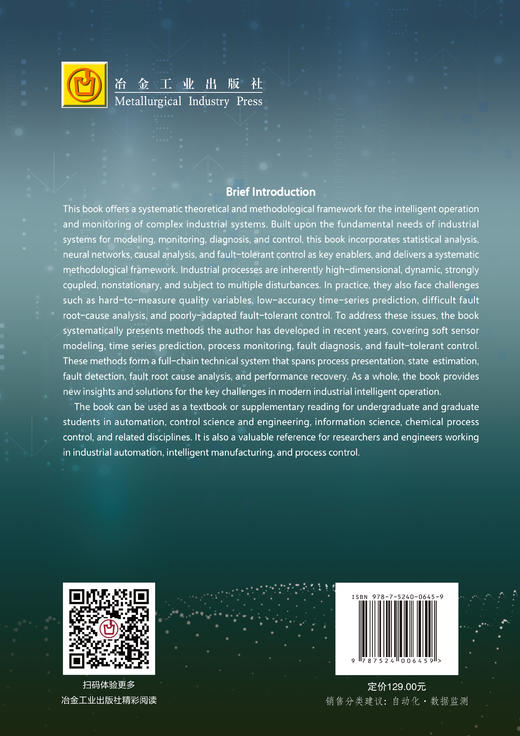
本书聚焦工业系统智能化运营中的数据驱动建模、控制、监测核心问题,针对工业过程强非线性、变量紧耦合、数据非平稳性等特征,以及传统方法建模精度不足、泛化能力弱等痛点,系统研究了软测量、时间序列预测、过程监测、故障溯源与容错控制等关键技术。书中先梳理统计分析、神经网络、因果分析等基础理论与方法,为后续研究奠定理论支撑,再从特征学习、模型结构设计、系统级应用角度,提出一系列改进方法,构建了适配复杂工业环境的建模与监测体系。 全书内容依次围绕“可预测潜特征学习的工业过程软测量建模”“基于回声状态网络的时间序列预测改进方法”“多元统计与神经网络融合的过程监测”“深度特征学习的工业过程监测”“时间序列因果检验的故障溯源”“旋转机械故障诊断深度学习方法”及“复杂工业系统故障检测与容错控制”展开研究,并结合脱丁烷塔、硫磺回收装置、田纳西 - 伊斯曼过程等典型工业案例验证方法有效性,为工业系统安全运行与性能优化提供了实用的技术方案和理论参考。
目录
1Introduction1
1.1Trends and mainstream in research3
1.1.1Soft sensing modeling 3
1.1.2Time series prediction4
1.1.3Process monitoring6
1.1.4Fault diagnosis8
1.1.5Fault-tolerant control12
1.2Outline of the contents14
References17
2Preliminaries21
2.1Statistical methods23
2.1.1Nonlinear iterative partial least squares(NIPALS)23
2.1.2Slow feature analysis24
2.1.3t-distributed stochastic neighbor embedding24
2.1.4Cointegration analysis25
2.2Neural network29
2.2.1Autoencoder29
2.2.2Recurrent neural network33
2.2.3Neural ordinary differential equations36
2.2.4Generative adversarial network37
2.2.5Extreme learning machine38
2.2.6Deep transfer learning40
2.3Causality analysis42
2.3.1Time lag analysis42
2.3.2Granger causality43
2.3.3Hidden Markov model44
2.3.4Bayesian network45
2.3.5Liang-Kleeman information flow46
2.4Robust control49
2.4.1Stable kernel and image representation of system49
2.4.2Gap metric51
References52
3Soft Sensing Modeling Based on Predictable Latent Feature Learning53
3.1Introduction55
3.2Predictive feature analysis with dual-rate linear mechanism
for soft sensing modeling56
3.2.1Problem formulation56
3.2.2Long-term dependency slow feature PLS56
3.2.3Residual-driven latent variable model with fast time-varying
process components57
3.2.4Layer-wise-residuals-driven approach for quality prediction in
composite dynamic process59
3.3Predictive autoencoder with graph regularization mechanism
for soft sensing modeling61
3.3.1Problem formulation61
3.3.2Predictability of time-series data with JMI61
3.3.3Predictable TAE with graph embedding62
3.3.4Deep-transfer predictable network with graph representation64
3.4Predictive autoencoder with variational dynamic embedding
for soft sensing modeling67
3.4.1Problem formulation67
3.4.2Supervised deep networks with a latent dynamic model embedding67
3.4.3Latent probabilistic dynamics with graph-guiding68
3.4.4Soft sensing with GLPDSDN70
3.5Predictive autoencoder with irregular time interval adaptation
for soft sensing modeling73
3.5.1Problem formulation73
3.5.2Extraction of predictable latent features73
3.5.3Irregular-time-interval latent probabilistic predictability embedding
autoencoder74
3.6Case study78
3.6.1Case1:soft sensing application of a debutanizer column process78
3.6.2Case2:soft sensing application of a sulfur recovery unit83
3.7Chapter conclusion88
References89
4Time Series Prediction Based on Echo State Networks91
4.1Introduction93
4.2Echo state network with error-driven chained multiple-
subnetwork mechanism for time series prediction94
4.2.1Problem formulation94
4.2.2Network structure and chained optimization mechanism94
4.2.3Training strategy and determination of the optimal number of
subnetworks95
4.3Echo state network with semi-supervised partial correlation
pruning for time series prediction97
4.3.1Problem formulation97
4.3.2Partial correlation analysis of reservoir neurons97
4.3.3Partial correlation pruning for unsupervised ESN98
4.3.4The structure of PCP-S2ESN model100
4.4Echo state network with t-SNE dimensionality reduction of
state matrix for time series prediction102
4.4.1Problem formulation102
4.4.2t-distributed stochastic neighbor embedding algorithm103
4.4.3TESN model104
4.5Case study106
4.5.1Case 1:time series prediction of the Santa Fe laser dataset106
4.5.2Case 2:time series prediction of energy consumption in public
building109
4.6Chapter conclusion114
References115
5Process Monitoring Based on Multivariate Statistics
and Neural Networks117
5.1Introduction119
5.2Cointegration analysis with nonstationarity sensitive variable
selection for dynamic process monitoring120
5.2.1Problem formulation120
5.2.2Nonstationarity sensitive variables selection 121
5.2.3Monitoring method based on NSCA122
5.2.4Case study:Tennessee Eastman process124
5.3Active nonstationary variables selection with just-in-time
cointegration analysis and slow feature analysis for dynamic
process monitoring129
5.3.1Problem formulation129
5.3.2Nonstationary variables selection129
5.3.3Just-in-time active nonstationary variables selection130
5.3.4Monitoring method based on JTCA-SFA131
5.3.5Case study:vinyl acetate monomer process133
5.4Cointegration stacked autoencoder with stationary feature
reconstruction for nonstationary process monitoring137
5.4.1Problem formulation137
5.4.2Design of SAE incorporated with cointegration analysis137
5.4.3Monitoring method based on CSAE138
5.4.4Case study:vinyl acetate monomer process141
5.5Two-stage stacked autoencoder with deep slow feature
representation for dynamic process monitoring144
5.5.1Problem formulation144
5.5.2Design of SAE incorporated with SFA principles144
5.5.3Monitoring method based on SFCSAE146
5.5.4Case study:vinyl acetate monomer process149
5.6Chapter conclusion153
References154
6Process Monitoring Based on Deep Learning Networks155
6.1Introduction157
6.2Deep probabilistic probabilistic learning with t-distributed stochastic
neighbor embedding for industrial process monitoring158
6.2.1Problem formulation158
6.2.2Design of VAE embedded with t-SNE neighborhood information159
6.2.3Monitoring method based on t-SNVAE160
6.2.4Case study:three-phase flow facility162
6.3Variational discriminative stacked autoencoder with a
prelearned discriminator for industrial process monitoring165
6.3.1Problem formulation165
6.3.2Prelearned variational discriminator165
6.3.3Design of variational discriminative SAE166
6.3.4Monitoring method based on VDSAE168
6.3.5Case study:wastewater treatment process168
6.4Unsupervised transfer autoencoder with adversarial strategy
for industrial process monitoring171
6.4.1Problem formulation171
6.4.2Domain adversarial training and universal feature representation
learning171
6.4.3Monitoring method based on AFD-mtAE173
6.4.4Case study:vinyl acetate monomer process174
6.5Chapter Conclusion178
References179
7Root Cause Diagnosis Based on Time-Series Causality Analysis181
7.1Introduction183
7.2Variable time-lag multivariate Granger causality with dynamic
coupling for root cause diagnosis184
7.2.1Problem formulation184
7.2.2Variable lag analysis and dynamic coupling intensity
quantification184
7.2.3Variable-lag-aware multivariate Granger causality scheme with
redundant causality removal186
7.3Liang-Kleeman information flow with cointegration constraints
for root cause diagnosis in nonstationary processes191
7.3.1Problem formulation191
7.3.2Liang-Kleeman information flow scheme with cointegration
constraints191
7.4Temporal causality Bayesian network with variable time lags
for cyclic loop diagnosis194
7.4.1Problem formulation194
7.4.2Cyclic loop decomposition mechanism based on dynamic time
warping194
7.4.3Variable time lag Bayesian network diagnosis scheme integrated
with HMM198
7.5Case study202
7.5.1Analysis of variable time lag and dynamic coupling202
7.5.2Elimination of redundant and spurious causality205
7.5.3Root cause diagnosis in nonstationary scenarios207
7.5.4Diagnosis of cyclic loops using bayesian networks210
7.6Chapter conclusion213
References214
8Rotating Machinery Fault Diagnosis Based on Deep Learning Methods215
8.1Introduction217
8.2Structure-preserving semi-supervised learning with graph
embedding for fault diagnosis under low-labeled conditions218
8.2.1Problem formulation218
8.2.2Data preprocessing and power spectral density transformation218
8.2.3Hybrid similarity measurement design219
8.2.4Construction of self-selected K-nearest neighbor graph220
8.2.5Graph structure-embedded SAE model construction220
8.3Ensemble denoising autoencoders with mutual information
constraint for fault diagnosis under noisy conditions223
8.3.1Problem formulation223
8.3.2Overall framework of the ETSDAE for fault diagnosis223
8.3.3Targeted ensemble denoising strategy224
8.3.4Optimization of cost function with mutual information constraints226
8.4Ensemble denoising autoencoders with mutual information
constraint for fault diagnosis under imbalanced conditions230
8.4.1Problem formulation230
8.4.2Multi-domain deep feature learning based on stacked denoising
autoencoder230
8.4.3Cost-sensitive strategy for the improved weighted extreme learning
machine231
8.4.4Development of the MOMVO algorithm for IWELM to realize the
adaptive cost strategy232
8.5Extreme learning machine with prior-guided adjustable input
for fault diagnosis under noisy and imbalanced conditions234
8.5.1Problem formulation234
8.5.2Deep feature learning and prior probability models construction234
8.5.3Bayesian posterior probability-weighted cost function for DIWELN235
8.5.4Dynamic input weight adjustment via multi-verse optimization236
8.6Case study238
8.6.1Case 1:fault diagnosis of laboratory rolling bearings238
8.6.2Case 2:fault diagnosis of industrial pump equipment244
8.7Chapter conclusion253
References254
9Fault Detection and Fault-tolerant Control Based on Subspace
Identification2559.1Introduction257
9.2Integrated performance degradation detection and recovery
with 2-DOF controllers for feedback control systems258
9.2.1Problem formulation258
9.2.2Gap metric based performance degradation detection258
9.2.3Design and implementation methodologies for performance
degradation recovery261
9.2.4Case study:laboratory three-tank system265
9.3Performance-oriented fault detection and fault-tolerant
control with improved stochastic configuration network for
nonlinear uncertain systems268
9.3.1Problem formulation268
9.3.2Improved stochastic configuration network-based nonlinear system
modeling268
9.3.3Performance-oriented FD and FTC for nonlinear uncertain
systems272
9.3.4Case study:continuous stirred-tank reacto system274
9.4Fault-tolerant control with hierarchical enhanced information
structure for industrial interconnected systems279
9.4.1Process descriptions and problem formulation279
9.4.2Generalization of subspace identification to the interconnected
system280
9.4.3Hierarchical enhanced information structure283
9.4.4Case study:AGC system of hot tandem rolling mill processes286
9.5Chapter conclusion290
References291
- 冶金工业出版社图书旗舰店
- 冶金工业出版社,是国内历史最悠久的专业科技出版社之一。主要承担学术专著、技术著作、技术手册、专业辞书、大中专教材、职工培训教材、科普读物、人文社科、文集、史志、年鉴等图书的出版。
- 扫描二维码,访问我们的微信店铺