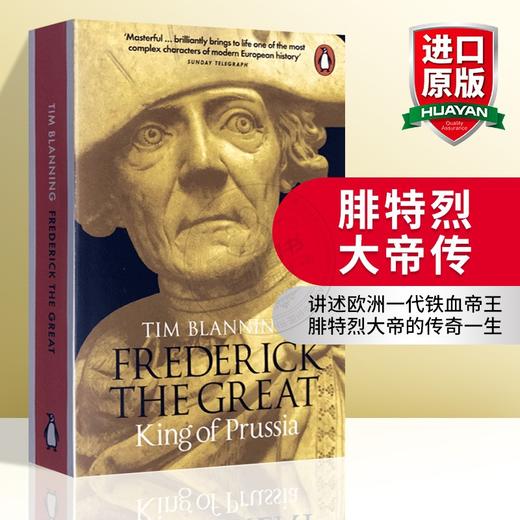
腓特烈大帝传 英文原版人物传记 Frederick the Great King of Prussia 全英文版 正版进口书籍 Penguin 企鹅经典
| 运费: | ¥ 0.00-999.00 |
| 库存: | 4 件 |




商品详情
 书名:Frederick the Great: King of Prussia腓特烈大帝传
作者:Tim Blanning
出版社名称:Penguin
出版时间:2016
语种:英文
ISBN:9780141039190
商品尺寸:12.9 x 2.9 x 19.8 cm
包装:平装
页数:672 腓特烈二世,后世尊称其为腓特烈大帝(Frederick the Great),普鲁士王国国王(1740年—1786年),欧洲历史上伟大的名将之一、著名军事家、政治家,还是一名作家、作曲家。腓特烈二世曾两次发动西里西亚战争。1756年发动对法兰西王国、俄罗斯帝国和奥地利公国等国的七年战争。1772年同俄罗斯帝国、奥地利大公国乘波兰内政危机第1次瓜分波兰领土,获得西普鲁士的领土。1785年组建由15个德意志联邦国组成的诸侯联盟。
腓特烈二世是欧洲“开明专制”的代表人物,在政治、经济、哲学、法律、甚至音乐诸多方面都颇有建树,为启蒙运动一大重要人物。在其铁腕统治下,普鲁士的国力迅速上升,在很短时间内便跃居欧洲列强之列。
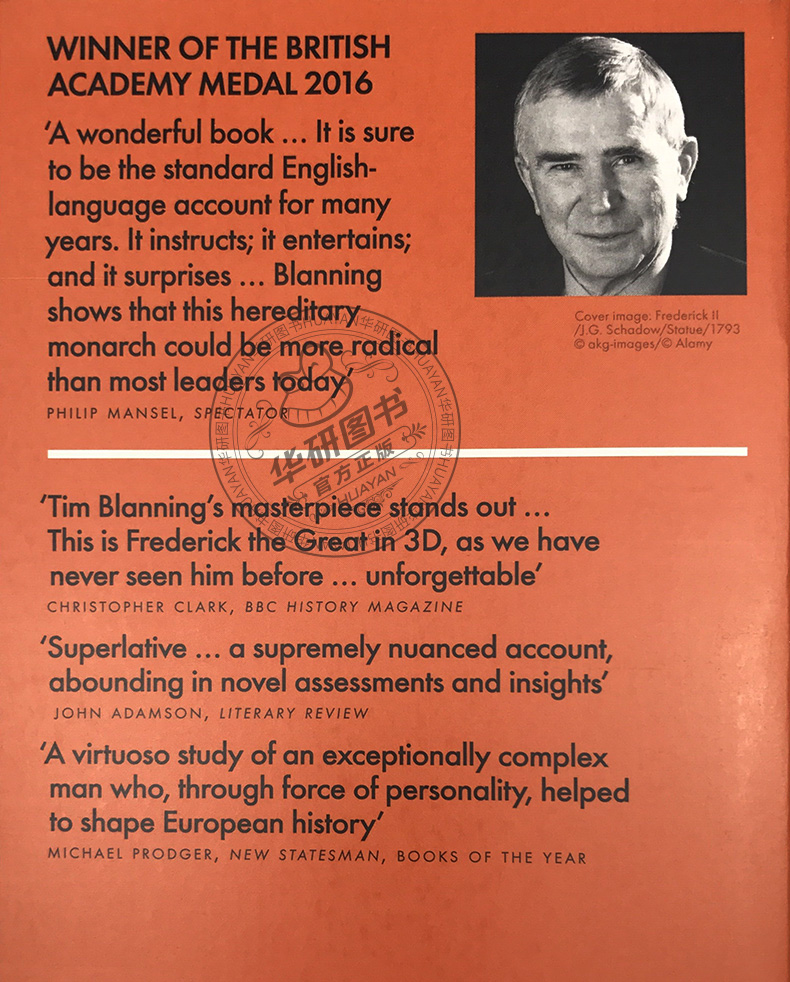
Frederick the Great: King of Prussia是英国剑桥大学历史教授布莱宁(Tim Blanning)所著的一本传记,讲述了欧洲一代铁血帝王腓特烈大帝的传奇一生,并重现了当时那个非凡时代的盛世景象。本书获颁2016年British Academy Medal。
Frederick the Great, King of Prussia, dominated the eighteenth century in the same way that Napoleon dominated the start of the nineteenth. He was a force of nature, a ruthless, brilliant, charismatic military commander, a monarch of exceptional energy and talent, a gifted composer, performer, poet and philosopher, and a discerning patron of artists, architects and writers, most famously Voltaire. From the very start of his reign he was an intensely divisive figure - fascinating even to those who hated him.
Tim Blanning's brilliant new biography captures Frederick's vitality, complexity and flawed genius better than any previous writer. He also recreates a remarkable era, the last flowering of the old regime that would be swept away almost immediately after Frederick's death by the French Revolution.
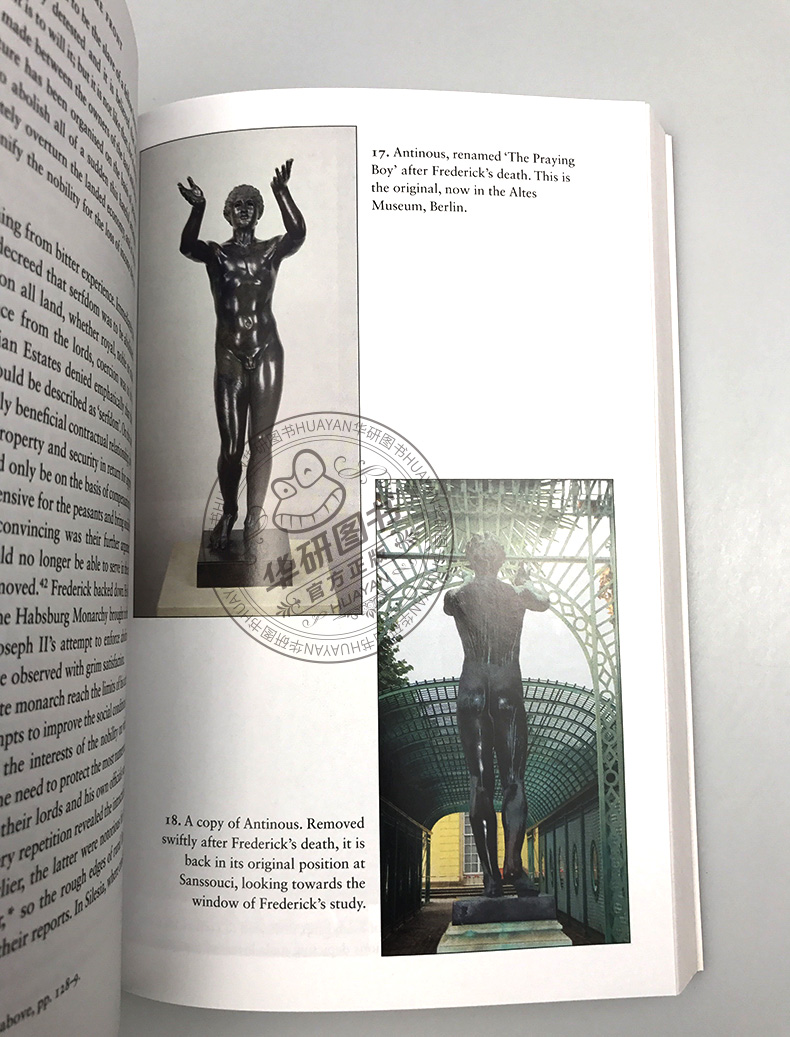
Equally at home on the battlefield or in the music room at Frederick's extraordinary miniature palace of Sanssouci, Blanning draws on a lifetime's immersion in the eighteenth century to present him in the round, with new attention paid to his cultural self-fashioning, including his sexuality. Frederick's spectre has hung over Germany ever since, both as inspiration and warning - Blanning at last allows us to understand him in his own time.
Review
'Highly readable and deeply researched' -- Andrew Roberts
'Masterful ... brilliantly brings to life one of the most complex characters of modern European history' -- Sunday Telegraph
'It is sure to be the standard English-language account for many years. It instructs; it entertains; and it surprises' -- Philip Mansel, The Spectator Tim Blanningis the author of a number of major works on eighteenth century Europe, including The Pursuit of Glory : Europe 1648-1815, The Culture of Power and the Power of Culture and Joseph II. He is Emeritus Professor of Modern European History at the University of Cambridge, a Fellow of Sidney Sussex College, Cambridge and a Fellow of the British Academy. His latest book, Frederick the Great, won the British Academy Medal 2016.
 Part I The Sufferings and Greatness of Frederick
1.The Inheritance
2.The Breaking of Frederick
3.The Making of Frederick
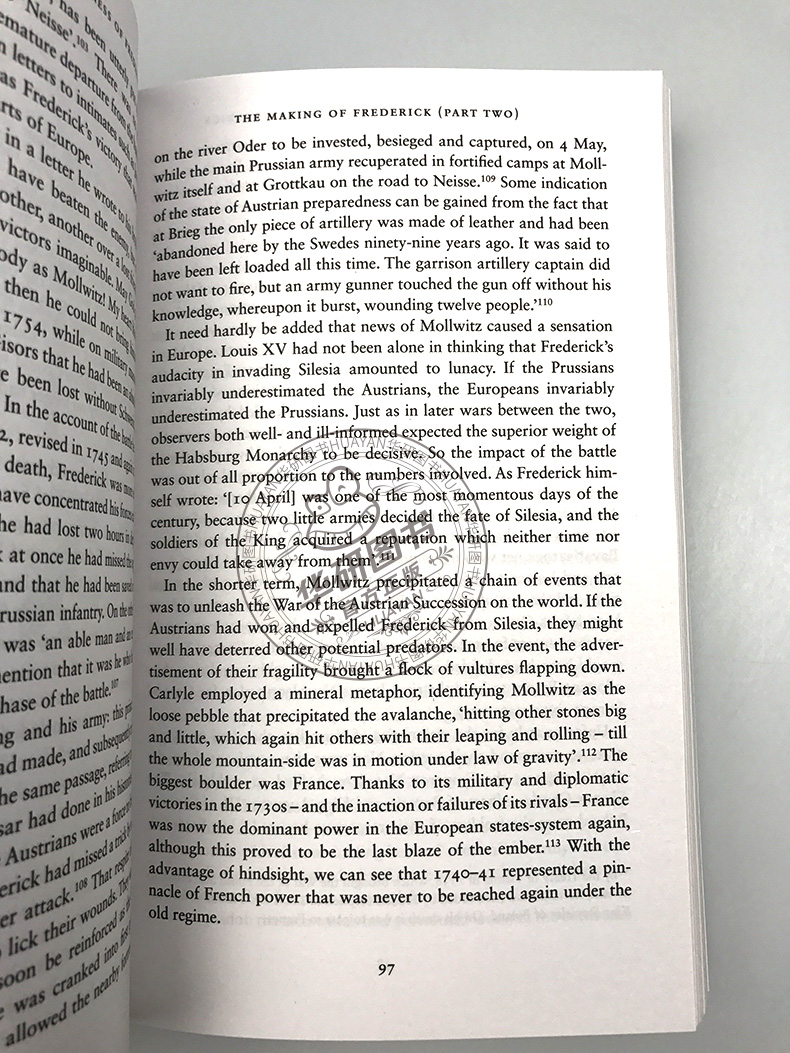
4.The Making of Frederick (Part Two)
5.The Masterful Servant of the State
6.Culture
Part II War and Peace
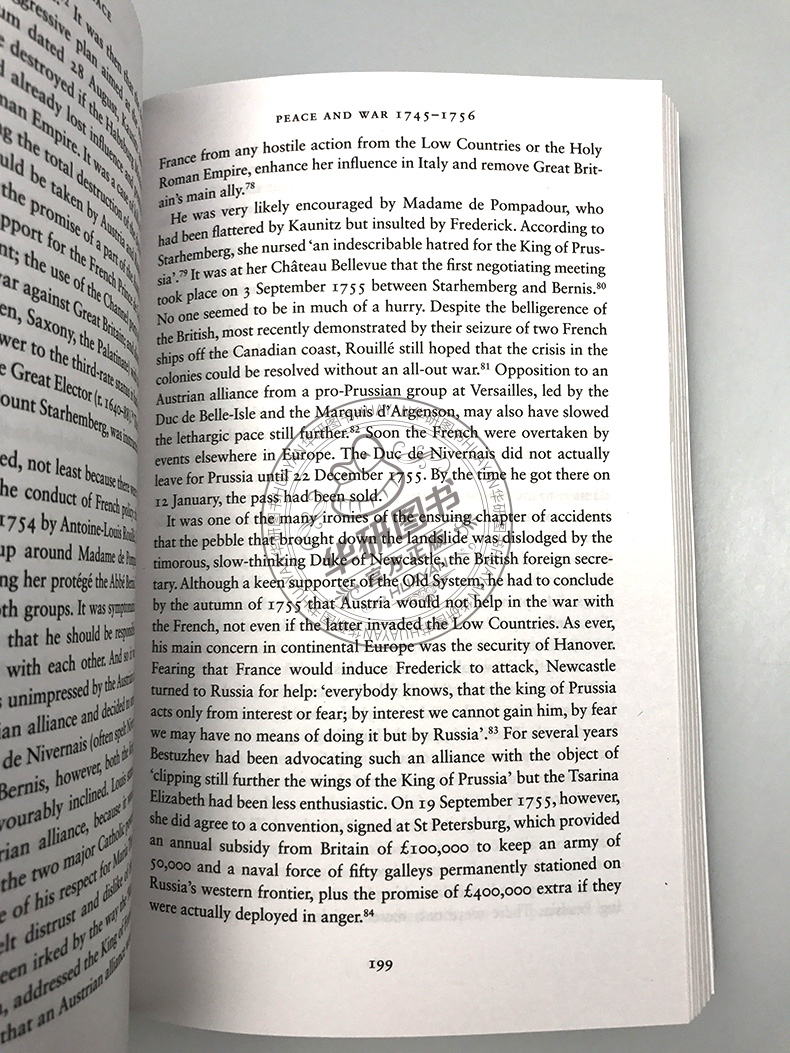
7.Peace and War 1745-1756
8.The Seven Years War: The First Three Campaigns
9.The Seven Years War: Disaster and Survival
10.The Seven Years War: Why Frederick Won
11.A Long Peace, a Short War and Double Diplomacy
Part III On the Home Front
12.Public and Nation
13.Light and Dark on the Home Front
14.Country and Town
15.At Court and at Home
‘Apart from Libya, there are few states that can equal ours when it comes to sand,’ wrote Frederick to Voltaire early in i6, adding later the same year in his Account of the Prussian Government that it was ‘poor and with scarcely any resources’. Not for nothing was Frederick’s core territory Brandenburg known as the ‘sandbox of the Holy Roman Empire’. This was a land of thin soil thinly populated, where lakes alternated with heaths, bogs with moors. Frederick told d’Alernbert that the good people of Aachen had come to believe that their foul-tasting mineral water represented the summit of God’s creation, in the same way that the Jews worshipped the mud of Jerusalem, but as for himself, he could never work up the same sort of enthusiasm for the Prussian equivalent: sand.
This repeated denigration was, of course, fishing for compliments. ‘If I could do all this with so little, what might I have done if I had had the population of France or the riches of England?’ was his unspoken question. It was all greatly overdone. Much of the soil of Brandenburg may have been infertile, but at least it was not mountainous. Across its featureless landscape wound rivers wide and slow- flowing, well suited for transportation in an age when roads were dust bowls when the sun shone and glutinous pits when the rains came. This was a natural gift to which Frederick’s predecessors had given a generous helping hand. During the 1660s, for example, his great-grandfather, Frederick William ‘The Great Elector’, had completed the ‘Müllrose canal, begun back in 1558, to allow shipping to cross from the Oder to the Spree and Berlin, and from there via the Havel to the Elbe and the North Sea.3 As his Austrian enemies slogged their way up hill and down dale, how they must have envied the Prussians the waterways that allowed them to move men and materiel so easily.
In any case, the Hohenzollern possessions were much more than just Brandenburg. In the far west, on the Dutch frontier, was the duchy of Cleves, sitting astride the Rhine, together with the adjacent county of Mörs. The latter included the town of Krefeld, home to a large community of Mennonites and their flourishing textile manufactories. On the right (eastern) bank of the Rhine was the county of Mark, bisected by the river Ruhr, which eventually gave its name to the most industrialized region of continental Europe. Also in fertile Westphalia were the counties of Ravensberg, Tecklenburg and Lingen and the principality of Minden. Further east, immediately to the south of Brandenburg, were the principality of Halberstadt and the duchy of Magdeburg. The city of Magdeburg on the river Elbe boasted one of Germany’s biggest cathedrals and strongest fortifications.
- 华研外语 (微信公众号认证)
- 本店是“华研外语”品牌商自营店,全国所有“华研外语”、“华研教育”品牌图书都是我司出版发行的,本店为华研官方源头出货,所有图书均为正规正版,拥有实惠与正版的保障!!!
- 扫描二维码,访问我们的微信店铺
- 随时随地的购物、客服咨询、查询订单和物流...