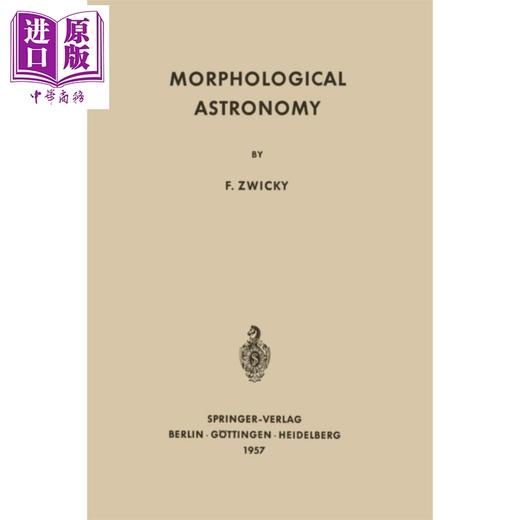
【中商原版】形态天文学 第1版 Morphological Astronomy 英文原版 Fritz Zwicky
| 运费: | ¥ 0.00-16.00 |
| 库存: | 1 件 |

商品详情
形态天文学 第1版 Morphological Astronomy 英文原版 Fritz Zwicky
基本信息
Format Paperback | 299 pages
Dimensions 152 x 229 x 16.26mm | 447g
Publication date 01 Jun 2012
Publisher Springer-Verlag Berlin and Heidelberg GmbH & Co. KG
Imprint Springer-Verlag Berlin and Heidelberg GmbH & Co. K
Language English
Edition Statement Softcover reprint of the original 1st ed. 1957
Illustrations note IV, 299 p.
ISBN10 3642875467
ISBN13 9783642875465
书籍简介
在错综复杂的细节和不必要的复杂情况下,人很容易迷失或躲藏起来。如果能把事情做得复杂,为什么要简单地去做呢?然而,生活本身也有很多问题让我们忙个不停。似乎没有必要仅仅为了乐趣而制造额外的困难,特别是如果这些自我创造的困难变得实际上无法克服,并且最终导致许多不幸。思想和行动的形态模式被构想出来,是为了打破寄生的并发症野蛮生长对生命各个阶段的恶性控制。形态学思想和行动一旦被清楚地描绘和充分发展,并被足够多的人实践过,就很可能在所有人类活动中具有价值。由于形态方法具有的普遍性,因此首先应用它的领域的选择并不是特别关键的。作者打算写两到三本书的形态几个大的问题,这是一个技术和一般的社会性质。这本书特别关注天文学中形态学思维的一些含义。我们首先将强调形态学方法的基本特征,并将在若干具体案例中展示它的建设性力量。
Man has a great tendency to get lost or to hide, as the case may be, in a jungle of details and in unnecessary complications. Why do anything simply if you can do it complicated? And still, life itself presents a sufficient number of problems to keep us busy. There would seem to be no need to create additional difficulties, just for the fun of it, especially if these self-made difficulties become practically insuperable and if in the end they cause much unhappiness. The morphological mode of thought and of action was conceived to break the vicious hold which the parasitic wild growth of complications exerts on life in all of its phases. Morphological thought and action are likely to be of value in all human activities, once such thought and action have been clearly delineated and fully developed, and once they have been practised by a sufficiently large number of people. Since the morphological method is of the greatest universality, the choice of the field to which one applies it first is not particulary critical. The author intends to write two or three books on the morphology of several large scale problems, which are both of a technical and of a general social nature. The present book is concerned in particular with some implications of morphological thinking in astronomy. We shall above all emphasize the basic character of the morphological approach, and we shall demonstrate its constructive power in a number of specific cases.
目录
I: Morphological Research and Invention.- 1. Introductory Remarks.- 2. Random Intuition and Systematized Discovery, Research and Invention. Communicable Truth and Incommunicable Truth.- 3. The Formalism of Communicable Truth.- 4. The Method of Negation and Subsequent Construction.- 5. The Morphological Method of Analysis and Construction.- 6. Past Applications of the Morphological Method.- 7. Deficiencies which Aid the Morphological Method.- 8. The Record of the 18-inch Schmidt Telescope on Palomar Mountain.- 9. Specific Plans for a Morphological Approach to Astronomy.- II: Clouds and Clusters of Galaxies.- 10. The Known and the Unknown.- 11. The Large Scale Distribution of Matter in the Universe.- 12. The Coma Cluster of Galaxies.- 13. Excursion into the Theory of Probabilities.- 14. Continuation of the Discussion on the Coma Cluster.- 15. The Cancer Cluster of Galaxies.- 16. The Pegasus Cluster of Galaxies.- 17. Review of the Observations on the Clusters of Galaxies in Coma, Cancer and Pegasus.- 18. Irregular Clusters of Galaxies.- 19. Isopleths of Nebular Distribution.- III: The Large Scale Distribution of Galaxies and of Clusters of Galaxies.- 20. Past and Present Views.- 21. Cluster Cells.- 22. The Field of the Coma Cluster.- 23. The Field of the Pegasus Cluster.- 24. The Field of the Corona Borealis Cluster.- 25. Various Statistical Methods in the Field of Dimensionless Morphology. Contagion.- 26. Comparison of the Observed and of the Random Distribution Curves of Galaxies.- 27. Intergalactic Obscuration.- 28. Counts of Galaxies in Depth and in Width.- 29. Counts of Galaxies in Dependence upon Apparent Magnitude.- IV: Kinematic and Dynamic Characteristics of the Large Scale Aggregates of Matter.- 30. The Velocities of Galaxies.- 31. Some Basic Problems Relating to the Universal Redshift.- 32. Elements of a Theory of the Large Scale Distribution of Matter in the Universe.- 33. Dimensional Aspects of Large Scale Clustering.- 34. Hydrodynamical Concepts.- 35. Applications of the Virial Theorem to Clusters of Galaxies.- 36. Clusters of Galaxies and the Emden Gravitational Isothermal Gas Sphere.- 37. A Possible Universal Characteristic Central Density of Clusters of Galaxies.- 38. Relative Physical Characteristics of Galaxies and of Clusters of Galaxies.- V: Dimensional and Dimensionless Morphology in Cosmology.- 39. Appraisal of Past Approaches to the Exploration of Extragalactic Space.- 40. Methodology of Cosmological Research.- a) Dimensionless Morphology.- b) Dimensional Morphology.- 41. Distribution of Clusters of Galaxies and their Apparent Populations. Intergalactic Obscuration.- 42. The Frequency of Clusters of Galaxies as a Function of their Angular Diameters. Crucial Tests for the Theory of the Expanding Universe.- 43. The Total Space Occupied by the Large Clusters of Galaxies.- 44. The Luminosity Function of Cluster Galaxies.- 45. Preliminary Test of the Theory of a Flat Expanding Universe.- 46. The Morphological Approach Toward the Determination of Absolute Dimensions and of Absolute Physical Characteristics of Very Remote Objects.- 47. Remarks on the Morphology of Possible Cosmological Theories.- 48. The Einstein Redshift.- 49. The Gravitational Drag of Light.- VI: Morphological Features of Individual Galaxies.- 50. References to the History of the Subject.- 51. Program for the Investigation of Individual Galaxies by the Methods of Dimensionless Morphology.- 52. The Kinematic and Dynamic Characteristics of Galaxies.- 53. The Masses of Galaxies.- 54. Galaxies as Gravitational Lenses.- 55. The Luminosity Function of Galaxies.- 56. Multiple Galaxies and Intergalactic Matter.- VII: Morphological Astronomical Kaleidoscope.- 57. General Remarks.- 58. Observations Made and Planned.- 59. Experimentation with Celestial Objects.- 60. Astrophysical Theories.- 61. Material Reconstruction of Parts of the Universe.- 62. Sociological Problems.- VIII: The Morphological Method and a priori Knowledge. The Magic Numbers.- 63. Philosophy and Communicable Truth.- 64. The Irreducible Foundations of Communicable Truth.- 65. Some Specific Problems.- 66. Outstanding Transcendental Numbers.- 67. The Dimensionalities used in Physics.- 68. Why is Space Three-Dimensional?.- 69. Other Magic Numbers.- 70. The Nature of the Physical Laws.- Epilogue.- Namelndex.
作者简介
Fritz Zwicky(1898 年 2 月 14 日 - 1974 年 2 月 8 日)是瑞士天文学家。 他一生的大部分时间都在美国加州理工学院工作,在那里他在理论和观测天文学方面做出了许多重要贡献。 1933 年,Zwicky 第一个使用维里定理推断出不可见的暗物质的存在,将其描述为“dunkle (kalt) Materie”‘’
Fritz Zwicky (February 14, 1898 – February 8, 1974) was a Swiss astronomer. He worked most of his life at the California Institute of Technology in the United States of America, where he made many important contributions in theoretical and observational astronomy.In 1933, Zwicky was the first to use the virial theorem to infer the existence of unseen dark matter, describing it as "dunkle (kalt) Materie"
- 中商进口商城 (微信公众号认证)
- 中商进口商城中华商务贸易有限公司所运营的英美日韩港台原版图书销售平台,旨在向内地读者介绍、普及、引进最新最有价值的国外和港台图书和资讯。
- 扫描二维码,访问我们的微信店铺
- 随时随地的购物、客服咨询、查询订单和物流...