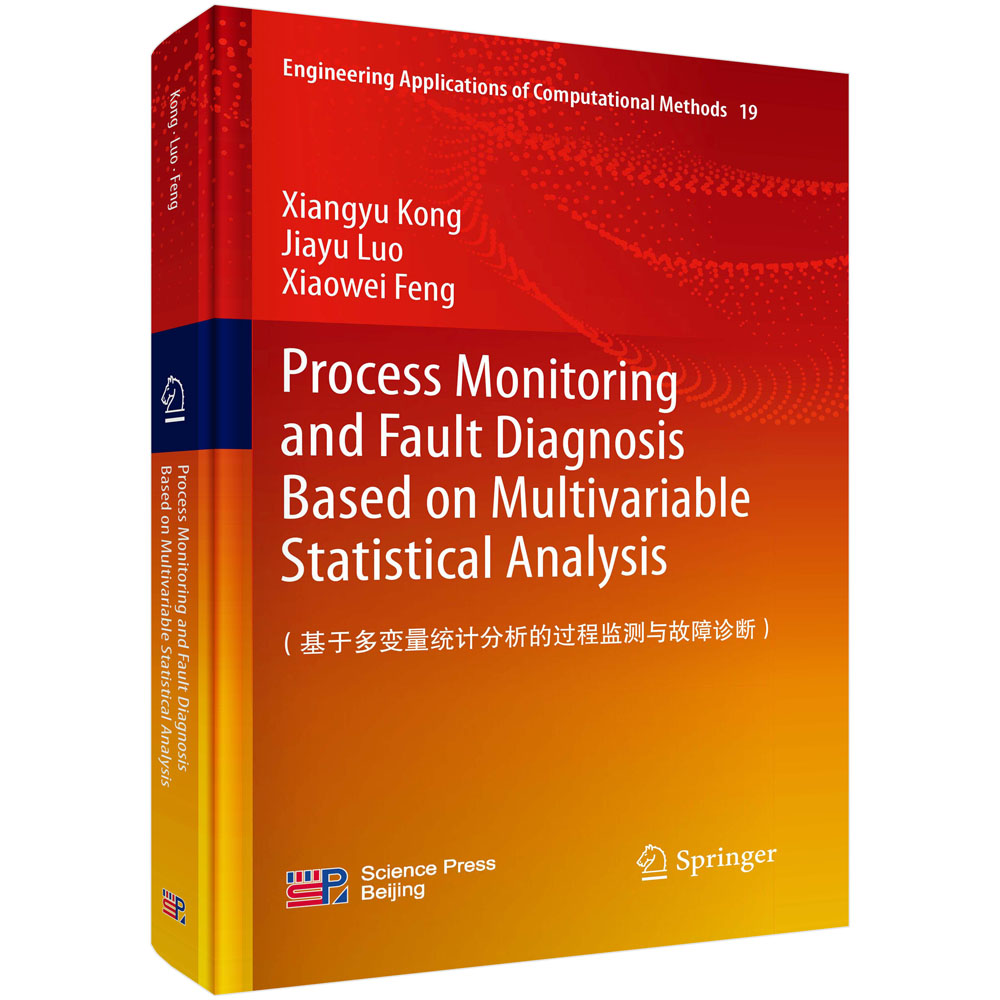
Process Monitoring and Fault Diagnosis Based on Multivariable Statistical Analysis(基于多变量统计分析的过程监测与故障
¥211.72
| 运费: | ¥ 0.00-18.00 |






商品详情
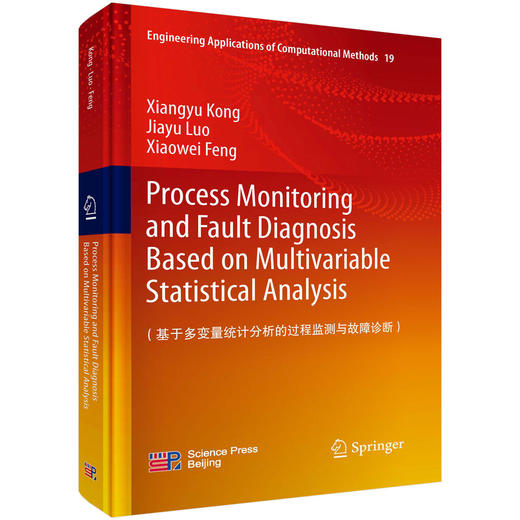
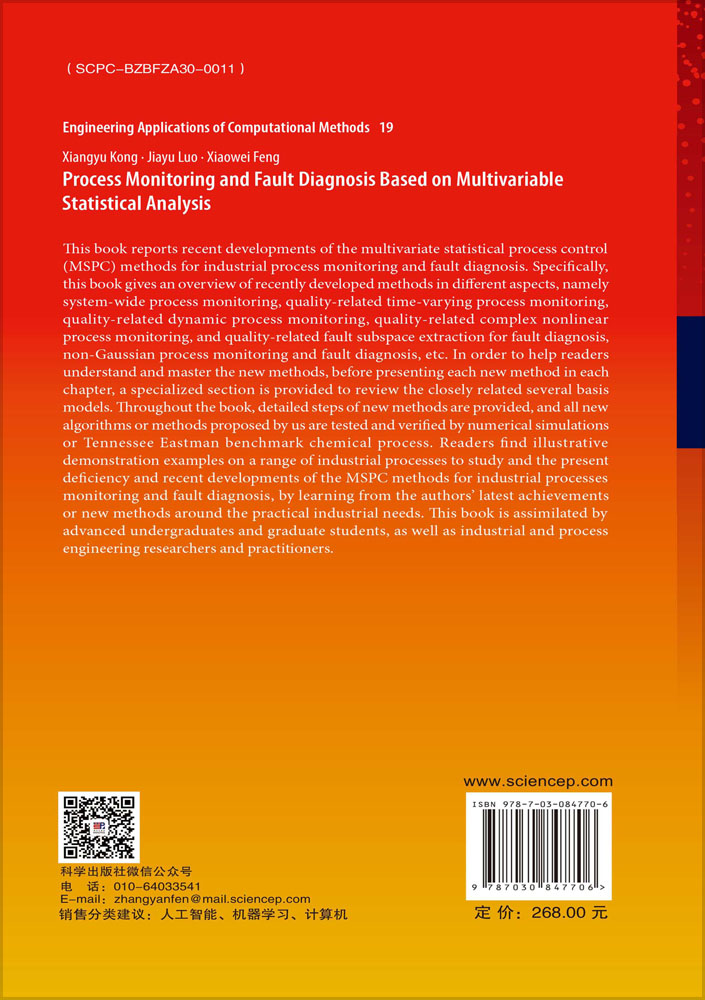
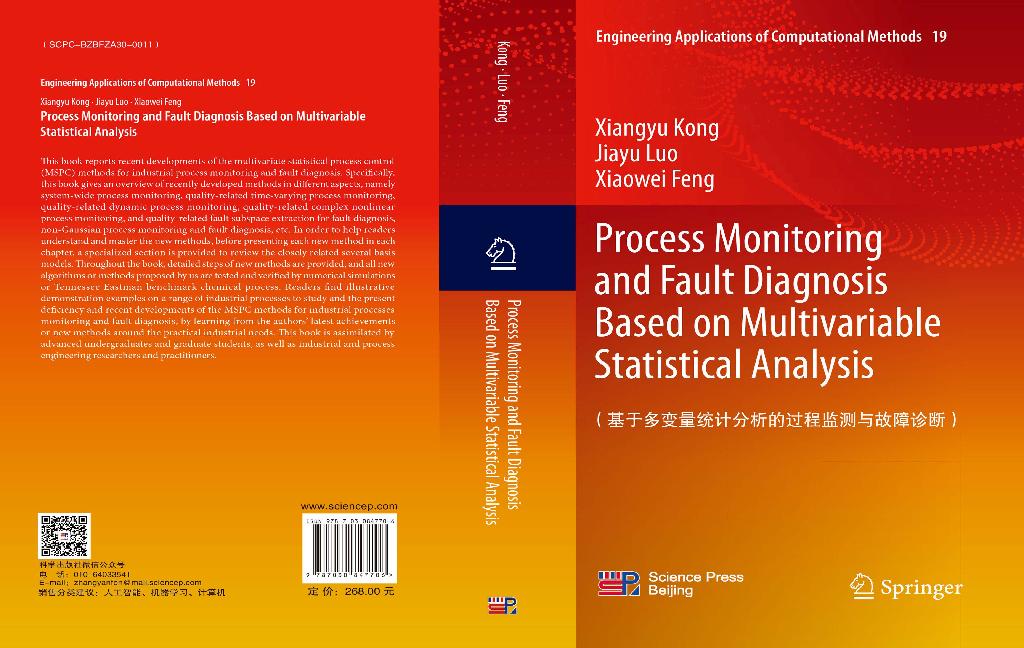
书名:Process Monitoring and Fault Diagnosis Based on Multivariable Statistical Analysis(基于多变量统计分析的过程监测与故障诊断)
定价:268.0
ISBN:9787030847706
作者:孔祥玉,罗家宇,马晓伟
版次:1
出版时间:2026-01
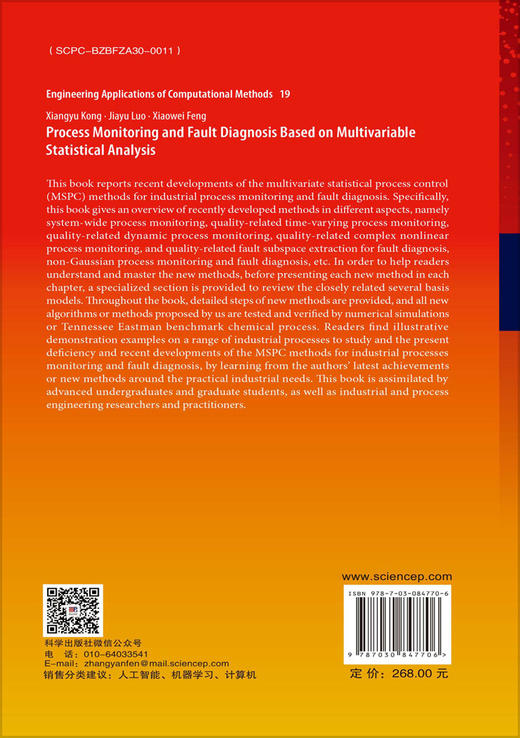
内容提要:
目录:
Contents
1 Introduction 1
1.1 An Overview of Process Monitoring and Fault Diagnosis 1
1.1.1 Data-Driven Process Monitoring 1
1.1.2 MSPC-Based Process Monitoring 2
1.1.3 Related Monographs for MSPC-Based Monitoring 3
1.2 Aim and Main Features of This Book 4
1.2.1 Aim of This Book 4
1.2.2 Main Features of This Book 4
1.3 Organization of This Book 7
References 8
2 An Overview of Conventional MSPC Methods 9
2.1 Overview 9
2.2 Multivariable Statistical Analysis Models 10
2.2.1 Principal Component Analysis 10
2.2.2 Independent Component Analysis 13
2.2.3 Kernel Principal Component Analysis 15
2.2.4 Total Projection to Latent Structure 16
2.3 Process Monitoring and Diagnosis Methods 17
2.3.1 PCA-Based Process Monitoring 17
2.3.2 PLS-Based Process Monitoring 19
2.3.3 Contribution Plot-Based Fault Identification 20
2.3.4 Reconstruction Based Fault Diagnosis 21
2.4 Summary 24
References 24
3 System-Wide Process Monitoring and Fault Diagnosis 27
3.1 Introduction 27
3.2 Review of Related PCA-Based Models Years, Many PCA 29
3.2.1 Dynamic PCA Model 29
3.2.2 Dynamic-Inner PCA Model 30
3.2.3 Recursive PCA Model 30
3.2.4 Moving-Window PCA Model 31
3.3 Time-Varying Process Monitoring Based on Adaptive Eigensubspace Extraction 33
3.3.1 Dynamic Process Monitoring Technique 34
3.3.2 Computer Simulations 37
3.3.3 Conclusion 42
3.4 GPCA-Based FS Decomposition and Its Fault Reconst. Application 42
3.4.1 PCA-Based Fault Detection 43
3.4.2 Subspace Extraction Approach of Responsible Fault Deviations 44
3.4.3 Illustration of Tennessee Eastman Process 46
3.4.4 Conclusion 49
3.5 Summary 49
References 51
4 Quality-Related Time-Varying Process Monitoring 53
4.1 Introduction 53
4.2 Review of the Related Work 55
4.2.1 Modified PLS Model 55
4.2.2 Recursive PLS Model 56
4.2.3 Orthogonal Signal Correction Model 58
4.2.4 Concurrent PLS Model 59
4.3 Quality-Relevant Process Monitoring Based on OSC and RMPLS 60
4.3.1 OSC-RMPLS Applied to Quality-Relevant Fault Monitoring 61
4.3.2 Slow-Time-Varying Process Monitoring Technology 64
4.3.3 Conclusion 70
4.4 Recursive CPLS-Based Quality-Relevant and Process-Relevant Fault Monitoring 73
4.4.1 RPLS and RCPLS Models 73
4.4.2 TEP Simulation Application 78
4.4.3 Conclusion 83
4.5 Summary 84
References 84
5 Quality-Related Dynamic Process Monitoring: Part I 87
5.1 Introduction 87
5.2 A Review of the Dynamic PLS Model 89
5.3 Quality-Related/Process-Related Fault Monitoring with Online Monitoring Dynamic CPLS 90
5.3.1 Online Monitoring Dynamic PLS Model 90
5.3.2 Online Monitoring Dynamic Concurrent PLS Model 92
5.3.3 Dynamic Process Monitoring Technology 93
5.4 Simulations and Applications 98
5.4.1 Simulations of Quality-Related and Process-Related Fault Monitoring 98
5.4.2 Case Study on the TEP 104
5.4.3 Conclusion 108
5.5 Summary 108
Appendix 109
References 109
6 Quality-Related Dynamic Process Monitoring: Part II 111
6.1 Introduction 111
6.2 Preliminaries 112
6.3 Orthogonal Multiblock Algorithm and Its Monitoring Strategy 113
6.3.1 Modified DPLS Model 113
6.3.2 Orthogonal Multiblock Dynamic PLS 117
6.3.3 Quality-Related Process Monitoring and Its Strategy 120
6.4 Simulations and Applications 122
6.4.1 Numerical Simulations 122
6.4.2 Simulation on TEP 135
6.4.3 Conclusion 139
6.5 Summary 140
References 140
7 Quality-Related Complex Nonlinear Process Monitoring 143
7.1 Introduction 143
7.2 Review of the Main Quality-Related Complex Nonlinear Process Monitoring 144
7.2.1 Kernel PLS Model 144
7.2.2 Total KPLS Model 145
7.2.3 Concurrent Kernel PLS Model 146
7.2.4 New Modified KPLS Model 147
7.3 General Quality-Related Nonlinear Process Monitoring Based on IO-KPLS 148
7.3.1 Nonlinear Input-Output Modeling and Monitoring Design 148
7.3.2 Simulations and Applications Studies 157
7.3.3 Conclusion 168
7.4 Summary 170
References 172
8 Quality-Related Fault Subspace Extraction for Fault Diagnosis 173
8.1 Introduction 173
8.2 Review of Related Work 174
8.2.1 PLS and IPLS Model 174
8.2.2 Generalized PCA Model 175
8.3 Novel FS Extraction for the Reconst.-Based Fault Diagnosis 176
8.3.1 Proposed Fault Subspace Extraction Method 177
8.3.2 Quality-Related Fault Diagnosis Strategy 182
8.3.3 Simulation and Applications 185
8.3.4 Conclusion 196
8.4 KPI-Related Fault Subspace Extraction for the Reconst.-Based Fault Diagnosis 197
8.4.1 IPLS Model for Monitoring 197
8.4.2 Proposed Quality-Related Fault Diagnosis Approach 199
8.4.3 Simulation and Application 205
8.4.4 Conclusion 213
8.5 Summary 214
References 217
9 Non-Gaussian Process Monitoring and Fault Diagnosis 219
9.1 Introduction 219
9.2 Review of ICA-Based Fault Monitoring Models 221
9.2.1 Dynamic ICA Model 221
9.2.2 Kernel ICA Model 223
9.2.3 Kernel Dynamic ICA Model 225
9.3 Extraction of Reduced Fault Subspace Based on KDICA and Its Fault Diagnosis Application 228
9.3.1 Fault Reconstruction Based on KDICA Model 228
9.3.2 Extraction of Fault Subspace and Fault Diagnosis 234
9.3.3 Case Study of the TE Benchmark Process 236
9.3.4 Conclusion 243
9.4 Fault Detection and Diagnosis Based on MKICR 243
9.4.1 Establishment of the MKICR Model 243
9.4.2 Quality-Related Fault Detection Based on MKICR 246
9.4.3 Detectability Analysis of the Quality-Related Faults 247
9.4.4 Fault Diagnosis Based on MKICR 248
9.4.5 Simulations and Discussion 251
9.4.6 Conclusions 264
9.5 Summary 266
Appendix 266
References 269
10 Hybrid Gaussian/Non-Gaussian Quality-Related Nonlinear Process Monitoring 271
10.1 Introduction 271
10.2 Review of the Related Work 272
10.2.1 Modified KPLS Model 272
10.2.2 KICA Model 273
10.3 Quality-Related Process Monitoring Based on a Bayesian Classifier 273
10.3.1 Variable Separation 273
10.3.2 Feature Extraction 274
10.3.3 Constructing a Bayesian-Based Quality-Related Classifier 277
10.4 Case Studies 280
10.4.1 Numerical Simulation Experiment 280
10.4.2 Application to Tennessee-Eastman Process 284
10.5 Summary 294
References 295
11 Conclusions and Future Work 297
11.1 Conclusions 297
11.2 Future Work 299
定价:268.0
ISBN:9787030847706
作者:孔祥玉,罗家宇,马晓伟
版次:1
出版时间:2026-01
内容提要:


目录:
Contents
1 Introduction 1
1.1 An Overview of Process Monitoring and Fault Diagnosis 1
1.1.1 Data-Driven Process Monitoring 1
1.1.2 MSPC-Based Process Monitoring 2
1.1.3 Related Monographs for MSPC-Based Monitoring 3
1.2 Aim and Main Features of This Book 4
1.2.1 Aim of This Book 4
1.2.2 Main Features of This Book 4
1.3 Organization of This Book 7
References 8
2 An Overview of Conventional MSPC Methods 9
2.1 Overview 9
2.2 Multivariable Statistical Analysis Models 10
2.2.1 Principal Component Analysis 10
2.2.2 Independent Component Analysis 13
2.2.3 Kernel Principal Component Analysis 15
2.2.4 Total Projection to Latent Structure 16
2.3 Process Monitoring and Diagnosis Methods 17
2.3.1 PCA-Based Process Monitoring 17
2.3.2 PLS-Based Process Monitoring 19
2.3.3 Contribution Plot-Based Fault Identification 20
2.3.4 Reconstruction Based Fault Diagnosis 21
2.4 Summary 24
References 24
3 System-Wide Process Monitoring and Fault Diagnosis 27
3.1 Introduction 27
3.2 Review of Related PCA-Based Models Years, Many PCA 29
3.2.1 Dynamic PCA Model 29
3.2.2 Dynamic-Inner PCA Model 30
3.2.3 Recursive PCA Model 30
3.2.4 Moving-Window PCA Model 31
3.3 Time-Varying Process Monitoring Based on Adaptive Eigensubspace Extraction 33
3.3.1 Dynamic Process Monitoring Technique 34
3.3.2 Computer Simulations 37
3.3.3 Conclusion 42
3.4 GPCA-Based FS Decomposition and Its Fault Reconst. Application 42
3.4.1 PCA-Based Fault Detection 43
3.4.2 Subspace Extraction Approach of Responsible Fault Deviations 44
3.4.3 Illustration of Tennessee Eastman Process 46
3.4.4 Conclusion 49
3.5 Summary 49
References 51
4 Quality-Related Time-Varying Process Monitoring 53
4.1 Introduction 53
4.2 Review of the Related Work 55
4.2.1 Modified PLS Model 55
4.2.2 Recursive PLS Model 56
4.2.3 Orthogonal Signal Correction Model 58
4.2.4 Concurrent PLS Model 59
4.3 Quality-Relevant Process Monitoring Based on OSC and RMPLS 60
4.3.1 OSC-RMPLS Applied to Quality-Relevant Fault Monitoring 61
4.3.2 Slow-Time-Varying Process Monitoring Technology 64
4.3.3 Conclusion 70
4.4 Recursive CPLS-Based Quality-Relevant and Process-Relevant Fault Monitoring 73
4.4.1 RPLS and RCPLS Models 73
4.4.2 TEP Simulation Application 78
4.4.3 Conclusion 83
4.5 Summary 84
References 84
5 Quality-Related Dynamic Process Monitoring: Part I 87
5.1 Introduction 87
5.2 A Review of the Dynamic PLS Model 89
5.3 Quality-Related/Process-Related Fault Monitoring with Online Monitoring Dynamic CPLS 90
5.3.1 Online Monitoring Dynamic PLS Model 90
5.3.2 Online Monitoring Dynamic Concurrent PLS Model 92
5.3.3 Dynamic Process Monitoring Technology 93
5.4 Simulations and Applications 98
5.4.1 Simulations of Quality-Related and Process-Related Fault Monitoring 98
5.4.2 Case Study on the TEP 104
5.4.3 Conclusion 108
5.5 Summary 108
Appendix 109
References 109
6 Quality-Related Dynamic Process Monitoring: Part II 111
6.1 Introduction 111
6.2 Preliminaries 112
6.3 Orthogonal Multiblock Algorithm and Its Monitoring Strategy 113
6.3.1 Modified DPLS Model 113
6.3.2 Orthogonal Multiblock Dynamic PLS 117
6.3.3 Quality-Related Process Monitoring and Its Strategy 120
6.4 Simulations and Applications 122
6.4.1 Numerical Simulations 122
6.4.2 Simulation on TEP 135
6.4.3 Conclusion 139
6.5 Summary 140
References 140
7 Quality-Related Complex Nonlinear Process Monitoring 143
7.1 Introduction 143
7.2 Review of the Main Quality-Related Complex Nonlinear Process Monitoring 144
7.2.1 Kernel PLS Model 144
7.2.2 Total KPLS Model 145
7.2.3 Concurrent Kernel PLS Model 146
7.2.4 New Modified KPLS Model 147
7.3 General Quality-Related Nonlinear Process Monitoring Based on IO-KPLS 148
7.3.1 Nonlinear Input-Output Modeling and Monitoring Design 148
7.3.2 Simulations and Applications Studies 157
7.3.3 Conclusion 168
7.4 Summary 170
References 172
8 Quality-Related Fault Subspace Extraction for Fault Diagnosis 173
8.1 Introduction 173
8.2 Review of Related Work 174
8.2.1 PLS and IPLS Model 174
8.2.2 Generalized PCA Model 175
8.3 Novel FS Extraction for the Reconst.-Based Fault Diagnosis 176
8.3.1 Proposed Fault Subspace Extraction Method 177
8.3.2 Quality-Related Fault Diagnosis Strategy 182
8.3.3 Simulation and Applications 185
8.3.4 Conclusion 196
8.4 KPI-Related Fault Subspace Extraction for the Reconst.-Based Fault Diagnosis 197
8.4.1 IPLS Model for Monitoring 197
8.4.2 Proposed Quality-Related Fault Diagnosis Approach 199
8.4.3 Simulation and Application 205
8.4.4 Conclusion 213
8.5 Summary 214
References 217
9 Non-Gaussian Process Monitoring and Fault Diagnosis 219
9.1 Introduction 219
9.2 Review of ICA-Based Fault Monitoring Models 221
9.2.1 Dynamic ICA Model 221
9.2.2 Kernel ICA Model 223
9.2.3 Kernel Dynamic ICA Model 225
9.3 Extraction of Reduced Fault Subspace Based on KDICA and Its Fault Diagnosis Application 228
9.3.1 Fault Reconstruction Based on KDICA Model 228
9.3.2 Extraction of Fault Subspace and Fault Diagnosis 234
9.3.3 Case Study of the TE Benchmark Process 236
9.3.4 Conclusion 243
9.4 Fault Detection and Diagnosis Based on MKICR 243
9.4.1 Establishment of the MKICR Model 243
9.4.2 Quality-Related Fault Detection Based on MKICR 246
9.4.3 Detectability Analysis of the Quality-Related Faults 247
9.4.4 Fault Diagnosis Based on MKICR 248
9.4.5 Simulations and Discussion 251
9.4.6 Conclusions 264
9.5 Summary 266
Appendix 266
References 269
10 Hybrid Gaussian/Non-Gaussian Quality-Related Nonlinear Process Monitoring 271
10.1 Introduction 271
10.2 Review of the Related Work 272
10.2.1 Modified KPLS Model 272
10.2.2 KICA Model 273
10.3 Quality-Related Process Monitoring Based on a Bayesian Classifier 273
10.3.1 Variable Separation 273
10.3.2 Feature Extraction 274
10.3.3 Constructing a Bayesian-Based Quality-Related Classifier 277
10.4 Case Studies 280
10.4.1 Numerical Simulation Experiment 280
10.4.2 Application to Tennessee-Eastman Process 284
10.5 Summary 294
References 295
11 Conclusions and Future Work 297
11.1 Conclusions 297
11.2 Future Work 299
- 科学出版社旗舰店 (微信公众号认证)
- 科学出版社秉承多年来形成的“高层次、高水平、高质量”和“严肃、严密、严格”的优良传统与作风,始终坚持为科技创新服务、为传播与普及科学知识服务、为科学家和广大读者服务的宗旨。
- 扫描二维码,访问我们的微信店铺
- 随时随地的购物、客服咨询、查询订单和物流...