
商品详情
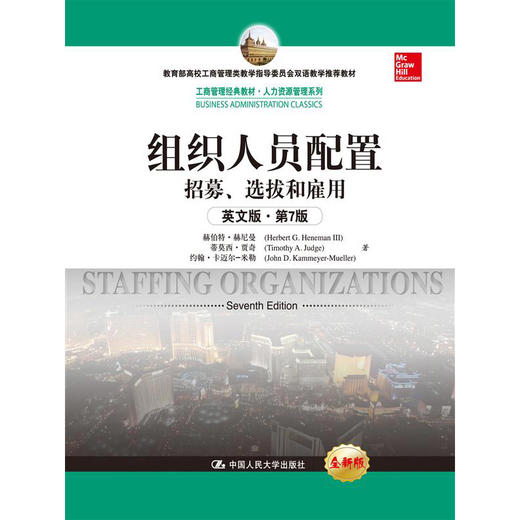
书名:组织人员配置——招募、选拔和雇用(英文版·第7版)(工商管理经典教材·人力资源管理系列)
定价:69.0
ISBN:9787300204048
作者:赫伯特·赫尼曼
版次:1
出版时间:2014-12
内容提要:
内容简介
本书是一本英文影版教材,原著是美国一本经典的人员配置教材。
本书创建了一个组织人员配置的模型,并基于这个模型构建了本书的框架。全书共分为6篇14章。
第Ⅰ篇对人员配置给出了明确的定义,即人员配置是一项涉及获取、安置和保留劳动力的关键组织职能,对组织整体的效能具有十分重要的作用。
第Ⅱ篇论述了法律遵从、规划和工作分析等与人员配置有关的支持性活动。
第Ⅲ~Ⅴ篇是全书的重点,论述了人员配置的三大核心活动,包括人员招募、选拔和雇用。
第Ⅵ篇论述人员配置系统和人员留任管理。
各章末设有小结、讨论题、伦理议题、练习与案例以及丰富的参考文献,方便读者复习、应用和做进一步的研究。
本书非常适合用作高校本科生、研究生双语教学教材,也适合研究者及其他感兴趣的读者阅读参考。
作者简介:
赫伯特•赫尼曼(Herbert G. Heneman Ⅲ),美国威斯康星大学麦迪逊分校商学院管理与人力资源系的Dickson-Bascom荣誉退休教授,同时也是威斯康星教育研究中心的资深研究人员。赫伯特还是华盛顿大学和佛罗里达大学的访问教授,也是俄亥俄州立大学的杰出访问教授。他的研究领域包括人员配置、绩效管理、薪酬和工作动机等,目前正在进行教师绩效管理与薪酬系统的设计与有效性的调查研究。赫伯特是美国人力资源管理基金会协会的理事会成员兼协会的研究主任。他也是美国管理学会人力资源分会职业成就奖的获得者。
蒂莫西•贾奇(Timothy A. Judge),美国圣母大学门多萨商学院管理系Franklin D. Schurz讲座教授。在伊利诺伊大学获得博士学位,之前曾是Kohl’s百货公司的一名经理。曾执教于美国康奈尔大学、艾奥瓦大学和佛罗里达大学。教学与研究兴趣在人格、领导与影响行为、人员配置与工作态度等领域。《应用心理学》、《人事心理学》、《人力资源管理评论》等学术期刊编审委员会的成员。
约翰•卡迈尔–米勒(John D. Kammeyer-Mueller),美国佛罗里达大学Warrington商学院管理系副教授,在明尼苏达大学获得博士学位。主要研究兴趣包括组织社会化与员工调适、人格与压力过程、长期研究方法等。为本科生、研究生、博士生讲授与组织人员配置相关的课程。
目录:
Co ntents
Part One
The Nature of Staffing 3
Chapt er One
Staffing Models and Strategy 5
Learning Objectives and Introduction 6
Learning Objectives 6
Introduction 6
The Nature of Staffing 7
The Big Picture 7
Definition of Staffing 8
Implications of Definition 8
Staffing System Examples 12
Staffing Models 14
Staffing Quantity: Levels 14
Staffing Quality: Person/Job Match 15
Staffing Quality: Person/Organization
Match 17
Staffing System Components 19
Staffing Organizations 21
Staffing Strategy 25
Staffing Levels 25
Staffing Quality 30
Staffing Ethics 31
Plan for the Book 34
Summary 35
Discussion Questions 36
Ethical Issues 37
Applications 37
Staffing for Your Own Job 37
Staffing Strategy for a New Plant 38
Tanglewood Stores Case 40
The Situation 40
Your Tasks 40
Endnotes 40
Part Two
Support Activities 43
Chapt er Two
Legal Compliance 45
Learning Objectives and Introduction 47
Learning Objectives 47
Introduction 47
The Employment Relationship 48
Employer–Employee 48
Independent Contractors 50
Temporary Employees 50
Laws and Regulations 51
Need for Laws and Regulations 52
Sources of Laws and Regulations 53
EEO/AA Laws: General Provisions and
Enforcement 54
General Provisions 55
hen12680_FM_i-xviii.indd 11 3/30/11 9:22 AM
xii Contents
Enforcement: EEOC 57
Enforcement: OFCCP 64
EEO/AA Laws: Specific Staffing
Provisions 64
Civil Rights Acts (1964, 1991) 64
Age Discrimination in Employment Act
(1967) 67
Americans With Disabilities Act (1990,
2008) 68
Genetic Information Nondiscrimination Act
(2008) 72
Rehabilitation Act (1973) 72
Executive Order 11246 (1965) 73
Other Staffing Laws 73
Federal Laws 73
State and Local Laws 76
Civil Service Laws and Regulations 77
Legal Issues in Remainder of Book 78
Summary 80
Discussion Questions 80
Ethical Issues 81
Applications 81
Age Discrimination in a Promotion? 81
Disparate Impact: What Do the Statistics
Mean? 83
Endnotes 83
Chapt er Thre e
Planning 85
Learning Objectives and Introduction 87
Learning Objectives 87
Introduction 87
External Influences 88
Economic Conditions 88
Labor Markets 89
Technology 94
Labor Unions 95
Human Resource Planning 95
Process and Example 95
Initial Decisions 98
Forecasting HR Requirements 100
Forecasting HR Availabilities 103
Reconciliation and Gaps 112
Staffing Planning 114
Staffing Planning Process 114
Core Workforce 117
Flexible Workforce 120
Outsourcing 123
Diversity Planning 125
Demography of the American
Workforce 125
Business Case for Diversity 126
Planning for Diversity 127
Legal Issues 128
Affirmative Action Plans 128
Legality of AAPs and Diversity
Programs 133
EEO and Temporary Workers 136
Summary 136
Discussion Questions 137
Ethical Issues 138
Applications 138
Markov Analysis and Forecasting 138
Deciding Whether to Use Flexible
Staffing 139
Tanglewood Stores Case 141
The Situation 141
Your Tasks 141
Endnotes 141
Chapt er Four
Job Analysis and Rewards 145
Learning Objectives and Introduction 146
Learning Objectives 146
Introduction 146
Changing Nature of Jobs 147
Job Requirements Job Analysis 149
Overview 149
Job Requirements Matrix 150
Job Descriptions and Job
Specifications 162
Collecting Job Requirements
Information 164
hen12680_FM_i-xviii.indd 12 3/30/11 9:22 AM
Contents xiii
Competency-Based Job Analysis 174
Nature of Competencies 174
Collecting Competency Information 178
Job Rewards 179
Types of Rewards 180
Employee Value Proposition 180
Collecting Job Rewards Information 181
Job Analysis for Teams 187
Legal Issues 188
Job Relatedness and Court Cases 188
Essential Job Functions 189
Summary 193
Discussion Questions 194
Ethical Issues 194
Applications 194
Conducting a Job Requirements or Job
Rewards Job Analysis 194
Maintaining Job Descriptions 195
Endnotes 196
Part Thre e
Staffing Activities: Recruitment 201
Chapt er F ive
External Recruitment 203
Learning Objectives and Introduction 205
Learning Objectives 205
Introduction 205
Recruitment Planning 206
Organizational Issues 206
Administrative Issues 207
Recruiters 214
Strategy Development 215
Open Versus Targeted Recruitment 215
Recruitment Sources 217
Recruiting Metrics 233
Searching 237
Communication Message 237
Communication Medium 242
Applicant Reactions 248
Reactions to Recruiters 249
Reactions to the Recruitment Process 249
Reactions to Diversity Issues 250
Transition to Selection 251
Legal Issues 252
Definition of a Job Applicant 252
Affirmative Action Programs 254
Electronic Recruitment 255
Job Advertisements 257
Fraud and Misrepresentation 257
Summary 258
Discussion Questions 259
Ethical Issues 259
Applications 260
Improving a College Recruitment
Program 260
Internet Recruiting 262
Tanglewood Stores Case 263
The Situation 263
Your Tasks 263
Endnotes 264
Chapt er S ix
Internal Recruitment 271
Learning Objectives and Introduction 272
Learning Objectives 272
Introduction 272
Recruitment Planning 273
Organizational Issues 273
Administrative Issues 278
Timing 279
Strategy Development 281
Closed, Open, and Hybrid
Recruitment 281
Recruitment Sources 285
Recruiting Metrics 292
Communication Message and Medium 294
Communication Message 294
Communication Medium 295
Applicant Reactions 296
Transition to Selection 296
hen12680_FM_i-xviii.indd 13 3/30/11 9:22 AM
xiv Contents
Legal Issues 297
Affirmative Action Programs
Regulations 297
Bona Fide Seniority Systems 298
The Glass Ceiling 299
Summary 303
Discussion Questions 304
Ethical Issues 305
Applications 305
Recruitment in a Changing Internal Labor
Market 305
Succession Planning for a CEO 306
Endnotes 307
Part Four
Staffing Activities: Selection 311
Chapt er S even
Measurement 313
Learning Objectives and Introduction 315
Learning Objectives 315
Introduction 315
Importance and Use of Measures 316
Key Concepts 316
Measurement 317
Scores 320
Correlation Between Scores 323
Quality of Measures 327
Reliability of Measures 328
Validity of Measures 335
Validation of Measures in Staffing 337
Validity Generalization 346
Staffing Metrics and Benchmarks 348
Collection of Assessment Data 349
Testing Procedures 350
Acquisition of Tests and Test Manuals 351
Professional Standards 352
Legal Issues 353
Determining Adverse Impact 353
Standardization 355
Best Practices 356
Summary 357
Discussion Questions 358
Ethical Issues 358
Applications 359
Evaluation of Two New Assessment
Methods for Selecting Telephone
Customer Service Representatives 359
Conducting Empirical Validation and
Adverse Impact Analysis 361
Tanglewood Stores Case I 364
The Situation 364
Your Tasks 364
Tanglewood Stores Case II 365
Adverse Impact 365
Endnotes 365
Chapt er Ei ght
External Selection I 369
Learning Objectives and Introduction 370
Learning Objectives 370
Introduction 370
Preliminary Issues 370
The Logic of Prediction 371
The Nature of Predictors 373
Development of the Selection Plan 374
Selection Sequence 376
Initial Assessment Methods 377
Résumés and Cover Letters 377
Application Blanks 381
Biographical Information 388
Reference and Background Checks 392
Initial Interview 398
Choice of Initial Assessment Methods 400
Legal Issues 405
Disclaimers 405
Reference Checks 406
Background Checks: Credit and
Criminal 406
Preemployment Inquiries 408
hen12680_FM_i-xviii.indd 14 3/30/11 9:22 AM
Contents xv
Bona Fide Occupational
Qualifications 410
Summary 416
Discussion Questions 417
Ethical Issues 417
Applications 417
Reference Reports and Initial Assessment in
a Start-Up Company 417
Developing a Lawful Application
Blank 419
Endnotes 421
Chapt er Nin e
External Selection II 425
Learning Objectives and Introduction 426
Learning Objectives 426
Introduction 426
Substantive Assessment Methods 427
Personality Tests 427
Ability Tests 434
Emotional Intelligence Tests 443
Performance Tests and Work Samples 445
Situational Judgment Tests 449
Integrity Tests 452
Interest, Values, and Preference
Inventories 455
Structured Interview 457
Choice of Substantive Assessment
Methods 468
Discretionary Assessment Methods 471
Contingent Assessment Methods 472
Drug Testing 472
Medical Exams 478
Legal Issues 479
Uniform Guidelines on Employee Selection
Procedures 479
Selection Under the Americans With
Disabilities Act 481
Drug Testing 485
Summary 486
Discussion Questions 487
Ethical Issues 487
Applications 487
Assessment Methods for the Job of Human
Resources Director 487
Choosing Among Finalists for the Job of
Human Resources Director 490
Tanglewood Stores Case 491
The Situation 491
Your Tasks 491
Endnotes 492
Chapt er T en
Internal Selection 503
Learning Objectives and Introduction 505
Learning Objectives 505
Introduction 505
Preliminary Issues 506
The Logic of Prediction 506
Types of Predictors 507
Selection Plan 507
Initial Assessment Methods 508
Talent Management/Succession
Systems 508
Peer Assessments 509
Self-Assessments 511
Managerial Sponsorship 512
Informal Discussions and
Recommendations 513
Choice of Initial Assessment Methods 513
Substantive Assessment Methods 515
Seniority and Experience 515
Job Knowledge Tests 517
Performance Appraisal 518
Promotability Ratings 519
Assessment Centers 520
Interview Simulations 526
Promotion Panels and Review Boards 527
Choice of Substantive Assessment
Methods 527
Discretionary Assessment Methods 529
hen12680_FM_i-xviii.indd 15 3/30/11 9:22 AM
xvi Contents
Legal Issues 529
Uniform Guidelines on Employee Selection
Procedures 529
The Glass Ceiling 530
Summary 531
Discussion Questions 532
Ethical Issues 532
Applications 532
Changing a Promotion System 532
Promotion From Within at Citrus
Glen 533
Endnotes 535
Part F ive
Staffing Activities: Employment 539
Chapt er El even
Decision Making 541
Learning Objectives and Introduction 543
Learning Objectives 543
Introduction 543
Choice of Assessment Method 544
Validity Coefficient 544
Face Validity 545
Correlation With Other Predictors 545
Adverse Impact 546
Utility 546
Determining Assessment Scores 551
Single Predictor 551
Multiple Predictors 551
Hiring Standards and Cut Scores 557
Description of the Process 557
Consequences of Cut Scores 558
Methods to Determine Cut Scores 559
Professional Guidelines 564
Methods of Final Choice 564
Random Selection 564
Ranking 565
Grouping 566
Ongoing Hiring 566
Decision Makers 566
Human Resource Professionals 566
Managers 567
Employees 568
Legal Issues 568
Uniform Guidelines on Employee Selection
Procedures 568
Diversity and Hiring Decisions 569
Summary 571
Discussion Questions 572
Ethical Issues 572
Applications 572
Utility Concerns in Choosing an
Assessment Method 572
Choosing Entrants Into a Management
Training Program 573
Tanglewood Stores Case 574
The Situation 576
Your Tasks 576
Endnotes 576
Chapt er Twe lve
Final Match 579
Learning Objectives and Introduction 581
Learning Objectives 581
Introduction 581
Employment Contracts 582
Requirements for an Enforceable
Contract 582
Parties to the Contract 583
Form of the Contract 584
Disclaimers 586
Contingencies 587
Other Employment Contract Sources 588
Unfulfilled Promises 588
Job Offers 589
Strategic Approach to Job Offers 589
Job Offer Content 592
Job Offer Process 602
Formulation of the Job Offer 604
Presentation of the Job Offer 609
hen12680_FM_i-xviii.indd 16 3/30/11 9:22 AM
Contents xvii
Timing of the Offer 610
Job Offer Acceptance and Rejection 611
Reneging 612
New Employee Orientation and
Socialization 613
Orientation 614
Socialization 617
Examples of Programs 619
Legal Issues 620
Employment Eligibility Verification 620
Negligent Hiring 621
Employment-at-Will 622
Summary 622
Discussion Questions 623
Ethical Issues 624
Applications 624
Making a Job Offer 624
Evaluating a Hiring and Variable Pay
Plan 626
Endnotes 627
Part S ix
Staffing System and Retention
Management 633
Chapt er Thirt e en
Staffing System Management 635
Learning Objectives and Introduction 636
Learning Objectives 636
Introduction 636
Administration of Staffing Systems 637
Organizational Arrangements 637
Jobs in Staffing 641
Policies and Procedures 644
Human Resource Information
Systems 648
Outsourcing 651
Evaluation of Staffing Systems 655
Staffing Process 655
Staffing Process Results 658
Calculating Staffing Metrics 663
Customer Satisfaction 664
Legal Issues 665
Record Keeping and Privacy 665
EEO Report 670
Legal Audits 670
Training for Managers and
Employees 670
Dispute Resolution 672
Summary 674
Discussion Questions 675
Ethical Issues 675
Applications 676
Learning About Jobs in Staffing 676
Evaluating Staffing Process Results 676
Endnotes 678
Chapt er Fourt e en
Retention Management 681
Learning Objectives and Introduction 683
Learning Objectives 683
Introduction 683
Turnover and Its Causes 684
Nature of the Problem 684
Types of Turnover 685
Causes of Turnover 687
Analysis of Turnover 689
Measurement 690
Reasons for Leaving 691
Costs and Benefits 694
Retention Initiatives: Voluntary Turnover 702
Current Practices and Deciding to
Act 702
Desirability of Leaving 709
Ease of Leaving 715
Alternatives 716
Retention Initiatives: Discharge 717
Performance Management 717
Progressive Discipline 721
Retention Initiatives: Downsizing 723
Weighing Advantages and
Disadvantages 723
hen12680_FM_i-xviii.indd 17 3/30/11 9:22 AM
xviii Contents
Staffing Levels and Quality 724
Alternatives to Downsizing 725
Employees Who Remain 725
Legal Issues 727
Separation Laws and Regulations 727
Performance Appraisal 728
Summary 728
Discussion Questions 730
Ethical Issues 730
Applications 731
Managerial Turnover: A Problem? 731
Retention: Deciding to Act 732
Tanglewood Stores Case 734
The Situation 734
Your Tasks 735
Endnotes 735
在线试读:
Preface
The seventh edition of Staffing Organizations contains many updates and
additions that reflect the rapidly evolving terrain of strategic, technological,
practical, and legal issues confronting organizations and their staffing
systems. As in previous editions, we have considerably updated our references,
found as chapter endnotes. We have also made significant changes to the opening
material in each chapter. Each chapter now opens with a list of learning objectives
to facilitate student learning. The chapter introductions have been revised as well.
A second major change to the book is a “freshening” of the writing style. While
readers have found the book well written, some have suggested that the writing
could be a bit livelier. Hence, we have made extensive changes to each chapter and
are confident that these changes make the book more accessible.
Technology continues to transform all aspects of human resources, and staffing
is no exception. Accordingly, in this edition, we provide enhanced coverage of
human resources information systems (HRISs) and their role in all phases of the
staffing process, including legal implications. We have also substantially expanded
our coverage of some increasingly important topics, including diversity in the
planning process, emotional intelligence tests, and video and computer interviews.
Even with the many changes and the significant additions to the book, we have
held the length by trimming those areas that have waned in interest or importance.
We have also added a coauthor to the book, John Kammeyer-Mueller. Previous
users of the book will remember John’s work on the Tanglewood Stores case. This
case continues in the book, and John has contributed to many other areas as well.
We are excited to have him onboard.
For the Tanglewood Stores case, at the end of Chapters 1, 3, 5, 7, 9, 11, and 14,
you will receive a brief description of the situation relevant to that chapter, along
with tasks that require you to analyze the situation by applying material directly
from the chapter. The full text of the case and your assignment are located online
at www.mhhe.com/heneman7e.
Listed below is the chapter structure for the seventh edition, along with the
updates to each chapter.
hen12680_FM_i-xviii.indd 5 3/30/11 9:22 AM
Chapter One: Staffing Models and Strategy
• New learning objectives and introduction
• Revised and updated information on global and national economic conditions
affecting staffing activities
• New examples and quotations reflecting the importance of the staffing function
• New example of staffing systems in business practice
• Updated section on short- and long-term staffing needs
• Increased coverage of ethical organizational culture
Chapter Two: Legal Compliance
• New learning objectives and introduction
• Revised material on temporary e
- 人民大学出版社微店 (微信公众号认证)
- 人大出版社自营微店,正版人大出版社书籍直发,品质保证!
- 扫描二维码,访问我们的微信店铺
- 随时随地的购物、客服咨询、查询订单和物流...