
商品详情
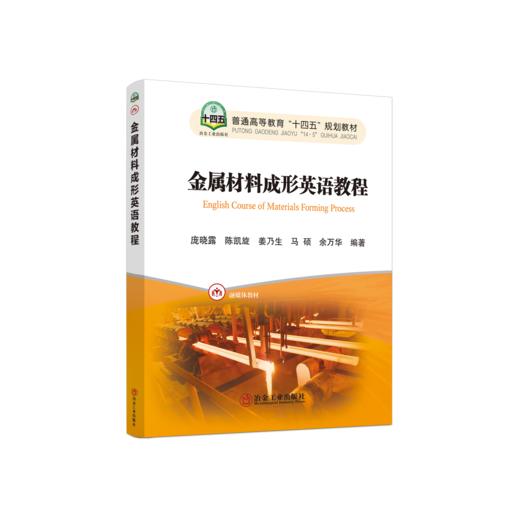
书名:金属材料成形英语教程
丛书名:普通高等教育“十四五”规划教材
ISBN:978-7-5240-0180-5
出版社:冶金工业出版社有限公司
定价:49
作者:庞晓露,陈凯旋,姜乃生,马硕,余万华
出版时间:2025-04-10
内容简介
本教材共分8章,内容涵盖材料科学基础、材料力学性能、材料测试与表征、材料加工工艺等方面的内容,重点介绍了铸、锻、轧、热处理、增材制造等工艺。在介绍专业知识时侧重培养学生前沿的材料研究方法、研发能力、学术思想和创新精神,激发学生开发新工艺及新材料的意识,使学生在掌握材料科学与成形工艺专业知识的基础上活学活用。在内容组织和结构安排上,力求理论联系实际践,切合材料专业学生能力培养的需要,突出科学性、时代性、前瞻性和适用性,旨在提供一本实用的专业英语教材。本书可供材料、冶金、机械行业的高等院校及大专院校的专业师生教材需要,也可供技术人员以及从事材料加工研究、生产和应用等方面的工程技术人员与管理人员参考。
编辑推荐
本书反映材料学科的最新理论和应用,确保教材的时效性和符合时代特征。根据近十年来材料科学和成形工艺在理论和应用研究方面所取得的主要进展和成果,精选最具代表性的内容并编入教材,如3D打印、材料基因工程等最新应用和发展前沿,力求使该教材具有鲜明的时代特征,使其真正起到启迪学生创新思维、培养学生创新能力的作用。
目录
Contents
1.General Introduction
1.1 What Is manufacturing and materialprocessing?
1.2 Examples of Manufactured Products
1.3 The Design Process and ConcurrentEngineering
1.4 Design for Manufacture and Assembly
1.5 Selecting Materials
1.6 Selecting Material Forming Processes
1.7 Intelligent Manufacturing
1.8 Computer-Integrated Material forming
1.9 Quality Assurance and Total QualityManagement
1.10 Organization for Manufacture
1.11 SUMMARY
Questions
Note
2.The Structure of Metals
2.1 The Crystal Structure of Metals
2.2 Deformation and Strength of SingleCrystals
2.3 Imperfections in the crystal structureof metals
2.3.1 Imperfection types
2.3.2 Dislocations
2.3.3 Work hardening (strain hardening)
2.4 Twins and twin boundaries
2.4.1 Twin features
2.4.2 Influence of twin boundaries
2.4.3 Strengthening of gradient nanotwinning structure
2.5 Grains and Grain Boundaries
2.5.1 Grain size
2.5.2 Influence of grain boundaries
2.5.3 Grain-boundary embrittlement
2.5.4 Nanocrystalline
2.5.5 Gradient nanocrystalline structure
2.6 Plastic Deformation of PolycrystallineMetals
2.7 Recovery, Recrystallization, and GrainGrowth
2.8 Case Study
2.9 SUMMARY
Questions
Note
3.Alloys: Their Structure and Strengthening by Heat Treatment
3.1 Introduction
3.2 Structure of Alloys
3.2.1 Solid solutions
3.2.2 Intermetallic compounds
3.2.3 Two-phase systems
3.3 Structure of Alloys
3.4 The Iron-Carbon System
3.4.1 Ferrite
3.4.2 Austenite
3.4.3 Cementite
3.4.4 CALPHAD and Materials Genome Engineering
3.5 Heat Treatment of Nonferrous Alloys andStainless Steels
3.5.1 Solution treatment
3.5.2 Precipitation hardening
3.6 Annealing
3.7 Case Study
3.8 SUMMARY
Questions
Note
4.Casting
4.1 Introduction
4.2 Solidification and Crystallization
4.3 Solidification of Metals
4.3.1 Pure metals
4.3.2 Alloys
4.3.3 In-situ observation of solidification process
4.3.4 Heterogeneous nucleation and homogeneous nucleation
4.3.5 Structure-property relationships
4.4 Fluid Flow and Heat Transfer
4.4.1 Fluid flow
4.4.2 Fluidity of molten metal
4.4.3 Heat transfer
4.4.4 Shrinkage
4.4.5 Defects
4.5 Case Study
4.6 SUMMARY
Questions
Note
5.Rolling
5.1 Introduction
5.2 Flat Rolling
5.2.1 Frictional forces
5.2.2 Roll force and power requirement
5.3 Flat-rolling practice
5.4 Defects in rolled plates and sheets
5.5 Rolling mills
5.5.1 High Rigidity Sendzimir Mill (HZ Mill)
5.5.2 New Type Six-High Reversing Cold Rolling Mill Unit
5.5.3 HC Mill and UC Mill HC
5.5.4 New Type Intelligent Mill
5.6 Rolls
5.7 Lubricants
5.8 Shape-Rolling Operations
5.9 Production of Seamless Tubing and Pipe
5.10 Thermo-Mechanical Control Process
5.11 Case Study
5.12 SUMMARY
Questions
Note
6.Forging
6.1 Introduction
6.2 Open-Die Forging
6.3 Impression-Die and Closed-Die Forging
6.4 Precision forging
6.5 Coining
6.6 Heading
6.7 Piercing
6.8 Other operations
6.9 Die Materials and Lubrication
6.10 Forgeability
6.10.1 Forging characteristics of ferrousmetals (steel)
6.10.2 Forging characteristics ofnon-ferrous metals
6.11 Forging Microstructure and Defects
6.12 Case Study
6.13 SUMMARY
Questions
Note
7.Additive Manufacturing
7.1 Introduction
7.2 Foil Bonding Process
7.3 Stereolithography Apparatus
7.4 Selective Laser Sintering
7.5 Fused Deposition Modeling
7.6 Laser Engineering Net Shaping
7.7 Electron Beam Melting
7.8 Other Operations
7.9 Additive Manufacturing Equipment
7.10 Case Study
7.11 Summary
Questions
Note
8.Quality Assurance, Testing and Inspection
8.1 Introduction
8.2 Microstructure Characterization
8.2.1 Electron microscopy
8.2.2 Mass spectrometry
8.2.3 X-Ray diffraction
8.2.4 Spectral analysis
8.2.5 Atom probe tomography
8.2.6 Other characterization methods
8.3 Destructive Testing
8.3.1 Tension test
8.3.2 Compression test
8.3.3 Torsion test
8.3.4 Bending test
8.3.5 Fatigue test
8.3.6 Creep test
8.3.7 Impact test
8.4 Product Quality
8.5 Quality Assurance
8.6 Total Quality Management
8.7 Quality engineering as a philosophy
8.8 The ISO 9000 standard
8.9 Statistical Methods of Quality Control
8.9.1 Statistical quality control
8.9.2 Statistical Process Control
8.10 Acceptance Sampling and Control
8.11 Reliability
8.12 Automated Inspection
8.13 Case Study
8.14 SUMMARY
Questions
Note
References
INDEX
- 冶金工业出版社图书旗舰店
- 冶金工业出版社,是国内历史最悠久的专业科技出版社之一。主要承担学术专著、技术著作、技术手册、专业辞书、大中专教材、职工培训教材、科普读物、人文社科、文集、史志、年鉴等图书的出版。
- 扫描二维码,访问我们的微信店铺