英文原版 Good to Great 从优秀到卓越 英文版进口经济管理书 基业长青作者吉姆柯林斯 Jim Collins 精装进口英语书籍
| 运费: | ¥ 0.00-999.00 |
| 库存: | 27 件 |





商品详情

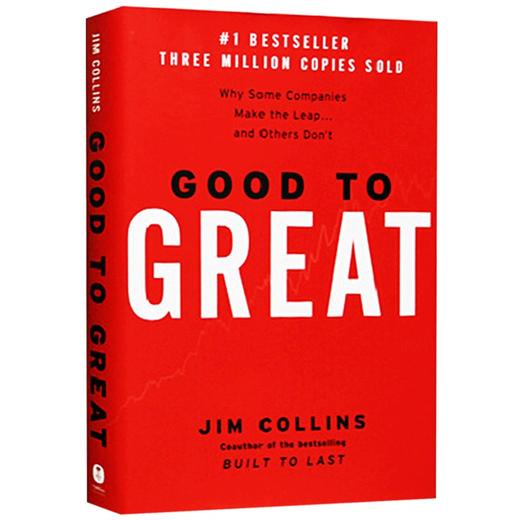
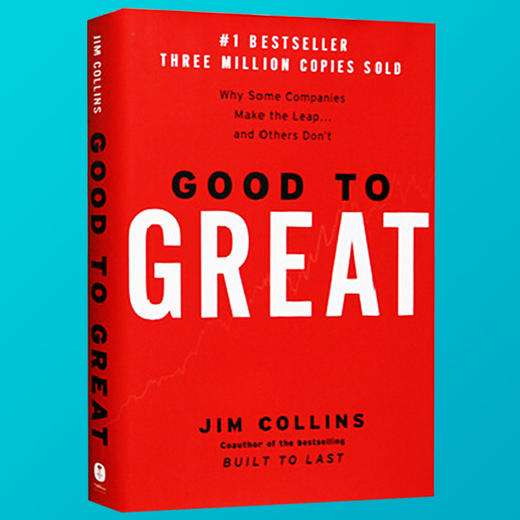
书名:Good to Great 从优秀到卓越 精装
作者:Jim Collins吉姆·柯林斯
出版社名称:Collins Business
出版时间:2001
语种:英文
ISBN:9780066620992
商品尺寸:15.6 x 2.7 x 23.5 cm
包装:精装
页数:300
Good to Great《从优秀到卓越》是畅销书《基业长青》的作者柯林斯的又一力作,它描绘了优秀公司实现向卓越公司跨越的宏伟蓝图。《基业长青》揭示了公司保持卓越的秘诀,但书中提到的公司自始至终都出类拔萃。对于那些业绩平平的公司,如何才能实现从优秀到卓越的跨越呢?是不是卓越的企业都有所谓的特殊“卓越气质”?发展的瓶颈是不是真的难以突破?
针对这一问题,柯林斯和他的研究小组历时5年,阅读并系统整理了6000篇文章,记录了2000多页的专访内容,创建了3.84亿字节的电脑数据,收集了28家公司过去50年,甚至更早的所有文章,进行了大范围的定性和定量分析,得出了如何使公司从优秀到卓越的令人惊异而振奋的答案。
柯林斯发现,公司从优秀到卓越,跟从事的行业是否在潮流之中没有关系,事实上,即使是一个从事传统行业的企业,即使它刚开始默默无闻,它也可能卓越。柯林斯提出了一整套观点,“只要采纳并认真贯彻,几乎所有的公司都能极大改善自己的经营状况,甚至可能成为卓越公司”。
媒体评论:
“这本书不会使平庸的公司成为优秀的公司。但是,它却会使优秀的公司成为卓越的公司。” ——彼得·德鲁克
“这是一本CEO们迫不及待要购买的书。” ——《今日美国》
“柯林斯和他的研究团队解决了商业中重要的难题之一。” ——《财富》
“柯林斯又写了一本会基业长青的书。” ——《商业周刊》
The Challenge
Built to Last, the defining management study of the nineties, showed how great companies triumph over time and how long-term sustained performance can be engineered into the DNA of an enterprise from the very beginning.
But what about the company that is not born with great DNA? How can good companies, mediocre companies, even bad companies achieve enduring greatness?
The Study
For years, this question preyed on the mind of Jim Collins. Are there companies that defy gravity and convert long-term mediocrity or worse into long-term superiority? And if so, what are the universal distinguishing characteristics that cause a company to go from good to great?
The Standards
Using tough benchmarks, Collins and his research team identified a set of elite companies that made the leap to great results and sustained those results for at least fifteen years. How great? After the leap, the good-to-great companies generated cumulative stock returns that beat the general stock market by an average of seven times in fifteen years, better than twice the results delivered by a composite index of the world's greatest companies, including Coca-Cola, Intel, General Electric, and Merck.
The Comparisons
The research team contrasted the good-to-great companies with a carefully selected set of comparison companies that failed to make the leap from good to great. What was different? Why did one set of companies become truly great performers while the other set remained only good?
Over five years, the team analyzed the histories of all twenty-eight companies in the study. After sifting through mountains of data and thousands of pages of interviews, Collins and his crew discovered the key determinants of greatness—why some companies make the leap and others don't.
The Findings
The findings of the Good to Great study will surprise many readers and shed light on virtually every area of management strategy and practice. The findings include:
Level 5 Leaders: The research team was shocked to discover the type of leadership required to achieve greatness.
The Hedgehog Concept (Simplicity within the Three Circles): To go from good to great requires transcending the curse of competence.
A Culture of Discipline:When you combine a culture of discipline with an ethic of entrepreneurship, you get the magical alchemy of great results. Technology Accelerators: Good-to-great companies think differently about the role of technology.
The Flywheel and the Doom Loop: Those who launch radical change programs and wrenching restructurings will almost certainly fail to make the leap.
“Some of the key concepts discerned in the study,” comments Jim Collins, “fly in the face of our modern business culture and will, quite frankly, upset some people.”
Perhaps, but who can afford to ignore these findings?

吉姆·柯林斯,美国著名商业畅销书作家。早年在斯坦福大学商学院从事教学与研究工作,并获得杰出教学奖。1996年,创办了自己的管理研究所,曾在默克公司、星巴克、时代明镜集团、麦肯锡公司等世界知名公司任高级经理和CEO。他的另外一本书《基业长青》也是公认的一部经典商业著作。他的著作被《财富》、《经济学人》、《商业周刊》、《今日美国》、《哈佛商业评论》等杂志广泛报道,引起巨大反响。
Jim Collins is author or coauthor of six books that have sold in total more than ten million copies worldwide, including the bestsellersGood to Great,Built to Last, andHow the Mighty Fall. Jim began his research and teaching career on the faculty at Stanford Graduate School of Business, where he received the Distinguished Teaching Award in 1992. He now operates a management laboratory in Boulder, Colorado, where he conducts research, teaches, and consults with executives from the corporate and social sectors.

Good is the enemy of great.
And that is one of the key reasons why we have so little that becomes great.
We don’t have great schools, principally becausewe have good schools. We don’t have great government, principally because we have goodgovernment. Few people attain great lives, in large part because it is just so easy to settle for a good life. The vast majority of companies never become great, precisely because the vast majority become quite good—and that is their main problem.
This point became piercingly clear to me in 1996, when I was having dinner with a group of thought leaders gathered for a discussion about organizational performance. Bill Meehan, the managing director of the San Francisco office of McKinsey & Company, leaned over and casually confided, “You know. Jim, we love Built to Last around here. You and your coauthor did a very fine job on the research and writing.Unfortunately, it’s useless.”
Curious, I asked him to explain.
“The companies you wrote about were, for the most part, always great.” he said. “They never had to him themselves from good companies into great companies. They had parents like David Packard and George Merck, who shaped the character of greatness from early on. But what about the vast majority of companies that wake up partway through life and realize that they’re good, but not great?”
I now realize that Meehan was exaggerating for effect with his “useless” comment, but his essential observation was correct—that truly great companies, for the most part, have always been great. And the vast majority of good companies remain just that—good, but not great. Indeed,Meehan’s comment proved to be an invaluable gift, as it planted the seed of a question that became the basis of this entire book — namely, Can a goodcompany become a great company and, if so, how? Or is the disease of “just being good” incurable?
Five years after that fateful dinner we can now say, without question, that good to great does happen, and we’ve learned much about the underlying variables that make it happen. Inspired by Bill Meehan’s challenge, my research team and I embarked on a five-year research effort, a journey to explore theinner workings of good to great.
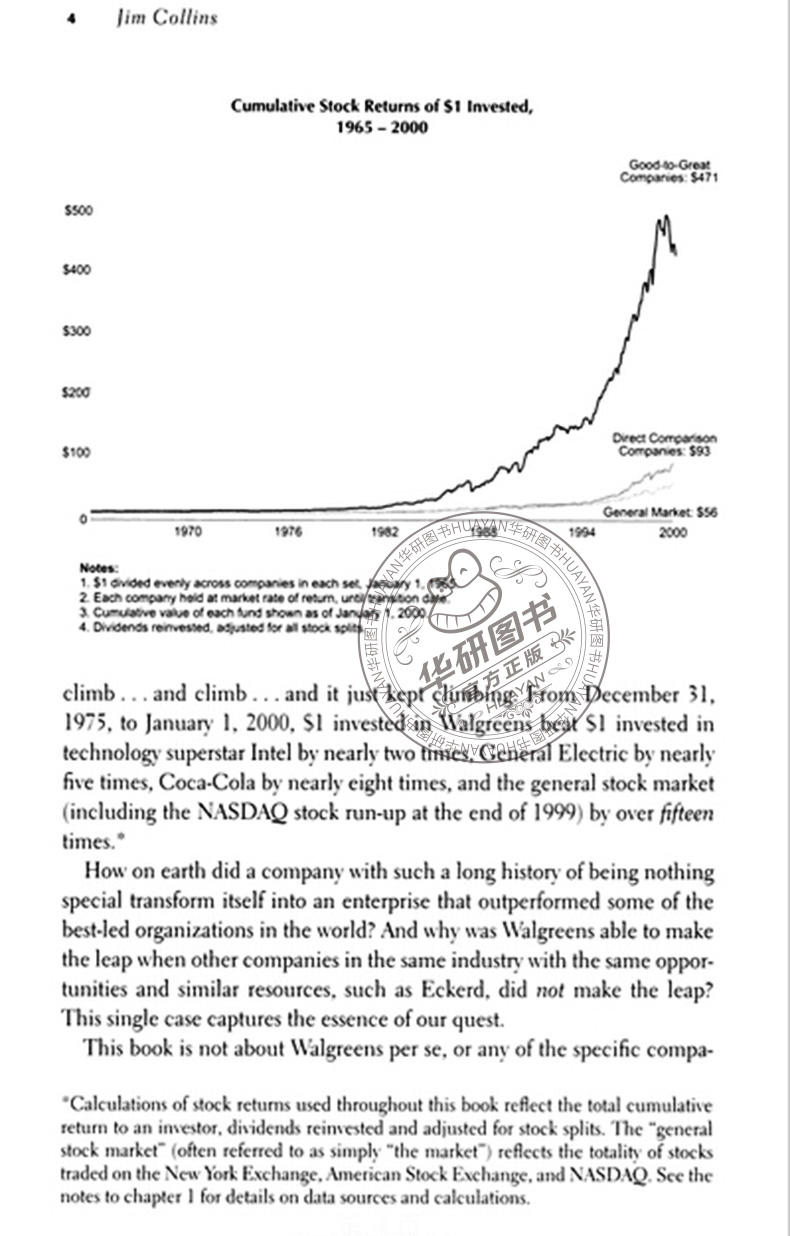
To quickly grasp the concept of the project, look at the chart on page 2. In essence, we identified companies that made the leap from good results to great results and sustained those results for at least fifteen s-cars.We compared these companies to a carefully selected control group of comparison companies that failed to make the leap, or if they did, failed to sustain it.We then compared the good-to-great companies to the comparison companies to discover the essential and distinguishing factors at work.
The good-to-great examples thatmade the final cut into the study attained extraordinary results, averaging cumulative stock returns 6.9 times the general market in the fifteen years following their transition points. To put that in perspective, General Electric (considered by many to be the best-led company in America at the end of the twentieth century) outperformed the market by 2.8 limes over the fifteen years 1985 to 2000.’ Furthermore, if you invested $1 in a mutual fund of the good-to- great companies in 1965, holding each company at the general market rate until the date of transition, and simultaneously invested $1 in a general market stock fund, your $1 in the good-to-great fund taken out on January 1, 2000, would have multiplied 471 times, compared to a 56 fold increase in the market.
0123456789
- 华研外语 (微信公众号认证)
- 本店是“华研外语”品牌商自营店,全国所有“华研外语”、“华研教育”品牌图书都是我司出版发行的,本店为华研官方源头出货,所有图书均为正规正版,拥有实惠与正版的保障!!!
- 扫描二维码,访问我们的微信店铺
- 随时随地的购物、客服咨询、查询订单和物流...