商品详情
l 戴森的传奇讲义:本书源自戴森1951年于康奈尔大学讲授的相对论性量子力学课程讲义。这套讲义在物理学界流传已久、享有盛誉。 l 清晰的讲解风格:物理学家埃德温杰恩斯(Edwin Thompson Jaynes)曾评价这套讲义是;一代物理学家的理想读本:比费曼的讲解更清晰、动机更充分,比施温格的讲述更直击要点。戴森特有的清晰笔触贯穿全书,使复杂概念易于理解。 l 六十周年纪念版:新版增加 David Kaiser撰写的前言及戴森1954年莱苏什补充讲稿,内容更为充实。 |
教学与研究价值:本书既可作为物理与数学专业研究生的量子场论入门读物,也可作为课程教学的补充资料,帮助读者理解量子场论如何发展成今天的形式
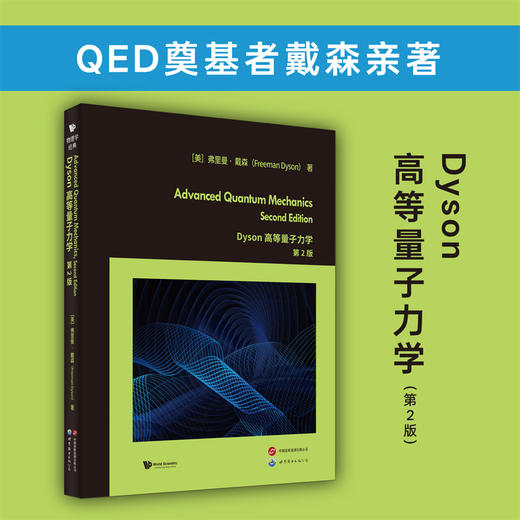
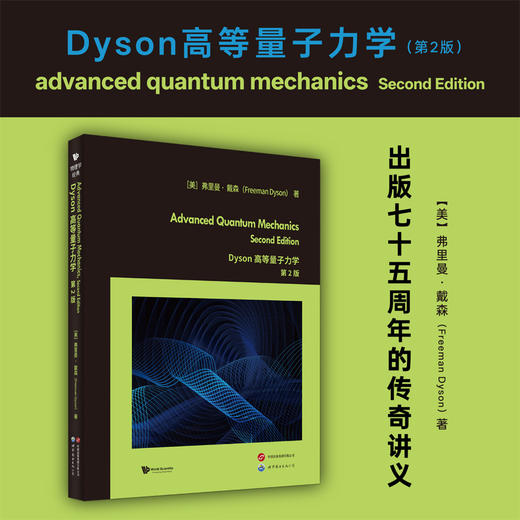
《Dyson高等量子力学(第 2 版)》(Advanced Quantum Mechanics, Second Edition)收录了戴森于1951年在康奈尔大学讲授的量子电动力学讲义。这套讲义曾被物理学家埃德温汤普森杰恩斯评价为兼具费曼的清晰动机与施温格的简练效率。第二版在康奈尔讲义六十周年之际出版,增添了科学史家戴维凯瑟撰写的前言,并附带了戴森1954年在莱苏什理论物理暑期学校的补充讲稿。莱苏什讲稿对场论作了更细致的展开,提供了费米黄金规则的严格推导,并对重整化与Ward恒等式作了深入处理。全书从狄拉克方程出发,经散射理论与相对论性多粒子处理,逐步过渡到经典与量子场论,涵盖麦克斯韦场、电子场及其相互作用的量子化框架。全书以戴森特有的清晰笔触写成,既适合物理与数学专业的研究生阅读,也可作为量子场论课程的有益补充。 |
弗里曼戴森(1923ndash;2020)是英裔美国物理学家、数学家和科普作家,以在量子电动力学中的关键贡献闻名他证明了费曼的路径积分表述与施温格和朝永振一郎的变分方法在数学上等价,统一了该理论框架,为量子电动力学的精密验证奠定了基础。他还提出;戴森球这一影响深远的天体物理思想实验,并在核武器政策、固态物理、生物学及应用数学等领域留有探索足迹。戴森撰写多部科普著作,长期在普林斯顿高等研究院从事研究,曾获沃尔夫物理学奖等荣誉,于2020年去世。
Foreword v Preface xiii Preface to First Edition xvii Generally used Notation xxv 1 Introduction 1 2 The Dirac Theory 5 3 Scattering Problems and Born Approximation 31 4 Field Theory 47 5 Examples of Quantized Field Theories 61 6 Free Particle Scattering Problems 125 7 General Theory of Free Particle Scattering 145 8 Scattering by a Static Potential. Comparison with Experimental Results 183 Notes 205 Appendix A 213 Appendix B 229 Appendix C 233 References 279 Index 283 |
Preface Within a year of World Scientificrsquo;s publishing Advanced Quantum Mechanics, Prof. Dyson wrote me that he had come across some of his lecture notes from the 1954 Les Houches Summer School in physics. This talk had been intended as a supplement to the AQM notes. Perhaps these notes could be appended to a new edition? I asked him to send me a copy, which he did. The pages were not entirely clear in spots, so I thought to contact Prof. Cacute;ecile DeWitt_Morette, the founder and, for much of its existence, the executive director of the Les Houches Summer School, in hopes that she had other copies of Prof. Dysonrsquo;s notes. Prof. DeWitt_Morette had a scanned copy and responded with a very lengthy PDF, notes of not one but three sets of Prof. Dysonrsquo;s lectures, together with many pages of lecture notes delivered that summer by her husband, Prof. Bryce S. DeWitt. I sent a copy to Prof. Dyson, who hadnrsquo;t seen notes of his last two lectures in many years. I promised him eventually to retype these as well. A year or more went by. Bob Jantzen, who had been instrumental in getting the original notes to the Arxiv web site, let me know that Prof. Dyson would be giving a talk at the Chandrasekhar centennial celebration at the University of Chicago in October of 2010.2 The talks were held at the universityrsquo;s International House, a ten minute walk from my house. I introduced myself a few minutes before his talk, and apologized for not yet getting the Les Houches notes retyped. We talked a little more, and he described how he had spent a few days in Chicago following his famous bus ride back east,3 being shown around the area by the distinguished mathematician Andracute;e Weil, then at the University of Chicago. They walked and talked for hours, one of the best ways to do important work. He was charmed and a little surprised that such a prominent scholar would devote his time to someone so young and relatively unknown, and provide such a generous welcome. Where did you stay, I asked him, and where did you begin to write up your results? Right in this building, he replied, the International House. In December, Kellye Curtis at World Scientific wrote me to ask about a new edition. I told her about the Les Houches notes and my promise to Prof. Dyson. She wrote to Prof. Dyson. He was very agreeable to a new edition incorporating his Les Houches lectures, and this is the result. I want to thank Dr. Curtis for her hard work as well; a physicist as well as an editor, she has been a dream to work with. In addition to Prof. DeWittndash;Morettersquo;s essential help, there were several others whose aid was critical to this project. The last lectures on renormalization were particularly difficult to transcribe. First, the notes were in French, a language I learned only partially as a child in New Orleans, reinforced sporadically by mostly ineffective grammar school classes. Next, the subject matter itself was substantially more challenging than in the earlier notes, and I was not always able to determine if there were errors in the manuscript. To repair my deficiencies, I turned to an old friend, my former Lab School student Matthew Headrick, a theoretical physicist now at Brandeis University. Matthew, who spent two years teaching mathematics and science in Gabon for the Peace Corps, has far deeper knowledge than I of both physics and French. (I may be a better typist.) He corrected several errors (in French and in physics) and removed many infelicities, and I am very grateful to him. He added that it was interesting how little the presentation of renormalization had changed from Prof. Dysonrsquo;s version to what he had learned from Sidney Coleman at Harvard many decades later. Finally, permission to use the French notes had to be obtained from the note_takers, Jean Lascoux and Jacques Mandelbrojt. Prof. Mandelbrojt was reached by World Scientific, and responded enthusiastically (in flawless English) to the incorporation of his notes. Alas, Prof. Lascoux was no longer alive, but Henri Epstein, one of his colleagues, provided the address of his widow, Mme. Fran,coise Lascoux. Steven Farver, a French teacher at the Laboratory Schools (and by far the wittiest of all Lab teachers), translated my letter to Mme. Lascoux into elegant French. Mme. Lascoux responded graciously, and added that she hoped it would help to preserve the memory of her husband Jean. I share that hope, and thank her for her kindness. Finally, the Feynman diagrams were drawn for the most part with Pierre Chatelierrsquo;s wonderful utility LaTeXiT, using the feynmf package by Thorsten Ohl. Occasionally Adobe Illustrator was used to fit together pieces of particularly complicated diagrams. It would have been very difficult to do these with Illustrator alone. Once again I am deeply grateful to Prof. Dyson for allowing the proceeds of the sale of this new edition to benefit the New Orleans Public Library, as did those of the previous edition. Things have gotten better in New Orleans in the last five years, but much remains to be done. David Derbes The Laboratory Schools The University of Chicago loki@uchicago.edu |
2 September 2011
- 新华一城书集 (微信公众号认证)
- 上海新华书店官方微信书店
- 扫描二维码,访问我们的微信店铺
- 随时随地的购物、客服咨询、查询订单和物流...