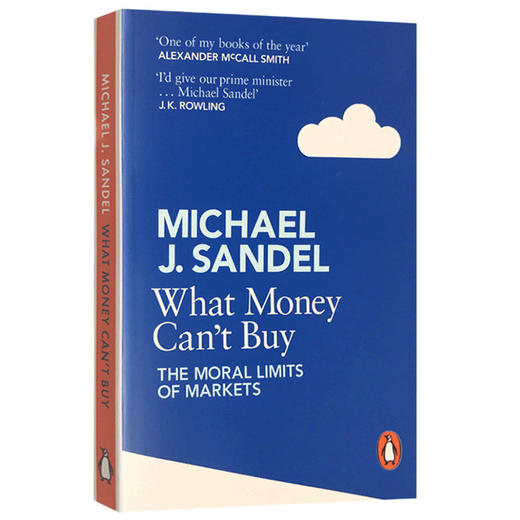
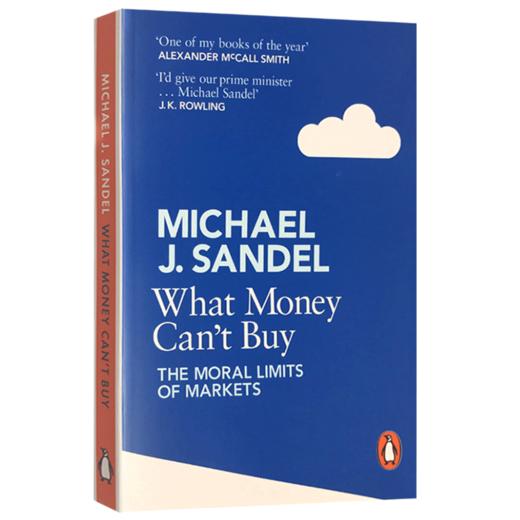
金钱不能买什么 英文原版 What Money Can't Buy 金钱与公正的正面交锋 公正作者迈克尔桑德尔 公开课 英文版进口书籍正版
| 运费: | ¥ 0.00-999.00 |
| 库存: | 12 件 |


商品详情
依据《出版管理条例》,本书个别内容与中国实际情况不符,已做适当处理(如涂抹),但不影响整体正常阅读(介意者慎拍)。此属正常情况,请事先知悉,以免给您带来不便。特此说明。
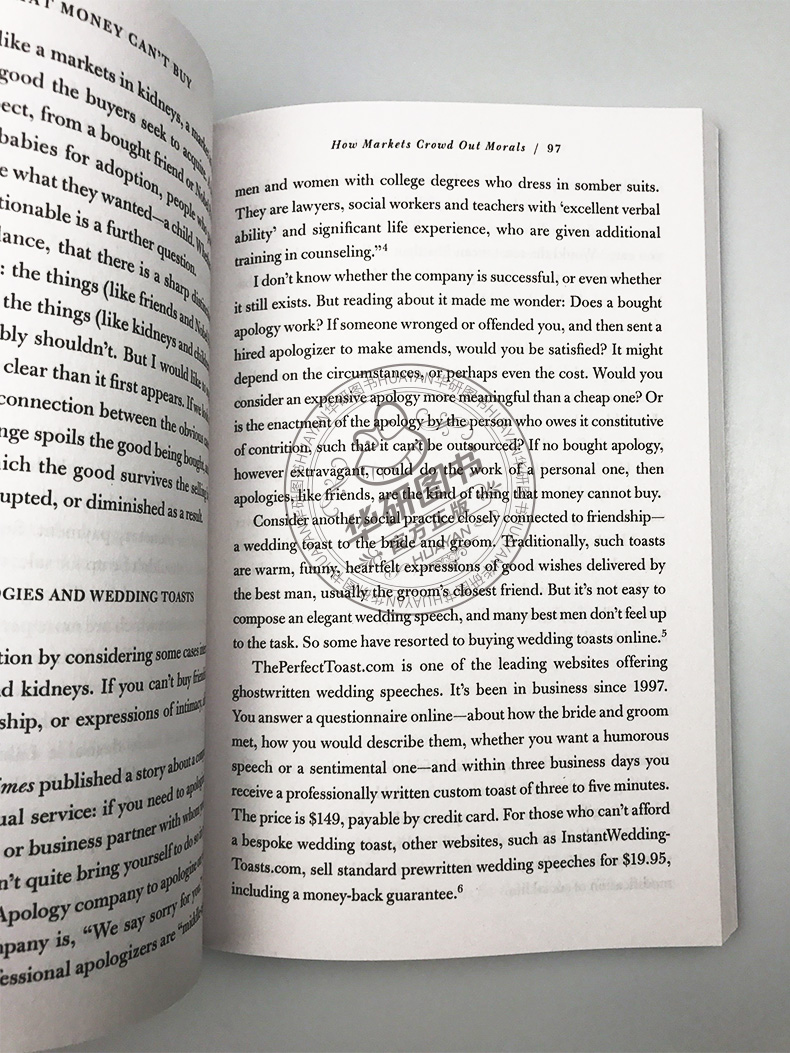
 书名:What Money Can't Buy: The Moral Limits of Markets金钱不能买什么:金钱与公正的正面交锋
作者:Michael Sandel
出版社名称:Penguin
出版时间:2013
语种:英文
ISBN:9780241954485
商品尺寸:12.9 x 1.5 x 19.8 cm
包装:平装
页数:256 随着中国经济的增长,中国的市场体制暴露出越来越多的问题,如何在市场与道德规范之间取得一个均衡点,是目前经济学界和知识界关注的焦点,What Money Can't Buy《金钱不能买什么》无疑能给人们很大启示。
本书是审视经济体制的新视野。作者跳出经济学的狭隘范畴,用哲学、社会学的观点来看待经济问题,这是过去的经济读物很难做到的。
我们正迈向一个一切都被拿来售卖的社会。反思“市场道德”市场行为追求社会效用化,是个人自由的扩张。但桑德尔指出在很多情况下,允许市场“发挥作用”会毁灭所涉及事物的“价值”。
不仅决策者及制定者应该思考如何通过政策规范市场,每一个民众也应该反思如何在市场化的社会中坚持公共的善。
媒体评论:
当代公共社会的主流观点之一认为,道德和宗教概念属于私人事务,应该排除在公共道德争论之外。对此桑德尔却有不同看法。——《观察家》(Observer)
无论是在波士顿还是在北京,桑德尔碰触到的都是深层问题。——托马斯·弗里德曼(Thomas Friedman)
桑德尔将其政治哲学的力量,承担起我们普遍的不安感。——《泰晤士报》(The Times)
他对于政治辩论无可回避的伦理色彩的坚持,让人耳目一新。——《新政治家》(New Statesman)
What Money Can't Buy is the Top Ten Sunday Times Bestseller from 'the superstar philosopher', Michael Sandel
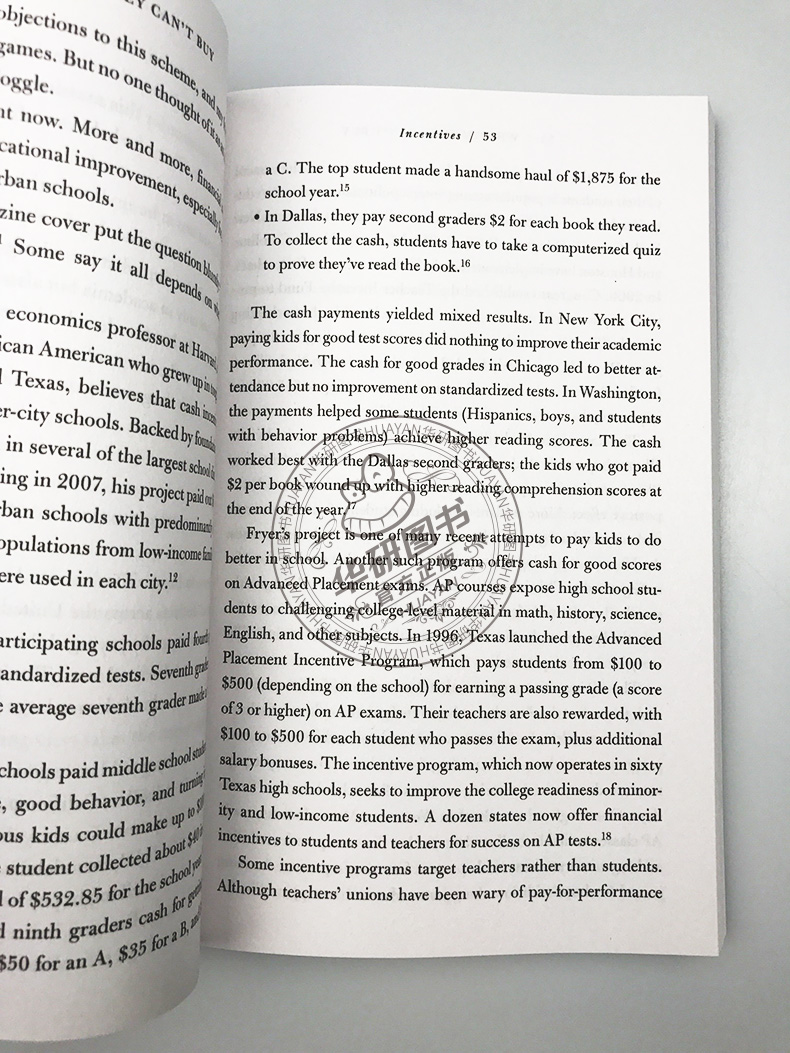
Should we financially reward children for good marks? Is it ethical to pay people to donate organs? What about hiring mercenaries to fight our wars, outsourcing inmates to for-profit prisons or selling citizenship?
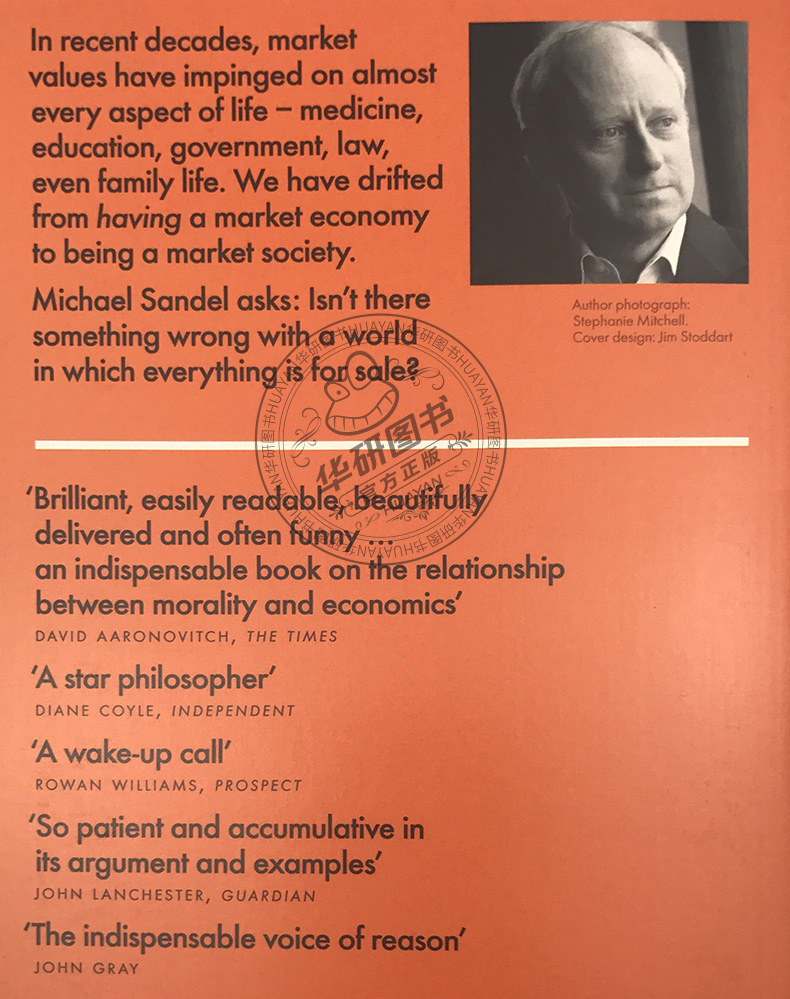
In recent decades, market values have impinged on almost every aspect of life - medicine, education, government, law, even family life. We have drifted from having a market economy to being a market society. In What Money Can't Buy Michael Sandel asks: Isn't there something wrong with a world in which everything is for sale? And how do we protect the things that really matter?
Review
One of the most popular teachers in the world (Observer)
Sandel is touching something deep in both Boston and Beijing
(Thomas Friedman New York Times)
The most influential foreign figure of the year (China's Newsweek)
Few philosophers are compared to rock stars or TV celebrities, but that's the kind of popularity Michael Sandel enjoys in Japan(Japan Times)
One of the world's most interesting political philosophers (Guardian)
What Money Can't Buy selected by the Guardian as a literary highlight for 2012(Guardian) 市场的角色和范围是现代政治所缺失的一场重大辩论。我们想要一个市场经济,还是市场社会?市场在公共生活和个人伦理扮演什么角色?我们怎样决定什么东西可以买卖,什么东西由非市场的价值掌握?哪里是金钱的法则行不通的地方?
在What Money Can't Buy《金钱不能买什么》中,迈克尔�9�9桑德尔论述了当下突出的道德问题之一:在我们这个世界,任何事物都可以出售,这个世界难道没有问题?如果是这样,我们又该如何防止市场价值观侵蚀本不该由它们主导的领域?市场的道德界限又何在?
近几十年来,在我们生活的几乎每一个层面,医疗、教育、政府、法律、艺术、体育,甚至家庭生活和人际关系等,非市场的准则都已被市场价值排挤出局。桑德尔认为,我们已经从一个拥有市场经济的社会变成了市场化的社会。
在畅销书《公正》中,桑德尔用简洁而敏锐的阐述,就我们在日常生活中所遇到的道德困境娓娓道来,展现了大师的拿捏能力。在《金钱不能买什么》一书中,他发起了一场我们这个“市场驱动时代”所缺失的争论:在民主社会中,市场应扮演什么角色;道德和公共的善为市场所不敬,金钱所不及,我们怎样才能够保护它们?
Should we pay children to read books or to get good grades? Is it ethical to pay people to test risky new drugs or to donate their organs? What about hiring mercenaries to fight our wars, outsourcing inmates to for-profit prisons, auctioning admission to elite universities, or selling citizenship to immigrants willing to pay? Isn't there something wrong with a world in which everything is for sale?
In recent decades, market values have crowded out nonmarket norms in almost every aspect of life-medicine, education, government, law, art, sports, even family life and personal relations. Without quite realizing it, Sandel argues, we have drifted from having a market economy to being a market society.
In What Money Can't Buy, Sandel examines one of the biggest ethical questions of our time and provokes a debate that's been missing in our market-driven age: What is the proper role of markets in a democratic society, and how can we protect the moral and civic goods that markets do not honour and money cannot buy?
 迈克尔•桑德尔,哈佛大学文理学院政府管理学Anne T.及Robert M. Bass讲席教授,自1980年起教授政治哲学。他备受赞誉的“公正”课程,是网络和电视上免费的哈佛公开课。桑德尔的作品已被译成18种语言,在英国、美国、日本、韩国、瑞典、巴西和中东国家被制作成电视系列片。他在哈佛举办Tanner讲座,同时兼任巴黎大学客座教授。2010年,中国的《新闻周刊》评选他为“具有影响力的外国学者年度人物”。2009年获选为英国广播公司Reith讲座主讲人。已出版的《公正》为世界畅销书。
Michael J. Sandelis the Anne T. and Robert M. Bass Professor of Government at Harvard University. His legendary 'Justice' course is the first Harvard course made freely available online (www.JusticeHarvard.org) and on television. His work has been translated into 15 languages and been the subject of television series in the U.K., the U.S., Japan, South Korea, Sweden, and the Middle East. He has delivered the Tanner Lectures at Oxford and been a visiting professor at the Sorbonne, Paris. In 2010, China Newsweek named him the "most influential foreign figure of the year" in China. Sandel was the 2009 BBC Reith Lecturer, and his most recent book Justice is an international bestseller. 1. Jumping the Queue
2. Incentives
3. How Markets Crowd Out Morals
4. Markets in Life and Death
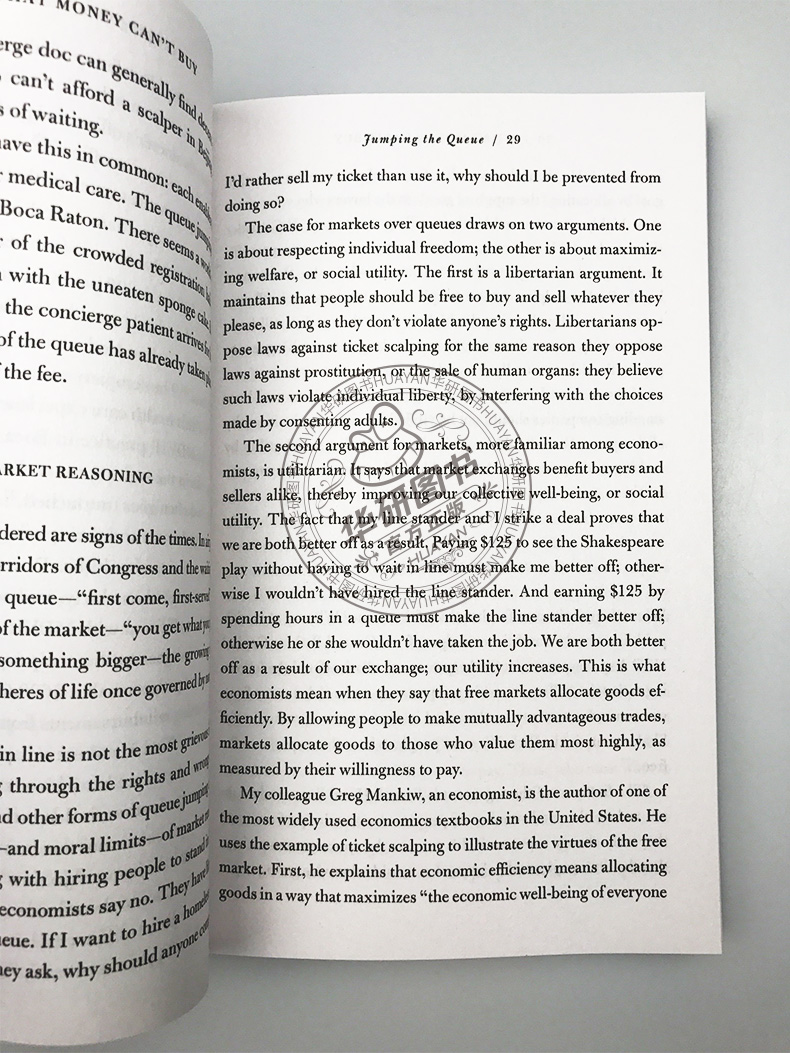
5. Naming Rights We live at a time when almost everything can be bought and sold. Over the past three decades, markets—and market values—have come to govern our lives as never before. We did not arrive at this condition through any deliberate choice. It is almost as if it came upon us.
As the cold war ended, markets and market thinking enjoyed unrivaled prestige, understandably so. No other mechanism for organizing the production and distribution of goods had proved as successful at generating affluence and prosperity. And yet, even as growing numbers of countries around the world embraced market mechanisms in the operation of their economies, something else was happening. Market values were coming to play a greater and greater role in social life. Economics was becoming an imperial domain. Today, the logic of buying and selling no longer applies to material goods alone but increasingly governs the whole of life. It is time to ask whether we want to live this way.
THE ERA OF MARKET TRIUMPHALISM
The years leading up to the financial crisis of 2008 were a heady time of market faith and deregulation—an era of market triumphalism. The era began in the early 1980s, when Ronald Reagan and Margaret Thatcher proclaimed their conviction that markets, not government, held the key to prosperity and freedom. And it continued in the 1990s, with the market-friendly liberalism of Bill Clinton and Tony Blair, who moderated but consolidated the faith that markets are the primary means for achieving the public good.
Today, that faith is in doubt. The era of market triumphalism has come to an end. The financial crisis did more than cast doubt on the ability of markets to allocate risk efficiently. It also prompted a widespread sense that markets have become detached from morals and that we need somehow to reconnect them. But it’s not obvious what this would mean, or how we should go about it.
Some say the moral failing at the heart of market triumphalism was greed, which led to irresponsible risk taking. The solution, according to this view, is to rein in greed, insist on greater integrity and responsibility among bankers and Wall Street executives, and enact sensible regulations to prevent a similar crisis from happening again.
This is, at best, a partial diagnosis. While it is certainly true that greed played a role in the financial crisis, something bigger is at stake. The most fateful change that unfolded during the past three decades was not an increase in greed. It was the expansion of markets, and of market values, into spheres of life where they don’t belong.
To contend with this condition, we need to do more than inveigh against greed: we need to rethink the role that markets should play in our society. We need a public debate about what it means to keep markets in their place. To have this debate, we need to think through the moral limits of markets. We need to ask whether there are some things money should not buy.
The reach of markets, and market-oriented thinking, into aspects of life traditionally governed by nonmarket norms is one of the most significant developments of our time.
Consider the proliferation of for-profit schools, hospitals, and prisons, and the outsourcing of war to private military contractors.
- 华研外语 (微信公众号认证)
- 本店是“华研外语”品牌商自营店,全国所有“华研外语”、“华研教育”品牌图书都是我司出版发行的,本店为华研官方源头出货,所有图书均为正规正版,拥有实惠与正版的保障!!!
- 扫描二维码,访问我们的微信店铺
- 随时随地的购物、客服咨询、查询订单和物流...