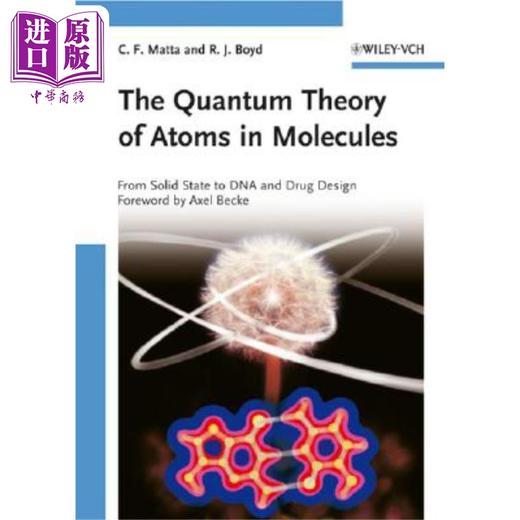
【中商原版】分子原子量子论 从固体到DNA及药物设计 The Quantum Theory Of Atoms In Molecules 英文原版 Cherif F Matta
| 运费: | ¥ 0.00-16.00 |
| 库存: | 1 件 |
商品详情
分子原子量子论:从固体到DNA及药物设计 The Quantum Theory Of Atoms In Molecules - From Solid State To Dna And Drug Design
基本信息
Edited by:Cherif F. Matta, Russell J. Boyd
Format:Hardback 567 pages
Publisher:Wiley-VCH Verlag GmbH
Imprint:Blackwell Verlag GmbH
ISBN:9783527307487
Published:26 Jan 2007
Weight:1179g
Dimensions:244 x 178 (mm)
页面参数仅供参考,具体以实物为准
书籍简介
本书将过去10年中从分子中的原子研究中获得的知识提炼成一本独特、方便的参考书。在整个过程中,作者面向广大读者,因此,这本书同样可以作为教科书使用,而不影响其研究导向的特点。该书结构清晰,从理论的进展开始,然后是化学键和反应性的理论研究。接下来是关于固态和表面以及实验电子密度的单独章节,后是生物科学和药物设计的应用。
该书是物理化学家、化学家、物理学家、光谱学家和材料科学家的需求之作。
This book distills the knowledge gained from research into atoms in molecules over the last 10 years into a unique, handy reference. Throughout, the authors address a wide audience, such that this volume may equally be used as a textbook without compromising its research-oriented character. Clearly structured, the text begins with advances in theory before moving on to theoretical studies of chemical bonding and reactivity. There follow separate sections on solid state and surfaces as well as experimental electron densities, before finishing with applications in biological sciences and drug-design.
The result is a must-have for physicochemists, chemists, physicists, spectroscopists and materials scientists.
作者简介
Chérif F. Matta是位于加拿大哈利法克斯的圣文森特山大学的化学助理教授和达尔豪斯大学的化学兼职教授。他于1987年在埃及的亚历山大大学获得学士学位,并于2002年在加拿大汉密尔顿的麦克马斯特大学获得理论化学的博士学位。之后,他在加拿大多伦多大学做博士后研究,然后被授予达尔豪斯大学的I. W. Killam奖学金。马塔教授曾获得J. C. Polanyi化学奖、两项BioVision Next奖学金和化学教学奖,并有40多篇论文和书籍章节以及两个软件程序。他的研究领域是理论和计算化学,重点是QTAIM及其应用。
拉塞尔-博伊德1967年毕业于不列颠哥伦比亚大学化学系,1971年获得麦吉尔大学理论化学博士学位。随后他到英国牛津大学做博士后,1973年至1975年以Killam博士后奖学金回到不列颠哥伦比亚大学化学系。之后,他加入哈利法克斯的达尔豪斯大学,从1992年到2005年担任化学系主任,2001年成为麦克劳德主席。博伊德教授在计算和理论化学方面发表了约200篇论文。他目前的兴趣包括辐射对DNA和蛋白质的影响,一种主要的抗肿瘤药物切割DNA的机制,以及催化剂的设计。
Chérif F. Matta is an assistant professor of chemistry at Mount Saint Vincent University and an adjunct professor of chemistry at Dalhousie University, both in Halifax, Canada. He obtained his BSc from Alexandria University, Egypt, in 1987 and gained his PhD in theoretical chemistry from McMaster University, Hamilton, Canada in 2002. He was then a postdoctoral fellow at the University of Toronto, Canada, before being awarded an I. W. Killam Fellowship at Dalhousie University. Professor Matta has held the J. C. Polanyi Prize in Chemistry, two BioVision Next Fellowships, and a Chemistry Teaching Award, and has more than 40 papers and book chapters and two software programs to his credit. His research is in theoretical and computational chemistry with a focus on QTAIM and its applications.
Russell Boyd graduated from the University of British Columbia in chemistry in 1967, receiving his PhD in theoretical chemistry from McGill University in 1971. He subsequently went to Oxford University, UK, as a postdoctoral fellow, before returning to British Columbia with a Killam Postdoctoral Fellowship at the Department of Chemistry from 1973 to 1975. He then joined Dalhousie University, Halifax, where he held the Chair of Chemistry from 1992 to 2005 and became McLeod Chair in 2001. Professor Boyd has published about 200 papers in computational and theoretical chemistry. His current interests include the effects of radiation on DNA and proteins, the mechanism by which a leading anti-tumor drug cleaves DNA, and the design of catalysts.
目录
部分目录,仅供参考
Foreword vii
Preface xix
List of Abbreviations Appearing in this Volume xxvii
List of Contributors xxxiii
1 An Introduction to the Quantum Theory of Atoms in Molecules 1
Chérif F. Matta and Russell J. Boyd
1.1 Introduction 1
1.2 The Topology of the Electron Density 1
1.3 The Topology of the Electron Density Dictates the Form of Atoms in Molecules 5
1.4 The Bond and Virial Paths, and the Molecular and Virial Graphs 8
1.5 The Atomic Partitioning of Molecular Properties 9
1.6 The Nodal Surface in the Laplacian as the Reactive Surface of a Molecule 10
1.7 Bond Properties 10
1.7.1 The Electron Density at the BCP (pb) 11
1.7.2 The Bonded Radius of an Atom (rb), and the Bond Path Length 11
1.7.3 The Laplacian of the Electron Density at the BCP (∇2pb) 11
1.7.4 The Bond Ellipticity (є) 12
1.7.5 Energy Densities at the BCP 12
1.7.6 Electron Delocalization between Bonded Atoms: A Direct Measure of Bond Order 13
1.8 Atomic Properties 15
1.8.1 Atomic Electron Population [N(Ω)] and Charge [q(Ω)] 16
1.8.2 Atomic Volume [Vol.(Ω)] 16
1.8.3 Kinetic Energy [T(Ω)] 17
1.8.4 Laplacian [L(Ω)] 17
1.8.5 Total Atomic Energy [Ee(Ω)] 18
1.8.6 Atomic Dipolar Polarization [μ(Ω)] 20
1.8.7 Atomic Quadrupolar Polarization [Q(Ω)] 24
1.9 ‘‘Practical’’ Uses and Utility of QTAIM Bond and Atomic Properties 25
1.9.1 The Use of QTAIM Bond Critical Point Properties 25
1.9.2 The Use of QTAIM Atomic Properties 26
1.10 Steps of a Typical QTAIM Calculation 27
References 30
Part I Advances in Theory 35
2 The Lagrangian Approach to Chemistry 37
Richard F. W. Bader
2.1 Introduction 37
2.1.1 From Observation, to Physics, to QTAIM 37
2.2 The Lagrangian Approach 38
2.2.1 What is The Lagrangian Approach and What Does it Do? 38
2.2.2 The Lagrangian and the Action Principle – A Return to the Beginnings 39
2.2.3 Minimization of the Action 40
2.2.4 Steps in Minimizing the Action 41
2.3 The Action Principle in Quantum Mechanics 42
2.3.1 Schrödinger’s Appeal to the Action 42
2.3.2 Schrödinger’s Minimization 42
2.3.2.1 Two Ways of Expressing the Kinetic Energy 43
2.3.3 Obtaining an Atom from Schrödinger’s Variation 44
2.3.3.1 The Role of Laplacian in the Definition of an Atom 45
2.3.4 Getting Chemistry from δG(Ψ, ∇Ψ; Ω) 46
2.4 From Schrödinger to Schwinger 48
2.4.1 From Dirac to Feynman and Schwinger 48
2.4.2 From Schwinger to an Atom in a Molecule 49
2.5 Molecular Structure and Structural Stability 52
2.5.1 Definition of Molecular Structure 52
2.5.2 Prediction of Structural Stability 53
2.6 Reflections and the Future 53
2.6.1 Reflections 53
2.6.2 The Future 55
References 57
3 Atomic Response Properties 61
Todd A. Keith
3.1 Introduction 61
3.2 Apparent Origin-dependence of Some Atomic Response Properties 62
3.3 Bond Contributions to ‘‘Null’’ Molecular Properties 64
3.4 Bond Contributions to Atomic Charges in Neutral Molecules 70
3.5 Atomic Contributions to Electric Dipole Moments of Neutral Molecules 71
3.6 Atomic Contributions to Electric Polarizabilities 73
3.7 Atomic Contributions to Vibrational Infrared Absorption Intensities 78
3.8 Atomic Nuclear Virial Energies 82
3.9 Atomic Contributions to Induced Electronic Magnetic Dipole Moments 88
3.10 Atomic Contributions to Magnetizabilities of Closed-Shell Molecules 90
References 94
4 QTAIM Analysis of Raman Scattering Intensities: Insights into the Relationship Between Molecular Structure and Electronic Charge Flow 95
Kathleen M. Gough, Richard Dawes, Jason R. Dwyer, and Tammy L. Welshman
- 中商进口商城 (微信公众号认证)
- 中商进口商城中华商务贸易有限公司所运营的英美日韩港台原版图书销售平台,旨在向内地读者介绍、普及、引进最新最有价值的国外和港台图书和资讯。
- 扫描二维码,访问我们的微信店铺
- 随时随地的购物、客服咨询、查询订单和物流...