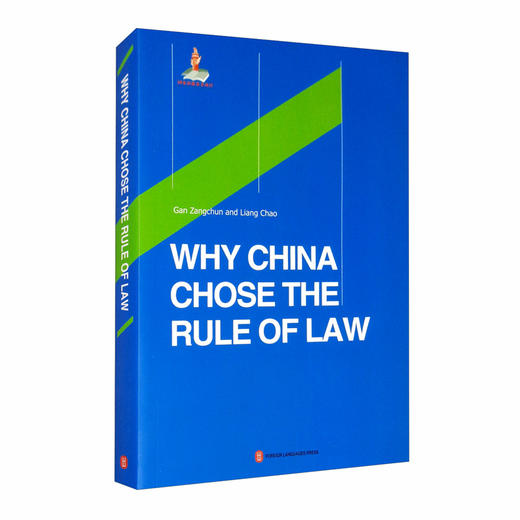
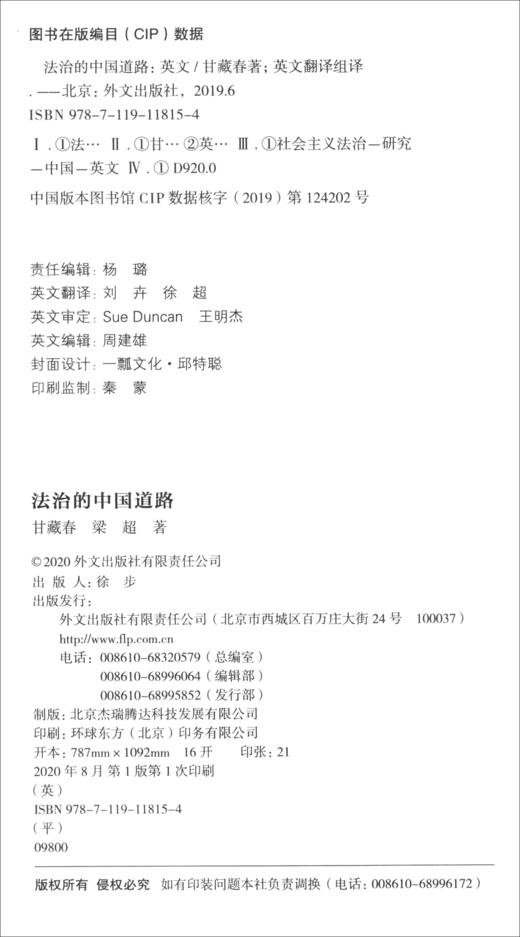
(仓发) 法治的中国道路(英文版)/外文出版社/甘藏春/9787119118154
¥98.00
| 运费: | ¥ 6.00-20.00 |
| 库存: | 10 件 |
商品详情
精彩摘要
In medieval Europe, central government had weak control over local governments, a situation that laid the important foundation for constraining sovereign power and implementing modern rule of law.States, manors, and cities commonly enjoyed autonomy.The jurisdic-tion of kings, lords, heads of civil councils and other local officials was an inherent authority rather than one granted by the emperor.Although local power could not compare with sovereign power, it was independent of the latter and a tendency toward the decentralization and diversifi-cation of power.Such a relationship between central and local govern-ments led to a particular Western tradition of a pluralist legal system including state laws, feudal laws, manor laws, city laws and business laws, in which legalinstitutions and judiciaries were not monopolized by central government.Of these, feudallaw regulated the rights-obligations relationsFup between feudal lords and vassals; manor laws regulated the relationship between lords and peasants and agricultural production;city law was a system of laws determined by citizens to ensure city autonomy and order; business law regulated domestic and international trade as well as maritime commerce.These sets of laws were the result of two sides being in agreement, rather than the stronger side imposing its will.Although the emperor was the most powerful lord, the relation-ship between emperor and kings, kings and vassals, central government and cities was not a relationship of one-way dorrunance and submis-sion, but a contractual relationship predicated on mutual benefits,a relationship containing stable rights and obligations.This unique legal tradition restricted the power and status of the monarch by means of laws and contracts, making it possible to establish modern rule of law with its emphasis on "restriction on public power and assurance of hu-man rights" and its removal of absolute power from the emperor and kings.
In China, the traditional central-local government relationship was completely different.With the abolition of the enfeoffment system and the establishment of prefectures and counties by Qin Shi Huang (259-210 B.C.),the first emperor of the Qin, things changed-the enfeoffment system only maintained lordship status symbolically, and there was an increasing trend toward unification; centralized authotity expanded so widely that the em-peror gradually deepened his control over the local governments' jurisdic-tion over property, personnel, military power and judiciary.For example,the selection, appointment and removal of local officials were decided centrally via the imperial examination system; by appointing finanaal offi-cials at the local level and conducting vert:ical management, local financial resources were turned over to the center; by minimizing local govern-ments' power of military deployment, authority to mobilize troops rested chiefly with the central government; establishing a centraLized legislation system where the central government had virtually all legislative power while the local governments had none; making the emperor the supreme judge, able to change judiaal decisions at will.
……
内容简介
This project is not only an essential interpretation of the spirit of the Fourth Plenary Session of the 18th CPC Central Committee,but also a profound interpretation of the theme of "rule of law".This book attempts to answer the concerns of the former society and domestic readers.On the basis of investigation and research,the book systematically introduces the tradition,concept,mode and construction of the rule of law in China with a large number of cases,detailed data and lively language.This book consists of 14 chapters in the above and the next two chapters.It discusses and explains in detail more than a dozen key issues such as "the Communist Party of China's view of the rule of law","China's right restraint mechanism","rule of law and ruling by law","rule of law and judicial reform","rule of law and society under the rule of law","China's concept and practice of human rights".This is not only a detailed description of the road map of China's future construction of a country ruled by law,but also a propaganda and interpretation of the new central leadership's ruling concept and governing strategy.At the same time,it will fill in the gap of external publicity of China's rule of law construction and promote the construction of China's political discourse system.
目录
Introduction The Three Basic Ways of State Governance
Chapter Ⅰ Why Did Modern Rule of Law Not Emerge in China First?
Section Ⅰ China Already Had the Social Gene for Modern Rule of Law in the Late Ming and Early Qing Period
Section Ⅱ The Powerful Feudal Autocracy and the Perfected
Governance System Killed Modern Rule of Law at Birth
Section Ⅲ Natural. Economy and the Policy of "Emphasizing Agriculture,
Restraining Commerce" Suppressed the Growth of Capitalism
Chapter Ⅱ How Did Rule of Law Begin in China?
Section ⅠThe Historic Context of Western Legal Culture's Introduction to China
Section Ⅱ Different Traditions of Legal Culture in China and the West
Section Ⅲ Rule of Law Embraced Socialism in China
Chapter Ⅲ Why Did China Choose Rule of Law?
Section Ⅰ Debate over Rule of Law and Rule of Man After 1949
Section Ⅱ Basic Motivations Behind the Party's Choice of Rule of Law
Section Ⅲ Major Arrangements for the Path to Socialist
Rule of Law with Chinese Characteristics
Section Ⅳ Key Factors Determining Success or Failure of Rule of Law in China
Section Ⅴ Criteria for Measuring the Success of Building Rule of Law
Chapter Ⅳ How Does China's Path to Rule of Law Differ from the West's?
Section Ⅰ What Is the Relationship Between Leadership by the Party and Rule of Law?
Section Ⅱ The CPC's View on Fairness and Justice
Section Ⅲ The CPC's View on Power
Section Ⅳ How Concepts of Human Rights Differ Between China and the West
Afterword China's Path of Rule of Law in the Period of Social Transformation
前言
Ever since the emergence of states in human society,debate has raged on the ways of state governance,and the focus of that debate has been what we should take as the ideal way to govern a state.
In discussion of state governance,the majority of Chinese scholars have defined "rule of man" and "rule of law" as the two fundamental ways. The first thinker in Chinese history to come up with the concept of "rule of man," was Guan Zhong,who lived in the Spring and Autumn Pe-riod (770-476 B.C.) and the Warring States Period (475-221 B.C.).He pro-posed "rule of law means people are ruled by law,and rule of man means men are ruled by men."Liang Qichao (1873-1929) reinterpreted the con-cept in the days when he was fighting against the feudal autocracy,saying,"For an autarchy,order may come with a wise governor whereas disorder is inevitable if the governor is daft,while for a constitutional state,things will be the same whether the governor is wise or not."2 In other words,for a state under rule by man,order will be accomplished by a wise monarch and disorder by an unwise one,whereas for a constitutional state,order or disorder has nothing to do with whether the monarch is wise or unwise.Therefore,he proclaimed, In the discussion,it is easy for people to conflate the way of state gov-ernance and the form of government as the same concept. Certainly,the form of government has much do with the way of state governance,but there are differences between them. The form of government is the basic organizational form of state political power,which can be basically divided into two categories - monarchy and republic. The monarchic system can be further divided into absolute monarchy,dual monarchy,and constitu-tional monarchy; the republic system is generally implemented in the forms of presidential system,semi-presidential system,parliamentary system,and cabinet system. The way of state governance is defined as a state's goal to pursue,the values to protect,the direction to move forward,and the means to take while conducting state governance,irrespective of which form of government it adopts. In fact,the same way of governance can be applied to states with different forms of government,and similarly,states with the same form of government can use different ways of state governance.
In medieval Europe, central government had weak control over local governments, a situation that laid the important foundation for constraining sovereign power and implementing modern rule of law.States, manors, and cities commonly enjoyed autonomy.The jurisdic-tion of kings, lords, heads of civil councils and other local officials was an inherent authority rather than one granted by the emperor.Although local power could not compare with sovereign power, it was independent of the latter and a tendency toward the decentralization and diversifi-cation of power.Such a relationship between central and local govern-ments led to a particular Western tradition of a pluralist legal system including state laws, feudal laws, manor laws, city laws and business laws, in which legalinstitutions and judiciaries were not monopolized by central government.Of these, feudallaw regulated the rights-obligations relationsFup between feudal lords and vassals; manor laws regulated the relationship between lords and peasants and agricultural production;city law was a system of laws determined by citizens to ensure city autonomy and order; business law regulated domestic and international trade as well as maritime commerce.These sets of laws were the result of two sides being in agreement, rather than the stronger side imposing its will.Although the emperor was the most powerful lord, the relation-ship between emperor and kings, kings and vassals, central government and cities was not a relationship of one-way dorrunance and submis-sion, but a contractual relationship predicated on mutual benefits,a relationship containing stable rights and obligations.This unique legal tradition restricted the power and status of the monarch by means of laws and contracts, making it possible to establish modern rule of law with its emphasis on "restriction on public power and assurance of hu-man rights" and its removal of absolute power from the emperor and kings.
In China, the traditional central-local government relationship was completely different.With the abolition of the enfeoffment system and the establishment of prefectures and counties by Qin Shi Huang (259-210 B.C.),the first emperor of the Qin, things changed-the enfeoffment system only maintained lordship status symbolically, and there was an increasing trend toward unification; centralized authotity expanded so widely that the em-peror gradually deepened his control over the local governments' jurisdic-tion over property, personnel, military power and judiciary.For example,the selection, appointment and removal of local officials were decided centrally via the imperial examination system; by appointing finanaal offi-cials at the local level and conducting vert:ical management, local financial resources were turned over to the center; by minimizing local govern-ments' power of military deployment, authority to mobilize troops rested chiefly with the central government; establishing a centraLized legislation system where the central government had virtually all legislative power while the local governments had none; making the emperor the supreme judge, able to change judiaal decisions at will.
……
内容简介
This project is not only an essential interpretation of the spirit of the Fourth Plenary Session of the 18th CPC Central Committee,but also a profound interpretation of the theme of "rule of law".This book attempts to answer the concerns of the former society and domestic readers.On the basis of investigation and research,the book systematically introduces the tradition,concept,mode and construction of the rule of law in China with a large number of cases,detailed data and lively language.This book consists of 14 chapters in the above and the next two chapters.It discusses and explains in detail more than a dozen key issues such as "the Communist Party of China's view of the rule of law","China's right restraint mechanism","rule of law and ruling by law","rule of law and judicial reform","rule of law and society under the rule of law","China's concept and practice of human rights".This is not only a detailed description of the road map of China's future construction of a country ruled by law,but also a propaganda and interpretation of the new central leadership's ruling concept and governing strategy.At the same time,it will fill in the gap of external publicity of China's rule of law construction and promote the construction of China's political discourse system.
目录
Introduction The Three Basic Ways of State Governance
Chapter Ⅰ Why Did Modern Rule of Law Not Emerge in China First?
Section Ⅰ China Already Had the Social Gene for Modern Rule of Law in the Late Ming and Early Qing Period
Section Ⅱ The Powerful Feudal Autocracy and the Perfected
Governance System Killed Modern Rule of Law at Birth
Section Ⅲ Natural. Economy and the Policy of "Emphasizing Agriculture,
Restraining Commerce" Suppressed the Growth of Capitalism
Chapter Ⅱ How Did Rule of Law Begin in China?
Section ⅠThe Historic Context of Western Legal Culture's Introduction to China
Section Ⅱ Different Traditions of Legal Culture in China and the West
Section Ⅲ Rule of Law Embraced Socialism in China
Chapter Ⅲ Why Did China Choose Rule of Law?
Section Ⅰ Debate over Rule of Law and Rule of Man After 1949
Section Ⅱ Basic Motivations Behind the Party's Choice of Rule of Law
Section Ⅲ Major Arrangements for the Path to Socialist
Rule of Law with Chinese Characteristics
Section Ⅳ Key Factors Determining Success or Failure of Rule of Law in China
Section Ⅴ Criteria for Measuring the Success of Building Rule of Law
Chapter Ⅳ How Does China's Path to Rule of Law Differ from the West's?
Section Ⅰ What Is the Relationship Between Leadership by the Party and Rule of Law?
Section Ⅱ The CPC's View on Fairness and Justice
Section Ⅲ The CPC's View on Power
Section Ⅳ How Concepts of Human Rights Differ Between China and the West
Afterword China's Path of Rule of Law in the Period of Social Transformation
前言
Ever since the emergence of states in human society,debate has raged on the ways of state governance,and the focus of that debate has been what we should take as the ideal way to govern a state.
In discussion of state governance,the majority of Chinese scholars have defined "rule of man" and "rule of law" as the two fundamental ways. The first thinker in Chinese history to come up with the concept of "rule of man," was Guan Zhong,who lived in the Spring and Autumn Pe-riod (770-476 B.C.) and the Warring States Period (475-221 B.C.).He pro-posed "rule of law means people are ruled by law,and rule of man means men are ruled by men."Liang Qichao (1873-1929) reinterpreted the con-cept in the days when he was fighting against the feudal autocracy,saying,"For an autarchy,order may come with a wise governor whereas disorder is inevitable if the governor is daft,while for a constitutional state,things will be the same whether the governor is wise or not."2 In other words,for a state under rule by man,order will be accomplished by a wise monarch and disorder by an unwise one,whereas for a constitutional state,order or disorder has nothing to do with whether the monarch is wise or unwise.Therefore,he proclaimed,
- 广州购书中心
- 广州购书中心——你我的城市文化生活中心
- 扫描二维码,访问我们的微信店铺

![(仓发) 经典名著·大家名作:三国演义(四大名著 套装全2册)/商务印书馆/[明]罗贯中/9787100128322](https://img01.yzcdn.cn/upload_files/2022/06/16/Fpt8dq8eRKlFq717EDhS_Rkjgp_c.jpg?imageView2/2/w/260/h/260/q/75/format/jpg)