
商品详情
定价:118.0
ISBN:9787524407690
作者:曾雄著
版次:1
内容提要:
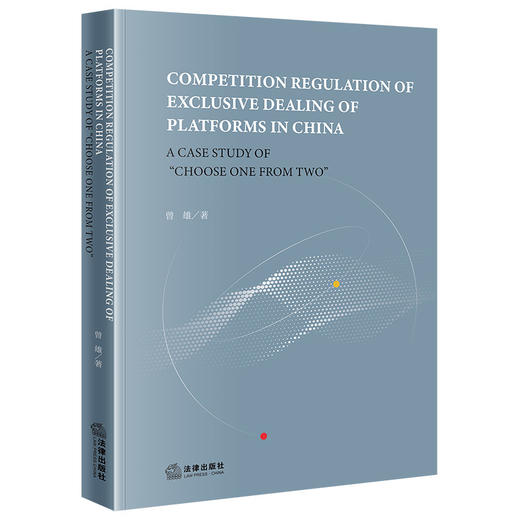
本书从跨学科视角,深入剖析*家交易基础理论问题,全面审视平台经济发展规律、内在特质以及平台实施*家交易的特殊机理和竞争效应,并以比较法视角对比分析域外平台经济竞争规制新动向,为我国平台经济监管模式转型提供政策建议,同时展望平台经济的未来规制趋势,提出实现竞争规制智能化这一命题。本书还以“一般到特殊”再由“特殊到一般”的逻辑进路,基于平台经济*家交易竞争分析的基本理论为解决我国电商领域的“二选一”问题和数字音乐领域*家版权问题提出应对方案,具有较高的学术价值和实践价值。
目录:
Contents
Introduction
I. Research Topic
II. Problems and Their Background
III. Main Contents
IV. Research Methods
V.Innovative Features
VI. Problems
Chapter 1 An Overview of Exclusive Dealing and the Trend of Competition Regulation
1.Definition of exclusive dealing
1.1 Definitions of exclusive dealing at home and abroad
1.2 Distinction between exclusive dealing and tying, loyalty rebates, and franchising
1.3 Legal definition of exclusive dealing in this paper
1.4 Explanation of the economic theories of exclusive dealing
2.Legal rules of major countries or regions on exclusive dealing
2.1 Provisions on exclusive dealing under the US antitrust law
2.2 EU competition law provisions on exclusive dealing
2.3 Provisions on exclusive dealing in the competition laws of Japan, the Republic of Korea and Singapore
3.The history, current status, and future of regulating exclusive dealing in major countries or regions
3.1 The determination of the legality of exclusive dealing focuses on market power and the degree of blocking
3.2 The focus of analyzing exclusive dealing has shifted from forms to effects
3.3 The enforcement targets of exclusive dealing in the digital age are platforms and digital ecosystems
Chapter summary
Chapter 2 Theoretical Framework for Analyzing Competitive Effects of Exclusive Dealing
1. Identification of exclusive dealing
1.1 Analysis of the elements of exclusive dealing
1.2 Specific forms of exclusive dealing
2. Regulatory approaches for exclusive dealing
2.1 Regulation under the anti-competitive agreement framework and key considerations
2.2 Regulation under dominance abuse framework and key considerations
2.3 Main differences between the two regulation frameworks
2.4 Considerations in selecting an appropriate regulatory approach
3.The theories of competitive harm of exclusive dealing
3.1 Basic theories of competitive harm of exclusive dealing
3.2 Forms of competitive harm of exclusive dealing
3.3 Analysis methodology and identifying elements for competitive harm of exclusive dealing
4.Efficiency claims for exclusive dealing
4.1 Types of efficiencies and efficiency trade-off
4.2 Standards for efficiency defense
4.3 The practical dilemma of efficiency defense
4.4 Efficiency analysis of exclusive dealing
Chapter summary
Chapter 3 Competition Analysis of Platforms’Exclusive Dealing under the Two-sided Market Theory
1. Introduction of the two-sided market theory
1.1 Concept of two-sided market and its differences with one-sided market
1.2 Cross-network effect is an essential feature of two-sided market
1.3 Two-sided dependence is the value basis of two-sided markets
1.4 Number of users is the source of power in the two-sided market
1.5 Exclusivity strategy is a means of competition in two-sided markets
2.Two-sided market characteristics of platforms: Take the e-commerce platform as an example
2.1 Business model and competitive characteristics of the platform
2.2 The platform needs to gain critical mass
2.3 Platforms need to exert network effects
3.Mechanism analysis of the platform’s implementation of exclusive dealing
3.1 Capability analysis: commercial dependence and platform’s “private power”
3.2 Motivation analysis: anti-competition and coping with competition
4.The particularity of the implementation of exclusive dealing by platforms
4.1 The implementation of exclusive dealing on the platform is asymmetrical in behavior
4.2 The platforms’implementation of exclusive dealing has the concealment of means
4.3 The platform’s implementation of exclusive dealing has an interactive impact
4.4 The platform’s implementation of exclusive dealing is technically intelligent
5.The implementation of exclusive dealing by platforms harms competition
5.1 Limit the adequacy and effectiveness of market competition
5.2 Infringe the legitimate rights and interests of the on-platform merchants
5.3 Infringe the legitimate rights and interests of end users
5.4 Inhibiting the economic vitality of platforms will hinder the construction of a domestic unified market
Chapter summary
Chapter 4 Challenges, Responses and Reflection Related to Law Enforcement Practice of Competition Regulations on Platform Exclusive Dealing
1.Difficulties in defining relevant markets in a two-sided market, and methods of improvement
1.1 Challenges in defining relevant markets for platforms
1.2 Failure of traditional methods in defining platform-related market
1.3 New approaches to define platform-related markets
1.4 Experience and reflection of Chinese law enforcement agencies on defining platform-related markets
2.Dilemma and regulatory revisions in determining market dominance in a two-sided market
2.1 Dilemma of identifying dominant position in platform markets
2.2 Possible new factors to consider for determining dominant position of platform markets
2.3 Revisions in regulations for determining dominant market position of platform markets
2.4 Experience of and reflection on Chinese law enforcement authorities’determination of dominant position
3.Challenges and path optimization for analysis of exclusive dealings under two-sided market conditions
3.1 Challenges in evaluating the competitive effect of exclusive dealings on platforms
3.2 Path optimization for evaluating competition effect of platforms’exclusive dealings
3.3 Experience of and reflection on competitive effect analysis of online-platform exclusive dealings by Chinese law enforcement authorities
Chapter summary
Chapter 5 The Shift in Extraterritorial Policy on Platform Competition Regulation and the Choice of Regulatory Pathways in China
1.New competition regulation of foreign platforms under the influence of the New Brandeis School
1.1 Platform economy poses challenges to global competition regulation
1.2 The rise of the New Brandeis School: the return to structuralism and the identification of formal criteria
1.3 The latest development in competition regulation of online platforms in major countries and regions
1.4 An analysis comparing regulation models for platform competition: the EU and the US
2.Analyzing the application of specialized regulations in foreign jurisdictions from the perspective of legal transplantation
2.1 An in-depth examination of the object of legal transplantation:the tension between the pursuit of legitimacy and the actual effects
2.2 In-depth examination of local facts: the divergence between the realities of local society and context of foreign legal texts
2.3 Prudent localization: the paradox of spontaneous order and legislatively constructed order
3.The history and experience of China’s platform competition regulation through the concept of responsive regulatory practices
3.1 The connotation, limitations and development of responsive regulation theory
3.2 The exploratory governance phase for platform competition regulation in China (pre-22)
3.3 Centralized governance phase for platform competition regulation in China (22-221)
3.4 Evaluation of the effectiveness of governance of China’s platform competition regulations and reflection on regulatory capabilities
4.The way forward for Chin’s platform competition regulation: transition to routine supervision
4.1 The essence of routine supervision
4.2 The choice of paradigm and implementation path for routine supervision: an agile governance model
4.3 The essential logic behind the agile governance model: ideology, regulations, hierarchical structure, and technology
Chapter summary
Chapter 6 The Future of Platform Competition Regulation:the Intelligence of Antitrust Regulation in the Intelligent Era
1.The intelligent evolution of monopoly behavior in the age of intelligence
1.1 The level of technological sophistication in monopolistic behavior is increasingly rising in the age of artificial intelligence
1.2 As we advance into the era of artificial intelligence, the covertness of monopoly behavior is becoming increasingly sophisticated
1.3 In this era of artificial intelligence, detrimental consequences of monopolistic actions are growing significantly
2.Global anti-monopoly regulatory system reform and technological response in the intelligent age
2.1 Anti-monopoly jurisdictions in foreign countries form specialized digital technology units focused on creating intelligent regulatory tools
2.2 Application and significance of artificial intelligence technology in monitoring and enforcing anti-monopoly laws
3.Current challenges and potential risks facing the intelligent upgrade of antitrust supervision
3.1 The realistic challenge of intelligent antitrust supervision
3.2 The possible risks associated with intelligent anti-monopoly regulation
4.The road of intelligent upgrade of anti-monopoly supervision in China
4.1 The current status and challenges faced in the process of intelligent anti-monopoly supervision in China
4.2 Suggestions to further promote the intelligent upgrade of China’s anti-monopoly supervision
Chapter summary
Chapter 7 China’s E-commerce Platform “Choose One from Two”Practice under the Three-pronged Regulatory Model and Its Improvement Path
1.The exclusive dealings on China’s e-commerce platforms
1.1 The typical case of the “choose one from two” practice of e-commerce platforms
1.2 Different type of “choose one from two” practice of e-commerce platforms
1.3 The essence and legal nature of the “choose one from two” practice of the e-commerce platform
2.Apply the Anti-Monopoly Law to platform exclusive dealings
2.1 The present state of enforcing the Anti-Monopoly Law on exclusive dealings
2.2 The path of enforcing the Anti-Monopoly Law to the exclusive dealings on the platform
2.3 The challenges in applying the Anti-Monopoly Law to platform exclusive dealings
3.Applying Anti-Unfair Competition Law to exclusive dealings on platforms
3.1 The legislative intent behind Article 12 of the Anti-Unfair Competition Law
3.2 Disputes concerning the application of Article 12 of the Anti-Unfair Competition Law
4.The application of the E-commerce Law to exclusive dealings on platforms
4.1 The legislative intent of Article 35 of the E-commerce Law
4.2 The dilemmas in applying Article 35 of the E-commerce Law
5.The rule enhancement and regulation model shift in the three-pronged regulatory approach
5.1 Conflict resolution: Clarify the relationship of applicability between laws
5.2 The improvement of relevant rules of the Anti-Monopoly Law
5.3 Improving the relevant provisions in the Anti-Unfair Competition Law
5.4 The improvement of relevant provisions of the E-commerce Law
5.5 Innovation of regulatory measures under the agile governance model
Chapter summary
- 法律出版社旗舰店 (微信公众号认证)
- 阅读自由与正义的另一种可能
- 扫描二维码,访问我们的微信店铺
- 随时随地的购物、客服咨询、查询订单和物流...