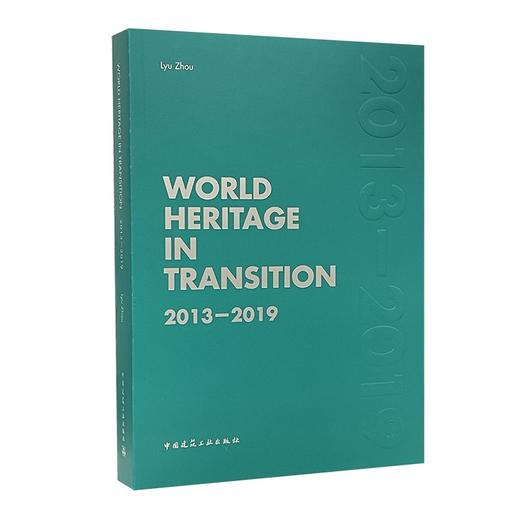
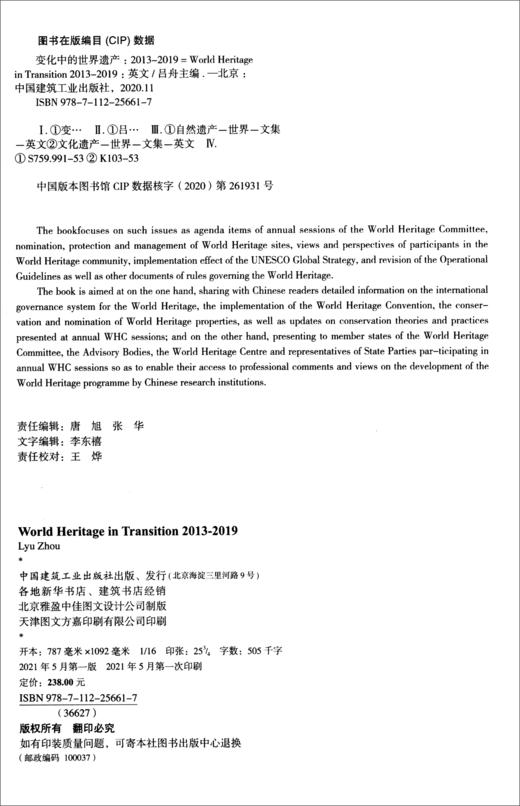
(仓发) 变化中的世界遗产2013-2019/中国建筑工业出版社/9787112256617
¥238.00
| 运费: | ¥ 6.00-20.00 |
| 库存: | 10 件 |
商品详情
内页插图
作者简介
吕舟(Lyu Zhou), professor and doctoral advisor from Tsinghua University School of Architecture, director of Tsinghua University National Heritage Center, chairman of the Sub-Committee of Architecture History under the Architecture Society of China, council member of ICCROM, vice president of IGOMOS-China, and vice chairman of the Expert Committee on World Heritage Sites in China.
Professor Lyu Zhou has been long engaged in study, teaching and practice on cultural heritage conservation and trained many professionals who are now active in the forefront of cultural heritage conservation, He was a lead expert to develop conservation plans for several key conservation projects, including the relocation of Zhang Fei Temple from the submerged area of the Three Gorges Dam, post-quake rescue of Erwang Temple (two kings' temple) and Fulong Temple in Dujiangyan, Sichuan Province, and elevation of Yuzhen Palace in the Wudang Mountains in conjunction with the South-to-North Water Diversion Project. He was also a principal expert for revising the Principles for the Conservation of Heritage Sites in China (2075 Edition) and an advisor for cultural heritage for the 28th Session of the World Heritage Committee convened in Suzhou, China. Under his promotion, the World Heritage Institute of Training and Research for the Asia and the Pacific Region under the Auspices of UNESCO (WHITRAP) was created. Cultural heritage conservation works carried out under his leadership have won the UNESCO Asia-Pacific Awards for Cultural Heritage Conservation three times and China's highest honor granted to conservation projects. In 2013, Professor Lyu Zhou was honored with ICCOM Award for his outstanding contribution to cultural heritage conservation.
内容简介
《变化中的世界遗产2013-2019》为《变化中的世界遗产2013-2019》的英文版,全书共分为“世界遗产全球战略的实施与机制建设”、“世界遗产申报与保护管理”和“世界遗产近期焦点问题”三大部分。
《变化中的世界遗产2013-2019》中论文围绕2013年至今历年世界遗产委员会会议内容展开讨论,关注全球范围世界遗产的申报、保护与管理,世界遗产领域不同参与者的观点与认知角度,全球战略的实施效果,《操作指南》等世界遗产领域规则文件的修订等多方面的问题。论文详细、深入地介绍世界遗产的国际管理体系、世界遗产公约的运行方式、世界遗产的申报与保护管理,以及遗产大会所反映出的遗产理论和保护实践发展的近期趋势。
目录
Preface
Recommendations of Domestic Experts
Recommendations of Foreign Experts
The Implementation and Mechanism of the Global Strategy of World Heritage
World Heritage Nomination and Implementation of the Global Strategy An
Analysis of Balance and Representativeness of Inscribed Properties Since 2004
Nominations to the World Heritage List: An Analysis of Gaming Relation ship in the Examination Process
Analysis of the Development and Implementation Mechanism of the
Concepts Concerning World Heritage Protection: A Perspective Based on
Updates and Changes of the Third Cycle of the Periodic Reporting
Heritage Conservation Management as One of the Three Pillars of OUV Its
Impact on World Heritage Nomination
Review and Analysis: the Upstream Process for World Heritage Nomination
World Heritage Nomination and Conservation
Community Participation in World Heritage Conservation: Inspirational
Concepts and Practices for China
The Weakening of the Standards of World Heritage Authenticity Assessment (2006-2016)
Evaluation and Protection of Integrity of World Cultural Heritage: A Perspective of Visual Integrity
Study of Impact of Nomination Strategies: Background Analysis and Adoption of the "One Nomination Per State Party Per Year Practice
Research on the Revision of the Operational Guidelines in Past Several Years
Recent World Heritage Issues in Focus
Differences and Causes: Advisory Bodies Recommendations and World
Heritage Committee Decisions Made over the Past Five Years
Evolution of Nomination Strategy for the Architectural Work of Le Corbusier, an Outstanding Contribution to the Modern Movement
World Heritage Property in Dispute
A Brief Analysis on the Development of International Theory of Post
Trauma Reconstruction for Historic Architecture
Developments and Challenges: Criteria for Inscription of Cultural Properties on the List of World Heritage in Danger
World Heritage Extension: Outstanding Universal Value and Integrity
Evolution of the Definition of Cultural Landscape: Fro m the English Lake
District to the Khomani Cultural Landscape
Postscript
About the Author
前言
The 44th Session of the World Heritage Committee, originally planned to take place in 2020 in Fuzhou, China, has been postponed due to the global spread of coronavirus. The Observation Report on the Annual Session of the World Heritage Committee, a tool to follow up with World Heritage concepts, practices and actions, has proceeded for seven years. This publication of selected papers is a summary of thematic studies carried out over the past years, based on further editing and deepening of previous research outcomes.
UNESCO World Heritage is a cultural initiative of global significance, reflecting an idea of shared destiny of humanity that gradually developed after WWII. The world in itself is a process of constant changes over time and this changing process has never stopped or remained static. The same is true of cultural and environmental domains. Culture, by its nature, is a process where different ways of thinking, values, aesthetic tastes and lifestyles gradually converge in a closed environment. After humans entered modern times, blockades between cultures have continued to be broken or removed and cultural convergence and fusion have expanded in an unprecedented manner, influencing ideas and lives of the whole of mankind. As for environmental issues, humans have been increasingly capable of changing nature in the process of industrialization and used their capacity to speed up changes to the earth environment. These changes were presented to human kind in an unprecedented intensity in the 20th century, exerting influence on human lives. The UNESCO Convention Concerning the Protection of the World Cultural and Natural Heritage (hereinafter referred to as the World Heritage Convention), is a common response and measure taken to address these changes and also an impact factor applied to such rapid changing process. The World Heritage Convention, in the cultural domain, has facilitated human recognition and awareness of their cultural diversity and advanced their practices in protecting and sustaining such cultural diversity; in the environmental domain, it has enabled humans to become aware of impact of environmental changes on mankind and promoted the global movement on the conservation of geological and ecological environments in the earth which is the only living habitat for humans.
作者简介
吕舟(Lyu Zhou), professor and doctoral advisor from Tsinghua University School of Architecture, director of Tsinghua University National Heritage Center, chairman of the Sub-Committee of Architecture History under the Architecture Society of China, council member of ICCROM, vice president of IGOMOS-China, and vice chairman of the Expert Committee on World Heritage Sites in China.
Professor Lyu Zhou has been long engaged in study, teaching and practice on cultural heritage conservation and trained many professionals who are now active in the forefront of cultural heritage conservation, He was a lead expert to develop conservation plans for several key conservation projects, including the relocation of Zhang Fei Temple from the submerged area of the Three Gorges Dam, post-quake rescue of Erwang Temple (two kings' temple) and Fulong Temple in Dujiangyan, Sichuan Province, and elevation of Yuzhen Palace in the Wudang Mountains in conjunction with the South-to-North Water Diversion Project. He was also a principal expert for revising the Principles for the Conservation of Heritage Sites in China (2075 Edition) and an advisor for cultural heritage for the 28th Session of the World Heritage Committee convened in Suzhou, China. Under his promotion, the World Heritage Institute of Training and Research for the Asia and the Pacific Region under the Auspices of UNESCO (WHITRAP) was created. Cultural heritage conservation works carried out under his leadership have won the UNESCO Asia-Pacific Awards for Cultural Heritage Conservation three times and China's highest honor granted to conservation projects. In 2013, Professor Lyu Zhou was honored with ICCOM Award for his outstanding contribution to cultural heritage conservation.
内容简介
《变化中的世界遗产2013-2019》为《变化中的世界遗产2013-2019》的英文版,全书共分为“世界遗产全球战略的实施与机制建设”、“世界遗产申报与保护管理”和“世界遗产近期焦点问题”三大部分。
《变化中的世界遗产2013-2019》中论文围绕2013年至今历年世界遗产委员会会议内容展开讨论,关注全球范围世界遗产的申报、保护与管理,世界遗产领域不同参与者的观点与认知角度,全球战略的实施效果,《操作指南》等世界遗产领域规则文件的修订等多方面的问题。论文详细、深入地介绍世界遗产的国际管理体系、世界遗产公约的运行方式、世界遗产的申报与保护管理,以及遗产大会所反映出的遗产理论和保护实践发展的近期趋势。
目录
Preface
Recommendations of Domestic Experts
Recommendations of Foreign Experts
The Implementation and Mechanism of the Global Strategy of World Heritage
World Heritage Nomination and Implementation of the Global Strategy An
Analysis of Balance and Representativeness of Inscribed Properties Since 2004
Nominations to the World Heritage List: An Analysis of Gaming Relation ship in the Examination Process
Analysis of the Development and Implementation Mechanism of the
Concepts Concerning World Heritage Protection: A Perspective Based on
Updates and Changes of the Third Cycle of the Periodic Reporting
Heritage Conservation Management as One of the Three Pillars of OUV Its
Impact on World Heritage Nomination
Review and Analysis: the Upstream Process for World Heritage Nomination
World Heritage Nomination and Conservation
Community Participation in World Heritage Conservation: Inspirational
Concepts and Practices for China
The Weakening of the Standards of World Heritage Authenticity Assessment (2006-2016)
Evaluation and Protection of Integrity of World Cultural Heritage: A Perspective of Visual Integrity
Study of Impact of Nomination Strategies: Background Analysis and Adoption of the "One Nomination Per State Party Per Year Practice
Research on the Revision of the Operational Guidelines in Past Several Years
Recent World Heritage Issues in Focus
Differences and Causes: Advisory Bodies Recommendations and World
Heritage Committee Decisions Made over the Past Five Years
Evolution of Nomination Strategy for the Architectural Work of Le Corbusier, an Outstanding Contribution to the Modern Movement
World Heritage Property in Dispute
A Brief Analysis on the Development of International Theory of Post
Trauma Reconstruction for Historic Architecture
Developments and Challenges: Criteria for Inscription of Cultural Properties on the List of World Heritage in Danger
World Heritage Extension: Outstanding Universal Value and Integrity
Evolution of the Definition of Cultural Landscape: Fro m the English Lake
District to the Khomani Cultural Landscape
Postscript
About the Author
前言
The 44th Session of the World Heritage Committee, originally planned to take place in 2020 in Fuzhou, China, has been postponed due to the global spread of coronavirus. The Observation Report on the Annual Session of the World Heritage Committee, a tool to follow up with World Heritage concepts, practices and actions, has proceeded for seven years. This publication of selected papers is a summary of thematic studies carried out over the past years, based on further editing and deepening of previous research outcomes.
UNESCO World Heritage is a cultural initiative of global significance, reflecting an idea of shared destiny of humanity that gradually developed after WWII. The world in itself is a process of constant changes over time and this changing process has never stopped or remained static. The same is true of cultural and environmental domains. Culture, by its nature, is a process where different ways of thinking, values, aesthetic tastes and lifestyles gradually converge in a closed environment. After humans entered modern times, blockades between cultures have continued to be broken or removed and cultural convergence and fusion have expanded in an unprecedented manner, influencing ideas and lives of the whole of mankind. As for environmental issues, humans have been increasingly capable of changing nature in the process of industrialization and used their capacity to speed up changes to the earth environment. These changes were presented to human kind in an unprecedented intensity in the 20th century, exerting influence on human lives. The UNESCO Convention Concerning the Protection of the World Cultural and Natural Heritage (hereinafter referred to as the World Heritage Convention), is a common response and measure taken to address these changes and also an impact factor applied to such rapid changing process. The World Heritage Convention, in the cultural domain, has facilitated human recognition and awareness of their cultural diversity and advanced their practices in protecting and sustaining such cultural diversity; in the environmental domain, it has enabled humans to become aware of impact of environmental changes on mankind and promoted the global movement on the conservation of geological and ecological environments in the earth which is the only living habitat for humans.
- 广州购书中心
- 广州购书中心——你我的城市文化生活中心
- 扫描二维码,访问我们的微信店铺

![(仓发) 完全写作指南:从提笔就怕到什么都能写/江西人民出版社/[美]劳拉,布朗/9787210074885](https://img01.yzcdn.cn/upload_files/2022/08/06/FkoK-ekQSfe4eazQQ_IxhAIGOgzk.jpg?imageView2/2/w/260/h/260/q/75/format/jpg)