西方哲学史 英文原版 The History of Western Philosophy 诺贝尔文学奖罗素著 全英文版进口英语书
| 运费: | ¥ 0.00-999.00 |
| 库存: | 0 件 |




商品详情

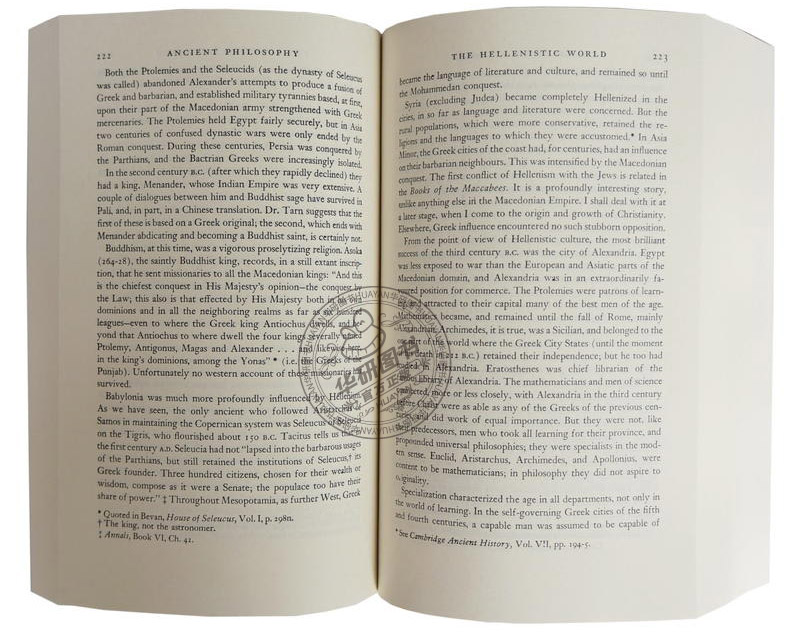
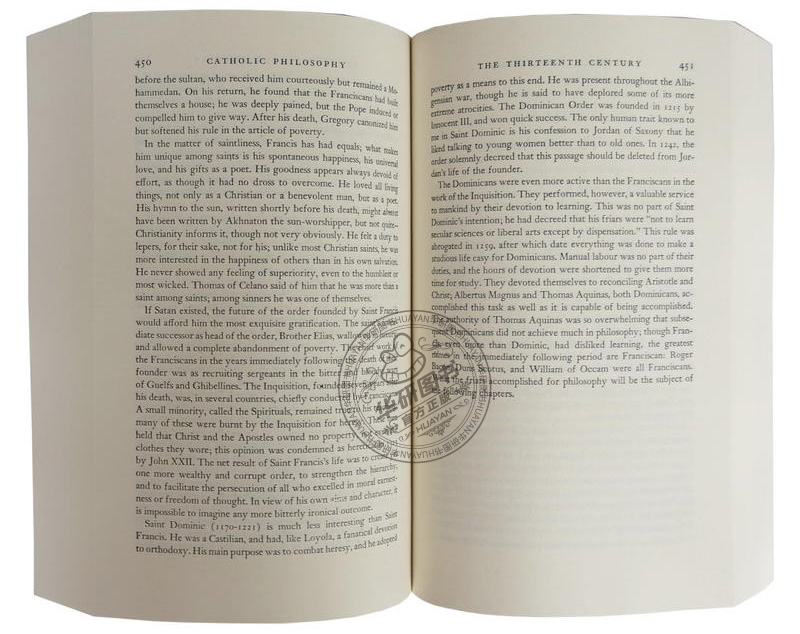

书名:The History of Western Philosophy西方哲学史
难度:Lexile蓝思阅读指数1430L
作者:Bertrand Russell伯特兰·罗素
出版社名称:Touchstone
出版时间:1972
语种:英文
ISBN:9780671201586
商品尺寸:13.6 x 4.1 x 21.1 cm
包装:平装
页数:898

The History of Western Philosophy《西方哲学史》是英国数学家、哲学家、文学家、社会活动与评论家伯兰特·罗素享誉世界的一部哲学名著。该书写于二战期间,源于罗素1941年-1942年在费城Barnes Foundation的一系列哲学史的讲座。很多关于历史方面的研究是由罗素的第三任妻子完成的。1943年,罗素收到出版商Simon and Schuster预付的3000美元,尔后1943年-1944年间在他在Bryn Mawr College写成该书。该书1945年在美国出版,一年后在英国出版。尽管学术界哲学家对该书多有批评,该书当时即在商业上大获成功,到1947年止即已重印几次,直到今天仍在重印。该书的成功带给罗素生命的后二十五年稳定的财源。
《西方哲学史》幽默易懂,也体现了二十世纪伟大哲学家自己的哲学。当罗素1950年被授予诺贝尔奖时,《西方哲学史》被列举为获奖因素之一,并在获奖演说中两次提及该书。
罗素不仅讨论该书中主要人物的生活、历史背景、社会环境、和他们的哲学系统,他随后还饶有兴致的解释他们错在那里以及为何出错。因此《西方哲学史》经常被看成既是关于书中人物哲学,也是关于罗素自己哲学的一部著作。
罗素有一句名言:“一种哲学要有价值,应该建立在一个宽大坚实的知识基础上,这个知识基础不单是关乎哲学的。”罗素本人就是这句名言的实践者。他的哲学著作涉及学科之多,令人叹为观止。评论家认为:“罗素的学识比他同时代的任何人都渊博。”怀特海形容罗素是“柏拉图的一个对话的化身”。
本书是《西方哲学史》的英文原版,无删节。读者不仅可以对西方主要的哲学家及其思想有一个大体的了解,还可以了解西方历史上的一些重要的事件、人物、发展阶段及其与特定的哲学之间的关联。
Hailed as “lucid and magisterial” by The Observer,The History of Western Philosophy is universally acclaimed as the outstanding one-volume work on the subject of Western philosophy.
Considered to be one of the most important philosophical works of all time, the History of Western Philosophy is a dazzlingly unique exploration of the ideologies of significant philosophers throughout the ages—from Plato and Aristotle through to Spinoza, Kant and the twentieth century. Written by a man who changed the history of philosophy himself, this is an account that has never been rivaled since its first publication over sixty years ago.
Review:
“A precious book… a work that is in the highest degree pedagogical which stands above the conflicts of parties and opinion.” —Albert Einstein
“Remains unchallenged as the perfect introduction to its subject... exactly the kind of philosophy that most people would like to read, but which only Russell could possibly have written.” — Ray Monk, University of Southampton, UK
“Beautiful and luminous prose, not merely classically clear but scrupulously honest.” — Isaiah Berlin
“It is a witty birds-eye view of the main figures in Western thought enlivened by references to the personalities and quirks of the thinkers themselves.” — The Week
“A great philosophers lucid and magisterial look at the history of his own subject, wonderfully readable and enlightening.” — The Observer

The History of Western Philosophy《西方哲学史》是一部很有特色的讨论西方哲学史的著作,全面考察了从古希腊罗马时期到20世纪中叶西方哲学思潮的发展历程。罗素将哲学看作某种介乎神学和科学之间的东西,基于对哲学的这种理解,他认为西方哲学在发展过程中始终受到来自科学和宗教两方面的影响,并据此把西方哲学发展史划分为古代哲学、天主教哲学和近代哲学三个时期,揭示了在哲学的发展历程中,科学与宗教、社会团结和个人自由是如何错综复杂地交织在一起与哲学交互作用的。
Since its first publication in 1945, Lord Russell’s A History of Western Philosophy is still unparalleled in its comprehensiveness, its clarity, its erudition, its grace, and its wit. In seventy-six chapters he traces philosophy from the rise of Greek civilization to the emergence of logical analysis in the twentieth century.
Among the philosophers considered are: Pythagoras, Heraclitus, Parmenides, Empedocles, Anaxagoras, the Atomists, Protagoras, Socrates, Plato, Aristotle, the Cynics, the Sceptics, the Epicureans, the Stoics, Plotinus, Ambrose, Jerome, Augustine, Benedict, Gregory the Great, John the Scot, Aquinas, Duns Scotus, William of Occam, Machiavelli, Erasmus, More, Bacon, Hobbes, Descartes, Spinoza, Leibniz, Locke, Berkeley, Hume, Rousseau, Kant, Hegel, Schopenhauer, Nietzsche, the Utilitarians, Marx, Bergson, James, Dewey, and lastly the philosophers with whom Lord Russell himself is most closely associated—Cantor, Frege, and Whitehead, coauthor with Russell of the monumental Principia Mathematica.

Preface by Author
Introduction
BOOK ONE. ANCIENT PHILOSOPHY
Part I. The Pre-Socratics
Chapter I. The Rise of Greek Civilization
Chapter II. The Milesian School
Chapter III. Pythagoras
Chapter IV. Heraclitus
Chapter V. Parmenides
Chapter VI. Empedocles
Chapter VII. Athens in Relation to Culture
Chapter VIII. Anaxagoras
Chapter IX. The Atomists
Chapter X. Protagoras
Part II. Socrates, Plato, and Aristotle
Chapter XI. Socrates
Chapter XII. The Influence of Sparta
Chapter XIII. The Sources of Plato's Opinions
Chapter XIV. Plato's Utopia
Chapter XV. The Theory of Ideas
Chapter XVI. Plato's Theory of Immortality
Chapter XVII. Plato's Cosmogony
Chapter XVIII. Knowledge and Perception in Plato
Chapter XIX. Aristotle's Metaphysics
Chapter XX. Aristotle's Ethics
Chapter XXI. Aristotle's Politics
Chapter XXII. Aristotle's Logic
Chapter XXIII. Aristotle's Physics
Chapter XXIV. Early Greek Mathematics and Astronomy
Part III. Ancient Philosophy after Aristotle
Chapter XXV. The Hellenistic World
Chapter XXVI. Cynics and Sceptics
Chapter XXVII. The Epicureans
Chapter XXVIII. Stoicism
Chapter XXIX. The Roman Empire in Relation to Culture
Chapter XXX. Plotinus
BOOK TWO. CATHOLIC PHILOSOPHY
Introduction
Part I. The Fathers
Chapter I. The Religious Development of the Jews
Chapter II. Christianity During the First Four Centuries
Chapter III. Three Doctors of the Church
Chapter IV. Saint Augustine's Philosophy and Theology
Chapter V. The Fifth and Sixth Centuries
Chapter VI. Saint Benedict and Gregory the Great
Part II. The Schoolmen
Chapter VII. The Papacy in the Dark Ages
Chapter VIII. John the Scot
Chapter IX. Ecclesiastical Reform in the Eleventh Century
Chapter X. Mohammedan Culture and Philosophy
Chapter XI. The Twelfth Century
Chapter XII. The Thirteenth Century
Chapter XIII. Saint Thomas Aquinas
Chapter XIV. Franciscan Schoolmen
Chapter XV. The Eclipse of the Papacy
BOOK THREE. MODERN PHILOSOPHY
Part I. From the Renaissance to Hume
Chapter I. General Characteristics
Chapter II. The Italian Renaissance
Chapter III. Machiavelli
Chapter IV. Erasmus and More
Chapter V. The Reformation and Counter-Reformation
Chapter VI. The Rise of Science
Chapter VII. Francis Bacon
Chapter VIII. Hobbes's Leviathan
Chapter IX. Descartes
Chapter X. Spinoza
Chapter XI. Leibniz
Chapter XII. Philosophical Liberalism
Chapter XIII. Locke's Theory of Knowledge
Chapter XIV. Locke's Political Philosophy
Chapter XV. Locke's Influence
Chapter XVI. Berkeley
Chapter XVII. Hume
Part II. From Rousseau to the Present Day
Chapter XVIII. The Romantic Movement
Chapter XIX. Rousseau
Chapter XX. Kant
Chapter XXI. Currents of Thought in the Nineteenth Century
Chapter XXII. Hegel
Chapter XXIII. Byron
Chapter XXIV. Schopenhauer
Chapter XXV. Nietzsche
Chapter XXVI. The Utilitarians
Chapter XXVII. Karl Marx
Chapter XXVIII. Bergson
Chapter XXIX. William James
Chapter XXX. John Dewey
Chapter XXXI. The Philosophy of Logical Analysis
Index

伯特兰·罗素(Bertrand Russell,1872-1970),20世纪英国声誉卓著的思想家、哲学家、数学家。 罗素一生所涉及的研究领域极其广泛,著述颇丰,其首要建树在数学和逻辑学领域,同时对西方哲学产生了深远影响。此外,他的研究还涉及道德、政治、教育、和平等方面。罗素的主要著作有:《西方哲学史》《意义与真理的探究》《数学原埋》《物的分析》《心的分析》等。
Bertrand Arthur William Russell, 3rd Earl Russell, Viscount Amberley, born in Wales, May 18, 1872. Educated at home and at Trinity College, Cambridge. During World War I, served four months in prison as a pacifist, where he wrote Introduction to Mathematical Philosophy. In 1910, published first volume of Principia Mathematica with Alfred Whitehead. Visited Russia and lectured on philosophy at the University of Peking in 1920. Returned to England and, with his wife, ran a progressive school for young children in Sussex from 1927-1932. Came to the United States, where he taught philosophy successively at the University of Chicago, University of California at Los Angeles, Harvard, and City College of New York. Awarded the Nobel Prize for Literature in 1950. Has been active in disarmament and anti-nuclear-testing movements while continuing to add to his large number of published books which include Philosophical Essays (1910); The ABC of Relativity (1925)Human Knowledge: Its Scope and Limits (1948); Why I Am Not a Christian (1957); and The Autobiography of Bertrand Russell (1967).

The Rise of Greek Civilization
In all history, nothing is so surprising or so difficult to account for as the sudden rise of civilization in Greece. Much of what makes civilization had already existed for thousands of years in Egypt and in Mesopotamia, and had spread thence to neighbouring countries. But certain elements had been lacking until the Greeks supplied them. What they achieved in art and literature is familiar to everybody, but what they did in the purely intellectual realm is even more exceptional. They invented mathematics and science and philosophy; they first wrote history as opposed to mere annals; they speculated freely about the nature of the world and the ends of life, without being bound in the fetters of any inherited orthodoxy. What occurred was so astonishing that, until very recent times, men were content to gape and talk mystically about the Greek genius. It is possible, however, to understand the development of Greece in scientific terms, and it is well worth while to do so.
Philosophy begins with Thales, who, fortunately, can be dated by the fact that he predicted an eclipse which, according to the astronomers, occurred in the year 585 B.C. Philosophy and science—which were not originally separate—were therefore born together at the beginning of the sixth century. What had been happening in Greece and neighbouring countries before this time? Any answer must be in part conjectural, but archeology, during the present century, has given us much more knowledge than was possessed by our grandfathers.
The art of writing was invented in Egypt about the year 4000 B.C., and in Babylonia not much later. In each country writing began with pictures of the objects intended. These pictures quickly became conventionalized, so that words were represented by ideograms, as they still are in China. In the course of thousands of years, this cumbrous system developed into alphabetic writing.
The early development of civilization in Egypt and Mesopotamia was due to the Nile, the Tigris, and the Euphrates, which made agriculture very easy and very productive. The civilization was in many ways similar to that which the Spaniards found in Mexico and Peru. There was a divine king, with despotic powers; in Egypt, he owned all the land. There was a polytheistic religion, with a supreme god to whom the king had a specially intimate relation. There was a military aristocracy, and also a priestly aristocracy. The latter was often able to encroach on the royal power, if the king was weak or if he was engaged in a difficult war. The cultivators of the soil were serfs, belonging to the king, the aristocracy, or the priesthood.
There was a considerable difference between Egyptian and Babylonian theology. The Egyptians were preoccupied with death, and believed that the souls of the dead descend into the underworld, where they are judged by Osiris according to the manner of their life on earth. They thought that the soul would ultimately return to the body; this led to mummification and to the construction of splendid tombs. The pyramids were built by various kings at the end of the fourth millennium B.C. and the beginning of the third. After this time, Egyptian civilization became more and more stereotyped, and religious conservatism made progress impossible. About 1800 B.C. Egypt was conquered by Semites named Hyksos, who ruled the country for about two centuries. They left no permanent mark on Egypt, but their presence there must have helped to spread Egyptian civilization in Syria and Palestine.
Babylonia had a more warlike development than Egypt. At first, the ruling race were not Semites, but "Sumerians," whose origin is unknown. They invented cuneiform writing, which the conquering Semites took over from them. There was a period when there were various independent cities which fought with each other, but in the end Babylon became supreme and established an empire. The gods of other cities became subordinate, and Marduk, the god of Babylon, acquired a position like that later held by Zeus in the Greek pantheon. The same sort of thing had happened in Egypt, but at a much earlier time.
The religions of Egypt and Babylonia, like other ancient religions, were originally fertility cults. The earth was female, the sun male. The bull was usually regarded as an embodiment of male fertility, and bull-gods were common. In Babylon, Ishtar, the earth-goddess, was supreme among female divinities. Throughout western Asia, the Great Mother was worshipped under various names. When Greek colonists in Asia Minor found temples to her, they named her Artemis and took over the existing cult. This is the origin of "Diana of the Ephesians." Christianity transformed her into the Virgin Mary, and it was a Council at Ephesus that legitimated the title "Mother of God" as applied to Our Lady.
Where a religion was bound up with the government of an empire, political motives did much to transform its primitive features. A god or goddess became associated with the State, and had to give, not only an abundant harvest, but victory in war. A rich priestly caste elaborated the ritual and the theology, and fitted together into a pantheon the several divinities of the component parts of the empire.
Through association with government, the gods also became associated with morality. Lawgivers received their codes from a god; thus a breach of the law became an impiety. The oldest legal code still known is that of Hammurabi, king of Babylon, about 2100 B.C.; this code was asserted by the king to have been delivered to him by Marduk. The connection between religion and morality became continually closer throughout ancient times.
Babylonian religion, unlike that of Egypt, was more concerned with prosperity in this world than with happiness in the next. Magic, divination, and astrology, though not peculiar to Babylonia, were more developed there than elsewhere, and it was chiefly through Babylon that they acquired their hold on later antiquity. From Babylon come some things that belong to science: the division of the day into twenty-four hours, and of the circle into 360 degrees; also the discovery of a cycle in eclipses, which enabled lunar eclipses to be predicted with certainty, and solar eclipses with some probability. This Babylonian knowledge, as we shall see, was acquired by Thales.
The civilizations of Egypt and Mesopotamia were agricultural, and those of surrounding nations, at first, were pastoral. A new element came with the development of commerce, which was at first almost entirely maritime. Weapons, until about 1000 B.C., were made of bronze, and nations which did not have the necessary metals on their own territory were obliged to obtain them by trade or piracy. Piracy was a temporary expedient, and where social and political conditions were fairly stable, commerce was found to be more profitable. In commerce, the island of Crete seems to have been the pioneer. For about eleven centuries, say from 2500 B.C. to 1400 B.C., an artistically advanced culture, called the Minoan, existed in Crete. What survives of Cretan art gives an impression of cheerfulness and almost decadent luxury, very different from the terrifying gloom of Egyptian temples.
Of this important civilization almost nothing was known until the excavations of Sir Arthur Evans and others. It was a maritime civilization, in close touch with Egypt (except during the time of the Hyksos). From Egyptian pictures it is evident that the very considerable commerce between Egypt and Crete was carried on by Cretan sailors; this commerce reached its maximum about 1500 B.C. The Cretan religion appears to have had many affinities with the religions of Syria and Asia Minor, but in art there was more affinity with Egypt, though Cretan art was very original and amazingly full of life. The centre of the Cretan civilization was the so-called "palace of Minos" at Knossos, of which memories lingered in the traditions of classical Greece. The palaces of Crete were very magnificent, but were destroyed about the end of the fourteenth century B.C., probably by invaders from Greece. The chronology of Cretan history is derived from Egyptian objects found in Crete, and Cretan objects found in Egypt; throughout, our knowledge is dependent on archeological evidence.
The Cretans worshipped a goddess, or perhaps several goddesses. The most indubitable goddess was the "Mistress of Animals," who was a huntress, and probably the source of the classical Artemis. She or another was also a mother; the only male deity, apart from the "Master of Animals," is her young son. There is some evidence of belief in an after life, in which, as in Egyptian belief, deeds on earth receive reward or retribution. But on the whole the Cretans appear, from their art, to have been cheerful people, not much oppressed by gloomy superstitions. They were fond of bull-fights, at which female as well as male toreadors performed amazing acrobatic feats. The bull-fights were religious celebrations, and Sir Arthur Evans thinks that the performers belonged to the highest nobility. The surviving pictures are full of movement and realism.
The Cretans had a linear script, but it has not been deciphered. At home they were peaceful, and their cities were unwalled; no doubt they were defended by sea power.
Before the destruction of the Minoan culture, it spread, about 1600 B.C., to the mainland of Greece, where it survived, through gradual stages of degeneration, until about 900 B.C. This mainland civilization is called the Mycenaean; it is known through the tombs of kings, and also through fortresses on hill- tops, which show more fear of war than had existed in Crete. Both tombs and fortresses remained to impress the imagination of classical Greece. The older art products in the palaces are either actually of Cretan workmanship, or closely akin to those of Crete. The Mycenaean civilization, seen through a haze of legend, is that which is depicted in Homer.
- 英童书屋
- 主营各类儿童正版书籍
- 扫描二维码,访问我们的微信店铺