正版 屠场 英文原版小说 The Jungle 影响美国食品安全的书 upton sinclair 全英文版进口英语文学书籍
| 运费: | ¥ 0.00-999.00 |
| 库存: | 6 件 |






商品详情

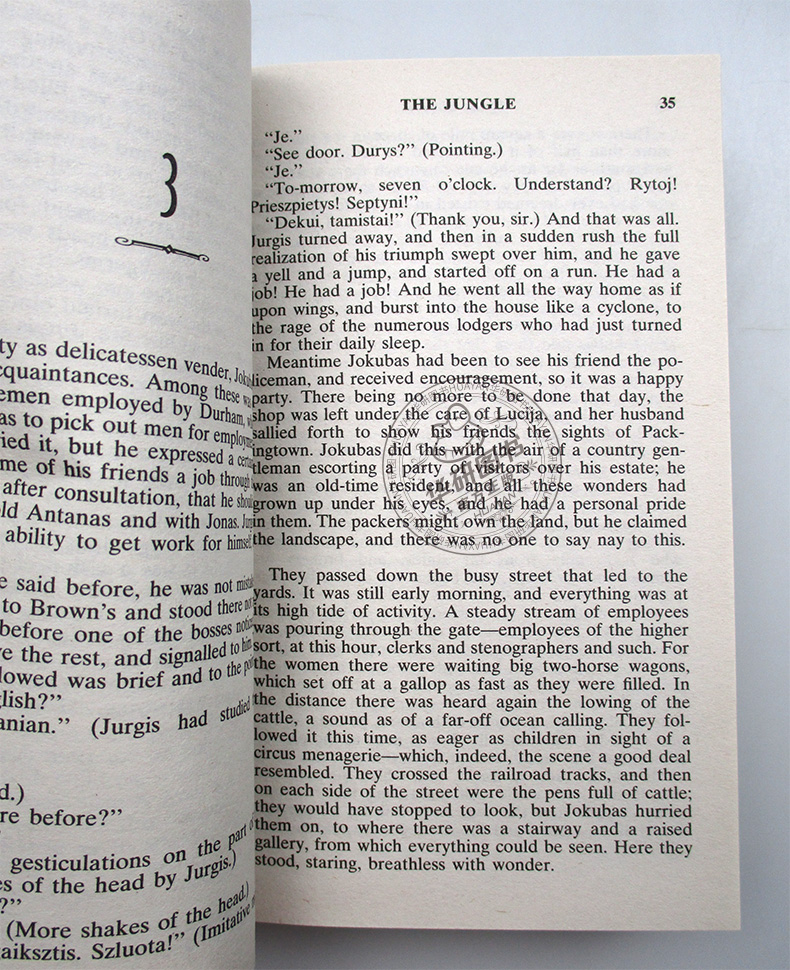
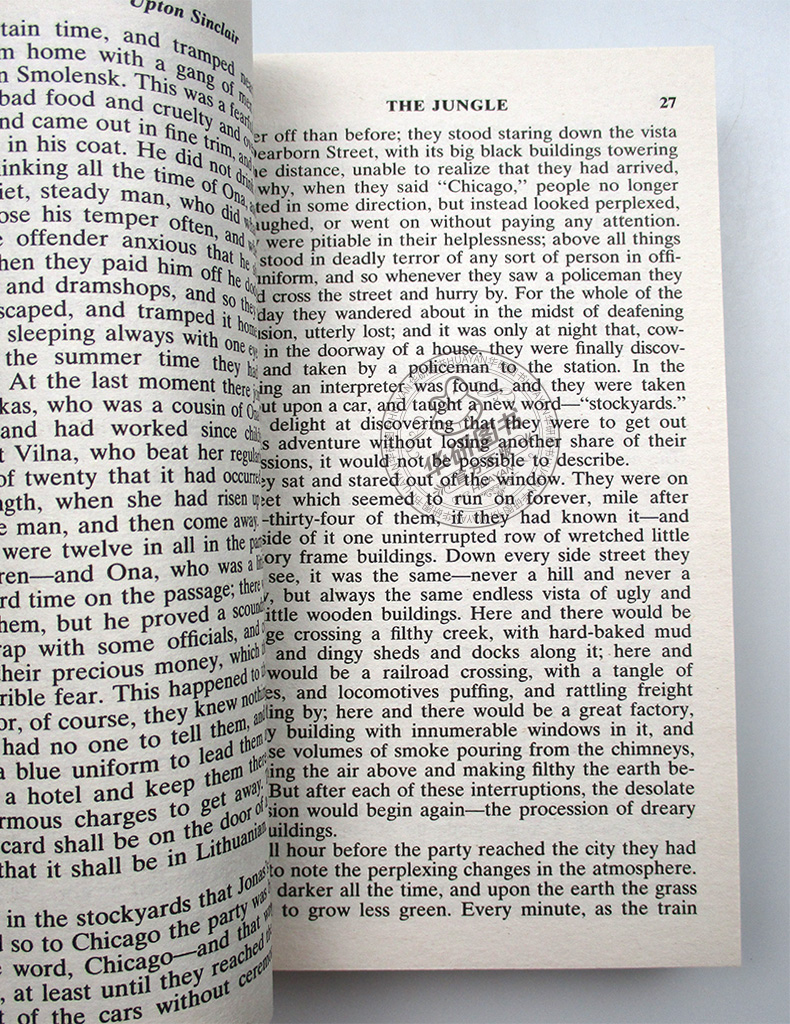
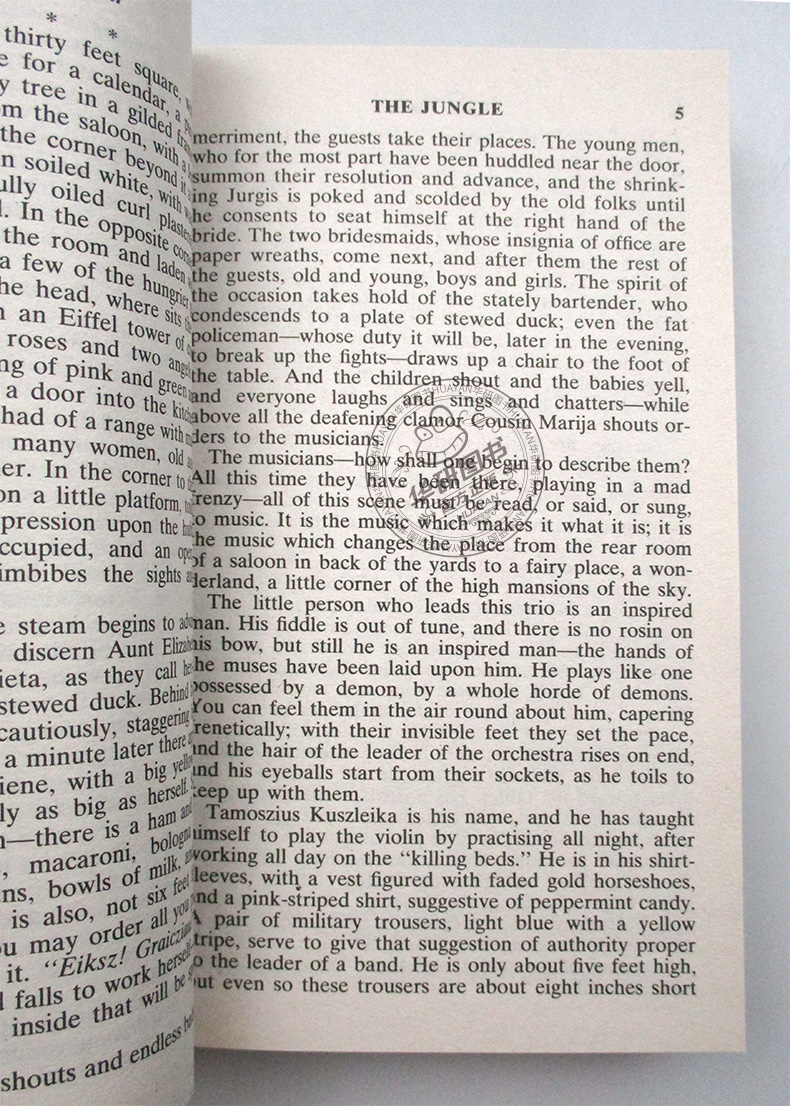

书名:The Jungle 屠场
难度:Lexile蓝思阅读指数1170L
作者:Upton Sinclair厄普顿•辛克莱
出版社名称:Signet Classics
出版时间:2015
语种:英文
ISBN:9780451472557
商品尺寸:10.6 x 2.8 x 17.3 cm
包装:简装
页数:416 (以实物为准)
The Jungle《屠场》一书于1906年在美国出版,该书的面世,触动了肉食品生产者和消费者,也惊动了美国政府。《屠场》这部惊世之作,揭开了美国食品安全的冰山一角,让当时的美国社会笼聚在一片恐慌和愤怒之中,促使美国总统罗斯福制定《纯净食品和药品法》,由此产生了美国食品安全守护神FDA(美国食品药品监督管理局)。这是一本关于食品安全的书,同时也是关于命运和抗争的书,是惊醒万千吃货的食品安全警示录。吃货们再也不浑浑噩噩地吃,不明不白地做黑心食品的小白鼠。
本书为Signet Classics推出的英文原版,内容完整无删减,书本轻巧便携,由Alicia Mischa Renfroe作序,Dr. Barry Sears后记。
“When people ask me what has happened in my long lifetime I do not refer them to the newspaper files and to the authorities, but to [Sinclair’s] novels.” — George Bernard Shaw
Upton Sinclair's classic revelatory novel about turn-of-the-century business and immigrant labor practices.
Jurgis Rudkus, a young Lithuanian immigrant in search of a better life, faces instead an epic struggle for survival. His story of factory life in Chicago in the early twentieth century is a saga of barbarous working conditions, crushing poverty, crime, disease, and despair.
Upton Sinclair’s vivid depiction of the horrors of Chicago’s stockyards and slaughterhouses aroused such public indignation that a government investigation was called, eventually resulting in the passage of pure food laws. More than a hundred years later,The Jungle continues to pack the same emotional power it did when it was first published.
Includes an Introduction by Alicia Mischa Renfroe and an Afterword by Dr. Barry Sears

尤吉斯一家满怀憧憬从家乡来到美国寻梦,在芝加哥屠场区找到工作,以为美好生活将从此开始。不料灾难接踵而至,先是尤吉斯工伤失业,接着妻子奥娜被工头奸污,尤吉斯怒打工头而入狱,随后妻子难产死亡,幼小的儿子淹死。亲朋好友中男的流落街头,女的被逼为娼,美国梦演变为可怕的梦魇……
In this powerful book we enter the world of Jurgis Rudkus, a young Lithuanian immigrant who arrives in America fired with dreams of wealth, freedom, and opportunity. And we discover, with him, the astonishing truth about “Packingtown,” the busy, flourishing, filthy Chicago stockyards, where new world visions perish in a jungle of human suffering. Upton Sinclair, master of the “muckraking” novel, here explores the workingman’s lot at the turn of the century: the backbreaking labor, the injustices of “wage-slavery,” the bewildering chaos of urban life.

Upton Beall Sinclair Jr.厄普顿·辛克莱,美国现实主义小说家。“社会丑事揭发派”(muckraker)作家。1906年发表The Jungle《屠场》,描写大企业对工人的压榨和芝加哥屠宰场的不卫生情况,引起人们对肉类加工质量的愤怒,导致制订了食品卫生检查法。辛克莱后以反法西斯英雄兰尼·巴德为主人公写了11本系列小说,反映1914年以来的重大事件。一生共著有小说和社会研究著作80余部。
Upton Sinclair (1878–1968) was born in Baltimore and began writing dime novels to pay his way through the College of the City of New York. While doing graduate work at Columbia University, he wrote six novels, includingKing Midas (1901), The Journal of Arthur Stirling (1903), and Manassas (1904). His masterwork, The Jungle(1906), aided the passage of pure food laws and won him wide acclaim. Active throughout his life in socialist causes, he invested the money he made from The Jungle in a Utopian experiment, the Helicon Hall Colony in Englewood, New Jersey. In 1915, he moved to California, where he ran unsuccessfully for public office and waged an antipoverty campaign. Among his later works was Dragon’s Teeth (1942), for which he won a Pulitzer Prize.

Chapter I
It was four o’clock when the ceremony was over and the carriages began to arrive. There had been a crowd following all the way, owing to the exuberance of Marija Berczynskas. The occasion rested heavily upon Marija’s broad shoulders—it was her task to see that all things went in due form, and after the best home traditions; and, flying wildly hither and thither, bowling every one out of the way, and scolding and exhorting all day with her tremendous voice, Marija was too eager to see that others conformed to the proprieties to consider them herself. She had left the church last of all, and, desiring to arrive first at the hall, had issued orders to the coachman to drive faster. When that personage had developed a will of his own in the matter, Marija had flung up the window of the carriage, and, leaning out, proceeded to tell him her opinion of him, first in Lithuanian, which he did not understand, and then in Polish, which he did. Having the advantage of her in altitude, the driver had stood his ground and even ventured to attempt to speak; and the result had been a furious altercation, which, continuing all the way down Ashland Avenue, had added a new swarm of urchins to the cortège at each side street for half a mile.
This was unfortunate, for already there was a throng before the door. The music had started up, and half a block away you could hear the dull “broom, broom” of a ’cello, with the squeaking of two fiddles which vied with each other in intricate and altitudinous gymnastics. Seeing the throng, Marija abandoned precipitately the debate concerning the ancestors of her coachman, and, springing from the moving carriage, plunged in and proceeded to clear a way to the hall. Once within, she turned and began to push the other way, roaring, meantime, “Eik! Eik! Uzdaryk-duris!” in tones which made the orchestral uproar sound like fairy music.
“Z. Graiczunas, Pasilinksminimams darzas. Vynas. Sznapsas. Wines and Liquors. Union Headquarters”—that was the way the signs ran. The reader, who perhaps has never held much converse in the language of far-off Lithuania, will be glad of the explanation that the place was the rear-room of a saloon in that part of Chicago known as “back of the yards.” This information is definite and suited to the matter of fact; but how pitifully inadequate it would have seemed to one who understood that it was also the supreme hour of ecstasy in the life of one of God’s gentlest creatures, the scene of the wedding-feast and the joy-transfiguration of little Ona Lukoszaite!
She stood in the doorway, shepherded by Cousin Marija, breath- less from pushing through the crowd, and in her happiness painful to look upon. There was a light of wonder in her eyes and her lids trembled, and her otherwise wan little face was flushed. She wore a muslin dress, conspicuously white, and a stiff little veil coming to her shoulders. There were five pink paper-roses twisted in the veil, and eleven bright green rose-leaves. There were new white cotton gloves upon her hands, and as she stood staring about her she twisted them together feverishly. It was almost too much for her—you could see the pain of too great emotion in her face, and all the tremor of her form. She was so young—not quite sixteen—and small for her age, a mere child; and she had just been married—and married to Jurgis,1 of all men, to Jurgis Rudkus, he with the white flower in the buttonhole of his new black suit, he with the mighty shoulders and the giant hands.
1. Pronounced Yoorghis.
Ona was blue-eyed and fair, while Jurgis had great black eyes with beetling brows, and thick black hair that curled in waves about his ears—in short, they were one of those incongruous and impos- sible married couples with which Mother Nature so often wills to confound all prophets, before and after. Jurgis could take up a two-hundred-and-fifty-pound quarter of beef and carry it into a car without a stagger, or even a thought; and now he stood in a far corner, frightened as a hunted animal, and obliged to moisten his lips with his tongue each time before he could answer the congratulations of his friends.
Gradually there was effected a separation between the spectators and the guests—a separation at least sufficiently complete for working purposes. There was no time during the festivities which ensued when there were not groups of onlookers in the doorways and the corners; and if any one of these onlookers came sufficiently close, or looked sufficiently hungry, a chair was offered him, and he was invited to the feast. It was one of the laws of the veselija that no one goes hungry; and, while a rule made in the forests of Lithuania is hard to apply in the stockyards district of Chicago, with its quarter of a million inhabi- tants, still they did their best, and the children who ran in from the street, and even the dogs, went out again happier. A charming informality was one of the characteristics of this celebration. The men wore their hats, or, if they wished, they took them off, and their coats with them; they ate when and where they pleased, and moved as often as they pleased. There were to be speeches and singing, but no one had to listen who did not care to; if he wished, meantime, to speak or sing himself, he was perfectly free. The resulting medley of sound distracted no one, save possibly alone the babies, of which there were present a number equal to the total possessed by all the guests invited. There was no other place for the babies to be, and so part of the preparations for the evening consisted of a collection of cribs and carriages in one corner. In these the babies slept, three or four together, or wakened together, as the case might be. Those who were still older, and could reach the tables, marched about munching contentedly at meat-bones and bologna sausages.
The room is about thirty feet square, with whitewashed walls, bare save for a calendar, a picture of a race-horse, and a family tree in a gilded frame. To the right there is a door from the saloon, with a few loafers in the doorway, and in the corner beyond it a bar, with a presiding genius clad in soiled white, with waxed black mustaches and a carefully oiled curl plastered against one side of his forehead. In the opposite corner are two tables, filling a third of the room and laden with dishes and cold viands, which a few of the hungrier guests are already munching. At the head, where sits the bride, is a snow-white cake, with an Eiffel tower of constructed decoration, with sugar roses and two angels upon it, and a generous sprinkling of pink and green and yellow candies. Beyond opens a door into the kitchen, where there is a glimpse to be had of a range with much steam ascending from it, and many women, old and young, rushing hither and thither. In the corner to the left are the three musicians, upon a little platform, toiling heroically to make some impression upon the hubbub; also the babies, similarly occupied, and an open window whence the populace imbibes the sights and sounds and odors.
Suddenly some of the steam begins to advance, and, peering through it, you discern Aunt Elizabeth, Ona’s stepmother—Teta Elzbieta, as they call her—bearing aloft a great platter of stewed duck. Behind her is Kotrina, making her way cautiously, staggering beneath a similar burden; and half a minute later there appears old Grandmother Majauszkiene, with a big yellow bowl of smoking potatoes, nearly as big as herself. So, bit by bit, the feast takes form—there is a ham and a dish of sauerkraut, boiled rice, macaroni, bologna sausages, great piles of penny buns, bowls of milk, and foaming pitchers of beer. There is also, not six feet from your back, the bar, where you may order all you please and do not have to pay for it. “Eiksz! Graicziau!” screams Marija Berczynskas, and falls to work herself—for there is more upon the stove inside that will be spoiled if it be not eaten.
- 华研外语 (微信公众号认证)
- 本店是“华研外语”品牌商自营店,全国所有“华研外语”、“华研教育”品牌图书都是我司出版发行的,本店为华研官方源头出货,所有图书均为正规正版,拥有实惠与正版的保障!!!
- 扫描二维码,访问我们的微信店铺
- 随时随地的购物、客服咨询、查询订单和物流...