编辑推荐
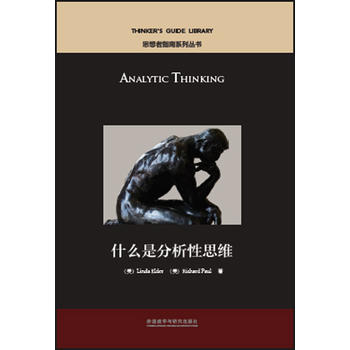
《什么是分析性思维》为“思想者指南系列丛书”中的一本,属于该系列当中的“基础篇”,是读者学习后续内
容,提升思辨能力的必读型基础读物。《什么是分析性思维》的主要内容为介绍分析性思维的概念、作用及如何进
行分析性思维,帮助读者能够科学地、有效地进行思辨性思考。
内容简介
《什么是分析性思维》为“思想者指南系列丛书”中的一本,属于该系列当中的“基础篇”,是读者学习后续内容,提升思辨能力的必读型基础读物。《什么是分析性思维》的主要内容为介绍分析性思维的概念、作用及如何进行分析性思维,帮助读者能够科学地、有效地进行思辨性思考。
作者简介
Linda Elder:教育心理学专家、思辨研究专家,在美国多所大学任教,主要教授课程为教育心理学、思辨能力培养;思辨研究协会会长、思辨中心执行主任。Richard Paul:思辨研究专家,国际思辨研究运动主要负责人,已发表200余篇与思辨研究相关的论文、出版7部论述思辨研究的著作。
目 录
Part I: Understanding the Basic Theory of Analysis........................1
This section provides the foundational theory essential to analysis. It delineates the eight basic
structures present in all thinking.
Why a Guide on Analytic Thinking?..........1
Why the Analysis of Thinking Is Important..........2
To Analyze Thinking We Must Learn to Identify and Question Its Elemental Structures.........4
To Evaluate Thinking, We Must Understand and Apply Intellectual Standards..........5
35 Dimensions of Critical Thought..........7
A Checklist for Reasoning..........9
Part 2: Getting Started—Some First Steps. ..........11
This section enumerates the most important foundational moves in analysis.
Think About Purpose..........11
State the Question..........12
Gather Information..........13
Watch Your Inferences..........14
Check Your Assumptions..........15
Clarify Your Concepts..........16
Understand Your Point of View..........17
Think Through the Implications..........18
Part 3: Using Analysis to Figure Out the Logic of Anything..........19
This section provides a range of sample analyses (as well as templates for analysis).
The Figuring Mind...........19
Figuring Out the Logic of Things..........20
Analyzing Problems..........23
Analyzing the Logic of an Article, Essay or Chapter..........25
Analyzing the Logic of a Textbook..........29
Evaluating an Author's Reasoning..........30
Analyzing the Logic of a Subject..........31
Part 4: Taking Your Understanding to a Deeper level..........40
This section explains the elements more comprehensively, differentiating skilled from unskilled
reasoners.
Analyzing and Assessing..........40
Distinguishing Between Inferences and Assumptions..........48
Conclusion..........50