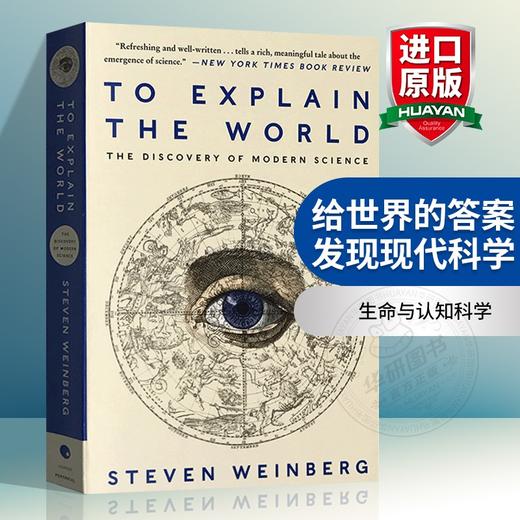
给世界的答案 发现现代科学 英文原版历史书 To Explain the World Steven Weinberg 生命与认知科学 英文版进口书籍正版
| 运费: | ¥ 0.00-999.00 |
| 库存: | 0 件 |

商品详情
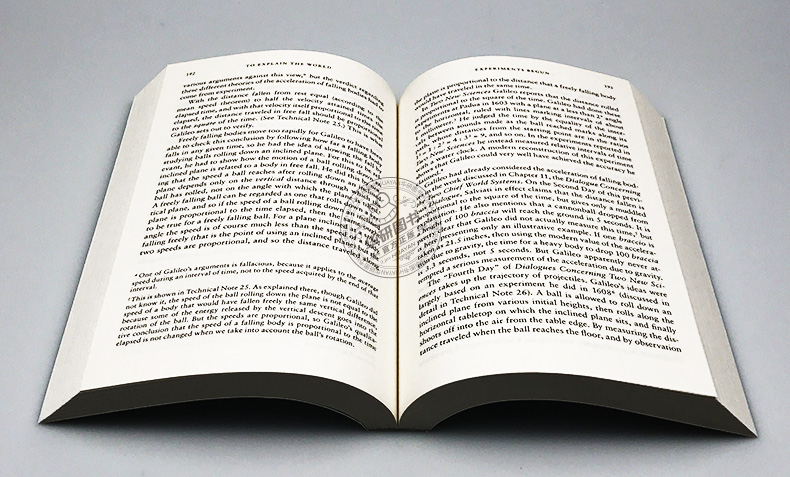
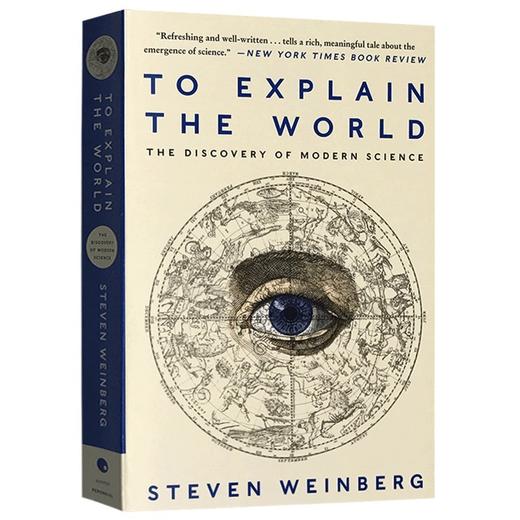
 书名:To Explain the World给世界的答案
作者:Steven Weinberg斯蒂芬·温伯格
出版社名称:Harper Perennial
出版时间:2016
语种:英文
ISBN:9780062346667
商品尺寸:13.5 x 2.5 x 20.3 cm
包装:平装
页数:432 人类在认识自己的道路上走了多远?还有多久才到终点?
在To Explain the World《给世界的答案》一书中:
★详述科学认知历程,从古米利都到伦敦皇家学会,从亚里士多德到托勒密、哥白尼直到牛顿
★探索世界的哪些方面是可认识、可解释的,以及如何认识和解释
★透析人类如何探索和理解世界万物的运转,从而领悟未来
★洞悉科学与诗歌、数学、哲学、技术和宗教等思维方式之间的冲突与合作
★犀利点评科学人物的成败得失及影响
精彩书评:
“本书点石成金,不再是单纯描述科学史,而是谱写了一曲宏大的赞歌,歌颂了人类为探寻大自然而进行的艰苦卓绝的英勇奋斗,直到今天,这一奋斗仍在继续。唯有如斯蒂芬•温伯格这般才华横溢、经验丰富、见解深远并全身心投入的科学家,方可有此成就。” ——伊恩•麦克尤恩,英国著名作家
“温伯格所涉足的内容超越其自身领域。本书是一部历史著作,但其真正的亮点,是这样一位当代科学家的独特视角。” ——《金融时报》
“发现现代科学方法的漫长征程,这是科学史家频繁涉足的领域,但对于这一熟悉话题,斯蒂芬•温伯格给出了深思熟虑、颇有新意的观点。” ——《华盛顿邮报》
“本书具有振奋人心的智慧,这是一部杰出的著作,是当今时代的经典书籍。” ——《独立报》
“温伯格以其一贯的学术自信,带读者领略了从古希腊到17世纪科学革命的早期科学理论。本书行文流畅,可阅读性强,在科普读者所熟知的领域,温伯格带来了全新的见解。” ——《出版人周刊》
A masterful commentary on the history of science from the Greeks to modern times, by Nobel Prize-winning physicist Steven Weinberg—a thought-provoking and important book by one of the most distinguished scientists and intellectuals of our time.
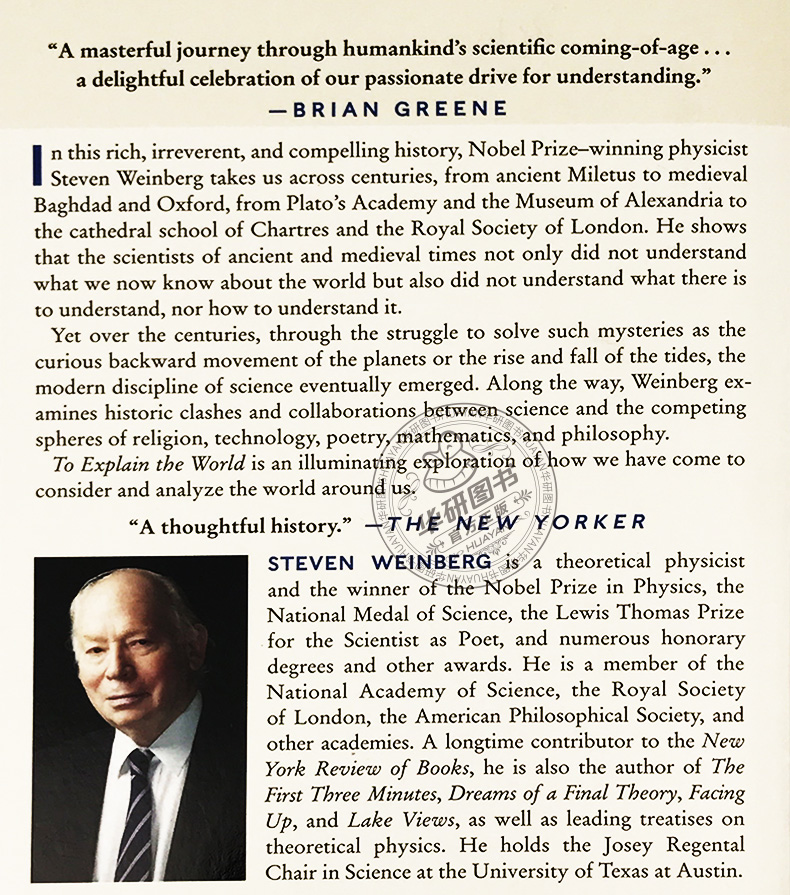
In this rich, irreverent, and compelling history, Nobel Prize-winning physicist Steven Weinberg takes us across centuries from ancient Miletus to medieval Baghdad and Oxford, from Plato’s Academy and the Museum of Alexandria to the cathedral school of Chartres and the Royal Society of London. He shows that the scientists of ancient and medieval times not only did not understand what we understand about the world—they did not understand what there is to understand, or how to understand it. Yet over the centuries, through the struggle to solve such mysteries as the curious backward movement of the planets and the rise and fall of the tides, the modern discipline of science eventually emerged. Along the way, Weinberg examines historic clashes and collaborations between science and the competing spheres of religion, technology, poetry, mathematics, and philosophy.
An illuminating exploration of the way we consider and analyze the world around us, To Explain the World is a sweeping, ambitious account of how difficult it was to discover the goals and methods of modern science, and the impact of this discovery on human knowledge and development.
Review
“A thoughtful history.” — The New Yorker
“The long march toward the modern scientific method is well-trodden territory for historians of science, but in tackling this familiar topic, Steven Weinberg offers a thoughtful, supplementary viewpoint.” — The Washington Post
“Steven Weinberg, the world’s preeminent physicist, provides a masterful journey through humankind’s scientific coming of age. With its refreshing candor and lyrical prose, To Explain the World is a delightful celebration of our passionate drive for understanding.” — Brian Greene
“This book transmutes the base metal of a mere history of science into pure gold—into a magisterial celebration of a long and heroic struggle, still incomplete, to understand nature. Only a committed scientist of Steven Weinberg’s brilliance, experience and breadth of insight could have accomplished this.” — Ian McEwan
“Refreshing and well-written.... To Explain the World tells a rich, meaningful tale about the emergence of science.” — The New York Times Book Review
“Fascinating.... A sweeping narrative of the progression of ideas.... Weinberg masterfully explains how the emergence of the modern scientific method, the mechanism by which we interrogate the world and devise well-supported explanations we can be confident in, is itself a discovery.” — Lewis Dartnell, The Telegraph
“Weinberg exemplifies a growing tendency in popular science writing to offer the matter of science and not just a superficial reading. It gives the book a bracing intellectuality.... This is a great book, a necessary book for our time.” — The Independent
“A refreshing contrast to other tomes on the topic.... With To Explain the World, Weinberg reminds us to be humble not only about what we know, but how we know it. It’s a nuance, but an important one.” — The Guardian
“I am amazed by what Steven Weinberg has done in this book. It is a unique and highly civilizing guide, obviously the result of years of wide-ranging scholarship, even with strategic humor.” — Gerald Holton
“Weinberg is a fine writer and communicator about ideas beyond his own field.... He has clearly carried out extensive scholarly investigation for the book, and it works as history. But what makes it stand out is his perspective as a top scientist working today.” — Financial Times
 日升月落,电闪雷鸣,四季更迭,生老病死,我们生活的世界充满了各种谜题,而我们对这个世界和我们自身的看法、感受,正源自我们如何认识和解释这个世界。但古代和中世纪的科学家不知道我们现在对世界已知的一切,更重要的是,他们没有类似于我们的思维方法,不知道世界还有哪些未知尚待发现,也不知道如何去发现未知。随着文明演进,人们不断努力解开众多谜团,科学的现代规则才终于问世。
诺贝尔物理学奖得主斯蒂芬·温伯格带我们回顾了挑战前人又扣人心弦的认知发展历程,足迹从古代的米利都到中世纪的巴格达和牛津,从柏拉图学院和亚历山大博物馆到沙特尔教会学校和伦敦皇家学会。温伯格富有启发性地探索了思考世界和分析世界的方法,说明了找到现代科学的目标和方法是何等的艰难,并论述了这一发现对人类认知和发展的影响。同时,温伯格还探讨了科学和各大竞争领域——宗教、技术、诗歌、数学和哲学的历史性冲突与合作。
他将其学术资质和科学史知识结合起来,研究了一个令人着迷的问题:解释世界的努力如何随着时间的推移而改变。而我们之所以苦苦求索,执着于解释世界,因为答案决定了我们如何看待世界、自己和未来。这不懈的坚持和追求,正是“非凡的故事,是人类历史中有趣的故事之一”。 斯蒂芬·温伯格,诺贝尔物理学奖得主,曾获得美国国家科学奖章、刘易斯·托马斯“诗人科学家”奖等多项殊荣。现任得克萨斯州大学奥斯汀分校教授。身兼美国国家科学院院士、伦敦皇家学会外籍会员、美国哲学学会会员等。温伯格出版了多部具有影响力的理论物理教材。在专业领域之外,他致力于将科学理念与人文知识相结合,所著的《zui初三分钟》《终极理论之梦》《仰望苍穹》等书畅销世界。
Steven Weinbergis a theoretical physicist and the winner of the Nobel Prize in Physics, the National Medal of Science, the Lewis Thomas Prize for the Scientist as Poet, and numerous honorary degrees and other awards. He is a member of the National Academy of Science, the Royal Society of London, the American Philosophical Society, and other academies. A longtime contributor to the New York Review of Books, he is also the author of The First Three Minutes, Dreams of a FinalTheory, FacingUp, and Lake Views, as well as leading treatises on theoretical physics. He holds the Josey Regental Chair in Science at the University of Texas at Austin. First, to set the scene. By the sixth century BC the western coast of what is now Turkey had for some time been settled by Greeks, chiefly speaking the lonian dialect. The richest and most powerful of the lonian cities was Miletus, founded at a natural harbor near where the river Meander flows into the Aegean Sea. In Miletus, over a century before the time of Socrates, Greeks began to speculate about the fundamental substance of which the world is made.
I first learned about the Milesians as an undergraduate at Cornell, taking courses on the history and philosophy of science. In lectures I heard the Milesians called “physicists.” At the same time, I was also attending classes on physics, including the modern atomic theory of matter. There seemed to me to be very little in common between Milesian and modern physics. It was not so much that the Milesians were wrong about the nature of matter, but rather that I could not understand how they could have reached their conclusions. The historical record concerning Greek thought before the time of Plato is fragmentary, but I was pretty sure that during the Archaic and Classical eras (roughly from 600 to 450 BC and from 450 to 300 BC, respectively) neither the Milesians nor any of the other Greek students of nature were reasoning in anything like the way scientists reason today.
The first Milesian of whom anything is known was Thales, who lived about two centuries before the time of Plato. He was supposed to have predicted a solar eclipse, one that we know did occur in 585 BC and was visible from Miletus. Even with the benefit of Babylonian eclipse records it’s unlikely that Thales could have made this prediction, because any solar eclipse is visible from only a limited geographic region, but the fact that Thales was credited with this prediction shows that he probably flourished in the early 500s BC. We don’t know if Thales put any of his ideas into writing. In any case, nothing written by Thales has survived, even as a quotation by later authors. He is a legendary figure, one of those (like his contemporary Solon, who was supposed to have founded the Athenian constitution) who were conventionally listed in Plato’s time as the “seven sages” of Greece. For instance, Thales was reputed to have proved or brought from Egypt a famous theorem of geometry (see Technical Note 1). What matters to us here is that Thales was said to hold the view that all matter is composed of a single fundamental substance. According to Aristotle’s Metaphysics, “Of the first philosophers, most thought the principles which were of the nature of matter were the only principles of all things.... Thales, the founder of this school of philosophy, says the principle is water.” Much later, Diogenes Laertius (fl. AD 230), a biographer of the Greek philosophers, wrote, “His doctrine was that water is the universal primary substance, and that the world is animate and full of divinities.” 
- 摄影与诗歌文艺书店
- 可议价折扣(加微信13901132852 进读者群折扣)
- 扫描二维码,访问我们的微信店铺