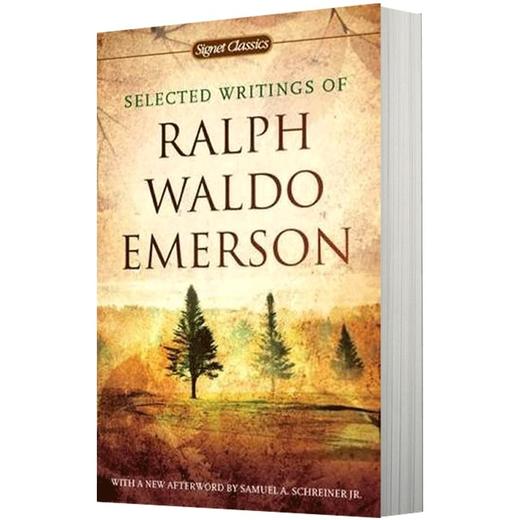
正版 爱默生文集 英文原版书籍 Selected Writings of Ralph Waldo Emerson 英文版进英语书
| 运费: | ¥ 0.00-999.00 |
| 库存: | 10 件 |



商品详情

书名:Selected Writings of Ralph Waldo Emerson 爱默生文集
难度:Lexile蓝思阅读指数1340
作者:Ralph Waldo Emerson爱默生
出版社名称:Signet Classics
出版时间:2006
语种:英文
ISBN:9780451531865
商品尺寸:10.7 x3.0x 17.2 cm
包装:简装
页数:546

拉尔夫·沃尔多·爱默生(Ralph Waldo Emerson)是确立美国文化精神的代表人物。美国前总统林肯称他为“美国的孔子”“美国文明之父”。他文学上的贡献主要在散文和诗歌上。Selected Writings of Ralph Waldo Emerson《爱默生文集》是Signet Classics推出的简装便携全英文版,由美国罗彻斯特大学英语教授William H. Gilman主编,收录爱默生的书信、随笔、演讲、诗歌等,包括《论自然》等名篇。另由Charles Johnson作序,Samuel A. Schreiner Jr.写后记,有助于理解作品及作者创作背景。
SELECTED WRITINGS OF RAPLH WALDO EMERSON
A classic collection of critical essays, poems, and letters from one of the greatest minds of nineteenth-century America.
Raplh Waldo Emerson is one the preeminent figures of American literature. The leading expositor of the transcendentalist movement, he helped shape modern American philosophy of religion, and his legacy continued through Thoreau, Melville, Whitman and Dickinson.Here is a broad view of Emerson’s greatest work, featuring a considerable amount of material from his journals, including an entry discovered in 1964 in the Library of Congress. The writings range from realistic descriptions of daily life to superbly polished meditations on human purpose and destiny, from sharply etched biographical studies to soaring, lyrical philosophic flights. Shaped by a passionate belief in individual freedom and deep humility before the immensity of nature, they reflect a life and a spirit whose independence and integrity speak out with resounding signficance to the contemporary world.
Edited by William H. Gilman
With a new Introduction by Charles Johnson and a New Afterword by Samuel A. Schreiner Jr.

Born in Boston,Ralph Waldo Emerson(1803-82) knew adversity early in life. His father died when he was young; his widowed mother was forced to become a landlady to support her five sons. After working his way through Harvard, the author suffered first from temporary loss of vision in one eye, then from a lung disease; later he was to experience the early deaths of his first wife, two of his brothers, and his eldest son. As a schoolteacher, he was dissatisfied; as a pastor, he was forced to resignhis position because of doctrinal differences with his chi1rch. He persevered, however, to become one of this country’s most vital voices: an immensely influential lecturer, essayist, and poet and a fierce foe of slavery and political immorality. On his trips abroad, he came in contact with such figures as Wordsworth, Tennyson, and Dickens and formed a deep friendship with Thomas Carlyle. At home his circle of friends included Margaret Fuller, Bronson Alcott, Hawthorne, and Thoreau. His death was mourned not only by the village of Concord—where he had lived most of his life—but by the nation whose highest ideals he had so nobly represented.
Dr. Charles Johnsonbegan his career as a journalist and political cartoonist. A 1998 MacArthur Fellow,he received the National Book Award for his novelMiddle Passage. And is a recipient of the Academy Award for Literature from the American Academy of Arts and Letters. He has published three other novels,Dreamer,OxherdingTale, andFaith and the Good Thing, as well as two story collections,The Sorcerer’s ApprenticeandSoulcatcher and Other Stories. Among his many nonfiction books areBeing and Race: Black Writing Since 1970andTurning the Wheel: Essays on Buddhism and Writing.He is the S. Wilson and Grace M. Pollock Professor ofEnglish at the University of Washington.
Samuel A. Schreiner Jr.is a veteran journalist and former senior editor atReader’sDigest. He is the author of fivenovels and eight nonfiction books, includingThe Trials of Mrs.Lincoln, Henry ClayFrick: The Gospel of Greed, The Passionate Beechers: The Family Saga of Sanctity and Scandal That ChangedAmerica,andThe Concord Quartet: Alcott, Emerson,Hawthorne, Thoreauand the Friendship That Freed the American Mind.

Introduction
An Emerson Chronology
Textual Note
I. JOURNALS AND LETTERS
II. ESSAYS AND ADDRESSES
Nature
The American Scholar
Divinity School Address
Self-reliance
The Over-soul
Circles
The Poet
Experience
Politics
Montaigne; or, the Sceptic
Fate
Illusions
Thoreau
Education
III. POEMS
Grace
The Rhodora
Each and All
The Snow-storm
The Humble-bee
Concord Hymn
The Problem
The Sphinx
Give All to Love
Uriel
Threnody
Merlin
Hamatreya
Ode to W. H. Channing
Bacchus
Days
Brahma
Two Rivers
Waldeinsamkeit
Boston Hymn
Terminus
Afterword

Our age is retrospective. It builds the sepulchres of the fathers. It writes biographies, histories, and criticism. The foregoing generations beheld God and nature face to face; we, through their eyes. Why should not we also enjoy an original relation to the universe? Why should not we have a poetry and philosophy of insight and not of tradition, and a religion by revelation to us, and not the history of theirs? Embosomed for a season in nature, whose floods of life stream around and through us, and invite us by the powers they supply, to action proportioned to nature, why should we grope among the dry bones of the past, or put the living generation into masquerade out of its faded wardrobe? The sun shines to-day also. There is more wool and flax in the fields. There are new lands, new men, new thoughts. Let us demand our own works and laws and worship.
Undoubtedly we have no questions to ask which are unanswerable. We must trust the perfection of the creation so far, as to believe that whatever curiosity the order of things has awakened in our minds, the order of things can satisfy. Every man's condition is a solution in hieroglyphic to those inquiries he would put. He acts it as life, before he apprehends it as truth. In like manner, nature is already, in its forms and tendencies, describing its own design. Let us interrogate the great apparition, that shines so peacefully around us. Let us inquire, to what end is nature?
All science has one aim, namely, to find a theory of nature. We have theories of races and of functions, but scarcely yet a remote approach to an idea of creation. We are now so far from the road to truth, that religious teachers dispute and hate each other, and speculative men are esteemed unsound and frivolous. But to a sound judgment, the most abstract truth is the most practical. Whenever a true theory appears, it will be its own evidence. Its test is, that it will explain all phenomena. Now many are thought not only unexplained but inexplicable; as language, sleep, madness, dreams, beasts, sex.
Philosophically considered, the universe is composed of Nature and the Soul. Strictly speaking, therefore, all that is separate from us, all which Philosophy distinguishes as the NOT ME, that is, both nature and art, all other men and my own body, must be ranked under this name, NATURE. In enumerating the values of nature and casting up their sum, I shall use the word in both senses;—in its common and in its philosophical import. In inquiries so general as our present one, the inaccuracy is not material; no confusion of thought will occur.Nature, in the common sense, refers to essences unchanged by man; space, the air, the river, the leaf.Artis applied to the mixture of his will with the same things, as in a house, a canal, a statue, a picture. But his operations taken together are so insignificant, a little chipping, baking, patching, and washing, that in an impression so grand as that of the world on the human mind, they do not vary the result.

- 华研外语 (微信公众号认证)
- 本店是“华研外语”品牌商自营店,全国所有“华研外语”、“华研教育”品牌图书都是我司出版发行的,本店为华研官方源头出货,所有图书均为正规正版,拥有实惠与正版的保障!!!
- 扫描二维码,访问我们的微信店铺
- 随时随地的购物、客服咨询、查询订单和物流...