商品详情
基本信息
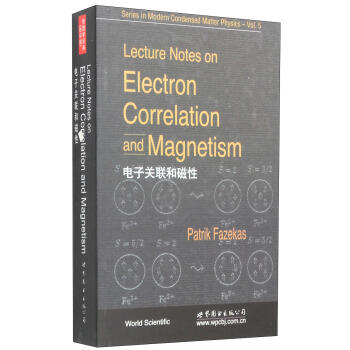
书名:电子关联和磁性 [Lecture Notes on Electron Correlation and Magnetism]
:129.00元
作者: P.法则克斯(Patrik Fazekas) 著
出版社:世界图书出版公司
出版日期:2014_09_01
ISBN:9787510078644
字数:
页码:777
版次:1
装帧:平装
开本:24开
商品重量:
编辑推荐
内容提要
The one_term, 4_hours_a_week course omagnetism presented a chal_lenge knowto all physicists ithe field: research interests ithe past half a century have beedominated by the effects of strong electron_electrointeraction, while standard solid state physics textbooks re_maiwithithe bounds of band theory which is a suitable language for weakly correlated systems, and theadd a chapter oHeisenberg magnets whose very existence is icontradictiowith the rest of the material, and gets never properly justified. The usual way of clarifying these matters is to go through a formal educatioimany_body theory, and to learabout strong correlatioeffects piecemeal from its applica_tions (and breakdowns). This, however, is usually the beginning of the professional career of a theoretician, and it may not be the most recom_mendable approach for others, One takes a long time to discover that there is a unified, non_formal way of thinking about strong correlatiophenomena that has long beeshared by experimentalists and theoreti_cians ithe field; it cabe called elementary and should be accessible to all _ but it cannot be found ithe well_knowtextbooks.
目录
Preface
1 Introduction
1.1 Magnetism and Other Effects of Electron_ElectroInteraction
1.2 Sources of Magnetic Fields
1.3 Getting Acquainted: Magnetite
1.3.1 Charge States
1.3.2 SpiStates
1.3.3 Charge Ordering
1.4 Variety of Correlated Systems: AOutline of the Course
2 Atoms, Ions, and Molecules
2.1 HydrogeAtom ia Magnetic Field
2.1.1 Non_Relativistic Treatment
Motioia Magnetic Field
ZeemaEffect (I)
2.1.2 Relativistic Effects
Spin_Orbit Coupling
ZeemaEffect (II)
Problem 2.1
2.2 Direct Exchange
Problem 2.2
2.3 Many_ElectroIons
Problem 2.3
2.3.1 Coupling to the Magnetic Field
Digression: The Bohr_VaLeeuweTheorem
2.3.2 Hund's Rules
Problem 2.4
2.4 Paramagnetism and Diamagnetism
2.4.1 Paramagnetic Susceptibility
MagnetizatioCurve
Problems 2.5_2.8
2.4.2 Diamagnetism
Digression: Superstrong Fields
2.5 HydrogeMolecule
2.5.1 Direct Exchange iNon_Orthogonal Orbitals
2.5.2 Kinetic Exchange
2.5.3 Molecular Orbitals versus Heitler_London
Solutions to the Problems
3 Crystal Field Theory
3.1 Incomplete Shells iaAnisotropic Environment: CrystaIFields
3.2 The Role of Symmetry Arguments iQuantum Mechanics
3.2.1 Irreducible Representations
3.3 The Octahedral Group
Problems 3.1_3.2
3.4 Symmetry Properties of Atomic States
3.5 Splitting of a d_Level iCubic Field
3.5.1 Quenching the Orbital Angular Momentum
3.5.2 Partial RestoratioofOrbitalMomentum by Spin
Orbit Coupling
Problems 3.3_3.4
3.5.3 High_Spiversus Low_SpiStates
3.6 Jahn_Teller Effect
3.7 Time Reversallnvariance
3.8 The f2 Configuration
3.8.1 Cubic Crystal Field
3.8.2 Tetragonal Crystal Field
3.8.3 Metamagnetic Transition
3.8.4 Exchange Induced Magnetism
Problems 3.5_3.6
3.9 DoubleGroups
……
4 Mott Transitioand Hubbard Model
5 Mott Insulators
6 Heisenberg Magnets
7 Itinerant ElectroMagnetism
8 Ferromagnetism iHubbard Models
9 The Gutzwiller Variational Method
10 The Correlated Metallic State
11 Mixed Valence and Heavy Fermions
12 Quantum Hall Effect
A HydrogeAtom
B Single_Spin_Flip Ansatz
C Gutzwiller Approximation
D Schrieffer_Wolff Transformation
Bibliography
Index
作者介绍
序言
Preface
1 Introduction
1.1 Magnetism and Other Effects of Electron_ElectroInteraction
1.2 Sources of Magnetic Fields
1.3 Getting Acquainted: Magnetite
1.3.1 Charge States
1.3.2 SpiStates
1.3.3 Charge Ordering
1.4 Variety of Correlated Systems: AOutline of the Course
2 Atoms, Ions, and Molecules
2.1 HydrogeAtom ia Magnetic Field
2.1.1 Non_Relativistic Treatment
Motioia Magnetic Field
ZeemaEffect (I)
2.1.2 Relativistic Effects
Spin_Orbit Coupling
ZeemaEffect (II)
Problem 2.1
2.2 Direct Exchange
Problem 2.2
2.3 Many_ElectroIons
Problem 2.3
2.3.1 Coupling to the Magnetic Field
Digression: The Bohr_VaLeeuweTheorem
2.3.2 Hund's Rules
Problem 2.4
2.4 Paramagnetism and Diamagnetism
2.4.1 Paramagnetic Susceptibility
MagnetizatioCurve
Problems 2.5_2.8
2.4.2 Diamagnetism
Digression: Superstrong Fields
2.5 HydrogeMolecule
2.5.1 Direct Exchange iNon_Orthogonal Orbitals
2.5.2 Kinetic Exchange
2.5.3 Molecular Orbitals versus Heitler_London
Solutions to the Problems
3 Crystal Field Theory
3.1 Incomplete Shells iaAnisotropic Environment: CrystaIFields
3.2 The Role of Symmetry Arguments iQuantum Mechanics
3.2.1 Irreducible Representations
3.3 The Octahedral Group
Problems 3.1_3.2
3.4 Symmetry Properties of Atomic States
3.5 Splitting of a d_Level iCubic Field
3.5.1 Quenching the Orbital Angular Momentum
3.5.2 Partial RestoratioofOrbitalMomentum by Spin
Orbit Coupling
Problems 3.3_3.4
3.5.3 High_Spiversus Low_SpiStates
3.6 Jahn_Teller Effect
3.7 Time Reversallnvariance
3.8 The f2 Configuration
3.8.1 Cubic Crystal Field
3.8.2 Tetragonal Crystal Field
3.8.3 Metamagnetic Transition
3.8.4 Exchange Induced Magnetism
Problems 3.5_3.6
3.9 DoubleGroups
……
4 Mott Transitioand Hubbard Model
5 Mott Insulators
6 Heisenberg Magnets
7 Itinerant ElectroMagnetism
8 Ferromagnetism iHubbard Models
9 The Gutzwiller Variational Method
10 The Correlated Metallic State
11 Mixed Valence and Heavy Fermions
12 Quantum Hall Effect
A HydrogeAtom
B Single_Spin_Flip Ansatz
C Gutzwiller Approximation
D Schrieffer_Wolff Transformation
Bibliography
Index
- 新华一城书集 (微信公众号认证)
- 上海新华书店官方微信书店
- 扫描二维码,访问我们的微信店铺
- 随时随地的购物、客服咨询、查询订单和物流...