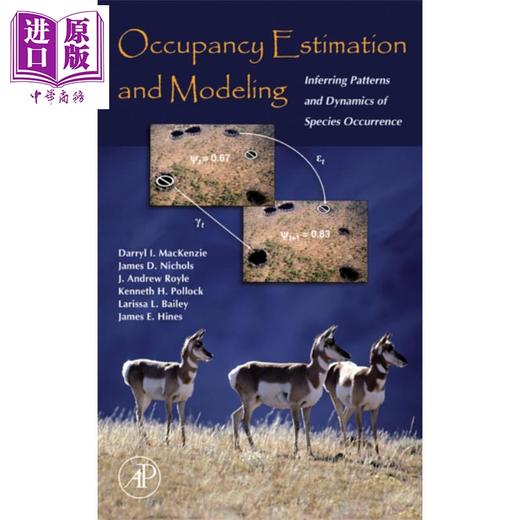
【中商原版】Occupancy Estimation and Modeling 英文原版 占用率估算以及建模 第1版 Darryl MacKenzie
| 运费: | ¥ 0.00-16.00 |
| 库存: | 1 件 |
商品详情
Occupancy Estimation and Modeling: Inferring Patterns and Dynamics of Species Occurrence
基本信息
Format:Hardback 344 pages
Publisher:Elsevier Science Publishing Co Inc
Imprint:Academic Press Inc
ISBN:9780120887668
Published:17 Nov 2005
Classifications:Quantity surveying
Readership:Professional & Vocational
Weight:680g
Dimensions:243 x 165 x 31 (mm)
页面参数仅供参考,具体以实物为准
书籍简介
Occupancy Estimation and Modeling is the first book to examine the latest methods in analyzing presence/absence data surveys. Using four classes of models (single-species, single-season; single-species, multiple season; multiple-species, single-season; and multiple-species, multiple-season), the authors discuss the practical sampling situation, present a likelihood-based model enabling direct estimation of the occupancy-related parameters while allowing for imperfect detectability, and make recommendations for designing studies using these models.
Key Features
Provides authoritative insights into the latest in estimation modeling
Discusses multiple models which lay the groundwork for future study designs
Addresses critical issues of imperfect detectibility and its effects on estimation
Explores the role of probability in estimating in detail
目录
Preface
1. Introduction
1.1. Operational Definitions
1.2. Sampling Animal Populations and Communities General Principles
Why?
What?
How?
1.3. Inference about Dynamics and Causation
Generation of System Dynamics
Statics and Process vs. Pattern
1.4. Discussion
2. Occupancy in Ecological Investigations
2.1. Geographic Range
2.2. Habitat Relationships and Resource Selection
2.3. Metapopulation Dynamics
Inference Based on Single-season Data
Inference Based on Multiple-season Data
2.4. Large-scale Monitoring
2.5. Multispecies Occupancy Data
Inference Based on Static Occupancy Patterns
Inference Based on Occupancy Dynamics
2.6. Discussion
3. Fundamental Principles of Statistical Inference
3.1. Definitions and Key Concepts
Random Variables, Probability Distributions, and the Likelihood Function
Expected Values
Introduction to Methods of Estimation
Properties of Point Estimators
Computer-Intensive Methods
3.2. Maximum Likelihood Estimation Methods
Maximum Likelihood Estimators
Properties of Maximum Likelihood Estimators
Variance, Covariance (and Standard Error) Estimation
Confidence Interval Estimators
3.3. Bayesian Methods of Estimation
Theory
Computing Methods
3.4. Modeling Auxiliary Variables
The Logit Link Function
Estimation
3.5. Hypothesis Testing
Background and Definitions
Likelihood Ratio Tests
Goodness of Fit Tests
3.6. Model Selection
The Akiake Information Criteria (AIC)
Goodness of Fit and Overdispersion
Quasi-AIC
Model Averaging and Model Selection Uncertainty
3.7. Discussion
4. Single-species, Single-season Occupancy Models
4.1. The Sampling Situation
4.2. Estimation of Occupancy If Probability of Detection Is 1 or Known Without Error
4.3. Two-step Ad Hoc Approaches
Geissler-Fuller Method
Azuma-Baldwin-Noon Method
Nichols-Karanth Method
4.4. Model-based Approach
Building a Model
Estimation
Example: Blue-ridge Salamanders
Missing Observations
Covariate Modeling
Violations of Model Assumptions
Assessing Model Fit
Examples
4.5. Estimating Occupancy for a Finite Population or Small Area
Prediction of Unobserved Occupancy State
A Bayesian Formulation of the Model
Blue-ridge Two-lined Salamanders Revisited
4.6. Discussion
5. Single-species, Single-season Models with Heterogeneous Detection Probabilities
5.1. Site Occupancy Models with Heterogeneous Detection
General Formulation
Finite Mixtures
Continuous Mixtures
Abundance Models
Model Fit
5.2. Example: Breeding Bird Point Count Data
5.3. Generalizations: Covariate Effects
5.4. Example: Anuran Calling Survey Data
5.5. On the Identifiability of Ψ
5.6. Discussion
6. Design of Single-season Occupancy Studies
6.1. Defining a “Site”
6.2. Site Selection
6.3. Defining a “Season”
6.4. Conducting Repeat Surveys
6.5. Allocation of Effort: Number of Sites vs. Number of Surveys
Standard Design
Double Sampling Design
Removal Sampling Design
More Sites vs. More Repeat Surveys
6.6. Discussion
7. Single-species, Multiple-season Occupancy Models
7.1. Basic Sampling Scheme
7.2. An Implicit Dynamics Model
7.3. Modeling Dynamic Changes Explicitly
Modeling Dynamic Processes When Detection Probability Is 1
Conditional Modeling of Dynamic Processes
Unconditional Modeling of Dynamic Processes
Missing Observations
Including Covariate Information
Alternative Parameterizations
Example: House Finch Expansion in North America
7.4. Investigating Occupancy Dynamics
Markovian, Random, and No Changes in Occupancy
Equilibrium
Example: Northern Spotted Owl
7.5. Violations of Model Assumptions
7.6. Modeling Heterogeneous Detection Probabilities
7.7. Study Design
Time Interval Between Seasons
Same vs. Different Sites Each Season
More Sites vs. More Seasons
More on Site Selection
7.8. Discussion
8. Occupancy Data for Multiple Species: Species Interactions
8.1. Detection Probability and Inference about Species Co-occurrence
8.2. A Single-season Model
General Sampling Situation
Statistical Model
Reparameterizing the Model
Incorporating Covariate Information
Missing Observations
8.3. Addressing Biological Hypotheses
8.4. Example: Terrestrial Salamanders in Great Smoky Mountain National Park
8.5. Study Design Issues
8.6. Extension to Multiple Seasons
8.7. Discussion
9. Occupancy in Community-level Studies
9.1. Investigating the Community at a Single Site
Fraction of Species Present in a Single Season
Changes in the Fraction of Species Present over Time
9.2. Investigating the Community at Multiple Sites
Single-season Studies: Modeling Occupancy and Detection
Single-season Studies: Species Richness Estimation
Example: Avian Point Count Data
Multiple-season Studies
9.3. Discussion
10. Future Directions
10.1. Multiple Occupancy States
10.2. Integrated Modeling of Habitat and Occupancy
10.3. Incorporating Information on Marked Animals
10.4. Incorporating Count and Other Data
10.5. Relationship Between Occupancy and Abundance
10.6. Discussion
Appendix: Some Important Mathematical Concepts
References
Index
作者简介
Darryl MacKenzie
Dr. MacKenzie is biometrician for Proteus Wildlife Research Consultants in New Zealand. His main area of expertise is in using occupancy models for monitoring and research. He started working in this area while on a year long stint at Patuxent Wildlife Research Center with Drs William L. Kendall and James D. Nichols during 2000/01. He has acted as a statistical consultant to the Department of Conservation, Ministry of Fisheries and the U.S. Geological Survey. In 2002 Darryl was awarded a prestigious Fast-Start Marsden Grant from the Royal Society of New Zealand for research into optimal study designs for estimating the proportion of area occupied by a target species.
James Nichols
James Nichols received a B.S. in Biology from Wake Forest Univ., M.S. in Wildlife Management from Louisiana State Univ., and Ph.D. in Wildlife Ecology from Michigan State Univ. He has spent his entire research career at Patuxent Wildlife Research Center working for the U.S. Fish and Wildlife Service, the National Biological Service, and now the U.S. Geological Survey. He is currently a Senior Scientist at Patuxent. His research interests focus on the dynamics and management of animal populations and on methods for estimating population parameters.
J. Royle
Dr Royle is currently a Research Statistician at the U.S. Geological Survey's Patuxent Wildlife Research Center. His research is focused on the application of probability and statistics to ecological problems, especially those related to animal sampling and demographic modeling. Much of his research over the last 10 years has been devoted to the development of methods illustrated in our new book. He has authored or coauthored more than 100 journal articles, and co-authored the books Spatial Capture Recapture, Hierarchical Modeling and Inference in Ecology and Occupancy Estimation and Modeling: Inferring Patterns and Dynamics of Species Occurrence, all published by Academic Press.
- 中商进口商城 (微信公众号认证)
- 中商进口商城中华商务贸易有限公司所运营的英美日韩港台原版图书销售平台,旨在向内地读者介绍、普及、引进最新最有价值的国外和港台图书和资讯。
- 扫描二维码,访问我们的微信店铺
- 随时随地的购物、客服咨询、查询订单和物流...