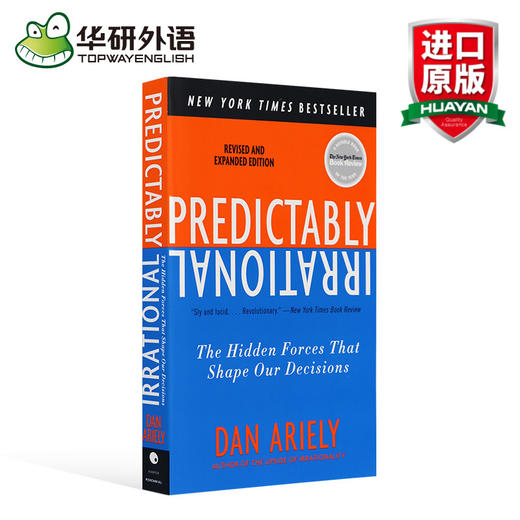
华研原版 怪诞行为学:可预测的非理性 Predictably Irrational 英文版书籍
| 运费: | ¥ 0.00-999.00 |
| 库存: | 8 件 |
商品详情

书名:Predictably Irrational 怪诞行为学:可预测的非理性(升级版)
作者:Dan Ariely 丹·艾瑞里
出版社名称:Harper Perennial
出版时间:2010
语种:英文
ISBN:9780061353246
商品尺寸:13.5 x 2.2 x 20.3 cm
包装:平装
页数:350

Predictably Irrational《怪诞行为学:可预测的非理性》是杜克大学行为经济学家、纽约时报畅销书作家丹·艾瑞里的著作。书中,作者将心理学引入经济学的研究中,用实验的方法彻底颠覆了主流经济学的“经济人”观点,告诉我们非理性是人类的本能,是主宰人类行为和决策的隐形力量;非理性不是杂乱无章的,而是可以预测和把握的。本系列共分为三部分,本书为首卷,适合有一定英文水平的心理学、经济学爱好者或企业员工阅读。
推荐理由:
1.诺贝尔经济学奖得主阿克尔洛夫、《黑天鹅》作者塔勒布、经济学家梁小民联袂推荐;
2.实例较多并且十分有趣,语言轻松幽默,将原本繁琐枯燥的学术研究讲得易于理解;
3.讲解清晰,阅读难度不大,无太多艰涩难懂的专业词汇;
4.本版本为新版,增加了“The Power of Free Cookie”和“The Cyle of Distrust”两个章节内容。
Review
“Sly and lucid… Predictably Irrational is a far more revolutionary book than its unthreatening manner lets on.” —New York Times Book Review
“Surprisingly entertaining…Easy to read… Ariely’s book makes economics and the strange happenings of the human mind fun.”— USA Today
“A marvelous book…thought provoking and highly entertaining.” — Jerome Groopman, New York Times bestselling author of How Doctors Think
“In creative ways, author Dan Ariely puts rationality to the test… New experiments and optimistic ideas tumble out of him, like water from a fountain.” — Boston Globe

Predictably Irrational《怪诞行为学:可预测的非理性》(升级版)
我们是如何看待金钱的?是什么让华尔街的银行家们对经济看走了眼?是什么让人们超出自己的经济能力去借贷?非理性是如何驱使我们作出决策的?我们如何才能摆脱经济危机的困扰?
传统经济学认为,我们都是理性的“经济人”,所作出的一切决策都是明智和的。然而现实中,我们的种种匪夷所思的行为却远非传统经济学家所说的那样完美。
杜克大学行为经济学家丹·艾瑞里将心理学引入经济学的研究中,用实验的方法 彻底颠覆了主流经济学的“经济人”观点,告诉我们非理性是人类的本能,是主宰人类行为和决策的隐形力量;非理性不是杂乱无章的,而是可以预测和把握的。
在增订部分中,针对非理性如何影响我们的日常生活和公共政策,并导致2008年金融危机,作者从行为经济学的角度出发,提出了自己独到的见解。并告诉我们如何运用“可预测的非理性”提高日常生活的幸福指数,制定出摆脱当前经济危机的佳政策。
Why do our headaches persist after we take a one-cent aspirin but disappear when we take a fifty-cent aspirin?
Why do we splurge on a lavish meal but cut coupons to save twenty-five cents on a can of soup?
When it comes to making decisions in our lives, we think we’re making smart, rational choices. But are we?
In this newly revised and expanded edition of the groundbreaking New York Times bestseller, Dan Ariely refutes the common assumption that we behave in fundamentally rational ways. From drinking coffee to losing weight, from buying a car to choosing a romantic partner, we consistently overpay, underestimate, and procrastinate. Yet these misguided behaviors are neither random nor senseless. They’re systematic and predictable—making us predictably irrational.

丹·艾瑞里(Dan Ariely),杜克大学心理学与行为经济学教授,也是“先进后见之明中心”(the Center for Advanced Hindsight)的创始人。他撰写了三本《纽约时报》畅销书:《怪诞行为学》、《怪诞行为学2》和《不诚实的诚实真相》。目前,他与妻子和两个可爱乖巧的孩子住在北卡罗来纳州的达勒姆。
Dan Ariely is the James B. Duke Professor of Psychology and Behavioral Economics at Duke University, with appointments at the Fuqua School of Business, the Center for Cognitive Neuroscience, the Department of Economics, and the School of Medicine. Dan earned one PhD in cognitive psychology and another PhD in business administration. His work has been featured in the New York Times, the Wall Street Journal, the Washington Post, the Boston Globe, Business 2.0, Scientific American, and Science. Dan has appeared on CNN and CNBC, and is a regular commentator on National Public Radio’s Marketplace. He lives in Durham, North Carolina, with his wife and two children.

Introduction
How an Injury Led Me to Irrationality and to the Research Described Here
CHAPTER 1 The Truth about Relativity
Why Everything Is Relative—Even When It Shouldn’t Be
CHAPTER 2 The Fallacy of Supply and Demand
Why the Price of Pearls—and Everything Else—Is Up in the Air
CHAPTER 3 The Cost of Zero Cost
Why We Often Pay Too Much When We Pay Nothing
CHAPTER 4 The Cost of Social Norms
Why We Are Happy to Do Things, but Not When We Are Paid to Do Them
CHAPTER5The Power of Free Cookie
How Free CanMake Us Less Selfish
CHAPTER6 The Influence of Arousal
Why Hot Is Much Hotter Than We Realize
CHAPTER7 The Problem of Procrastination and Self-Control
Why We Can’t Make Ourselves Do What We Want to Do
CHAPTER8The High Price of Ownership
Why We Overvalue What We Have
CHAPTER9Keeping Doors Open
Why Options Distract Us from Our Main Objective
CHAPTER10 The Effect of Expectations
Why the Mind Gets What It Expects
CHAPTER 11 The Power of Price
Why a 50-Cent Aspirin Can Do What a Penny Apsirin Can’t
CHAPTER 12 The Cyle of Distrust
Why We Don’tBelieve What Marketers Tell Us
CHAPTER 13The Context of Our Character, Part I
Why We Are Dishonest, and What We Can Do about It
CHAPTER 14 – The Context of Our Character, Part II
Why Dealing with Cash Makes Us More Honest
CHAPTER 15 – Beer and Free Lunches
What Is Behavioral Economics and Where Are the Free Lunches?
Thanks
List of Collaborators
Notes
Bibliography andAdditionalReadings

But then I read the third option: a print and Internet subscription for $125. I read it twice before my eye ran back to the previous options. Who would want to buy the print option alone, I wondered, when both the Internet and the print subscriptions were offered for the same price? Now, the print- only option may have been a typographical error, but I suspect that the clever people at the Economist’s London offices (and they are clever-and quite mischievous in a British sort of way) were actually manipulating me. I am pretty certain that they wanted me to skip the Internet- only option (which they assumed would be my choice, since I was reading the advertisement on the Web) and jump to the more expensive option: Internet and print.
But how could they manipulate me? I suspect it’s because the Economist’s marketing wizards (and I could just picture them in their school ties and blazers) knew something important about human behavior: humans rarely choose things in absolute terms. We don’t have an internal value meter that tells us how much things are worth. Rather, we focus on the relative advantage of one thing over another, and estimate value accordingly. (For instance, we don’t know how much a six- cylinder car is worth, but we can assume it’s more expensive than the four- cylinder model.)
In the case of the Economist, I may not have known whether the Internet- only subscription at $59 was a better deal than the print- only option at $125. But I certainly knew that the print and-Internet option for $125 was better than the print- only option at $125. In fact, you could reasonably deduce that in the combination package, the Internet subscription is free! “It’s a bloody steal-go for it, governor!” I could almost hear them shout from the riverbanks of the Thames. And I have to admit; if I had been inclined to subscribe I probably would have taken the package deal myself. (Later, when I tested the offer on a large number of participants, the vast majority preferred the Internet- and- print deal.)
- 华研外语 (微信公众号认证)
- 本店是“华研外语”品牌商自营店,全国所有“华研外语”、“华研教育”品牌图书都是我司出版发行的,本店为华研官方源头出货,所有图书均为正规正版,拥有实惠与正版的保障!!!
- 扫描二维码,访问我们的微信店铺
- 随时随地的购物、客服咨询、查询订单和物流...