
商品详情
定价:28.0
ISBN:9787122107220
作者:曹同玉 冯连芳 张菊华 主编
版次:2
出版时间:2011-06
内容提要:
基本信息
书名:高分子材料工程专业英语(第2版)
原价:28.00元
作者:
出版社:化学工业出版社
出版日期:2011年6月1日
ISBN:9787122107220
字数:
页码:200
版次:第2版
装帧:平装
开本:16
重量:481 g
正文语种:英语
编辑推荐
《高分子材料工程专业英语(第2版)》是大学英语专业阅读教材编写委员会组织编写的。
媒体推荐
内容提要
《高分子材料工程专业英语(第2版)》是《高分子材料工程专业英语》的第二版,是“大学英语专业阅读教材编写委员会”组织编写的高等学校化工专业英语系列教材之一。全书共分32课,包括高分子化学、高分子物理、聚合反应工程、聚合物性能、成型加工及应用,以及高分子材料的实验、研制与生产等多方面的内容。每课均由课文、重点词汇(单词、音标及解释)、词组、课文注释、练习、阅读材料等部分组成。
《高分子材料工程专业英语(第2版)》主要作为全国各高等院校高分子专业英语教材,也可作为从事高分子合成、成型加工、研制及应用工作的科技人员、教师及研究生提高专业英语水平的参考用书。
目录
PART APolymer Chemistry and Physics1
UNIT 1What Are Polymers?1
UNIT 2Chain Polymerization7
UNIT 3StepGrowth Polymerization13
UNIT 4Ionic Polymerization19
UNIT 5Introduction to Living Radical Polymerization25
UNIT 6Molecular Weight and Its Distributions of Polymers30
UNIT 7Polymer Solution36
UNIT 8Morphology of Solid Polymers42
UNIT 9Structure and Properties of Polymers48
UNIT 10Glass Transition Temperature54
UNIT 11Functional Polymers59
UNIT 12Preparations of Amino Resins in Laboratory65PART BPolymerization Reaction Engineering72
UNIT 13Reactor Types72
UNIT 14Bulk Polymerization78
UNIT 15General Description of VC Suspension Polymerization Process83
UNIT 16StyreneButadiene Copolymer88
UNIT 17Heat Transfer Process95
UNIT 18Copolymer Composition Distributions Affected by Micromixing100
UNIT 19Introduction to Modelling of Polymerization Kinetics106
UNIT 20Polymerization Process Instrumentation112
UNIT 21Reactor Scaleup118
UNIT 22Unipol Process for Polyethylene123PART CProcessing,Properties and Applications of Polymer Material129
UNIT 23Polymer Processing129
UNIT 24Mechanical Properties of Polymers135
UNIT 25Thermal Properties of Polymers139
UNIT 26Polymer Melts143
UNIT 27Processing and Fabrication of Thermoplastics147
UNIT 28General Aspects of Polymer Degradation153
UNIT 29Synthetic Plastics158
UNIT 30Synthetic Rubber164
UNIT 31Structure of Fiberforming Polymers171
UNIT 32Matching Adhesive to Adherend175APPENDIXES179
Appendix 1聚合物的命名法179
Appendix 2总词汇表188
作者介绍
文摘
版权页: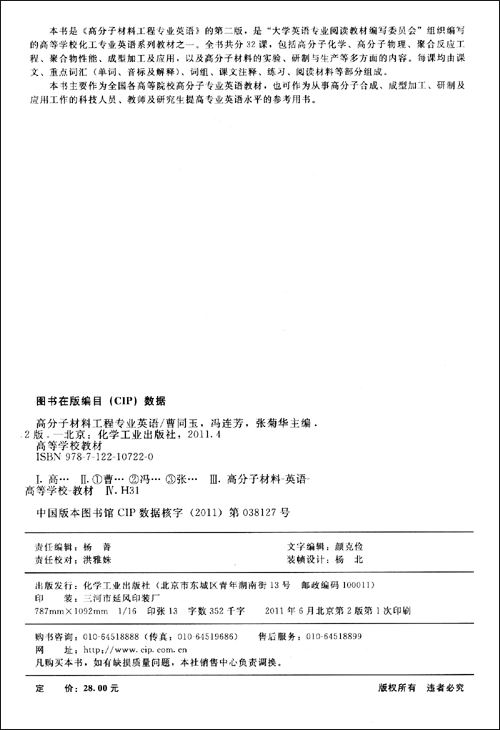
插图: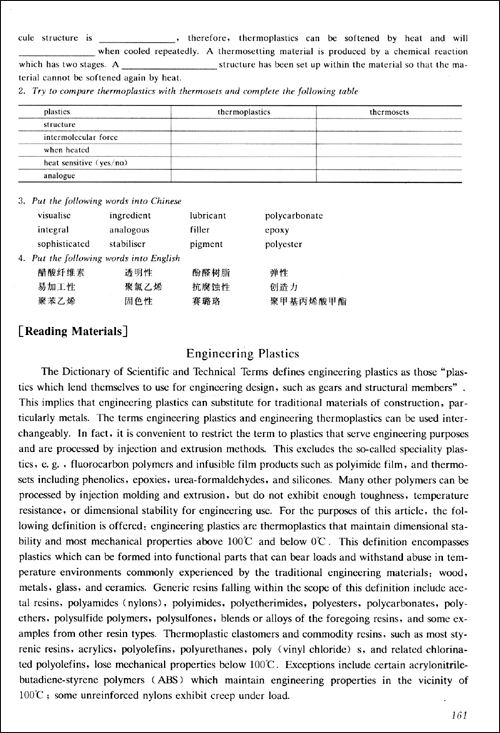
Before the temperature is increased again,the stirrer is stopped and another sample of resin is withdrawn,weighed,and titrated.The stirrer is restarted,and the temperature ofthe reaction mixture quickly is raised another 10 degree where it is maintained until the wa-ter-evolution rate perceptibly is diminished.The reaction is completed isothermally at the highest practical temperature.The titration data are more meaningful than the azeotrope data in the later stages of the reaction.A final sample of resin should be titrated before the reaction is halted.
Some formulations cannot be permitted to react to their theoretical endpoint since side reactions cause crosslinking and its consequence-gelation.If the reaction mixture thickens markedly and it begins to ascend the stirrer shaft,additional glycol should be introduced quickly to induce ester-interchange reactions.This action will serve to inhibit the crosslink-ing reaction of the decomposing resin,and will facilitate the removal of the resin from the kettle.Measurements made beyond the gel point are meaningless;the partially gelled resin should be discarded.
When the reaction is concluded,the distillation trap and the nitrogen-inlet tube are re-moved.Before proceeding further,be sure to put on the asbestos gloves.The thermocouple and the stirrer may be wiped clean with a cotton swab once they have been removed.When the resin mixture has cooled below 200℃,it maY be poured into a heavy-walled glass jar placed inside of a protective metal container.The conventional 8screwcap laboratory jars are excellent for this purpose;they have good resistance to thermal shock.
The transfer of the resin into the jar is best accomplished by inverting the resin kettle while it is still secured in its mechanical mount and by permitting the kettle to drain in this position.The drained kettle also may be cleaned with cotton swabs.
The decalin-polyester mixture will separate upon cooling to room temperature.A characteristic resin sample will be obtained merely by decanting the supernatant decalin layer.
序言
目录:
PART A Polymer Chemistry and Physics UNIT 1 What Are Polymers? UNIT 2 Chain Polymerization UNIT 3 Step?Growth Polymerization UNIT 4 Ionic Polymerization UNIT 5 Introduction to Living Radical Polymerization UNIT 6 Molecular Weight and Its Distributions ofPolymers UNIT 7 Polymer Solution UNIT 8 Morphology of Solid Polymers UNIT 9 Structure and Properties of Polymers UNIT 10 Glass Transition Temperature UNIT 11 Functional Polymers UNIT 12 Preparations of Amino Resins in Laboratory PART B Polymerization Reaction Engineering
PART A Polymer Chemistry and Physics
UNIT 1 What Are Polymers?
UNIT 2 Chain Polymerization
UNIT 3 Step?Growth Polymerization
UNIT 4 Ionic Polymerization
UNIT 5 Introduction to Living Radical Polymerization
UNIT 6 Molecular Weight and Its Distributions of Polymers
UNIT 7 Polymer Solution
UNIT 8 Morphology of Solid Polymers
UNIT 9 Structure and Properties of Polymers
UNIT 10 Glass Transition Temperature
UNIT 11 Functional Polymers
UNIT 12 Preparations of Amino Resins in Laboratory
PART B Polymerization Reaction Engineering
UNIT 13 Reactor Types
UNIT 14 Bulk Polymerization
UNIT 15 General Description of VC Suspension Polymerization Process
UNIT 16 Styrene?Butadiene Copolymer
UNIT 17 Heat Transfer Process
UNIT 18 Copolymer Composition Distributions Affected by Micromixing
UNIT 19 Introduction to Modelling of Polymerization Kinetics
UNIT 20 Polymerization Process Instrumentation
UNIT 21 Reactor Scale?up
UNIT 22 Unipol Process for Polyethylene
PART C Processing,Properties and Applications of Polymer Material
UNIT 23 Polymer Processing
UNIT 24 Mechanical Properties of Polymers
UNIT 25 Thermal Properties of Polymers
UNIT 26 Polymer Melts
UNIT 27 Processing and Fabrication of Thermoplastics
UNIT 28 General Aspects of Polymer Degradation
UNIT 29 Synthetic Plastics
UNIT 30 Synthetic Rubber
UNIT 31 Structure of Fiber?forming Polymers
UNIT 32 Matching Adhesive to Adherend
APPENDIXES
Appendix 1 聚合物的命名法
Appendix 2 总词汇表
显示全部信息
- 化学工业出版社官方旗舰店 (微信公众号认证)
- 扫描二维码,访问我们的微信店铺
- 随时随地的购物、客服咨询、查询订单和物流...