Collins 魔鬼经济学 英文原版书 SuperFreakonomics 超爆魔鬼经济学 比尔盖茨推荐 正版进口书籍 英文版
| 运费: | ¥ 0.00-999.00 |
| 库存: | 15 件 |
商品详情
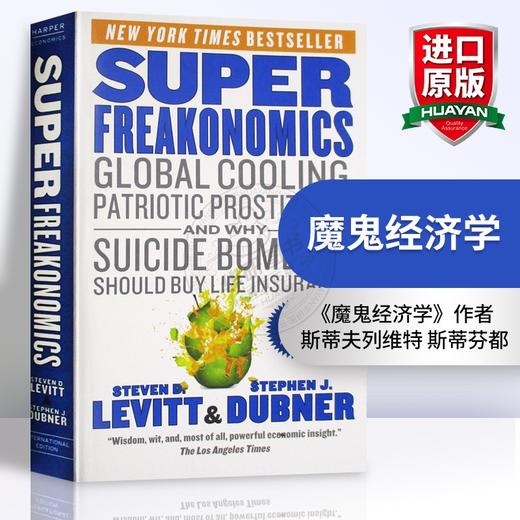
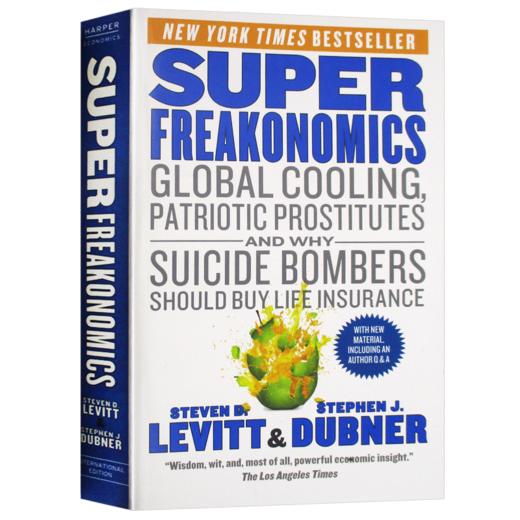
 书名:SuperFreakonomics超级魔鬼经济学/超爆魔鬼经济学
作者:Steven D. Levitt; Stephen J Dubner
出版社名称:Harper
出版时间:2011
语种:英文
ISBN:9780062063373
商品尺寸:10.6 x 2 x 17.1 cm
包装:简装
页数:320 (以实物为准) 不敲破你的脑袋,誓不罢休!赋予你看透世界的魔力!
连续数周荣登亚马逊、《纽约时报》畅销书总榜前10名
想要改变世界吗?你的魔力就藏在这本充满怪诞思考的书里
读书也如同看戏,不会看的看热闹,会看的看门道。看热闹的往往看到了外面浮浅的东西,就大呼不可取!看门道的,不会如此浮躁、浅尝辄止,他更愿意深入到书的精彩之处,以察究大道之理。读《超爆魔鬼经济学》,应手执一杯名茶,一边细细品味名茶的清香,一边深索书中蕴含的精细哲理——但在你读到精彩之处而拍案惊奇时,别忘了把杯子放在桌上。
精彩书评:
“我的确喜欢《超爆魔鬼经济学》这本书,而且,我认为该书较《魔鬼经济学》更胜一筹。”——比尔•盖茨微软公司创始人
“《超爆魔鬼经济学》的发散思维方法,也许我们还不习惯,但的确有利于打开思路,深化分析。只要认真读下去,你的思维水平会有所提高。”——梁小民经济学家
“如果你想知道什么是实验经济学,什么是行为经济学,特别是如果你还想知道一些实验经济学家们的人生轨迹和行为艺术,你千万不可错过列维特和都伯纳的这册非常有趣的大众读本。”——王则柯经济学家
“列维特和都伯纳的比较方式新奇,通过对照分析看似毫无关联的主题,不断挖掘出事实真相,让人有茅塞顿开的畅快之感,这就是本书趣味横生的原因所在..真是精彩绝伦的一本书。”——《纽约时报》
“大胆、令人赞叹,它在向传统智慧开战。没读过这本书,可不要在饮水机旁聊天哦。”——《华盛顿邮报》
“这本书很像《魔鬼经济学》,但更精彩。”——《金融时报》
“这是迄今为止世界知名经济学家用统计数据所做的搞怪的研究..列维特和都伯纳设法从人类行为这道高深的数学难题中,寻求其内在联系。”——《娱乐周报》
“痛快……事实上,这本书表明:在探索欲永无穷尽、分析技能极为娴熟的经济学家的手中,普通的传统经济学可以发挥什么样的作用。”——《经济学人》
“《超爆魔鬼经济学》要做的就是彻底颠覆你头脑中的传统思维——真是一部让人赞叹称奇的作品。”——《华尔街日报》
“简直就是飞驰而过的过山车《超爆魔鬼经济学》真是精彩绝伦、生动有趣,还有那么一点醉人,就像一大杯龙舌兰酒。”——《泰晤士报》
Freakonomics lived on the New York Times bestseller list for an astonishing two years. Now authors Steven D. Levitt and Stephen J. Dubner return with more iconoclastic insights and observations in SuperFreakonomics—the long awaited follow-up to their New York Times Notable blockbuster. Based on revolutionary research and original studies SuperFreakonomics promises to once again challenge our view of the way the world really works. 在高中积极参加体育锻炼的女生再进入大学,毕业之后就能找到好工作?
导致大多数男女薪水差异的主要原因在于:女性追求高薪的愿望不足?
为什么世界上大部分顶级运动员都出生在1月-3月份?
马和汽车,谁的危险更大?想阻止气候变暖?用烟囱捅破天吧!?
发生在中国四川的汶川大地震,与横扫美国的卡特里娜飓风有什么不同?
安全带真的能保证你的驾车和乘车安全吗?儿童车座也照样不安全?
你是不是经常碰到令你无法解决的事情?或者即使解决了,又不能令你满意?这是为什么?那是因为你的传统思维在作祟,像列维特和都伯纳一样换个思路吧,把你的传统思维彻底颠覆掉,你会发现原来麻烦重重的问题可以这样解决!
阅读《超爆魔鬼经济学》,你会发现,跟随列维特和都伯纳荒诞不经的思维,来一次彻头彻尾的头脑风暴,将会是多么地酣畅淋漓!
“全美国有趣的脑袋”列维特和都伯纳又出场了!
阿基米德曾经说过,如果能给他一个支点,他能把地球撬起。而现在,列维特和都伯纳凭借这本《超爆魔鬼经济学》简直就可以把你的脑袋敲破。不信,你就试试。
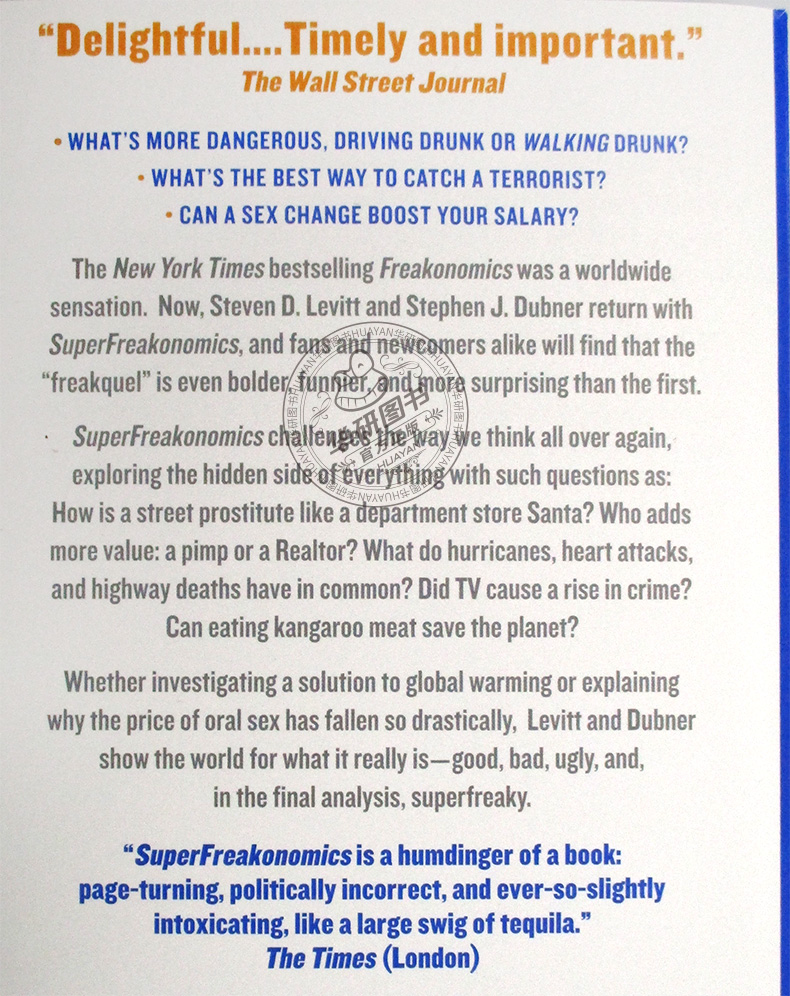
The New York Times bestselling Freakonomics was a worldwide sensation. Now, Steven D. Levitt and Stephen J. Dubner return with SuperFreakonomics, and fans and newcomers alike will find that the “freakquel” is even bolder, funnier, and more surprising than the first.
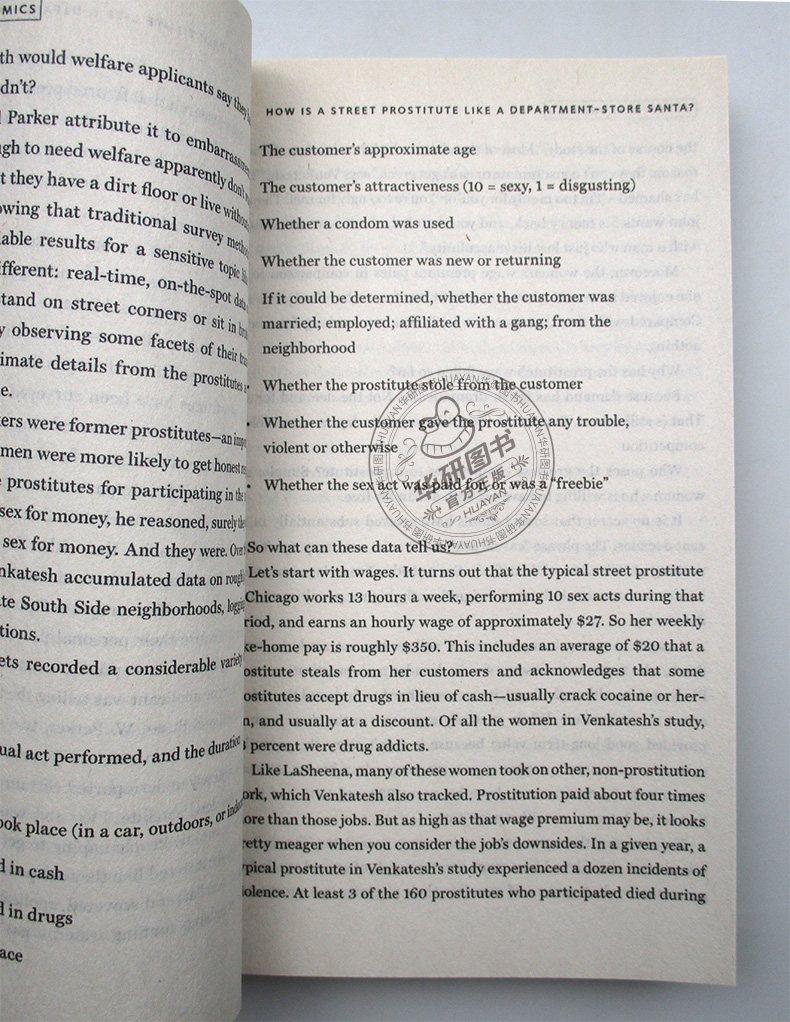
SuperFreakonomics challenges the way we think all over again, exploring the hidden side of everything with such questions as: How is a street prostitute like a department store Santa? Who adds more value: a pimp or a Realtor? What do hurricanes, heart attacks, and highway deaths have in common? Did TV cause a rise in crime? Can eating kangaroo meat save the planet?
Whether investigating a solution to global warming or explaining why the price of oral sex has fallen so drastically, Levitt and Dubner show the world for what it really is—good, bad, ugly, and, in the final analysis, superfreaky. 史蒂芬•列维特(Steven D. Levitt),芝加哥大学经济学教授,约翰•贝茨•克拉克奖得主(该奖被称为“小诺贝尔奖”),被誉为“当今美国40岁以下久负盛名的经济学家”,他的声誉得到了整个经济学界的公认。列维特1989年毕业于哈佛大学,1994年在麻省理工学院取得经济学博士学位,1997年进入芝加哥大学执教,短短两年时间,列维特就成为芝加哥大学经济学院终身教授。2002年列维特被选为美国科学院经济学部委员。他还担任《政治经济学杂志》(JPE)的编辑和《经济学季刊》(OJE)的编辑。克林顿政府曾经力邀他加入自己的智囊团。小布什总统在大选的时候也把“请到列维特作为犯罪专家”作为拉拢选票的一张底牌。
史蒂芬•都伯纳(Stephen J. Dubner),获奖作家、记者、电台和电视名人。他放弃了使他几乎成为摇滚歌星的第1个职业,成为了一名作家,曾就职于《纽约时报》,著有《骚动的灵魂》《一个英雄崇拜者的自白》,另著有儿童图书《长两个肚脐眼的男孩》。
Steven D. Levitt, a professor of economics at the University of Chicago, was awarded the John Bates Clark Medal, given to the most influential American economist under forty. He is also a founder of The Greatest Good, which applies Freakonomics-style thinking to business and philanthropy.
Stephen J. Dubner, an award-winning journalist and radio and TV personality, has worked for the New York Times and published three non-Freakonomics books. He is the host of Freakonomics Radio and Tell Me Something I Don't Know.
 Many of life’s decisions are hard. What kind of career should you pursue? Does your ailing mother need to be put in a nursing home? You and your spouse already have two kids; should you have a third?
Such decisions are hard for a number of reasons. For one, the stakes are high. There’s also a great deal of uncertainty involved. Above all, decisions like these are rare, which means you don’t get much practice making them. You’ve probably gotten pretty good at buying groceries, since you do it so often, but buying your first house is another thing entirely.
Some decisions, meanwhile, are really, really easy. Imagine you’ve gone to a party at a friend’s house. He lives only a mile away. You have a great time, perhaps because you drank four glasses of wine. Now the party is breaking up. While draining your last glass, you dig out your car keys. Abruptly you conclude this is a bad idea: you are in no condition to drive home.
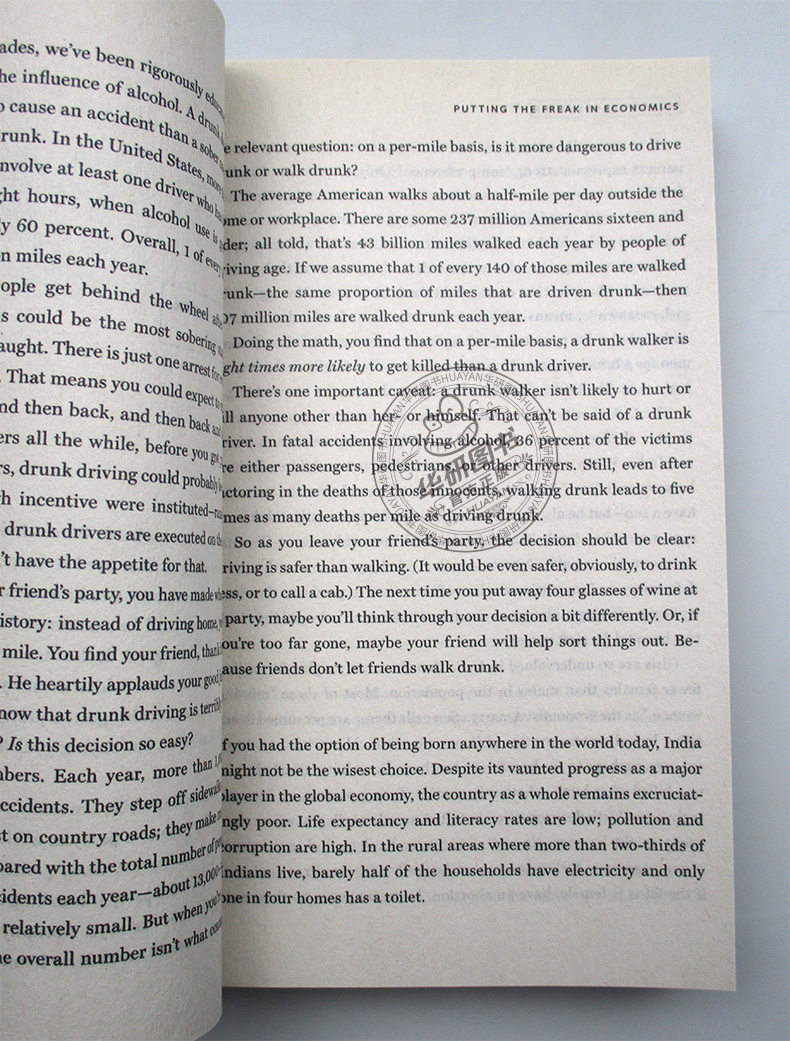
For the past few decades, we’ve been rigorously educated about the risks of driving under the influence of alcohol. A drunk driver is thirteen times more likely to cause an accident than a sober one. And yet a lot of people still drive drunk. In the United States, more than 30 percent of all fatal crashes involve at least one driver who has been drinking. During the late-night hours, when alcohol use is greatest, that proportion rises to nearly 60 percent. Overall, 1 of every 140 miles is driven drunk, or 21 billion miles each year.
Why do so many people get behind the wheel after drinking? Maybe because—and this could be the most sobering statistic yet—drunk drivers are rarely caught. There is just one arrest for every 27,000 miles driven while drunk. That means you could expect to drive all the way across the country, and then back, and then back and forth three more times, chugging beers all the while, before you got pulled over. As with most bad behaviors, drunk driving could probably be wiped out entirely if a strong-enough incentive were instituted—random roadblocks, for instance, where drunk drivers are executed on the spot—but our society probably doesn’t have the appetite for that.
Meanwhile, back at your friend’s party, you have made what seems to be the easiest decision in history: instead of driving home, you’re going to walk. After all, it’s only a mile. You find your friend, thank him for the party, and tell him the plan. He heartily applauds your good judgment.
But should he? We all know that drunk driving is terribly risky, but what about drunk walking? Is this decision so easy?
Let’s look at some numbers. Each year, more than 1,000 drunk pedestrians die in traffic accidents. They step off sidewalks into city streets; they lie down to rest on country roads; they make mad dashes across busy highways. Compared with the total number of people killed in alcohol-related traffic accidents each year— about 13,000—the number of drunk pedestrians is relatively small. But when you’re choosing whether to walk or drive, the overall number isn’t what counts. Here’s the relevant question: on a per-mile basis, is it more dangerous to drive drunk or walk drunk?
The average American walks about a half-mile per day outside the home or workplace. There are some 237 million Americans sixteen and older; all told, that’s 43 billion miles walked each year by people of driving age. If we assume that 1 of every 140 of those miles are walked drunk—the same proportion of miles that are driven drunk—then 307 million miles are walked drunk each year.
Doing the math, you find that on a per-mile basis, a drunk walker is eight times more likely to get killed thana drunk driver.
- 华研外语 (微信公众号认证)
- 本店是“华研外语”品牌商自营店,全国所有“华研外语”、“华研教育”品牌图书都是我司出版发行的,本店为华研官方源头出货,所有图书均为正规正版,拥有实惠与正版的保障!!!
- 扫描二维码,访问我们的微信店铺
- 随时随地的购物、客服咨询、查询订单和物流...