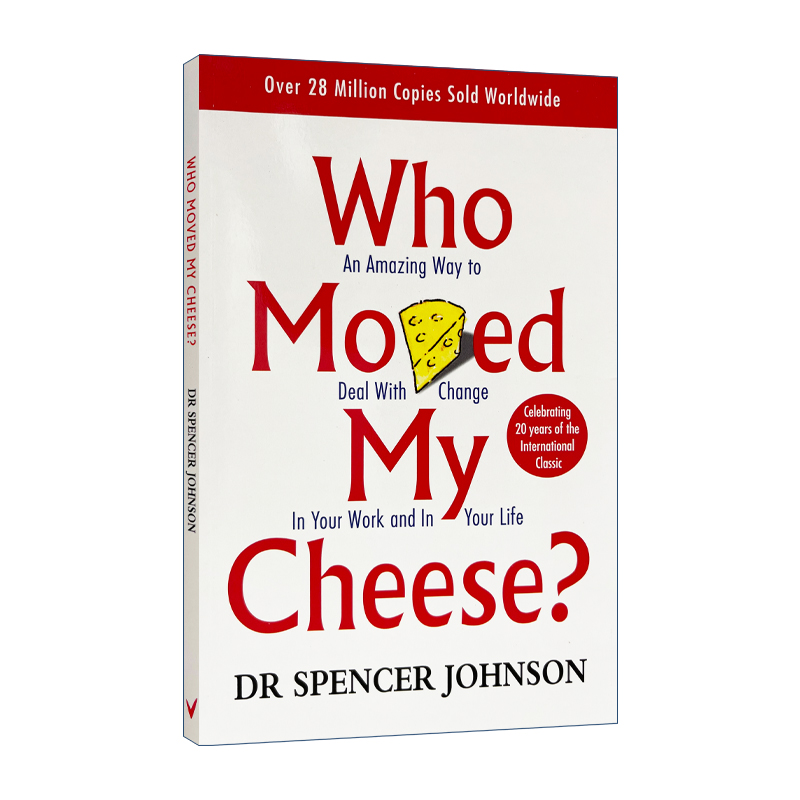
正版 道林格雷的画像英文版 快乐王子 英文原版小说 The Picture of Dorian Gray 奥斯卡王尔德经典名著 进口英语书籍
| 运费: | ¥ 0.00-999.00 |
| 库存: | 44 件 |
商品详情
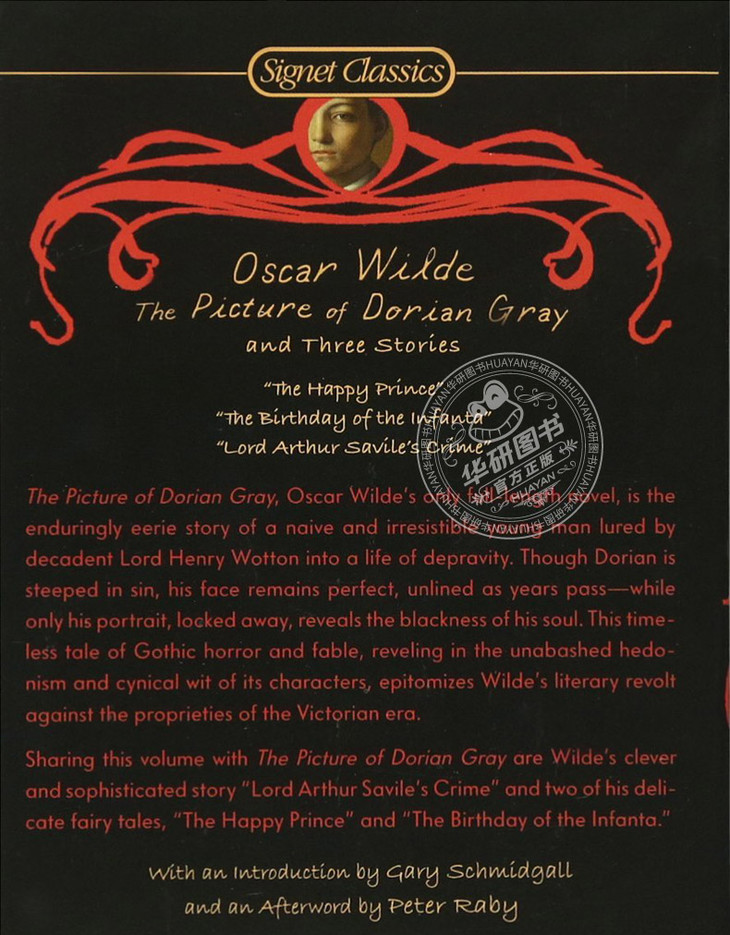
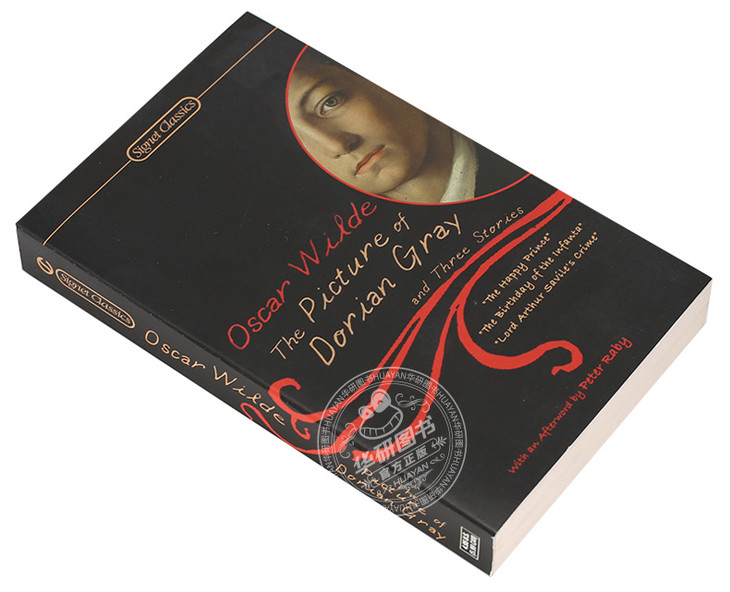

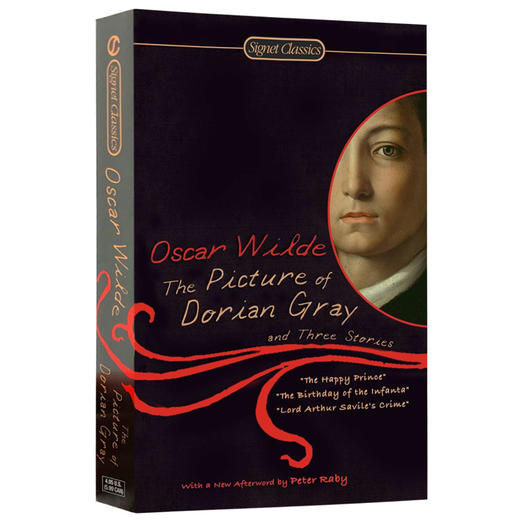
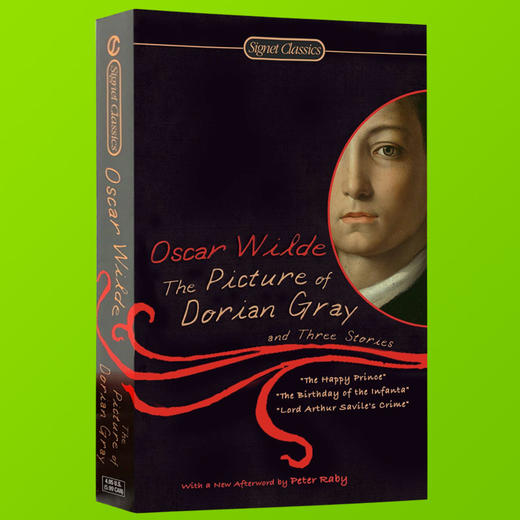
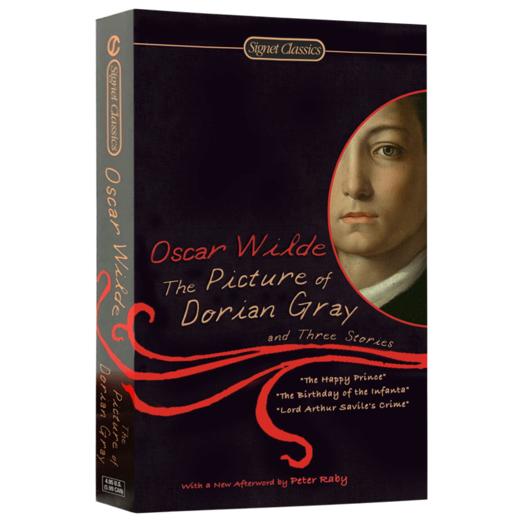
书名:The Picture of Dorian Gray and Three Stories 道林格雷的画像和其他三个故事
难度:Lexile蓝思阅读指数970L
作者:Oscar Wilde奥斯卡·王尔德
出版社名称:Signet Classics
出版时间:2007
语种:英文
ISBN:9780451530455
商品尺寸:10.6 x 2.3 x 17.5 cm
包装:简装
页数:336

“I am what I am.”这句话就出自英国知名戏剧家、小说家奥斯卡·王尔德的哲学性作品The Picture of Dorian Gray《道林格雷的画像》。这部王尔德少有的小说,是哲学、美学和文学的完美结合。作品揭示了社会以及人性黑暗面,在发表之初一度引起争议。但在今天看来,因为其深刻的内涵和引人深思的人物情节设置,《道林格雷的画像》却是一部不可多得的好作品,英国“卫报”推荐百大文学作品排名第27位。
本书为Signet Classics推出的英文原版,包含The Picture of Dorian Gray《道林格雷的画像》以及其他三个故事:The Happy Prince《快乐王子》、The Birthday of the Infanta《西班牙公主的生日》和Lord Arthur Savile’s Crime《阿瑟·萨维尔勋爵的罪行》。故事内容完整无删减,书本轻巧便携,由Gary Schnidgall作序,Peter Raby后记。
A fashionable young man sells his soul for eternal youth and beauty in Oscar Wilde's fascinating gothic tale.
The Picture of Dorian Gray, Oscar Wilde’s only full-length novel, is the enduringly eerie story of a naive and irresistible young man lured by decadent Lord Henry Wotton into a life of depravity. Though Dorian is steeped in sin, his face remains perfect, unlined as years pass—while only his portrait, locked away, reveals the blackness of his soul. This timeless tale of Gothic horror and fable, reveling in the unabashed hedonism and cynical wit of its characters, epitomizes Wilde’s literary revolt against the proprieties of the Victorian era.
Sharing this volume with The Picture of Dorian Gray are Wilde’s clever and sophisticated story “Lord Arthur Savile’s Crime” and two of his delicate fairy tales, “The Happy Prince” and “The Birthday of the Infanta.”
With an Introduction by Gary Schnidgall and an Afterword by Peter Raby

道林格雷是一名长在伦敦的贵族少年,相貌极其俊美,并且心地善良。道林见了画家霍尔沃德为他所作的画像,发现了自己惊人的美,在画家朋友亨利勋爵的蛊惑下,他向画像许下心愿:美少年青春永葆,所有岁月的沧桑和少年的罪恶都由画像承担。后来他的愿望成真了,但是他却开始了一系列罪恶的行为……
The Picture of Dorian Gray is the story of one beautiful, innocent young man’s seduction, moral corruption, and eventual downfall. Dorian Gray is the subject of a full-length portrait in oil by Basil Hallward, an artist who is impressed and infatuated by Dorian’s beauty; he believes that Dorian’s beauty is responsible for the new mode in his art as a painter. Through Basil, Dorian meets Lord Henry Wotton, and he soon is enthralled by the aristocrat’s hedonistic worldview: that beauty and sensual fulfilment are the only things worth pursuing in life. Newly understanding that his beauty will fade, Dorian expresses the desire to sell his soul, to ensure that the picture, rather than he, will age and fade. The wish is granted, and Dorian pursues a libertine life of varied and amoral experiences, while staying young and beautiful; all the while his portrait ages and records every soul-corrupting sin.

奥斯卡·王尔德(Oscar Wilde,1854~1900),19世纪英国非常伟大、有才华的作家与艺术家之一,他的经典作品包含小说、童话、戏剧、诗歌等等,是一个难得的全能作家。同时,王尔德是唯美主义代表人物,19世纪80年代美学运动的主力和先驱,是与萧伯纳齐名的绝世才子。他写的童话故事,常与安徒生、格林童话相并论。他的戏剧作品可与莎士比亚的作品相媲美。几百年来,王尔德的作品一直被广为流传,并受到广大读者的青睐。
Oscar Wilde (1854–1900) was born in Dublin, Ireland. He was an outstanding student of classics at Trinity College, and in 1874, he entered Magdalen College, Oxford, where he won the Newdigate Prize with his poemRavenna (1878). An early leader of the Aesthetic Movement, which advanced the concept of “art for art’s sake,” Wilde became a prominent personality in literary and social circles. His volume of fairy tales, The Happy Prince and Other Tales (1888), was followed by The Picture of Dorian Gray (1891) and The House of Pomegranates (1892). However, it was not until his play Lady Windermere’s Fan (1892) was presented to the pubic that he became widely famous. A Woman of No Importance (1893) and The Importance of Being Earnest (1895) confirmed his stature as a dramatist. In 1895, he brought libel action against the Marquis of Queensbury, who had accused him of the crime of sodomy. He lost, however, and was sentenced under the Criminal Law Amendment Act to two years’ imprisonment with hard labor. Upon his release in 1897, he settled in France, where he wrote his most powerful and enduring poem,The Ballad of Reading Gaol (1898). Wilde never returned to England; he died in Paris.
Gary Schmidgall is the author of such acclaimed titles as The Strange Wilde: Interpreting Oscar and Shakespeare and The Poet’s Life. He is professor of English at Hunter College.
Peter Raby has written extensively on modern drama and theater, and is the editor of the Cambridge Companion to Oscar Wilde. He is emeritus fellow of Homerton College, Cambridge. Among his other books are a biography of Alfred Russel Wallace and Bright Paradise, a study of Victorian scientific travellers.

CHAPTER 1
THE STUDIO was filled with the rich odour of roses, and when the light summer wind stirred amidst the trees of the garden there came through the open door the heavy scent of the lilac, or the most delicate perfume of the pink-flowering thorn.
From the corner of the divan of Persian saddlebags on which he was lying, smoking, as was his custom, innumerable cigarettes, Lord Henry Wotton could just catch the gleam of the honey-sweet and honey-coloured blossoms of a laburnum, whose tremulous branches seemed hardly able to bear the burden of a beauty so flamelike as theirs; and now and then the fantastic shadows of birds in flight flitted across the long tussore-silk curtains that were stretched in front of the huge window, producing a kind of momentary Japanese effect, and making him think of those pallid jade-faced painters of Tokio who, through the medium of an art that is necessarily immobile, seek to convey the sense of swiftness and motion. The sullen murmur of the bees shouldering their way through the long unmown grass, or circling with monotonous insistence round the dusty gilt horns of the straggling woodbine, seemed to make the stillness more oppressive. The dim roar of London was like the bourdon note of a distant organ.
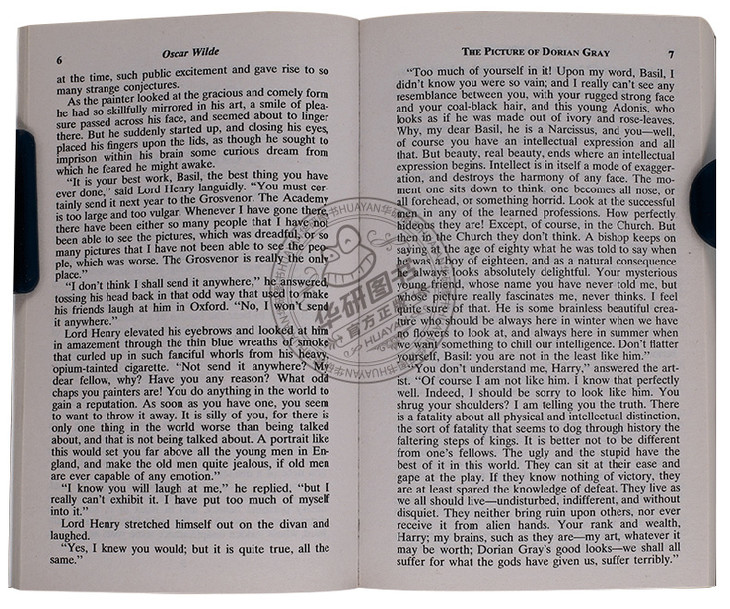
In the centre of the room, clamped to an upright easel, stood the full-length portrait of a young man of extraordinary personal beauty, and in front of it, some little distance away, was sitting the artist himself, Basil Hallward, whose sudden disappearance some years ago caused, at the time, such public excitement, and gave rise to so many strange conjectures.
As the painter looked at the gracious and comely form he had so skilfully mirrored in his art, a smile of pleasure passed across his face, and seemed about to linger there. But he suddenly started up, and, closing his eyes, placed his fingers upon the lids, as though he sought to imprison within his brain some curious dream from which he feared he might awake.
“It is your best work, Basil, the best thing you have ever done,” said Lord Henry, languidly. “You must certainly send it next year to the Grosvenor. The Academy is too large and too vulgar. Whenever I have gone there, there have been either so many people that I have not been able to see the pictures, which was dreadful, or so many pictures that I have not been able to see the people, which was worse. The Grosvenor is really the only place.”
“I don't think I shall send it anywhere,” he answered, tossing his head back in that odd way that used to make his friends laugh at him at Oxford. “No; I won't send it anywhere.”
Lord Henry elevated his eyebrows, and looked at him in amazement through the thin blue wreaths of smoke that curled up in such fanciful whorls from his heavy opium-tainted cigarette. “Not send it anywhere? My dear. fellow, why? Have you any reason? What odd chaps you painters are! You do anything in the world to gain a reputation. As soon as you have one, you seem to want to throw it away. It is silly of you, for there is only one thing in the world worse than being talked about, and that is not being talked about. A portrait like this would set you far above all the young men in England, and make the old men quite jealous, if old men are ever capable of any emotion.”
“I know you will laugh at me,” he replied, “but I really can’t exhibit it. I have put too much of myself into it.”
Lord Henry stretched himself out on the divan and laughed. “Yes, I knew you would; but it is quite true, all the same.”
“Too much of yourself in it! Upon my word, Basil, I didn’t know you were so vain; and I really can’t see any resemblance between you, with your rugged strong face and your coal-black hair, and this young Adonis, who looks as if he was made out of ivory and rose leaves. Why, my dear Basil, he is a Narcissus, and you—well, of course you have an intellectual expression, and all that. But beauty, real beauty, ends where an intellectual expression begins. Intellect is in itself a mode of exaggeration, and destroys the harmony of any face. The moment one sits down to think, one becomes all nose, or all forehead, or something horrid. Look at the successful men in any of the learned professions. How perfectly hideous they are! Except, of course, in the Church. But then in the Church they don’t think. A bishop keeps on saying at the age of eighty what he was told to say when he was a boy of eighteen, and as a natural consequence he always looks absolutely delightful.
Your mysterious young friend, whose name you have never told me, but whose picture really fascinates me, never thinks. I feel quite sure of that. He is some brainless, beautiful creature, who should be always here in winter when we have no flowers to look at, and always here in summer when we want something to chill our intelligence. Don’t flatter yourself, Basil: you are not in the least like him.”
- 华研外语 (微信公众号认证)
- 本店是“华研外语”品牌商自营店,全国所有“华研外语”、“华研教育”品牌图书都是我司出版发行的,本店为华研官方源头出货,所有图书均为正规正版,拥有实惠与正版的保障!!!
- 扫描二维码,访问我们的微信店铺
- 随时随地的购物、客服咨询、查询订单和物流...